
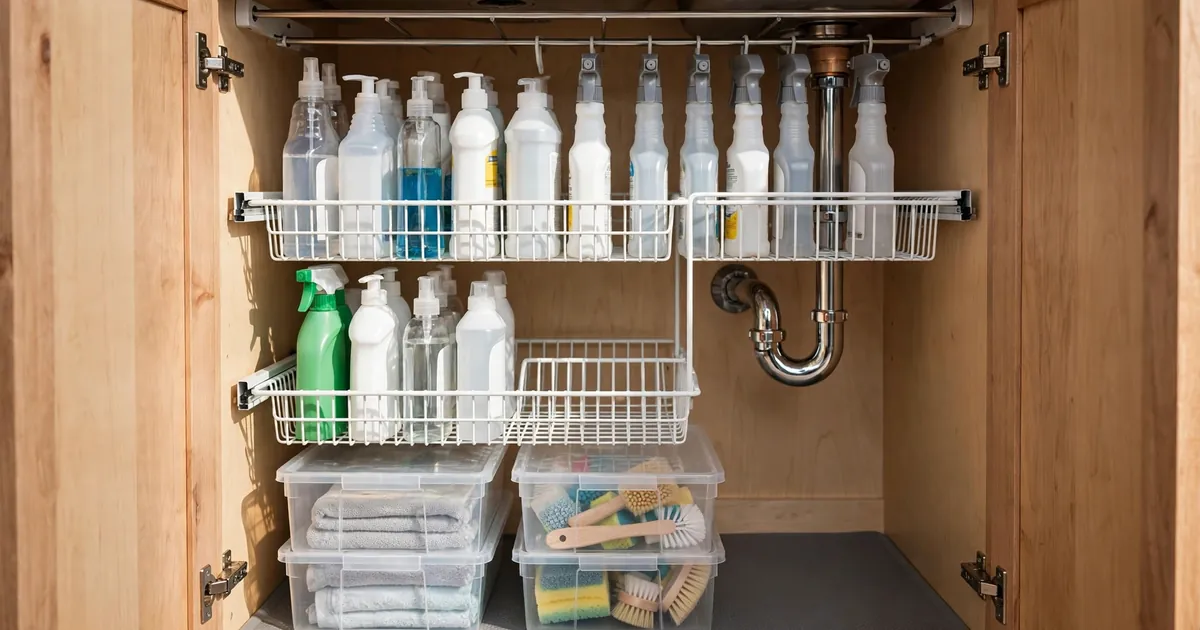

The best under sink kitchen organization starts with three moves: measure the cabinet, zone the space around the pipes, and line the base with a waterproof mat. Daily cleaners go up front, backups go in back, spray bottles hang from a tension rod, and small items live in clear bins. Keep paper, food, and harsh chemicals out. The 15 ideas below build on that setup, budget by budget.
TL;DR: Measure first, then zone around the plumbing. Hang sprays from a tension rod, bin small items in clear containers, line the base with a waterproof mat, and check for leaks monthly.
- Measure width, height, and depth before buying anything. The door opening runs narrower than the inside.
- Zone it: daily cleaners up front, backups in back, sprays hung high, small items binned.
- Three budget tiers: a starter setup, a mid-range setup, and a premium pull-out system.
- Line the base with a waterproof mat and check the supply lines and the P-trap monthly.
- Keep paper goods, mixed chemicals, food, medicine, and batteries out from under the sink.
Compare the main under sink kitchen organization options below, then pick two or three that fit your cabinet.
| Organizer | Best for | Price tier | Install | Renter friendly? |
|---|---|---|---|---|
| Tension rod | Hanging spray bottles | $ | None, twist to fit | Yes |
| Stackable clear bins | Small bottles, sponges, bags | $ | None | Yes |
| Two-tier sliding basket | Bottles around pipes | $$ | Set in place, no tools | Yes |
| Pull-out sliding drawer system | Deep cabinets | $$$ | Screws or brackets | Rarely |
| Over-door basket rack | Sponges, gloves, trash bags | $ | Hooks over the door | Yes |
| Lazy Susan turntable | Corners and dead space | $ | None | Yes |
| U-shaped under-sink shelf | Around-plumbing storage | $$ | Assemble, no tools | Yes |
| Waterproof cabinet mat | Leak protection | $ | Lay flat | Yes |
| Adhesive hooks | Brushes, gloves, small tools | $ | Stick on | Yes |
| Labeled cleaning caddy | Daily supply transport | $ | None | Yes |
Why is under the kitchen sink so hard to organize?
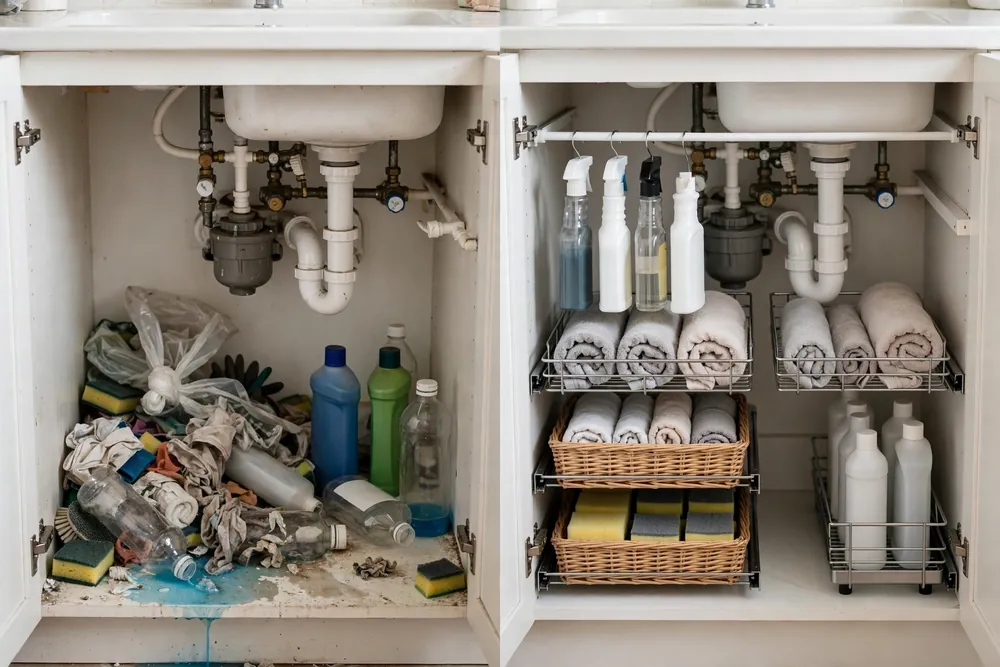
It is hard because the plumbing runs through the middle of the cabinet, the space is deep and dark, and moisture breaks down cardboard boxes and paper labels. Most people stack everything in front of the pipes, which buries the back half. The cabinet is not broken. The stack-everything approach is.
A deep cabinet hides things. You push the dish soap to the back, buy a second bottle because you cannot see the first, and now you own three. A Pixie survey found Americans spend 2.5 days a year looking for misplaced items. Replacing them costs US households 2.7 billion dollars a year. The National Soap and Detergent Association reports that clearing clutter would eliminate 40 percent of housework in the average home.
Here is my opinion: fix the layout before you buy organizers. A cheap tension rod in a well-zoned cabinet beats a pricey system in a cabinet where everything still lands in a pile. Your cabinet is not haunted. It is just badly zoned. Good under sink kitchen organization is zones, not piles.
What should you measure before buying a single under sink organizer?
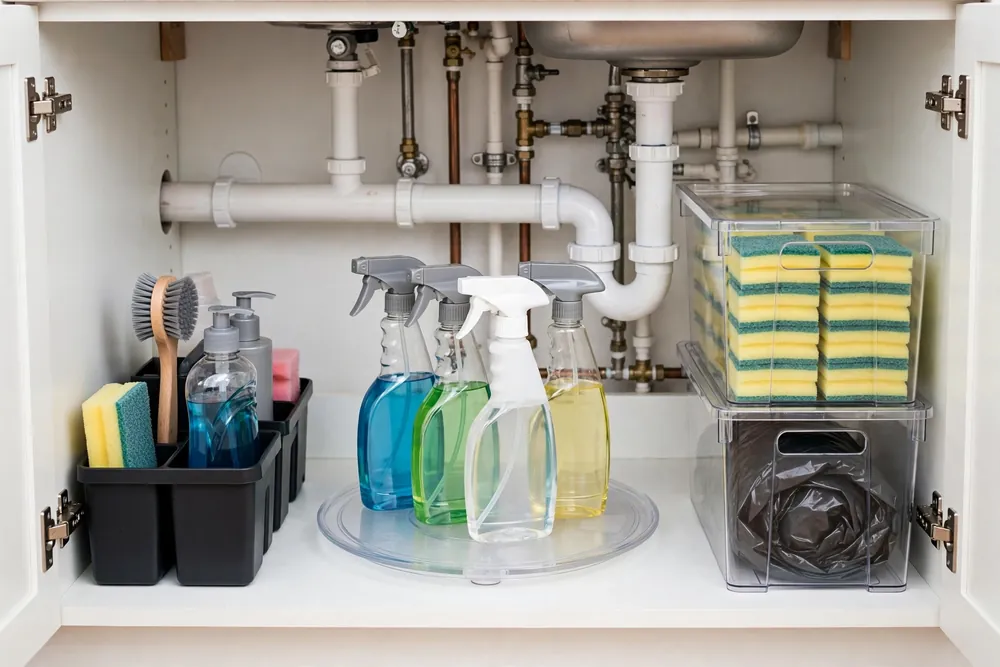
Measure the inside width front and back, the height from the cabinet floor to the lowest pipe, the depth front to back, and the width of the door opening. Write down all four before you buy anything. Most US sink bases are 30, 33, 36, or 42 inches wide on the outside.
The P-trap is the U-shaped bend in the drain pipe that traps water to block sewer gases. It hangs lowest, so measure under it, not beside it. A garbage disposal steals inches from one side, so measure the clear space on each side too.
The door opening is narrower than the inside, so measure the opening itself and buy organizers at least an inch narrower than it.
| Outside width | Inside width | What fits |
|---|---|---|
| 30 in | ~28 in | Narrow baskets, one tension rod |
| 33 in | ~31 in | Stackable bins, slim sliding basket |
| 36 in | ~34 in | Standard two-tier organizers |
| 42 in | ~40 in | Double organizers, pull-out systems |
Odd-size cabinet or a crowding disposal? Skip fixed-width kits and go modular. Bins, rods, and risers are the most forgiving form of under sink kitchen organization.
What belongs under the kitchen sink, and what should live somewhere else?
Keep daily cleaning supplies under the sink: dish soap, dishwasher detergent, sponges, scrub brushes, trash bags, and rubber gloves. Move paper towels, bulk refills, food, medicine, batteries, and harsh chemicals somewhere dry. Moisture ruins paper goods, and fumes make loose chemicals dangerous.
| Store here | Store elsewhere, and why |
|---|---|
| Dish soap, dishwasher pods | Paper towels, they absorb moisture and go limp |
| Sponges, scrubbers, gloves | Bulk refills, they are heavy and leak-prone |
| Trash bags | Food and pet treats, damp air spoils them |
| Daily spray cleaners | Medicine, heat and humidity break it down |
| Cleaning caddy | Batteries, moisture corrodes the contacts |
| Plunger or small brush | Bleach, it needs a locked high spot |
Never mix products, and never store bleach and ammonia where a spill could combine them. That is a basic rule of under sink kitchen organization. Ready.gov warns that mixing household chemicals such as chlorine bleach and ammonia can cause dangerous reactions. One product at a time, caps on, stored apart. The same thinking works in the bathroom: our bathroom storage ideas guide applies it to the vanity.
How do you use the vertical space when pipes are in the way?
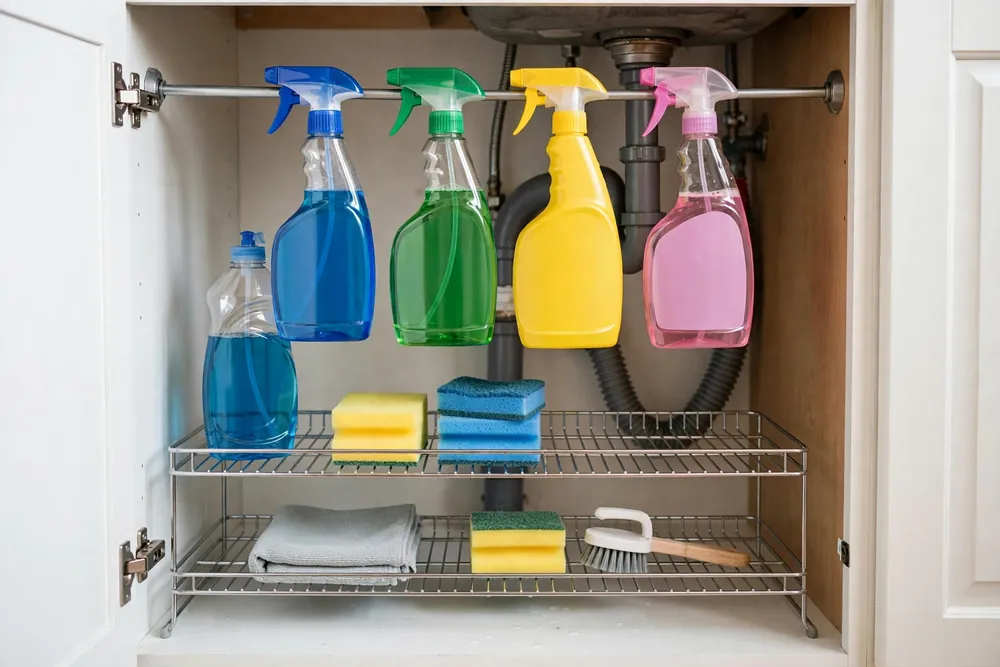
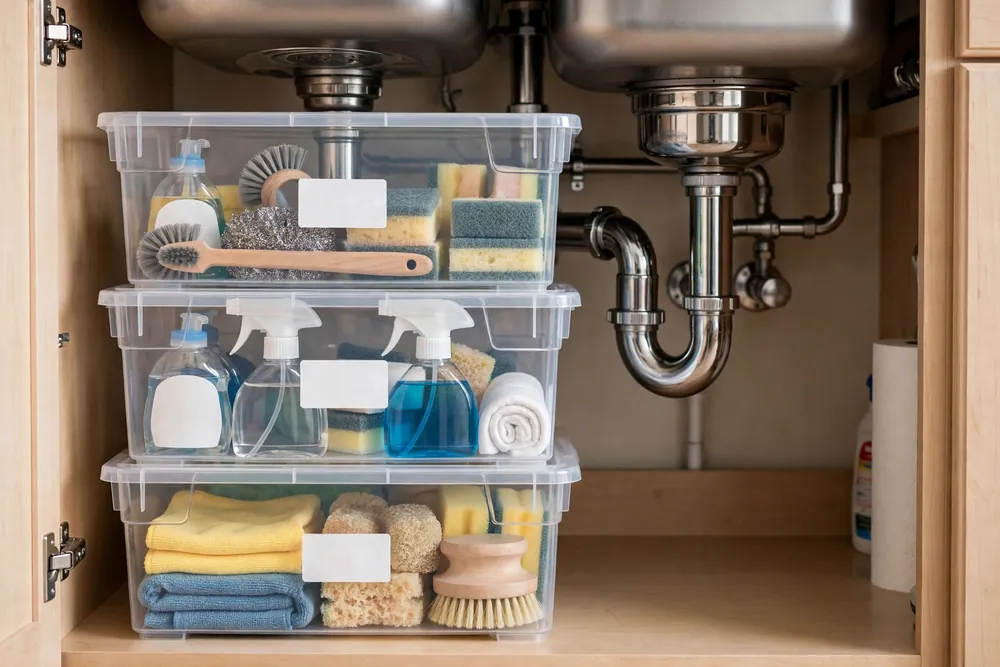
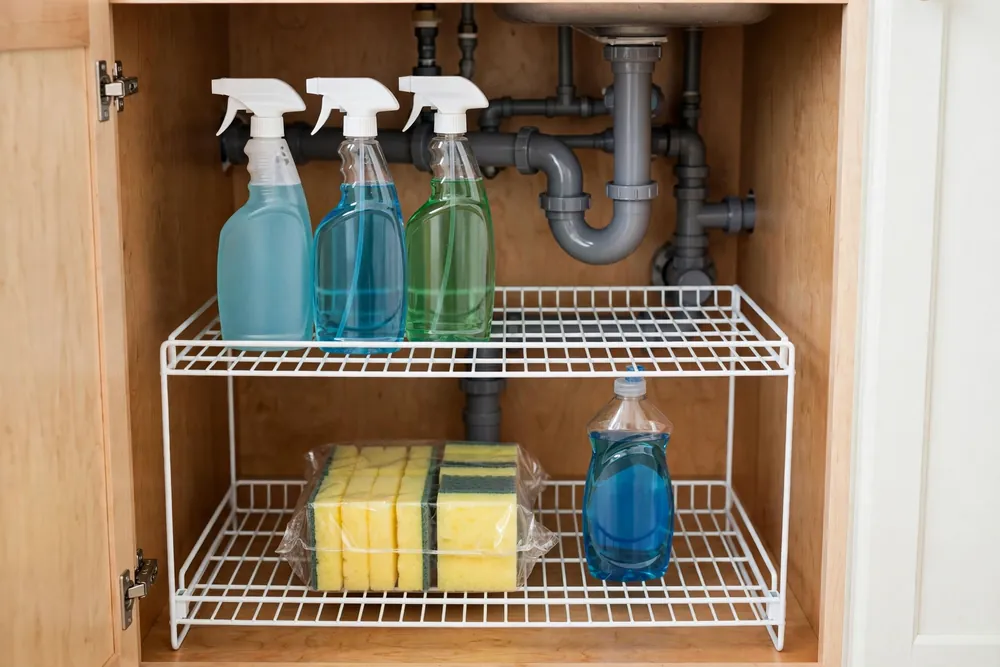
Hang a tension rod across the cabinet to hold spray bottles by their triggers, stack clear bins beside the pipes, and add a shelf riser to double the height for short bottles. Vertical layering fits more than one big organizer, because it builds around the plumbing instead of competing with it.
The tension rod is the cheapest trick in this guide: twist it between the cabinet walls and hang spray bottles from it. Curtain ring clips help: clip one around each bottle neck, hook it on the rod, and bottles slide aside. Stick to light daily sprays; heavy bottles can work a rod loose.
Stacking bins handle the sides. Put two or three on each side of the P-trap, tallest in back. Being clear, they show the dish soap refill without pulling everything out. A shelf riser adds a second level for short bottles; a plain wire shelf does the same, and its open grid lets drips fall through.
My judgment: in under sink kitchen organization, vertical layering beats one big organizer. One big basket leaves the air above it empty, while three cheap layers fill the cabinet from floor to pipe.
Which organizers actually work around plumbing?
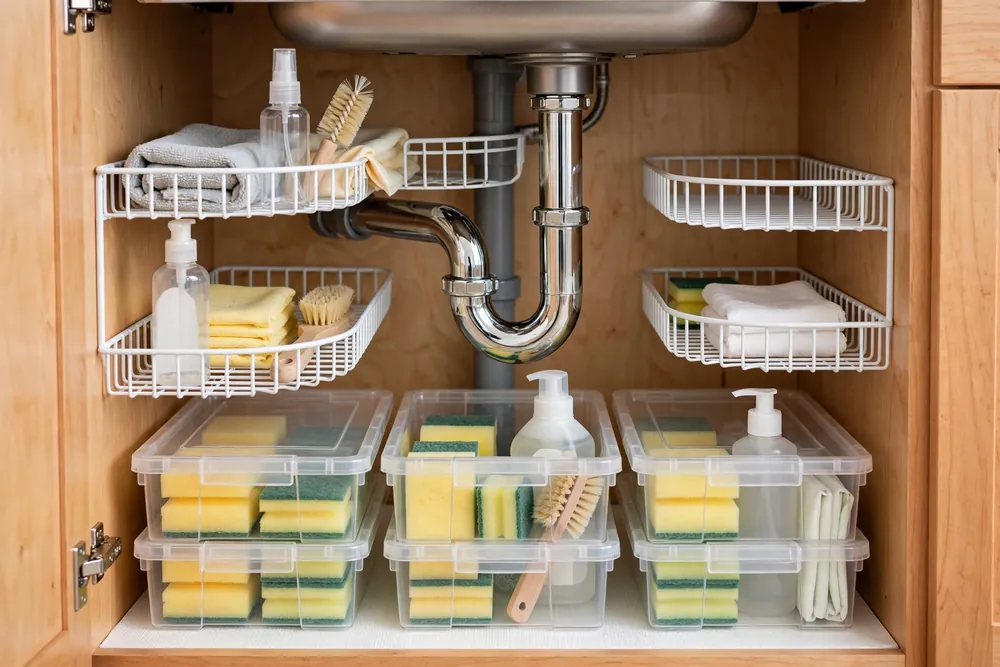
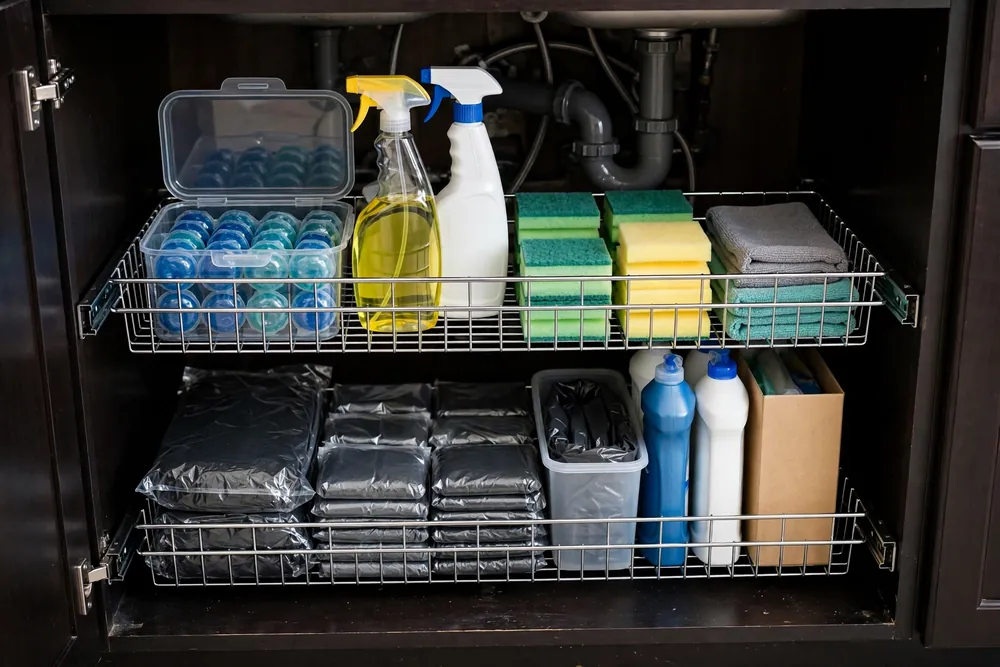
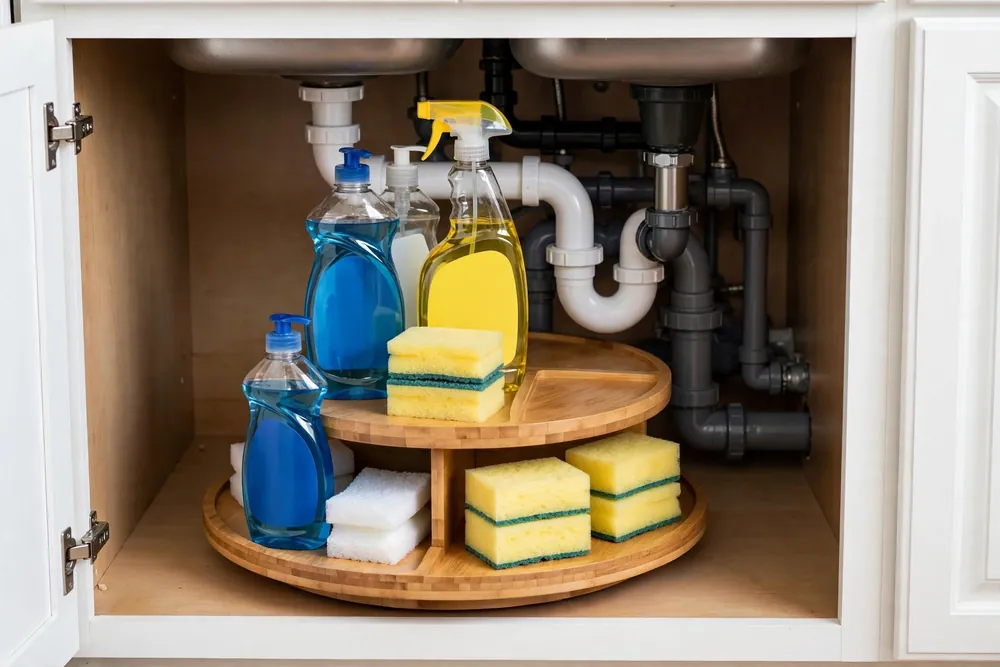
U-shaped shelves and two-tier sliding baskets fit around the P-trap and the disposal. Narrow side bins fill the strips of space on either side of the pipes. A lazy Susan turntable covers the corners where nothing else reaches. Look for a rust-resistant coating and adjustable width before you buy.
The U-shaped shelf is the workhorse of under sink kitchen organization. Its cutout wraps the drain pipes, so you get a full shelf of storage where the center would otherwise go to waste. Two-tier pull-out organizers do the same job with baskets: the top tier is split or notched to clear the pipes, and the bottom basket slides out so you can reach the back. A slide-out basket matters because the back of the cabinet is where things go to die.
Check the coating first. Powder-coated steel or plastic stands up to damp air, while bare wire rusts and stains the cabinet. Check the width range next, since adjustable frames fit the real spread of US cabinets. If a garbage disposal eats the middle, treat each side as its own mini cabinet: one narrow basket left, one right, turntable in the corner.
How do you turn the cabinet door into storage?
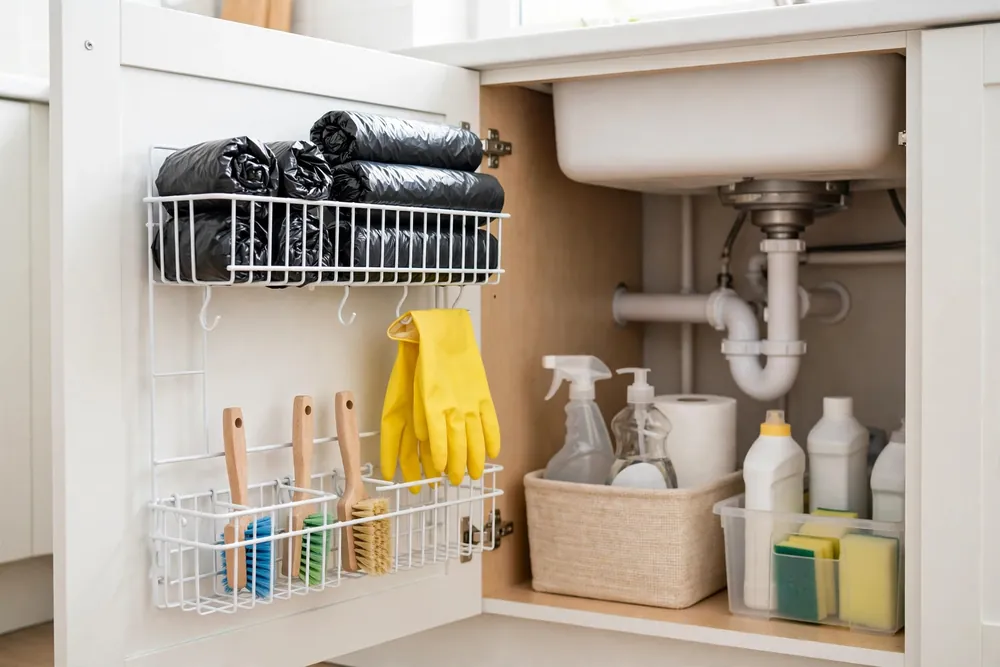
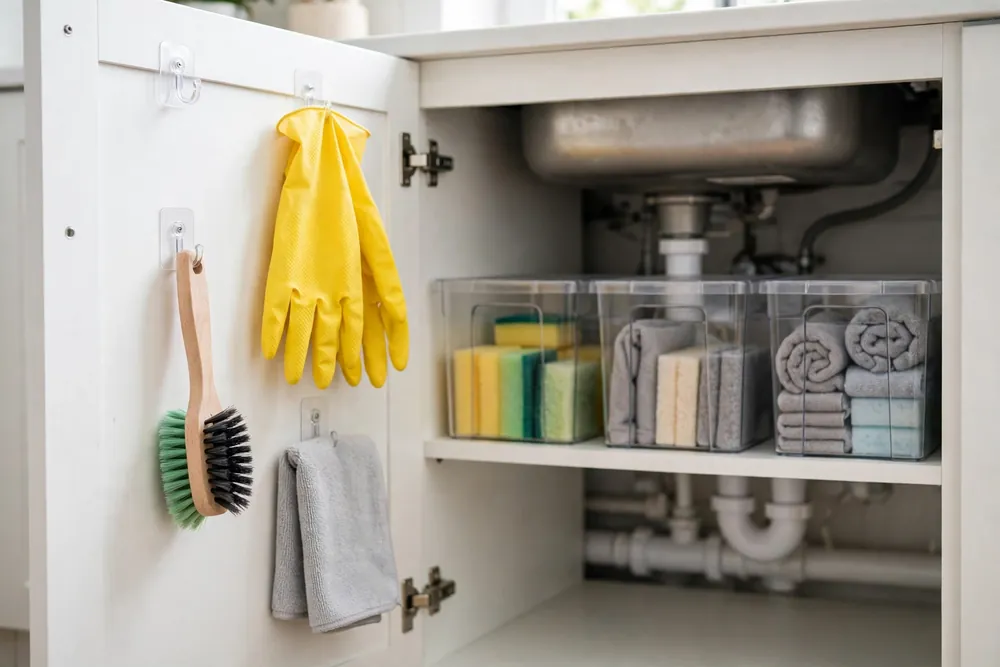
Hang an over-door basket rack or stick adhesive baskets and hooks inside the door. This is the best home for sponges, gloves, scrub brushes, and trash bags. Renters should stick with hook-over and adhesive options and skip anything that needs screws.
An over-door organizer uses dead air. Slim wire baskets hook over the top of the door and hold the light things you grab daily. Command strips and Command hooks handle the inside face: stick a couple of adhesive towel hooks low on the door for gloves and a brush, and they peel off clean when you move. No holes, no lost deposit.
Adhesive has one limit: it is not for heavy bottles. A full spray bottle defeats most adhesive hooks within a week, so keep heavy liquids in bins on the floor. Check door clearance before buying: hold a ruler against the inside of the door and close it slowly. Two inches is plenty for under sink kitchen organization that lasts.
How do you set up zones so everything has a home?
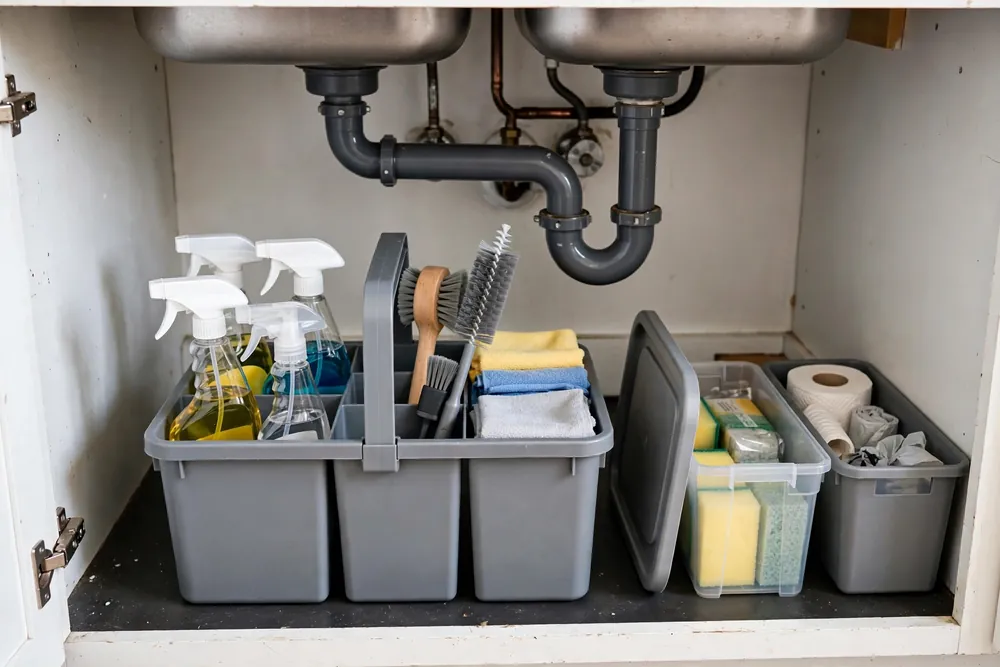
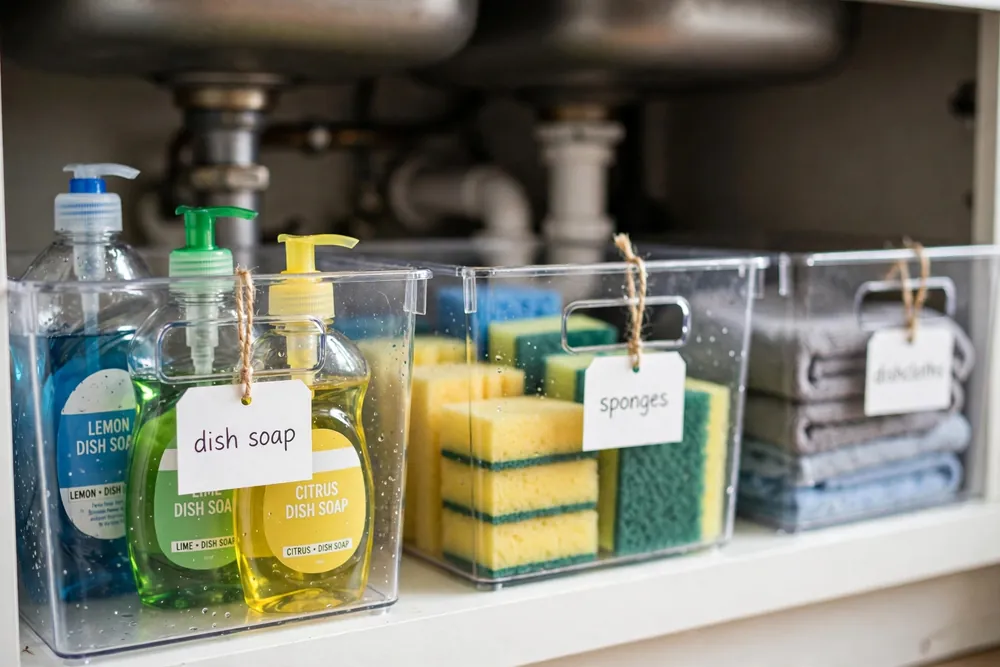
Split the cabinet into four zones: front for daily cleaners, back for backups, the door for small tools, the top for hung sprays. Label every bin with a label maker or waterproof tape, because paper labels peel off in the damp air. Zones end the digging. That is the whole point of under sink kitchen organization.
The front zone holds what you touch daily: dish soap, the sponge, the all-purpose spray. The back holds the dish soap refill, spare sponges, and extra garbage bags. The door holds gloves and brushes. The top holds the sprays. When something runs out, the empty spot up front tells you to pull the refill from the back.
Labels must survive humidity. A label maker with plastic tape lasts for years under a sink, and waterproof packing tape over a handwritten tag works too. Paper stickers curl and fall off within a month, so label the bins, not the bottles. Bins stay; bottles get replaced. Keep a portable cleaning caddy in the front zone, and our small kitchen storage ideas guide zones the rest of a tight kitchen the same way.
What is the cheapest way to organize under the sink?
Buy a tension rod and basic clear bins from IKEA, Walmart, or a dollar store, then label them. That starter setup handles most under-sink cabinets and sits in the lowest price tier. Fifteen dollars of the right bins beats sixty of the wrong organizer, because fit matters more than features.
| Tier | What you buy | Who it fits |
|---|---|---|
| Starter ($) | Tension rod, 4 to 6 basic bins, labels | Renters, small cabinets, testing a layout |
| Mid ($$) | Two-tier sliding basket, over-door rack, waterproof mat | Most kitchens, first real upgrade |
| Premium ($$$) | Branded pull-out system, U-shaped shelf | Deep cabinets, shared kitchens |
Real prices: two-tier sliding baskets list in the 25 to 40 dollar range on Walmart, waterproof mats around 22 dollars there, and a simplehuman pull-out at 35 dollars at The Container Store. Prices move with sales.
My honest take on under sink kitchen organization: start at the starter tier, live with it for a month, then upgrade what annoys you. Renters should stay in the starter or mid tier; a pull-out system you leave behind is money left in the cabinet.
Are pull-out drawers and sliding systems worth the money?
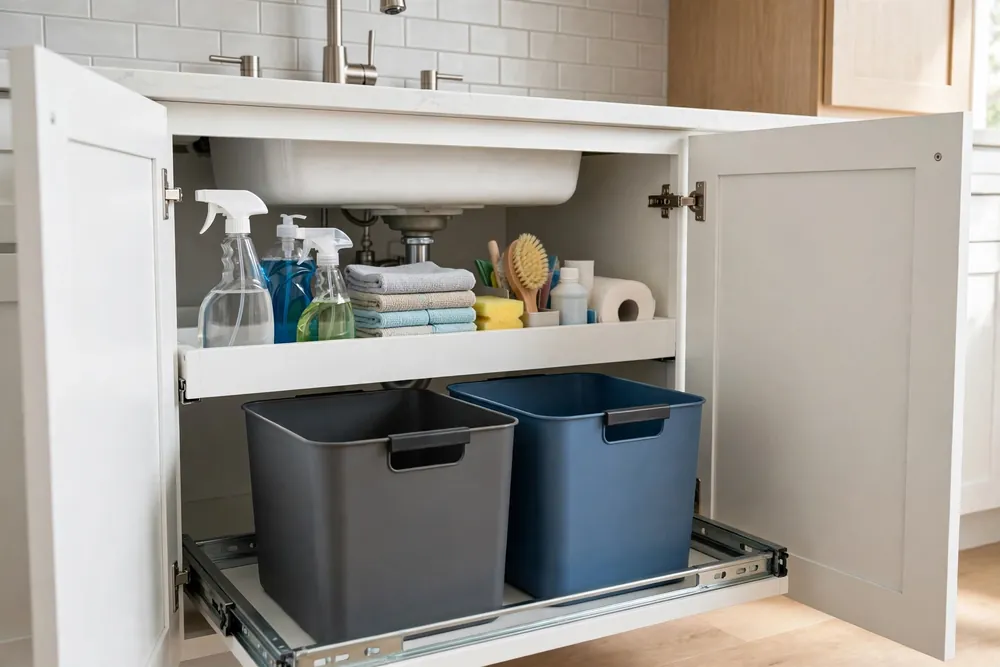
They are worth it for deep cabinets where the back half is unreachable, for bad knees or backs, and for shared kitchens where everyone needs to see everything. They are not worth it for renters or cabinets under 24 inches wide, where a simple bin works just as well.
The benefit is access, not capacity. A pull-out drawer does not hold more than a bin. It shows you more. You pull, you see every bottle, you push it back. No kneeling, no moving six things to reach the seventh. In a deep 24-inch cabinet that changes everything. In a shallow apartment cabinet it changes nothing.
A simplehuman pull-out lists at 35 dollars at The Container Store, and most cabinets want two. Two-tier sliding baskets list in the 25 to 40 dollar range on Walmart. A real pull-out setup lands in the 50 to 100 dollar band. Fine if you own the place. A bad deal if you rent. My rule for under sink kitchen organization: buy pull-outs only after the cheap tier proves your layout.
How do you protect the cabinet from leaks and mold?
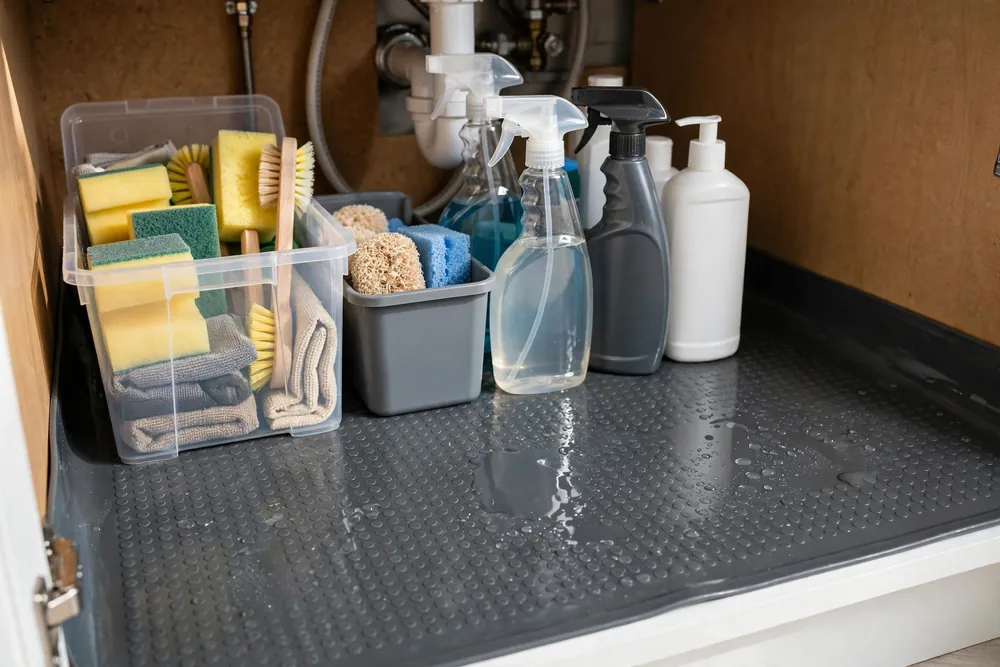
Lay a waterproof mat with raised edges on the cabinet floor, then check the supply lines, P-trap joints, and disposal gasket monthly. Dry any wet spot the day you find it. The EPA says to dry water-damaged areas within 24 to 48 hours, because mold cannot grow without moisture.
The Insurance Information Institute reports about one in 60 insured homes files a water damage or freezing claim each year, with the average claim at 13,954 dollars from 2018 to 2022. Under-sink leaks are the quiet kind: a slow drip can soak the cabinet base for weeks before you notice.
A waterproof mat with a lip is the cheapest insurance in the kitchen; shelf liner and contact paper are just decoration.
Monthly, five minutes: feel the supply lines for dampness and look under the P-trap for drips. A dry cabinet is the first rule of under sink kitchen organization. Early mold shows as dark spots or fuzzy patches. It wipes off hard surfaces with detergent and water, but you must fix the water problem too, or it returns. Leave the door open for an hour after finding dampness, and keep bins off the back wall so air moves. Our over-toilet storage guide applies the same moisture thinking to the bathroom.
How do you keep under-sink storage safe for kids and pets?
Put a childproof latch or lock on the cabinet door, move bleach and harsh chemicals to a high locked spot, and never store heavy bottles where a toddler can pull them down. Heavy bottles stay low, small items go up, so nothing dangerous lands within reach.
In 2024, household cleaning substances led America’s Poison Centers poison exposures in children five and under: 87,031 cases, 10.1 percent. A study covered by CNN found bleach caused about 30 percent of children’s injuries from household products, and researchers logged 90,000 poison-control calls involving these products in 2023.
Magnetic locks hide inside the door and open with a key you keep high up. Slide latches are cheap and strong. Adhesive strap locks suit renters. Install the lock before you organize, not after. A beautiful cabinet with no lock is a display case for poison.
Never mix cleaners. Ready.gov warns that mixing household chemicals such as chlorine bleach and ammonia can trigger dangerous reactions. Save the national poison control number in your phone now: 1-800-222-1222. Our small closet organization ideas guide covers lockable bins and high shelving for the same reason.
What does a full weekend reset look like, step by step?
A full reset takes about two hours: empty, clean and inspect, sort, measure, install the mat and organizers, then zone and label. Do it on a Saturday morning, when most of the time goes to deciding what to throw away.
Step 1: Empty it (15 minutes). Pull everything onto the kitchen floor. You cannot zone a cabinet you cannot see.
Step 2: Clean and inspect (20 minutes). Wipe it with detergent and water. Check the supply lines, P-trap joints, and disposal gasket for drips.
Step 3: Sort (20 minutes). Three piles: keep, toss, relocate. Toss expired items and duplicates past one backup.
Step 4: Measure (10 minutes). Take the four measurements: inside width front and back, height under the lowest pipe, depth, door opening.
Step 5: Install (30 minutes). Lay the mat first. Set in the bins, twist in the rod, hook the rack.
Step 6: Zone and label (20 minutes). Front for daily, back for backups, door for tools, rod for sprays. Label the bins.
Do the steps in order. A full reset is how under sink kitchen organization stays done instead of drifting back to chaos.
What is the smartest under sink kitchen organization move to make this weekend?
Measure your cabinet and set up the starter tier of under sink kitchen organization: a tension rod, a set of bins, and labels. That is the whole move. It costs little, needs no tools, and works in rentals. Upgrade to pull-outs only if the cheap tier proves the layout works. For the cabinets holding your cookware, see our pots and pans storage ideas guide.
Five things keep this cabinet clean, dry, and safe. Measure before you buy, because the door opening is narrower than you think. Zone around the plumbing instead of stacking in front of it. Line the base with a waterproof mat and check the pipes monthly. Lock the chemicals away from kids. Never mix bleach with ammonia.
Start your under sink kitchen organization with the measuring tape, not the shopping cart. When the cabinet is done, keep going: our small kitchen storage ideas and bathroom storage ideas guides apply the same system to the rest of the house. Pair it with our kitchen counter organization ideas to keep the whole sink zone clear. For the rest of the kitchen, our kitchen cabinet organization ideas cover the full system.
The same zone thinking works in the bathroom too. Our guide to under bathroom sink organization ideas walks through measuring around the P-trap, picking organizers that actually fit, and keeping the cabinet dry.
What is the best way to organize under the kitchen sink?
Measure first, then zone around the plumbing: daily cleaners up front, backups in back, sprays on a rod, small items in labeled bins.
How do you organize under the sink with pipes in the way?
Hang a tension rod for spray bottles, fit U-shaped shelves or sliding baskets around the P-trap, and fill the side strips with narrow bins.
What should you not store under the kitchen sink?
Paper towels, bulk refills, food, pet treats, medicine, vitamins, and batteries. Moisture ruins paper and corrodes batteries; damp heat breaks down medicine.
How do I make the most of space under a small kitchen sink?
Go vertical and use the door: tension rod for sprays, stackable bins beside the pipes, a shelf riser, over-door rack for sponges.
Are pull-out organizers worth it under the sink?
Yes for deep cabinets and bad knees; no for renters or cabinets under 24 inches wide. Try bins and a rod for a month first.
How do you prevent mold under the kitchen sink?
Control moisture: waterproof mat, fix drips fast, dry wet spots within 24 to 48 hours, leave air space behind bins.
What size organizer fits a standard sink cabinet?
US sink bases run 30 to 42 inches wide outside, about 1.5 inches less inside. Measure width, height, depth, and door opening first.
How do I childproof under the kitchen sink?
Install a magnetic lock, slide latch, or adhesive strap lock, and move bleach to a high locked spot. Store heavy bottles low.
How often should you declutter under the sink?
Five-minute check monthly; full empty-and-sort reset once or twice a year. One-in-one-out rule for cleaners.
Can you store cleaning products under the kitchen sink safely?
Yes: original labeled containers, never mix products, lock the cabinet if children or pets can reach it.
Deep cabinets under the sink follow the same front and back zone rule in our guide on how to organize deep kitchen cabinets.
