
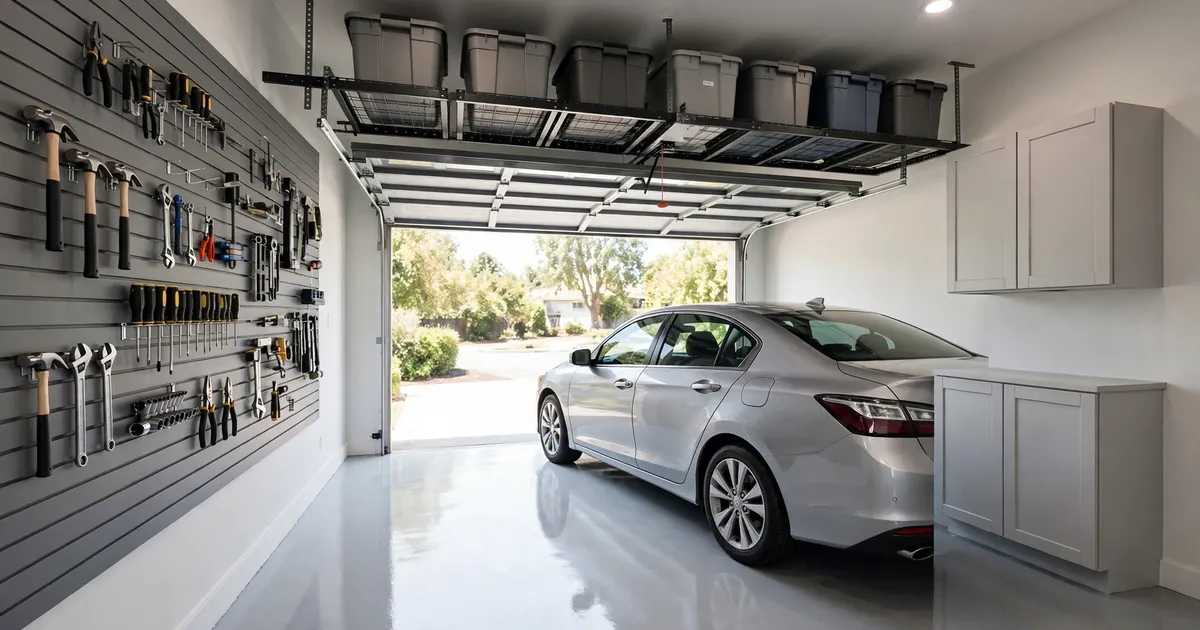

Small garage storage starts with a rule most guides bury: the floor goes last. Measure the space, divide it into zones, push storage onto the walls and ceiling, and only then decide what earns a spot on the floor. Nearly one in four Americans say their garage is too cluttered to fit even one car, according to a 2015 homeowner survey by Gladiator GarageWorks, and one in three keep the garage door shut out of embarrassment. The fix is not a bigger garage. It is a system where the car fits first and everything else hangs, stacks, or slides overhead.
These 15 small garage storage ideas work in real one-car and tight two-car garages, the kind where you sidestep the lawn mower to reach the car door. Every one of these small garage storage ideas includes the measurements that decide whether it fits your space, honest budget tiers with typical street prices at US retailers (not quotes; exact prices move with sales), and a note on when the fix is wrong for you. No remodel, no contractor, no wall of custom cabinets required.
The short version
– Measure first: wall-to-wall width, ceiling height, garage-door track clearance, stud spacing, and your car’s footprint with the doors open. Inches decide what fits, so this step comes before any shopping. All of these small garage storage ideas build on these five numbers.
– Zone by frequency: daily tools near the house door, weekly sports gear in one corner, seasonal stuff overhead. A garage zoned by how often you touch things stays organized longer than one zoned by category.
– Go vertical, then overhead: walls hold tools and bikes, the ceiling holds holiday bins and anything you touch twice a year. The floor holds the car and a walkway, nothing else.
– Start cheap: a tape measure, a pack of heavy-duty hooks, and four clear bins fix more garages than a $2,000 cabinet system. Spend big only on the one wall you touch daily. The cheapest small garage storage ideas are usually the easiest to maintain.
| Budget tier | What it buys | Best first buy |
|---|---|---|
| Free | The driveway sort, a zone map sketched on paper, purging what you do not use | A Saturday and a trash bag |
| Under $50 | Heavy-duty hooks, a 4-pack of clear bins with lids, a magnetic tool strip | Hooks plus bins |
| $50 to $150 | Pegboard or a slatwall starter panel, a bike hoist, a corner tool tower | The tool wall starter |
| $150 to $400 | One overhead ceiling rack, a folding workbench, two wall cabinets | The overhead rack |
| $400 and up | Full slatwall wall, multiple racks, rolling tool chest | Only after the cheap tiers prove the layout |
Typical street prices at US retailers, not quotes. Exact prices move with sales.
What counts as a small garage, really?
A small garage is any garage where the car fits but nothing else does. The average attached garage in the US measures about 20 by 20 feet, and a common crew-cab pickup like the Ford F-150 SuperCrew stretches about 230 inches, just over 19 feet long, according to The Drive. Nearly three out of four households can only park one car in their two-car garage, per a 2014 Family Features survey, and more than 80 percent of real estate agents in that survey said a cluttered garage hurts a buyer’s first impression.
Here is my opinion, and I will not soften it: if your car fits with the door closed, you do not have a hopeless garage. You have a normal one. The one in five homeowners who have argued with a spouse about the garage, per that Gladiator survey, were not arguing about square footage. They were arguing about a system. Square footage is fixed. Systems are buildable.
This guide assumes your garage still has to park at least one car. If yours is a workshop that happens to have a garage door, different rules apply and most of the overhead advice still helps.
How do I measure my garage before buying anything?
You need five numbers, and they take twenty minutes with a tape measure. Every one of these small garage storage ideas depends on them. One: wall-to-wall width and depth, so you know the true footprint. Two: ceiling height, because overhead racks need at least 8 feet to clear a car’s roofline with room for bins. Three: garage-door track clearance, the highest point the door and its rails reach when open, because anything mounted above the door must clear it. Four: stud spacing, usually 16 inches on center in US homes but sometimes 24, because every heavy mount must hit studs or joists.
Five: your car’s footprint with the doors open, because the walkway around an open car door is the space most plans forget.
Write the numbers on the wall in painter’s tape. Seriously. It is the least glamorous of these small garage storage ideas and the most important. When the bin or rack arrives, you will check the tape instead of guessing, and guessing is how a 24-inch-deep shelf ends up blocking the car door.
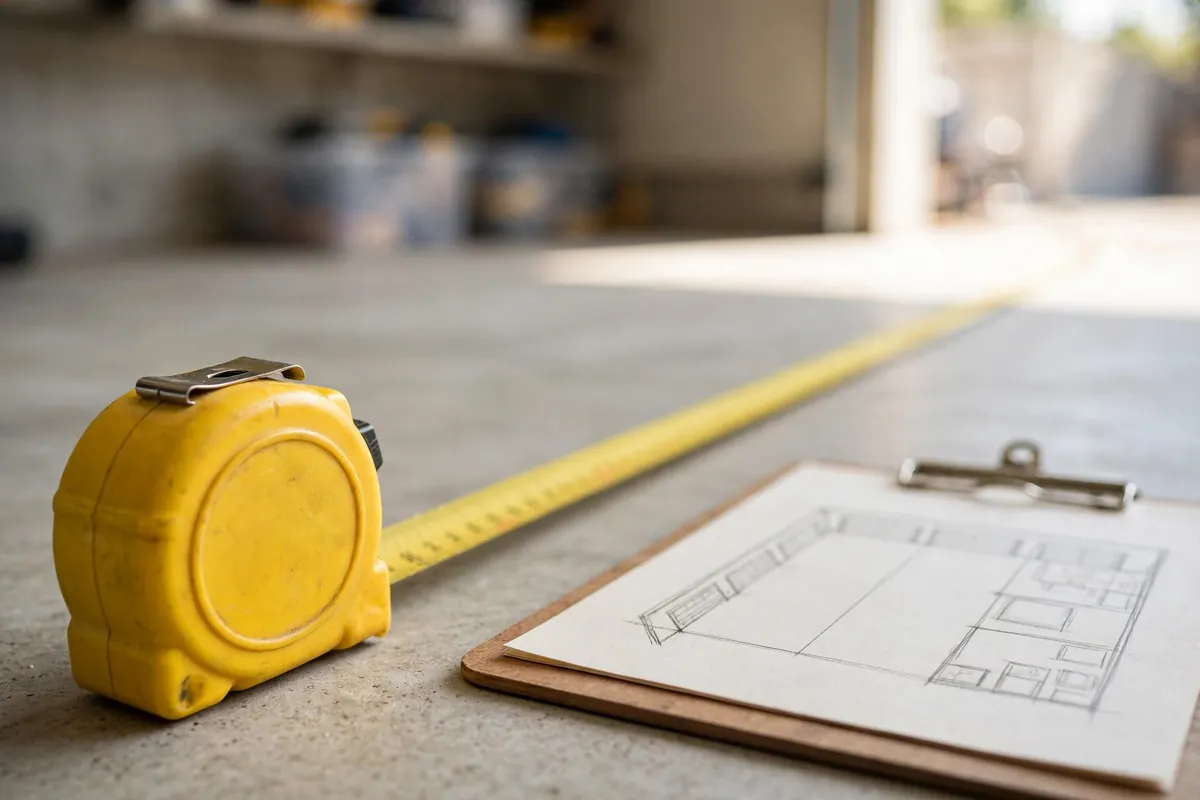
My strong opinion: the tape measure is the highest-return purchase in this entire guide. A $12 tape measure prevents more returns than any product review. Buy organizers after you measure, never before.
Where should everything go in a small garage?
Give everything a zone and the garage stops being one big junk drawer. Zoning is what makes these small garage storage ideas actually work. I zone by frequency of use, not by category, because category zoning puts the holiday lights next to the drill you grab twice a week.
Daily tools live on the wall nearest the door into the house. Weekly items, sports gear and the lawn mower, get one corner with a clear path. Monthly items like automotive supplies sit on shelves at eye level. Twice-a-year items, holiday decorations and camping gear, go overhead where you need a step stool to reach them.
About 80 percent of clutter comes from disorganization rather than lack of space, according to the National Association of Professional Organizers, and zoning is what turns a pile into a system.
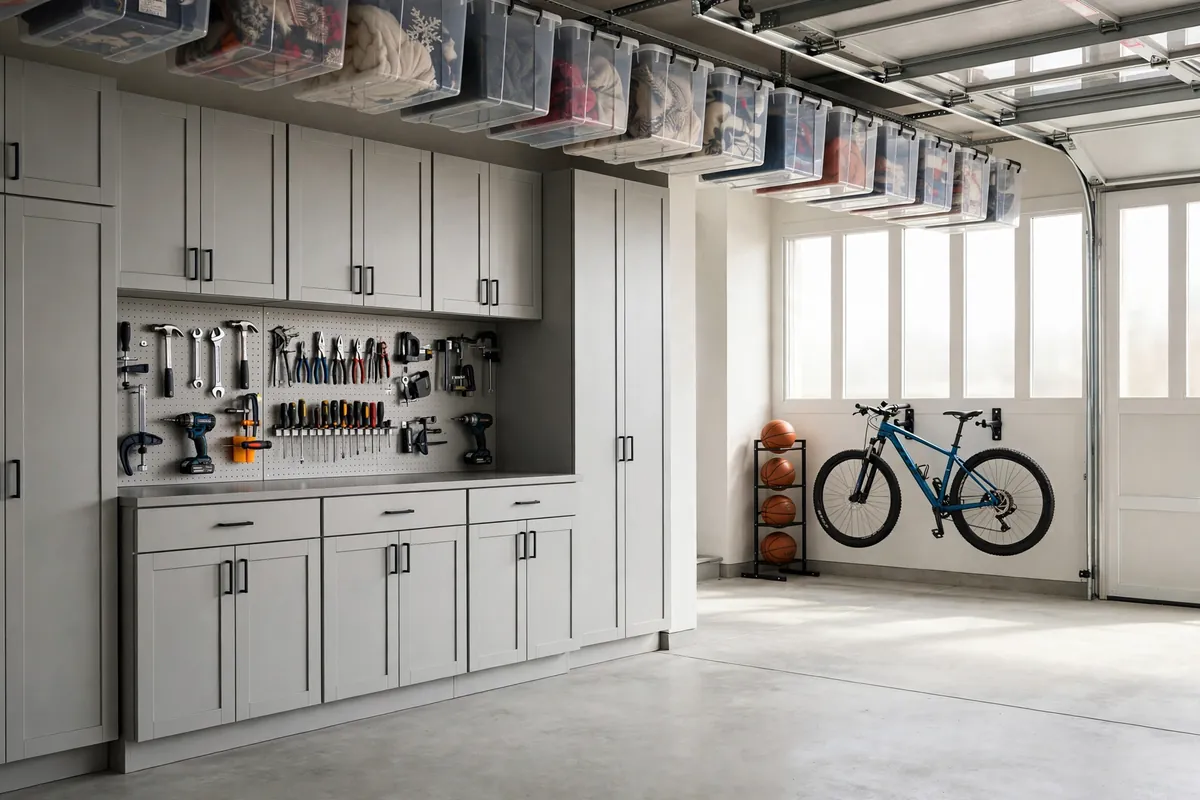
Sketch the zones on paper before you mount anything. The map below is the template; adjust the corners to your five numbers.
| Zone | What lives there | Storage type |
|---|---|---|
| Tool wall (near house door) | Hand tools, drills, fasteners | Slatwall or pegboard, magnetic strip |
| Sports corner | Balls, bikes, helmets | Ball rack, wall hooks or hoist, one bin per kid |
| Seasonal overhead | Holiday decor, camping gear | Ceiling racks with labeled clear bins |
| Garden strip (near garage door) | Rake, shovel, broom, hose | Corner tool tower, deep wall hooks |
| Auto shelf | Fluids, rags, jumper cables | One shelf or cabinet at eye level |
Pin this zone map for your weekend reset. You will check it every time something new enters the garage.
A NAPO survey found 54 percent of Americans feel overwhelmed by clutter at home. A zone map answers the “where does this go” question before it gets asked, which is most of the battle.
What is the best way to use the ceiling in a small garage?
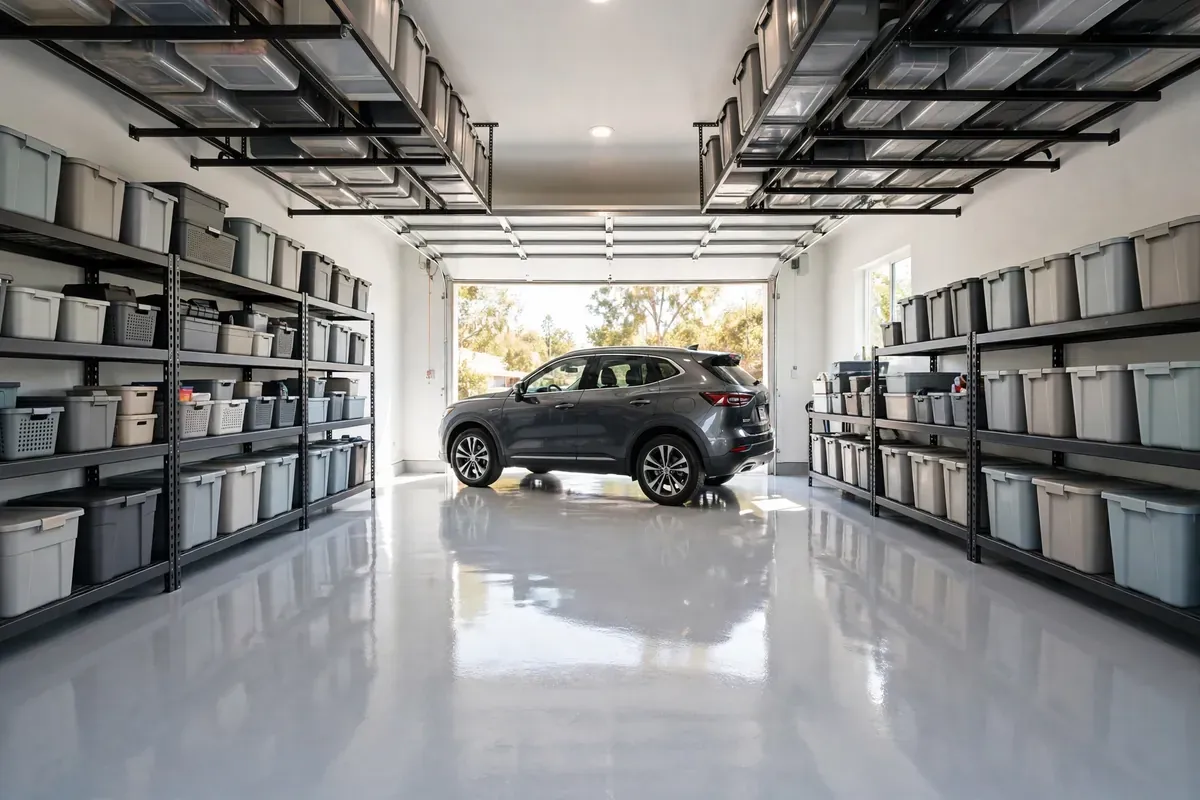
The ceiling is the biggest unused surface in a small garage, and ceiling storage is the single best square-foot buy you can make. Of all the small garage storage ideas in this guide, this one pays back fastest. A standard 4-by-8-foot rack adds 32 square feet of storage without touching the floor or the walls. Mount the racks above the car’s roofline, with proper garage door clearance from the tracks and the opener rail, and reserve them for light, bulky, twice-a-year seasonal storage: holiday bins, camping gear, luggage, the artificial tree.
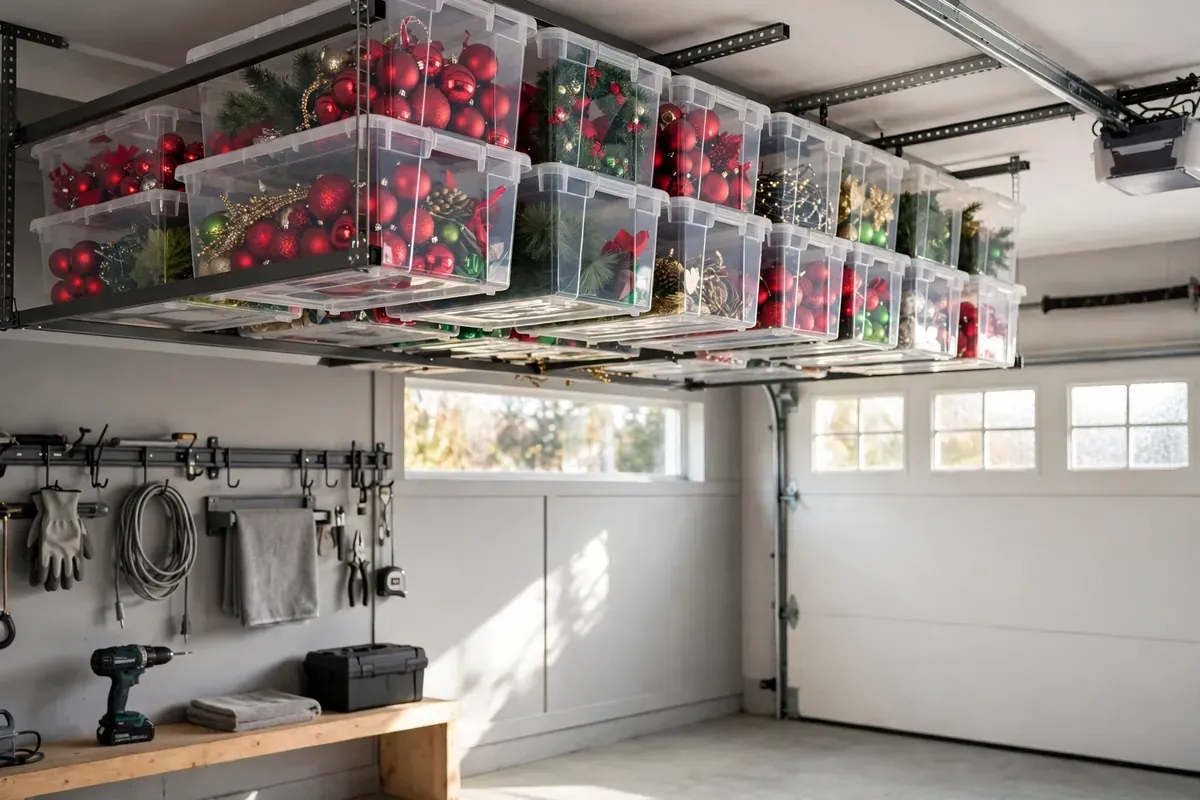
Weight limits are real, so respect them. Most residential overhead storage racks rate 250 to 600 pounds total when bolted into ceiling joists. Spread heavy items across the platform instead of stacking them in one corner, and never mount into drywall alone. If your joists run 24 inches on center instead of 16, buy a rack built for that span or add blocking between joists first. A $15 stud finder answers the joist question in five minutes.
Not for you if: your ceiling is under 8 feet (bins plus rack will hang into the car’s roofline), or you rent and cannot drill into joists. Renters should skip to the freestanding options and treat the ceiling as a future-home project.
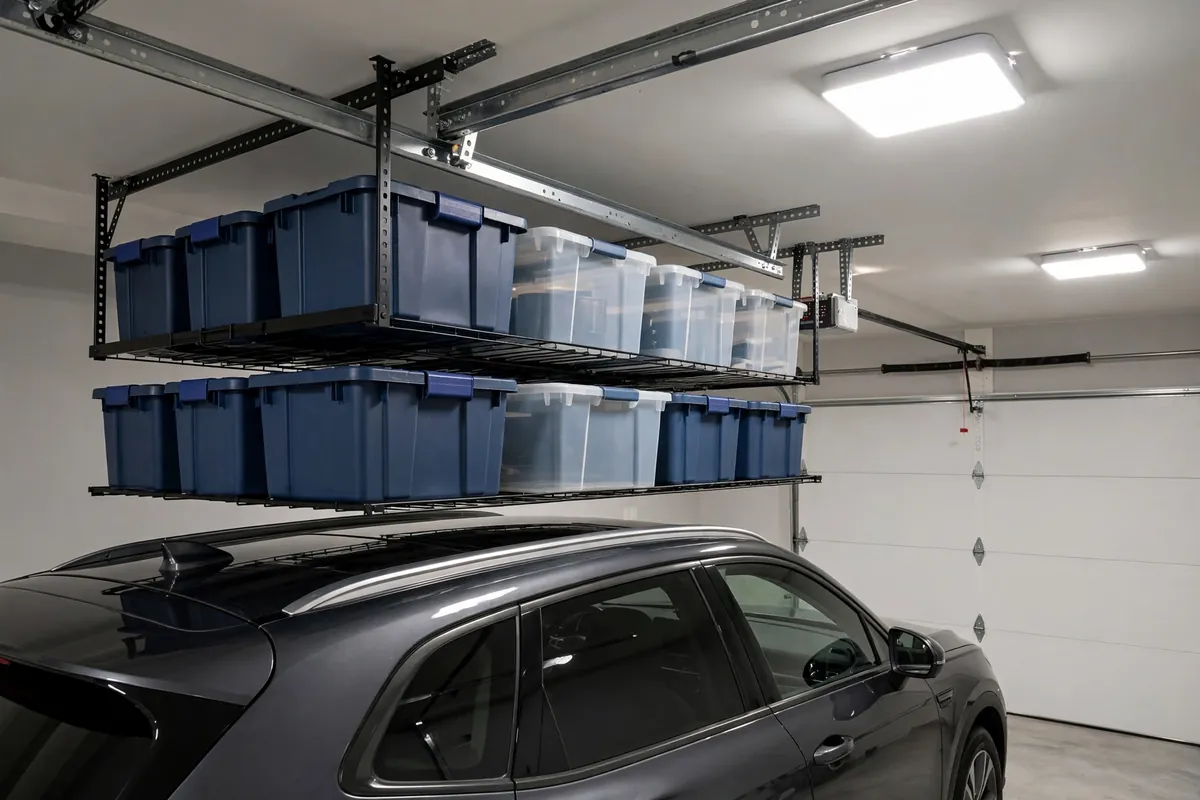
| Overhead type | Weight capacity | Best for | Watch out for |
|---|---|---|---|
| Fixed overhead rack | 250 to 600 lbs | Holiday bins, camping gear | Needs 8-ft+ ceiling; check door-track clearance |
| Lift rack (pulley or motor) | 200 to 400 lbs | Heavy bins you lower a few times a year | Costs more; needs solid joists |
| Single-item hoist | 50 to 150 lbs | Bikes, kayaks, ladders | One item per hoist; mind the swing radius |
| Ceiling bin tracks | 100 to 200 lbs | Light seasonal bins that slide in and out | Bins must match the track size |
| Ceiling hooks | 25 to 50 lbs each | Bikes, extension ladders | Screw into joists only, never drywall |
Slatwall or pegboard: which wins for tool storage?
Both hang tools on a wall. The difference is weight, cost, and how often your layout changes. Slatwall panels lock hooks into horizontal grooves, so they hold heavier loads, survive rearranging, and look finished. A starter panel with a hook kit runs in the $50 to $150 tier and handles drills, garden tools, and extension cords without complaint. Pegboard is the budget classic: a 4-by-8 sheet costs little, paints nicely, and holds light hand tools on standard hooks. Paint it a light color and you will actually see your tools.
Here is the honest trade-off the forums taught me. Pegboard has poor storage density compared with a rolling cabinet or slatwall, because every tool needs its outline of empty board around it. If you own six hand tools, pegboard is perfect and slatwall is overkill. If you own forty tools and the collection keeps growing, slatwall’s repositionable hooks are worth the extra money within a year. Either way, mount into wall studs, keep daily tools at chest height, and push the once-a-month tools to the edges.
| Slatwall | Pegboard | |
|---|---|---|
| Typical cost | $50 to $150 for a starter wall | Under $50 for a 4×8 sheet plus hooks |
| Weight capacity | Heavy: drills, garden tools | Light to medium: hand tools |
| Rearranging | Slide hooks anywhere in seconds | Pull hooks and rehang |
| Renter-friendly | No (screws into studs) | Somewhat (still needs studs for loads) |
| Best for | Growing collections, heavy gear | Starter sets, tight budgets |
My opinion: buy the slatwall for the wall you touch daily and pegboard for the overflow wall. Most small garage storage ideas for tools come down to this one choice. Most small garages need exactly one great tool wall, not three mediocre ones.
Where do bikes go when the garage barely fits the car?
Bikes go up. A ceiling-mounted pulley hoist system lifts a bike flat above the car’s roofline, and bike storage is where small garage storage ideas earn their keep, costs less than a wall of cabinets, and takes about a minute to lower when you want to ride. That is the answer for most one-car garages. Wall hooks are the runner-up: cheap, simple, and fine if you have a free stretch of wall and a bike light enough to lift chest-high without a struggle. Vertical floor stands work but eat the walkway, which defeats the purpose in a small garage.
Not for daily riders with heavy e-bikes: hoisting a 60-pound e-bike overhead twice a day gets old fast. If the bike leaves the garage daily, give it the floor spot nearest the door and put something you touch monthly overhead instead. Kids’ bikes deserve wall hooks at kid height, not a hoist they cannot operate. Match the storage to how the bike actually gets used.
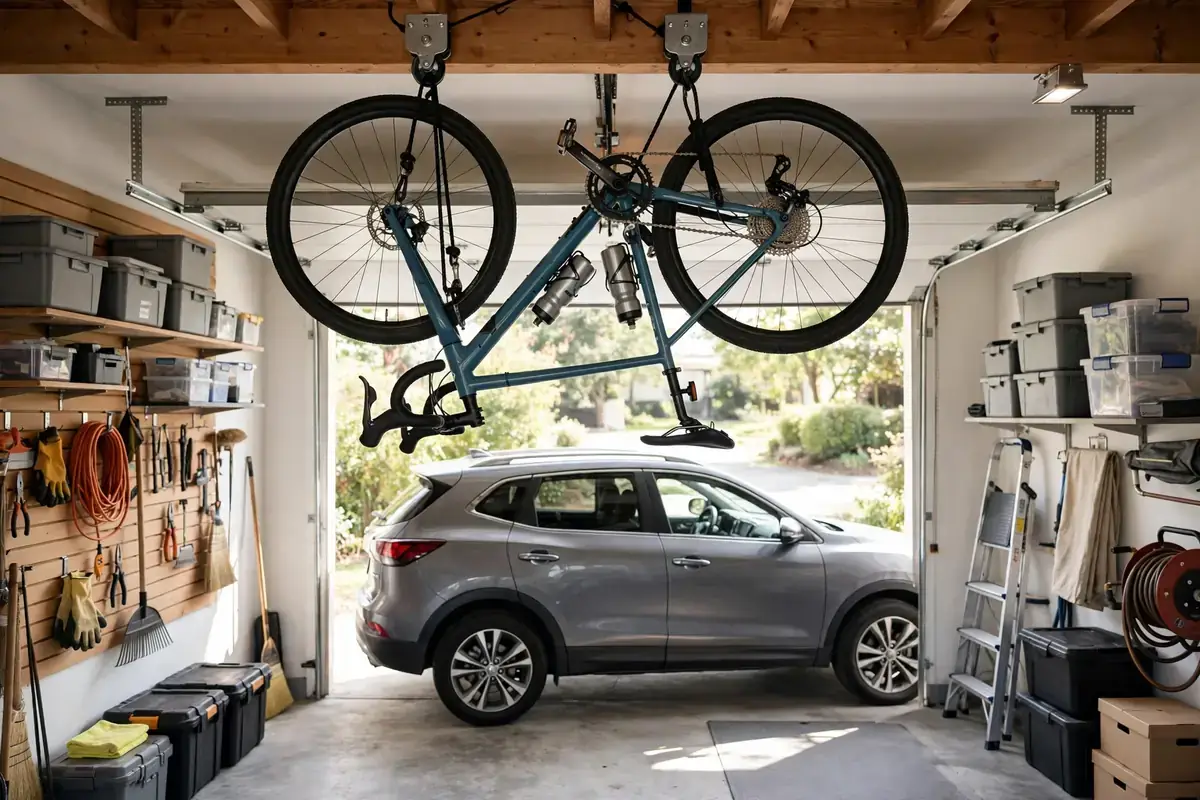
How do I stop sports gear from taking over?
Sports equipment multiplies because every item has a different shape and none of them stack. The fix is containment by kid, not by sport. Give each kid one bin and one stretch of wall hooks, the same one-bin rule that keeps kids’ rooms under control; when the bin is full, something leaves before something new enters. A vertical ball rack in the corner holds four or five balls in two square feet of floor. Mesh bags on hooks swallow helmets, gloves, and pads where bins would waste space.
One rule keeps this working: nothing sports-related lives on the floor except what is drying. The one-bin rule is the simplest of these small garage storage ideas. Wet gear dries on hooks, then goes back in the bin. The garage floor is a no-storage zone, and sports gear is the category that tests the rule hardest. Rotate by season: when winter ends, the skis and snowboards go up on wall racks and the bikes come down to the hooks, and when summer ends, reverse it. A ten-minute seasonal swap beats a garage that tries to hold every sport at once.
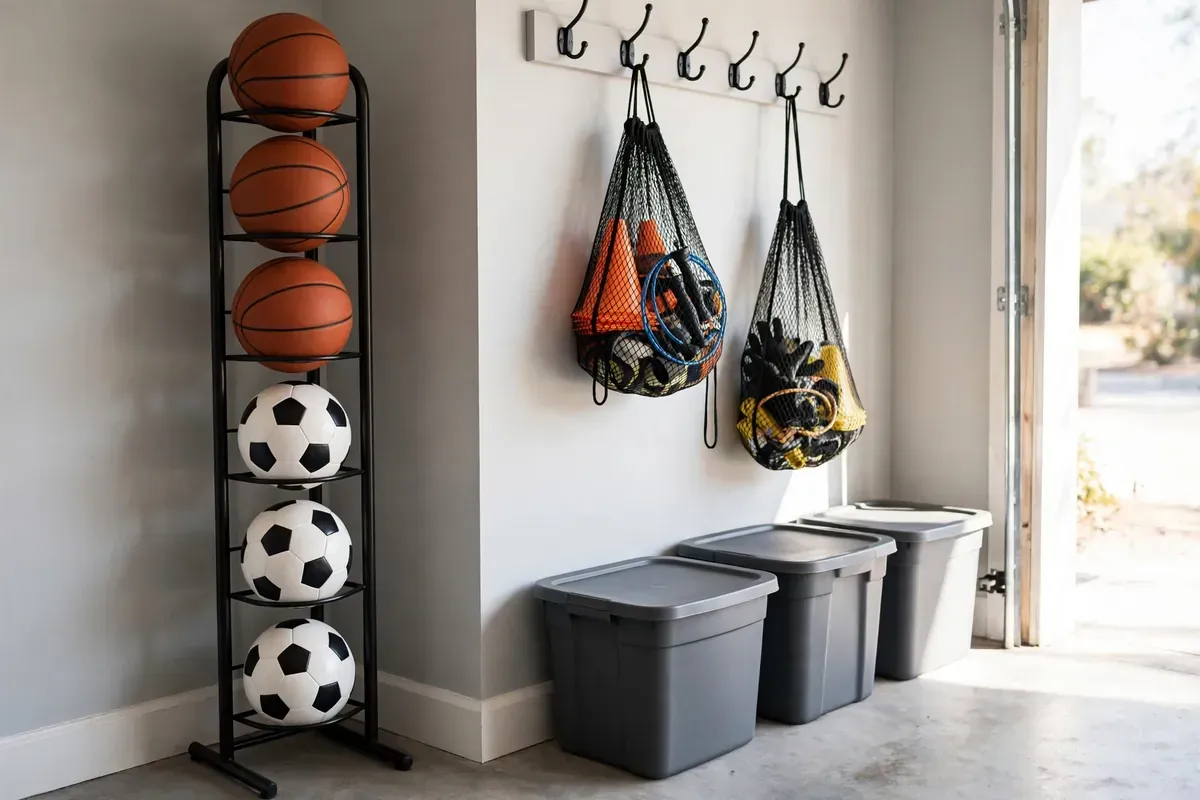
Do I really need a workbench in a small garage?
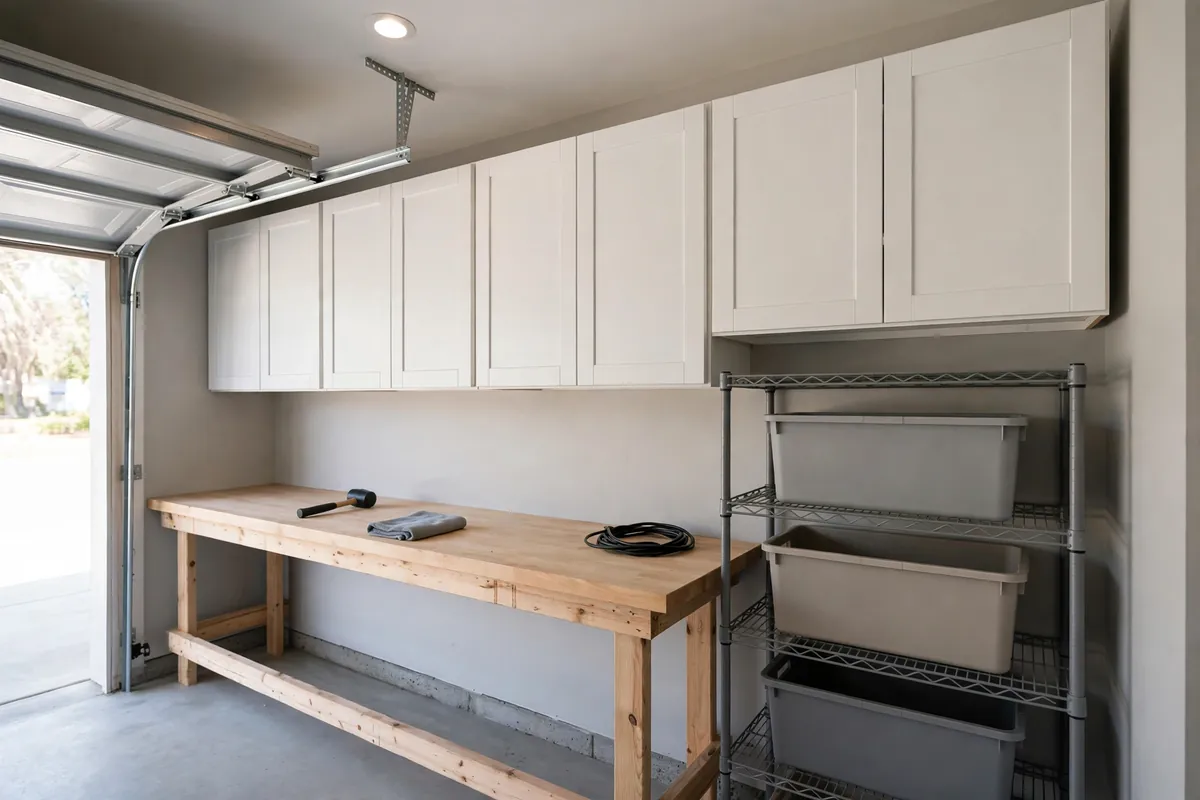
Probably not a permanent one. A wall-mounted folding workbench gives you a sturdy surface for the Saturday project and folds flat against the wall when the car needs the space, and the good ones rate for several hundred pounds. Pair it with a small rolling cart for the tools and you have a workshop that appears and disappears in two minutes. This is the right answer for the garage that fixes things monthly. Among small garage storage ideas for workspaces, the folding bench is the best space saver.
If you build or repair weekly, skip the folder and claim a real bench, because setup time kills momentum. Put the bench on the wall opposite the car door swing and keep the footprint tight. And if your “projects” are really just changing wiper blades, a rolling tool chest with a wood top is a workbench already. Do not buy furniture for a hobby you visit twice a year.
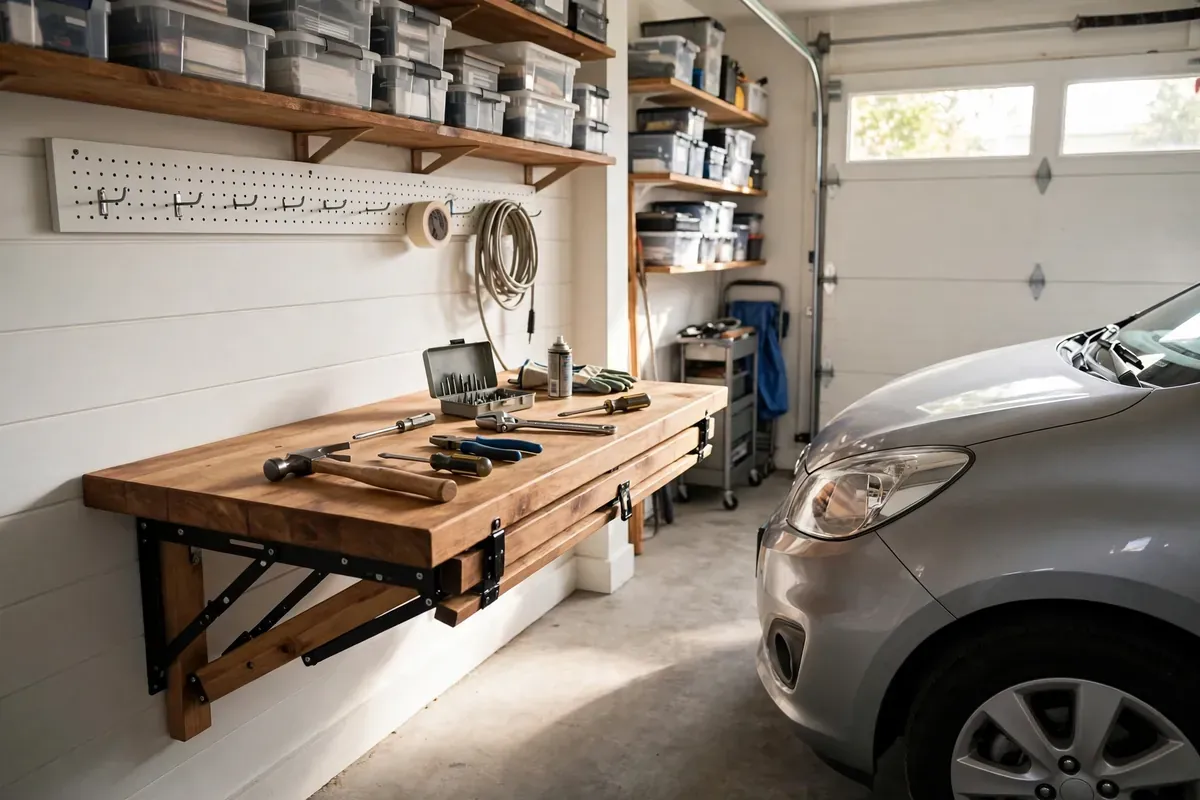
Cabinets or open shelves: what works better?
Closed cabinets win for the messy truth; open shelves win for what you grab weekly. Cabinets hide the half-empty paint cans, the mystery cords, and the spray bottles, and they keep dust off everything inside, which matters in a garage. A pair of wall-mounted cabinets above a workbench costs in the $150 to $400 tier and instantly makes the garage look finished. Open shelves cost less and keep weekly items visible, but they collect dust and turn into display shelves for clutter within months.
My opinion, tested the hard way: put doors on everything you touch less than weekly, and leave open only the shelf you restock. These small garage storage ideas for cabinets hide the messy truth. Labeled clear bins on open shelves are the compromise that actually survives, because you can see inside without dusting. Use the same bin-labeling approach that works in small pantries. If you must choose one, choose cabinets. Freestanding garage shelving units are the renter-safe fallback when you cannot mount anything. A garage with closed storage looks organized even on the weeks you skip the reset.
How do I store long-handled yard tools in one corner?
Give them a single corner and stop letting them lean against every wall. A corner tool tower holds a rake, two shovels, a broom, and a weed whacker in about two square feet, and the good ones add a bottom shelf for dustpans and twine. One reader with a small one-car garage fit nearly all of her yard tools into a single corner tower, which tells you how little space this category actually needs. The alternative is a set of deep wall hooks beside the garage door, which keeps the shovel within arm’s reach for surprise snow.
Do not scatter yard tools across three walls. They migrate, they fall, and they block the car door. One corner, one tower, done. That is the whole philosophy behind these small garage storage ideas for yard tools. Give the hose its own hook or reel on the same wall, because a hose left on the floor migrates across the whole garage within a week. Keep fertilizers and pesticides on a high shelf in their original containers with labels facing out. If you only own a rake and a broom, skip the tower and use two deep hooks. Buy storage for the tools you have, not the garden you imagine.
What fits above the garage door?
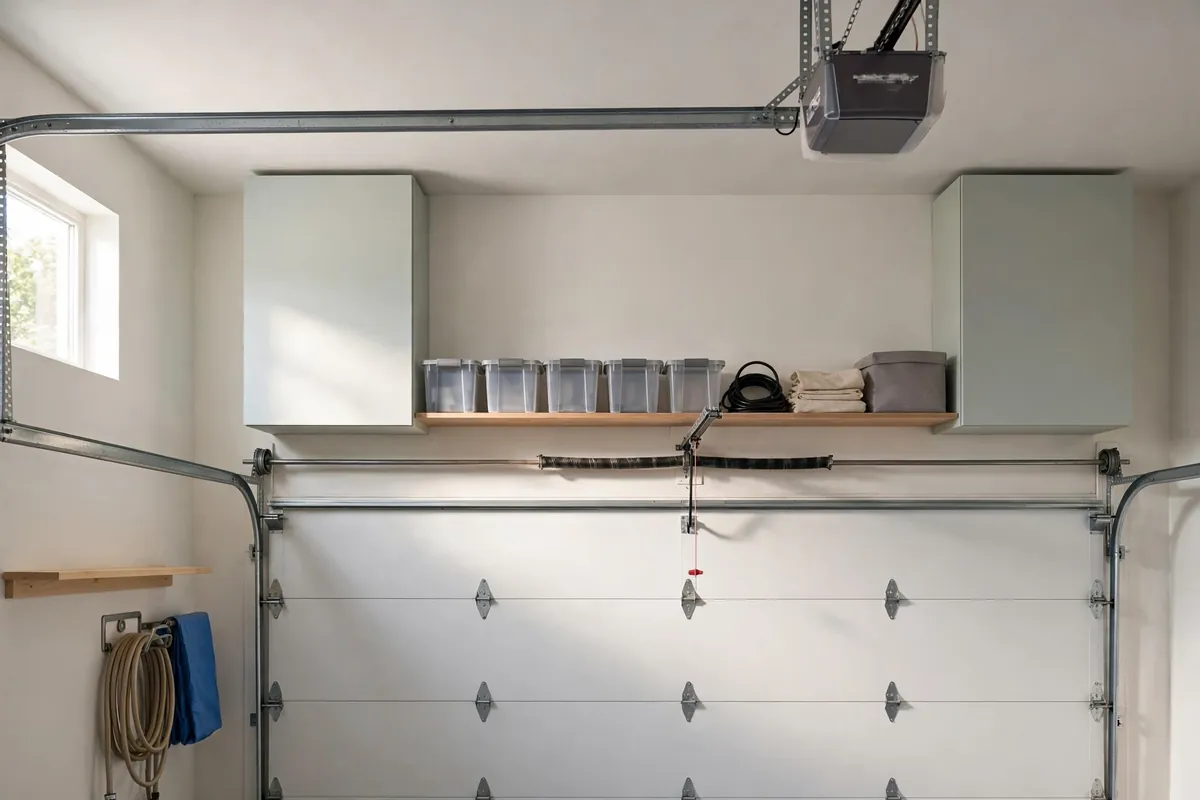
More than you think. The wall above the garage door is dead space in most small garages, and slim-profile cabinets or a shallow shelf fit there without interfering with anything. The wall beside the door takes deep hooks for ladders, hoses, and the extension cord. Some people mount a fold-down workbench on that wall, which works as long as it clears the door’s swing.
Measure the door’s travel before you mount a single screw. This is the most overlooked of all small garage storage ideas. Open the door fully and mark the highest point the door and its rails reach, then keep everything a few inches above that line. A shelf that clears the door by half an inch is a shelf that gets hit the week you forget. Ladders hang well on the wall beside the door on deep utility hooks, as long as the hooks clear the door’s swing. Keep this wall for the awkward long items: the extension ladder, the folding chairs, the spare hose.
Where do screws, cords, and paint cans actually go?
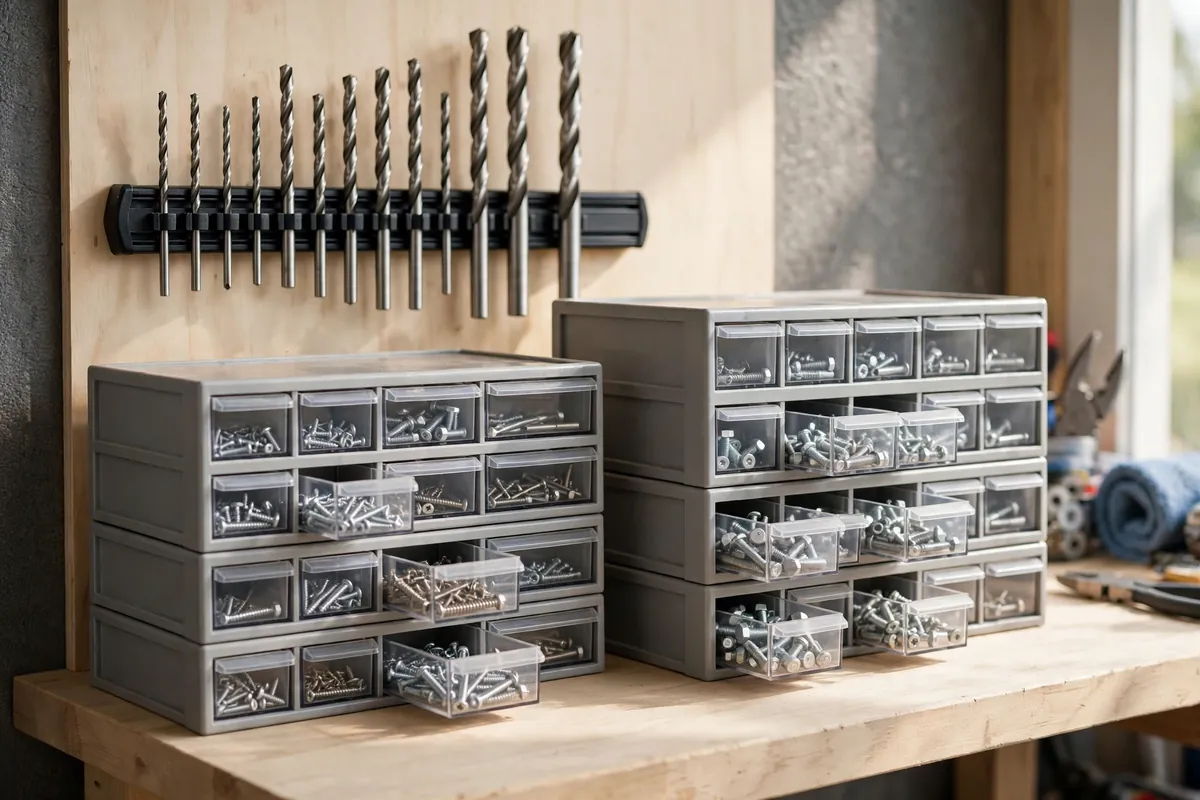
Small things need drawers, not bins. These small garage storage ideas for tiny items prevent the most annoying kind of clutter. Screws, bolts, and wall anchors vanish in bins and thrive in stackable small-parts drawers where every compartment has one job. A magnetic strip on the wall holds drill bits and driver heads where you can see them. Extension cords belong on a wall-mounted winder or a deep hook, never coiled on the floor where they become a trip hazard. A 150-foot cord winder costs little and removes the most annoying floor clutter in the garage.
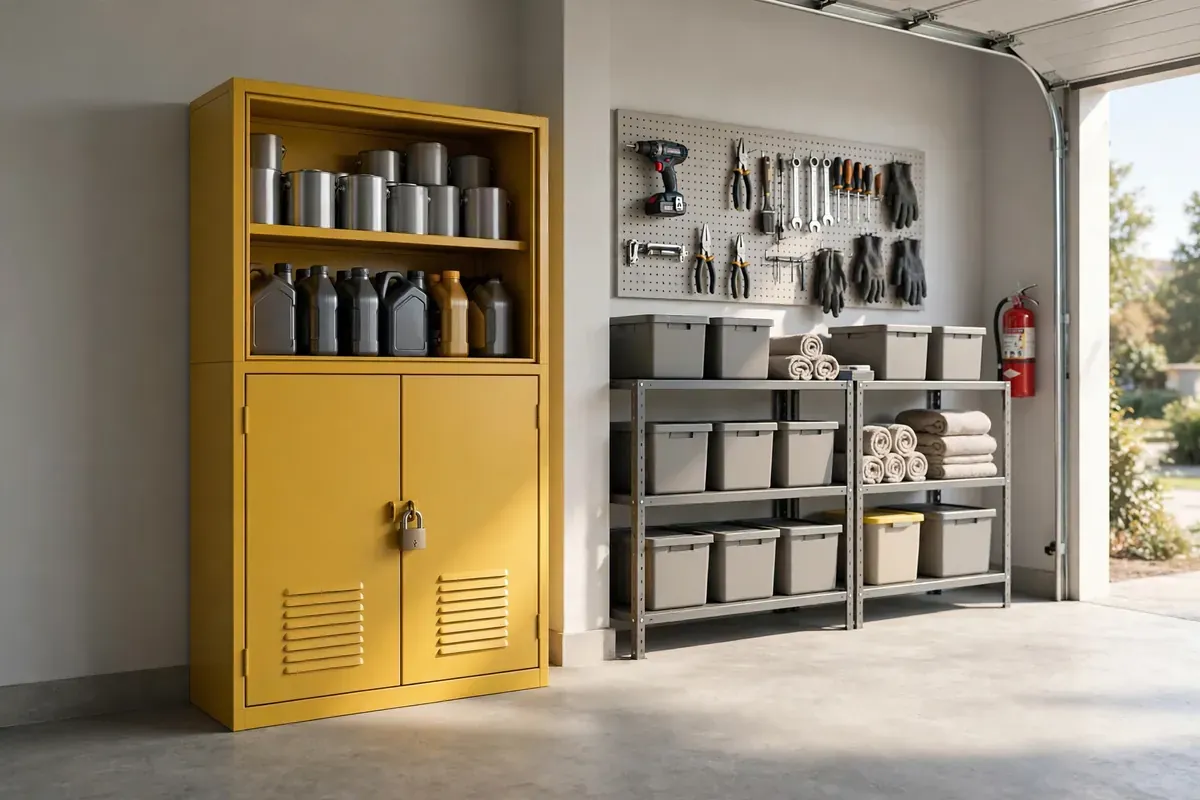
Paint cans go on one cool, dry shelf, lids hammered shut, with the label facing out. Keep them off the concrete floor, where moisture rusts the lids, and away from the water heater or furnace. Buy only what the job needs; a shelf of dried-out half gallons is not storage, it is a museum of abandoned projects. Take the dead cans to your county’s hazardous waste collection day.
Mount a hardware wall for the tiny things: small-parts drawers for screws and anchors, a magnetic strip for drill bits, and labeled jars under a shelf for the odd bolts every junk drawer collects. When every fastener has a labeled home, you stop buying your third pack of the same screws.
What should never be stored in a garage?
Some things do not belong in a garage no matter how small it is. The safety rules are the most important small garage storage ideas here. Gasoline, propane tanks, oil-based paints, varnishes, and paint thinners are the big ones: the U.S. Fire Administration advises storing flammables in approved containers in a detached shed away from the home, not in an attached garage.
About 6,600 garage fires happen in the US each year, causing roughly $457 million in property damage, per US Fire Administration data cited by First Alert, and electrical malfunctions are the leading cause. Do not run a generator or grill in the garage, do not daisy-chain extension cords for battery chargers, and keep oily rags in a sealed metal container.
The quieter list: paper records and photographs (heat and humidity destroy them), pet food (it draws pests), and anything you would cry over losing. A garage is a semi-outdoor space with a roof. Store accordingly. If you are unsure about a chemical, read its label or call your local hazardous waste office before you shelve it.
How do I keep it organized once it is done?
Maintenance beats motivation. The small garage storage ideas above only work if the weekly reset happens. Label every bin on the short end you see from the ladder, follow the 80/20 rule from Better Homes and Gardens (leave about 20 percent of every shelf empty), and run a ten-minute reset weekly: put back what migrated, sweep the walkway. When something new enters, something old leaves the same day. The system fails the week you start piling “temporarily.”
Tie the big resets to the seasons. Every spring, rotate winter gear up and summer gear down; every fall, reverse it and check the overhead racks’ bolts while you are up there. Get the household in on it, because people maintain what they helped create. If your garage door opens straight into the house, set up a mini drop zone just inside: a slim bench, four hooks, and a tray for keys. Our entryway storage guide has drop-zone layouts by footprint. Once the floor is clear, an epoxy coating makes sweeping take minutes and the whole space feel bigger.
Start with the tape measure this weekend
Here are all 15 small garage storage ideas in one Saturday. Morning: pull everything onto the driveway and sweep. Midday: measure the five numbers, sketch the zones, and put back only what earns a zone. Afternoon: mount the hooks, hang the tools, load the overhead rack with the holiday bins. You will finish with a garage that fits the car, a floor you can see, and a system simple enough to survive real life.
Next step: walk to the garage with the tape measure right now and take the five numbers. Everything after that is just shopping with answers instead of guesses. When the bins come home, our under-stairs storage guide has the seasonal-bin system that keeps holiday boxes readable, and our small closet guide covers the labeling method that works from a ladder.
Small garage storage ideas: the quick-start checklist
Start with the five numbers. These small garage storage ideas only work when the measurements come first: wall-to-wall width, ceiling height, door-track clearance, stud spacing, and your car’s footprint with the doors open.
Zone the space by frequency. The small garage storage ideas in this guide put daily tools by the house door, weekly sports gear in one corner, and twice-a-year seasonal bins overhead where a step stool reaches them.
Go vertical before you buy. The cheapest small garage storage ideas are hooks, bins, and a tape measure. Wall storage beats floor storage every time in a small garage, and the floor stays clear for the car.
Use the ceiling for the light, bulky stuff. Among all small garage storage ideas, overhead racks give you the most square feet per dollar: one 4-by-8-foot rack adds 32 square feet without touching the floor or the walls.
Contain the small stuff. Small-parts drawers, magnetic strips, and labeled jars are the small garage storage ideas for screws, bits, and fasteners. When every fastener has a labeled home, you stop buying your third pack of the same screws.
Respect what never belongs. The safety-first small garage storage ideas are simple: gasoline, propane, and oil-based paints live in a detached shed, not the garage. Electrical malfunctions cause most garage fires, so give chargers and tools their own outlets.
How do I organize a small one-car garage?
Start by measuring: wall-to-wall width, ceiling height, and the space your car needs with the doors open. Then divide the garage into zones (tools, sports, seasonal, garden) and push storage to the walls and ceiling before anything earns floor space. These small garage storage ideas work in any garage that still has to fit a car. Overhead racks above the car’s roofline, a slatwall or pegboard tool wall, and labeled bins on shelves handle most of the load. The floor stays clear for the car and a walkway.
What is the best way to store bikes in a small garage?
A ceiling-mounted pulley hoist is the best option for most small garages because it lifts the bike flat above the car where dead space already exists, and it costs less than a wall of cabinets. Wall hooks work if you have a free stretch of wall and the bike is light enough to lift. Skip floor stands in a one-car garage; they eat the walkway.
How much weight can overhead garage storage hold?
Most residential overhead racks are rated for 250 to 600 pounds total when they are bolted into ceiling joists, and some lift-style racks rate each platform separately. Always mount into joists or blocking, never into drywall alone, and spread heavy items like paint cans and tool boxes across the platform instead of piling them in one spot. If your garage has 24-inch joist spacing instead of 16, use a rack designed for it or add blocking between joists.
Can I put shelves above my garage door?
Yes. Of all small garage storage ideas, the wall above the garage door is some of the best dead space in a small garage. Slim cabinets or a shallow shelf work well there, plus hooks for ladders and hoses on the wall beside the door. Measure the door’s travel first: the door and its tracks need full clearance when open, so keep everything at least a few inches above the highest point the door reaches.
What should I not store in my garage?
Do not store gasoline, propane, oil-based paints, or varnishes in an attached garage if you can avoid it; the U.S. Fire Administration advises keeping flammables in approved containers in a detached shed away from the home. Also skip paper records, photographs, and pet food (heat, humidity, and pests ruin them), and never run a generator or grill in the garage. Electrical malfunctions are the leading cause of garage fires, so do not daisy-chain extension cords for chargers and tools.
How do I organize a garage with no built-in storage if I rent?
Use nothing that needs a drill: freestanding wire shelving units, stackable bins with lids, a rolling tool cart, magnetic strips on a metal cabinet side, and heavy-duty adhesive hooks rated for the weight. A corner tool tower corrals long-handled tools without mounting anything. Keep everything portable so move-out day is just loading, not patching drywall.
Are overhead garage racks safe for the ceiling?
Yes, when they are installed correctly. Bolt the rack into ceiling joists (not drywall), anchor the wall side to studs where the design allows, stay under the rated weight limit, and keep the load balanced. Do not hang a rack from a garage door opener rail or from drywall anchors. If you are unsure where your joists run, a fifteen-dollar stud finder answers the question in five minutes.
How do I keep my garage organized long term?
Label every bin, follow the 80/20 rule (leave about 20 percent of every shelf empty so retrieving things stays easy), and do a ten-minute reset once a week. That is how these small garage storage ideas stay working years later: put back what migrated, break down one cardboard box, sweep the walkway. Give every category a single home so nothing drifts. The system fails the week you start “temporarily” piling, so treat the floor as a no-storage zone.
Where should I store holiday decorations in a small garage?
Holiday decorations are the perfect overhead-storage item: you touch them once or twice a year, and the bins are light. Put them in clear, lidded bins on a ceiling rack above the car’s roofline, grouped by holiday, with the tree and wreaths in bags on the same rack. Label the short ends of the bins so you can read them from the ladder.
If the layout is planned and you are ready to shop systems, see our best garage storage systems for small garages, where we compare 7 real wall, ceiling, and cabinet picks with verified weight capacities.
