
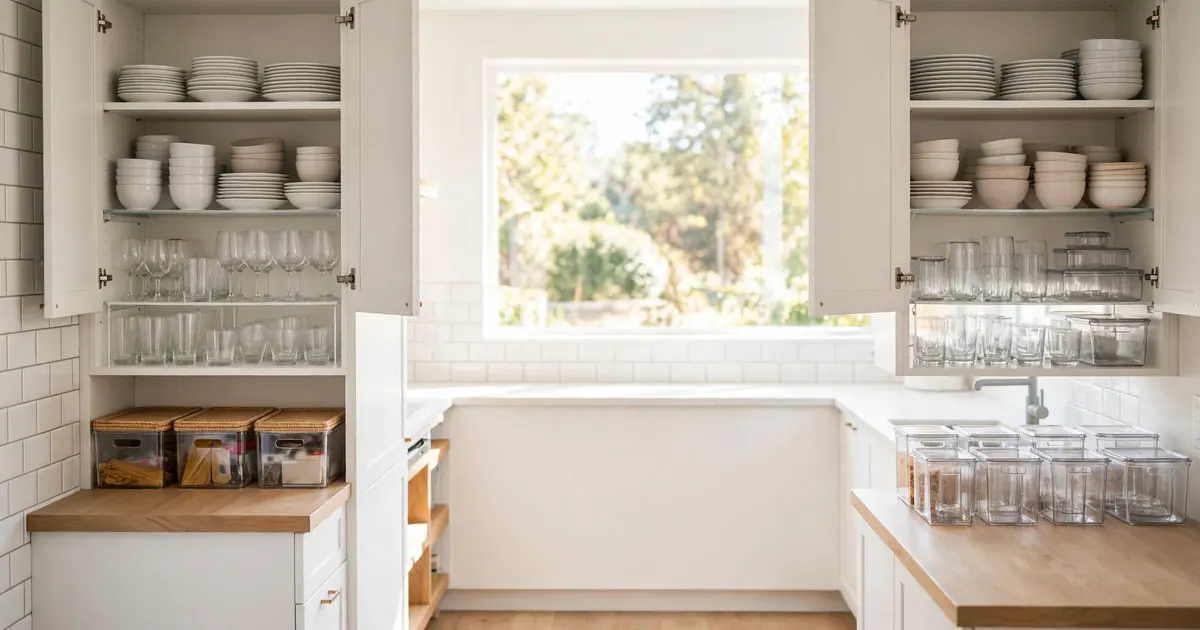

These 15 kitchen cabinet organization ideas start with the fastest win: empty one cabinet at a time, sort everything into keep, donate, and toss piles, group what is left by how you actually cook, then put daily items near their use zone. Two or three cheap organizers, like a shelf riser and a door rack, fix most of the mess. The full system below takes one weekend and holds for months if you keep the reset rule at the end.
The 5-step system behind these kitchen cabinet organization ideas, in 30 seconds:
- Empty one cabinet, not all of them.
- Sort into keep, donate, toss. Be honest.
- Zone by cooking task, not by item size.
- Add 2 to 3 targeted organizers where they earn their keep.
- Reset for 5 minutes every week.
Why these kitchen cabinet organization ideas work: kitchen cabinets and drawers rank as the second-biggest clutter hotspot in the home, according to IKEA’s Store and Organise Report 2026, which surveyed 31,488 people across 31 markets. A survey of 1,000 US homeowners by Eagle Woodworking found 58% say kitchen clutter causes them daily stress, while 55% say an organized kitchen helps them feel relaxed. MasterBrand Cabinets asked more than 1,000 US homeowners similar questions and found 95% feel their life is organized when their home is, while 81% say they can’t relax if the kitchen is a mess. The gap between those numbers is this post.
| Organizer | What it fixes | Best for | Price tier | Drill-free option? |
|---|---|---|---|---|
| Shelf riser | Dead vertical space in tall cabinets | Dishes, mugs, cans | $ | Yes, it sits on the shelf |
| Pull-out shelf | Deep-cabinet black holes | Pots, pans, small appliances | $$$ | No, it screws into the cabinet |
| Lazy Susan | Corner cabinets and condiment graveyards (see these blind corner kitchen cabinet ideas for the deep L-shaped ones) | Oils, sauces, jars | $$ | Yes, it sits on the shelf |
| Door-mounted rack | Wasted space behind doors | Lids, wraps, spice packets | $ | Yes, adhesive or over-door |
| Vertical dividers | Toppling stacks of flat cookware | Baking sheets, cutting boards, lids | $ | Yes, tension or freestanding |
Where should everything go in your kitchen cabinets?
Put things where you use them, not where they fit. The cooking zone lives in the cabinet beside the stove: oils, spices, pots, pans, and the utensils you grab while something is on the burner. The prep zone sits near your main counter: knives, cutting boards, mixing bowls. Daily dishes belong near the dishwasher so unloading takes two minutes, not ten. Here is the part people skip: decide the zones BEFORE you buy a single organizer. An organizer without a zone is just a tidier pile. Every one of the 15 kitchen cabinet organization ideas below assumes your zones are set.
My opinion on these kitchen cabinet organization ideas, stated plainly: frequency beats category. The mug you use every morning earns the easiest shelf even if it breaks up your matching set. The fondue pot you use at Christmas doesn’t, even though it’s technically cookware. I have seen too many kitchens where everything is grouped by type and nothing is reachable. Group by how often you touch it, then by type inside each frequency tier. Walk through one dinner in your head: you reach for oil, then the pan, then the spatula, then the plate. Those four things should live within two steps of each other, even if a tidiness book would file them in four different categories.
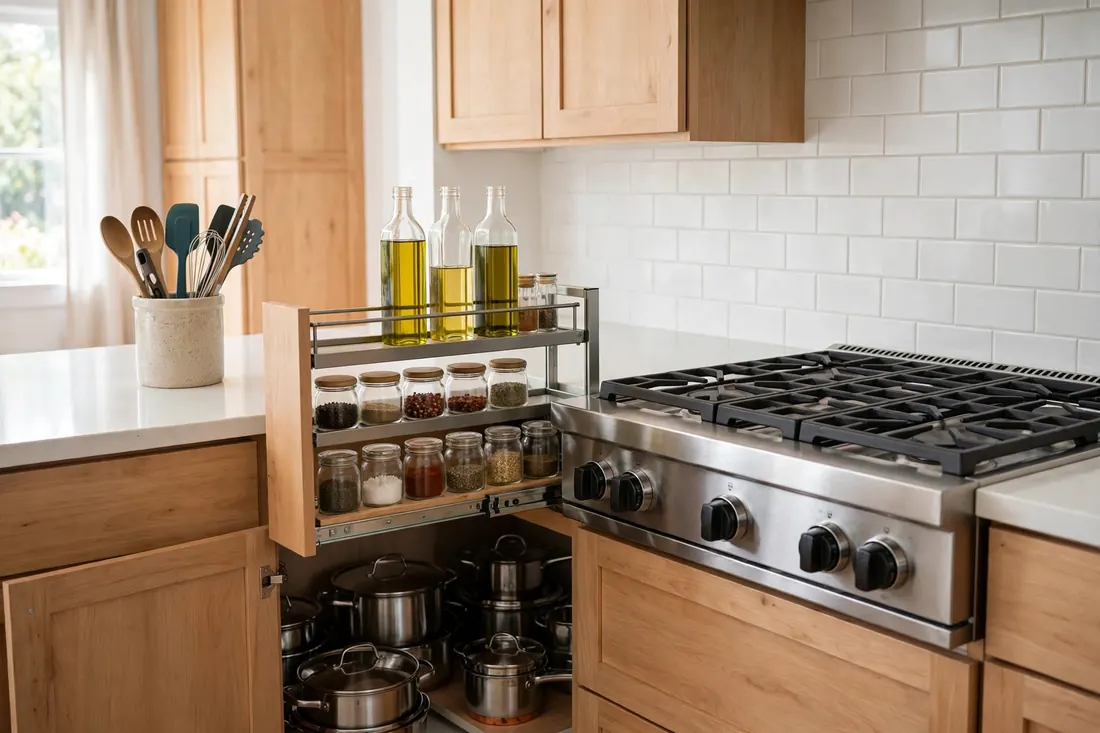
For the trickiest spice setups, see our spice storage ideas.
| Zone | Put it | What lives there |
|---|---|---|
| Cooking | Cabinet beside the stove | Oils, spices, pots, pans, cooking utensils |
| Prep | Near the main counter | Knives, cutting boards, mixing bowls |
| Coffee and breakfast | Near the coffee maker | Mugs, coffee, filters, cereal, bowls |
| Baking | One dedicated cabinet | Flour, sugar, measuring cups, baking sheets |
| Unloading | Cabinets around the dishwasher | Daily plates, bowls, glasses |
How do you empty and sort cabinets without making a bigger mess?
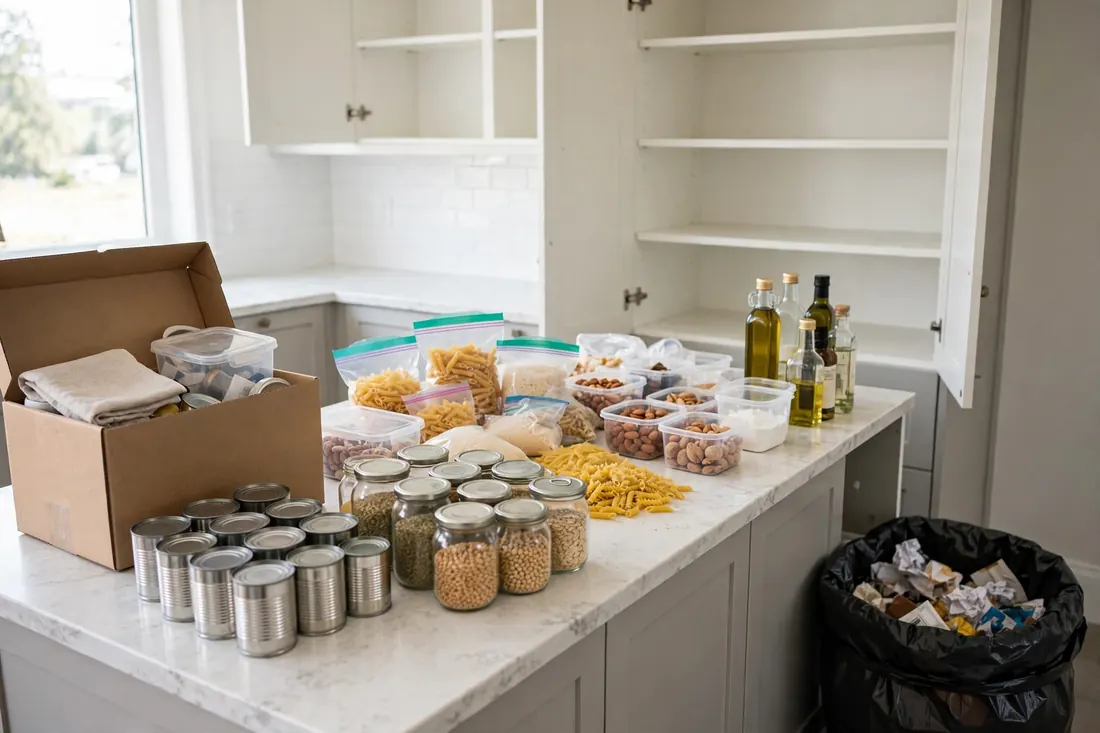
Do one cabinet at a time. That restraint is the first of these 15 kitchen cabinet organization ideas to master: emptying the whole kitchen at once feels productive for an hour and then the counter is buried and dinner is ruined. One cabinet, one afternoon, done. Pull everything out, wipe the shelf, and sort into three piles: keep, donate, toss. Then ask the question that actually cuts: if I did not own this, what would I do instead? A regular knife handles the croissant cutter’s job. A disposable pan covers the roasting pan you use once a year.
This is the step where sentiment sneaks in. IKEA’s 2026 report found 82% of people keep things purely for sentimental reasons, even items they rarely use. Keep the mug your grandmother gave you. Let go of the third garlic press. Sentiment gets one shelf, not the whole cabinet. That rule has ended more arguments in my house than any organizer ever did.
How do you organize deep kitchen cabinets without losing things in the back?
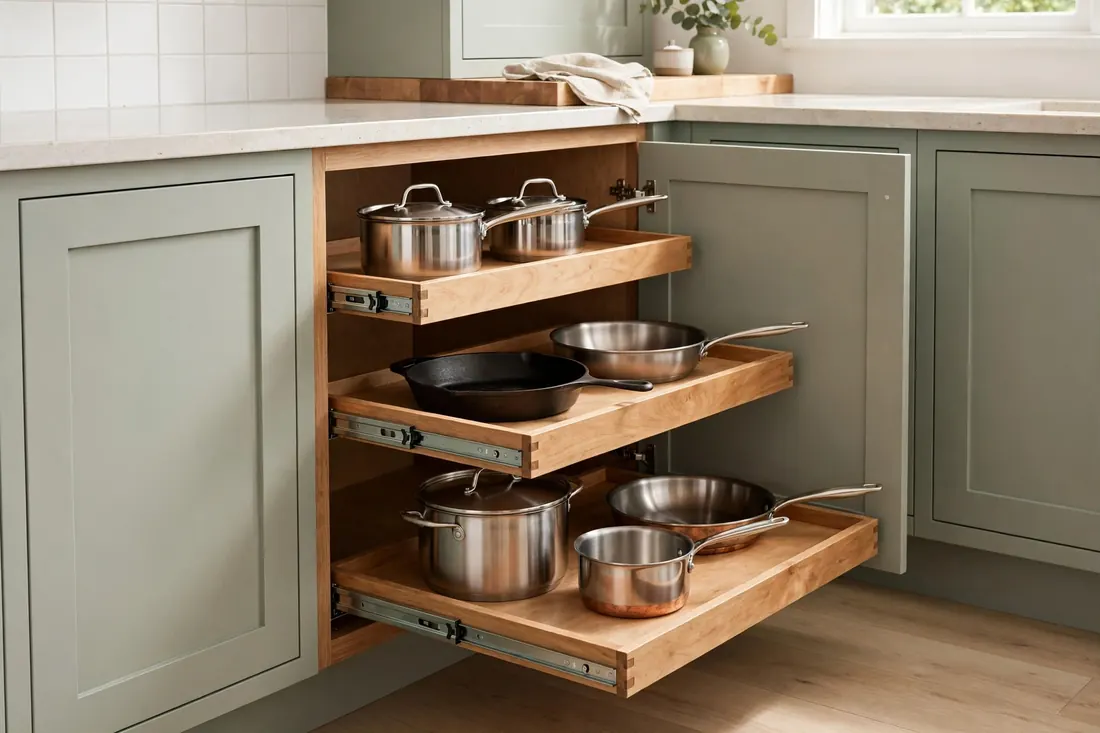
Treat the back half of a deep cabinet as a different country: nothing loose ever goes there. Of these kitchen cabinet organization ideas, front-back frequency zones are the whole trick. Daily items live in the front third. Weekly items in the middle. The back is for backup stock and the things you touch monthly, stored in one long clear bin that pulls out like a drawer. When you need something from the back, you pull the bin, not yourself.
If the budget allows one real upgrade, make it pull-out (roll-out) shelves for the lower cabinets. They turn a 24-inch-deep cave into a drawer you can see into from above. Measure twice here: note the cabinet’s interior width, depth, and the height of the door opening, because a pull-out that clears the shelf but not the door frame is an expensive mistake. Most kits need about an inch of clearance on each side for the slides.
Here is the honest part: they are the most expensive fix here, usually $75 and up per cabinet, and they screw into the cabinet box, so renters should skip them. The renter version is long clear bins used the same way, for under $15, and it gets you 80% of the result with zero holes in anything.
Can a lazy Susan actually fix a corner cabinet?
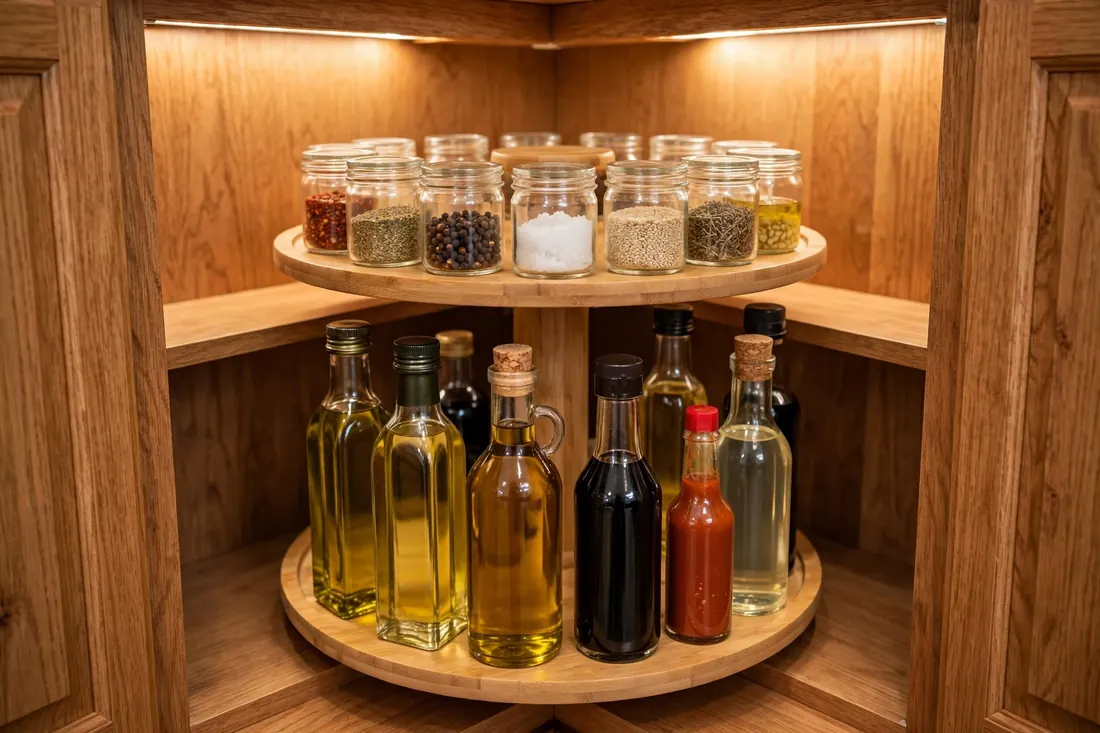
Yes, and it is one of the most satisfying kitchen cabinet organization ideas for one specific job: small bottles that vanish behind each other. Oils, vinegars, sauces, nut butters, and spice jars are perfect lazy Susan citizens because a spin brings the back row to the front. Get one with a raised rim so bottles don’t slide off mid-spin, and don’t put tall bottles on a two-tier model unless you measured first. That mistake is how olive oil ends up on the shelf below.
What a lazy Susan isn’t for: heavy pots, stacked dishes, or anything you need to see all of at once. A turntable full of pots is a turntable you will stop turning. Corner cabinets also swallow lazy Susans that are too small, so measure the cabinet opening, not just the shelf. One well-sized turntable beats two wobbly small ones every time. Blind corner cabinets, the L-shaped ones with a dead zone you can barely see into, are the hardest case of all. A half-moon or kidney-shaped turntable made for blind corners pulls that dead space forward instead of letting it become a graveyard for expired condiments.
What is the best way to store pots and lids without the avalanche?
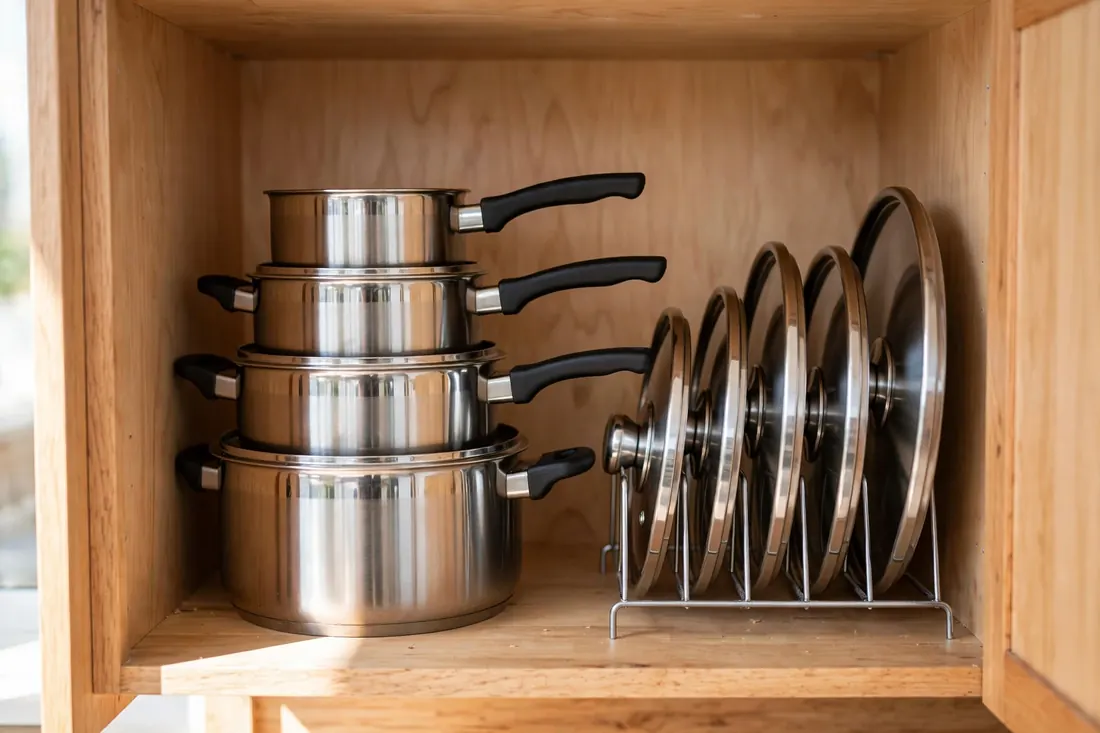
Give lids their own home, separate from the pots: of all 15 kitchen cabinet organization ideas, that single change ends the daily crash. File lids upright in a rack like records, mount a slim lid rack inside the cabinet door, or stand them in a vertical divider next to the pots. For plastic food container lids specifically, our food container lid storage guide covers 12 vertical-filing methods. Then nest the pots themselves, largest to smallest, with a paper towel or pan protector between nonstick surfaces so they don’t scratch each other.
Two placement rules matter more than any product. Heavy cookware, especially cast iron, lives on low shelves where you aren’t lifting it over your head. And the pots you use weekly go near the stove; the Dutch oven you use monthly can live further away. One more habit that saves the stack: let pans cool fully before nesting them, because trapping heat and steam between nested nonstick pans wears the coating faster. Eagle Woodworking’s survey found 77% of US homeowners name appliances and gadgets as the biggest source of kitchen clutter, and cookware is half that problem. Fewer pots, better placed, beats more organizers every time.
We cover cookware-only solutions in our pots and pans storage ideas.
How can you double the storage inside tall cabinets?
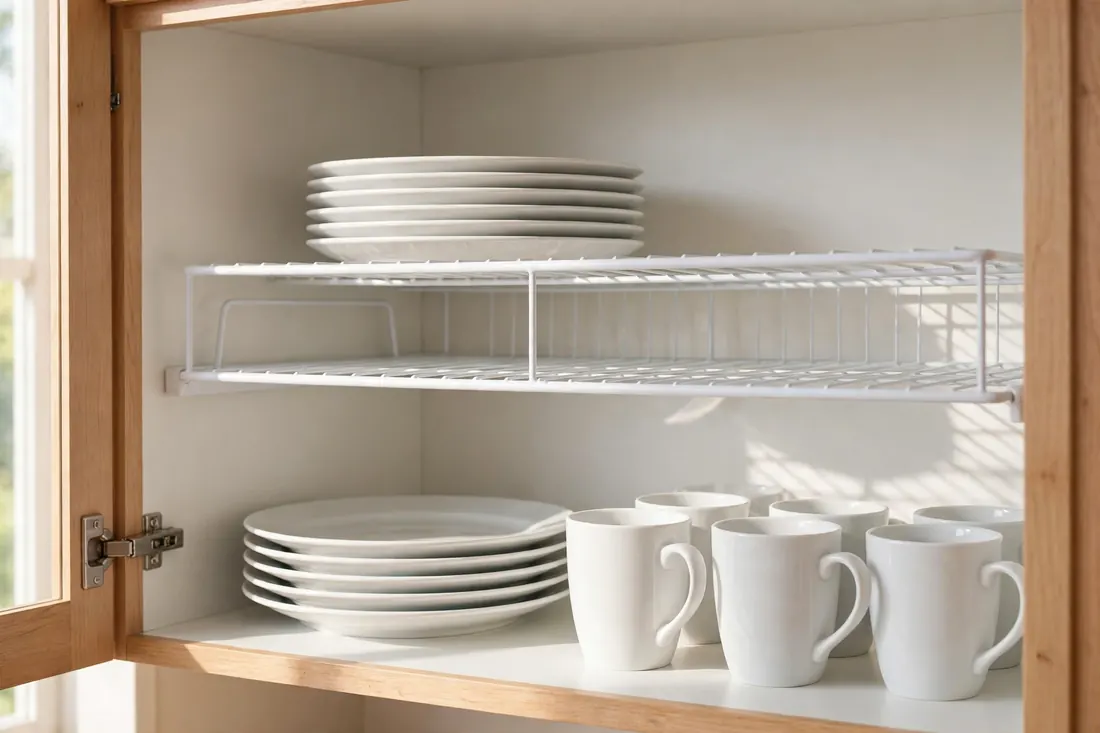
Add a second floor. Of these kitchen cabinet organization ideas, the shelf riser is the cheapest square footage you will ever buy: a wire or bamboo riser drops into a tall cabinet and instantly doubles the usable surface for plates, bowls, and mugs. Measure your shelf height first and leave clearance for the tallest stack. The classic fail is a riser that fits the shelf but not the plates, which turns one problem into a leaning tower.
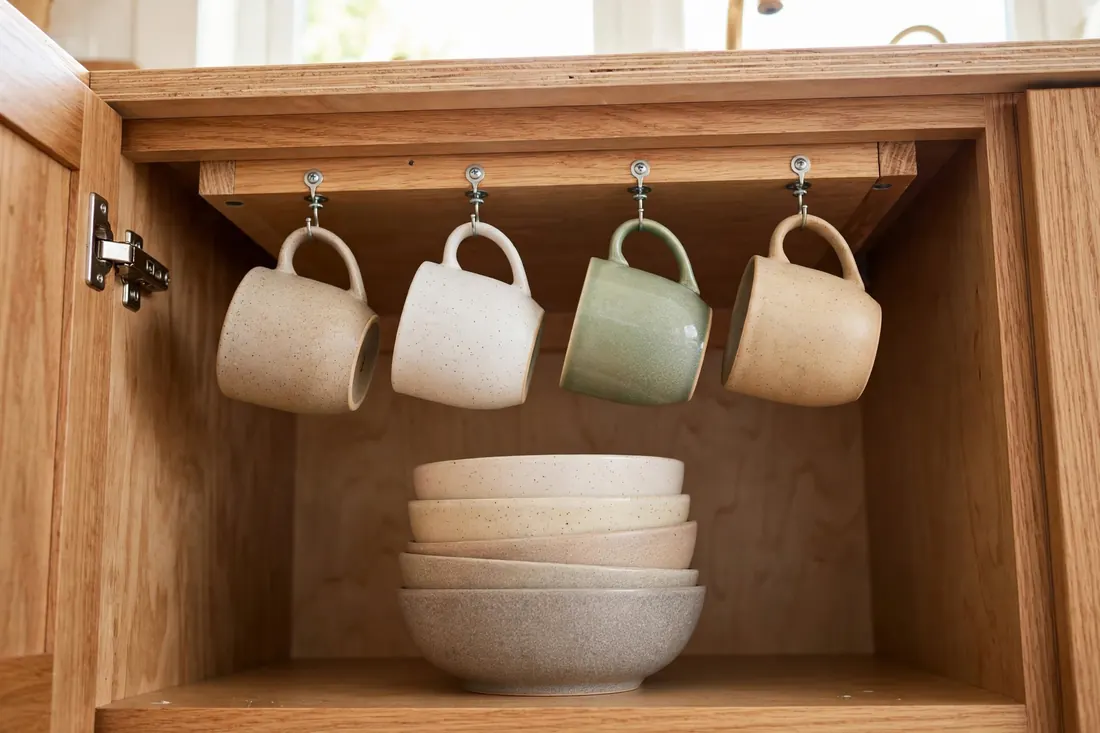
Then work the underside of each shelf, the most ignored surface in the kitchen. Small adhesive hooks under a shelf hold mugs by their handles above the bowls below. A slim under-shelf basket slides onto the shelf itself and corrals packets, lids, or spice pouches. Stackable bins are the riser’s best partner in pantry-style cabinets: two or three matching bins with lids turn one tall shelf into a neat tower of categories you can pull out one at a time. My take: do the risers before you buy anything else. And if the pantry is the real bottleneck, our small pantry storage ideas tackle zones, deep shelves, and the pantry door next. They cost less than takeout, need no tools, and the before-and-after looks dramatic enough to keep you motivated for the rest of the project.
If the cabinet under your sink is its own disaster, our under-sink kitchen organization ideas handle the pipe maze step by step. under-sink kitchen organization ideas
What is the smartest way to use the inside of cabinet doors?
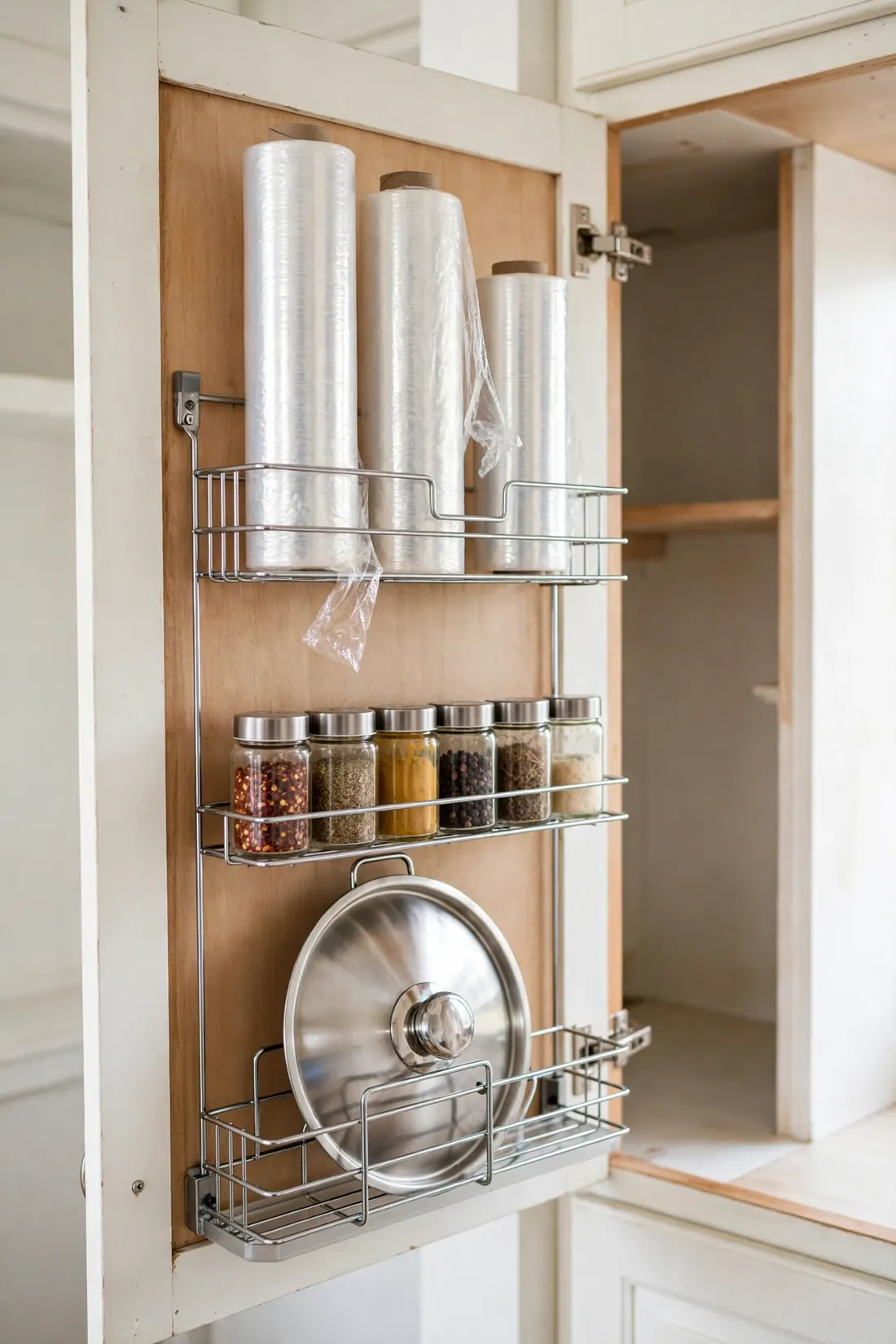
In these kitchen cabinet organization ideas, cabinet doors are free real estate with one strict rule: measure the clearance. A slim cabinet door organizer, whether a wire rack that hooks over the door or an adhesive-mounted one, turns the door back into a home for pot lids, plastic wrap, measuring spoons, and spice packets. Command-style adhesive strips are the renter’s best friend here because they hold real weight and come off clean. If you already have a pegboard on the kitchen wall holding utensils, leave it there. It does the same job for tools, but it doesn’t replace a door organizer for the small contained things that need their own spot.
Keep door storage light and flat. This isn’t the place for the cast iron lid or the full spice collection. Doors swing, and heavy items stress hinges over time. I limit door backs to things under a pound or two: lids, wraps, small jars, cleaning cloths. The test is simple. Load the rack, close the door, open it fast. If anything shifts, it’s too much. And skip door racks entirely on glass-front cabinets, unless you enjoy looking at the backs of your spice jars every time you walk into the kitchen.
How do you store baking sheets and cutting boards upright?
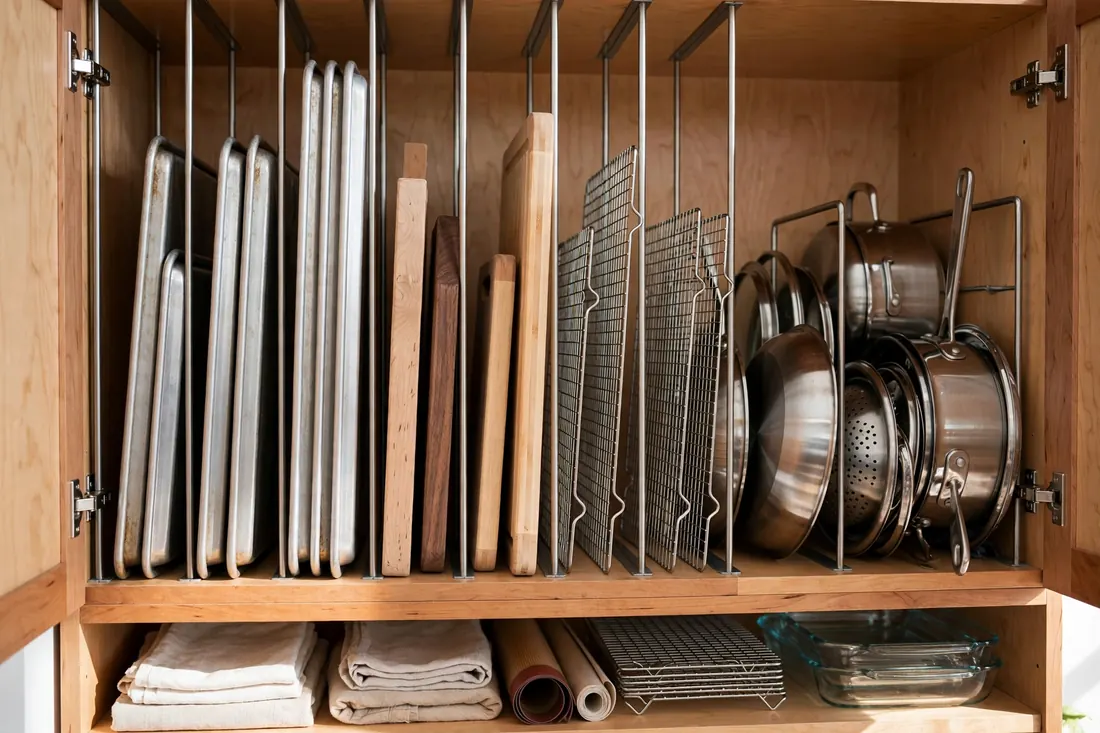
File them like records: one of the simplest kitchen cabinet organization ideas. Vertical dividers turn a collapsing stack into a tidy row where you can see every tray and grab the one you want without moving five others. Freestanding dividers drop into any cabinet, and a cheap tension rod wedged across a cabinet does the same job for a few dollars. Put the boards you use daily at the front of the row and the holiday platters at the back.
This is one of those fixes that feels too simple to matter until you live with it. Stacked baking sheets are loud, they scratch, and they punish you every time you need the one on the bottom. Filed upright, the same cabinet holds more and stays silent. If your dividers slide around, a strip of non-slip shelf liner underneath solves it.
How do you keep spices organized inside a cabinet?
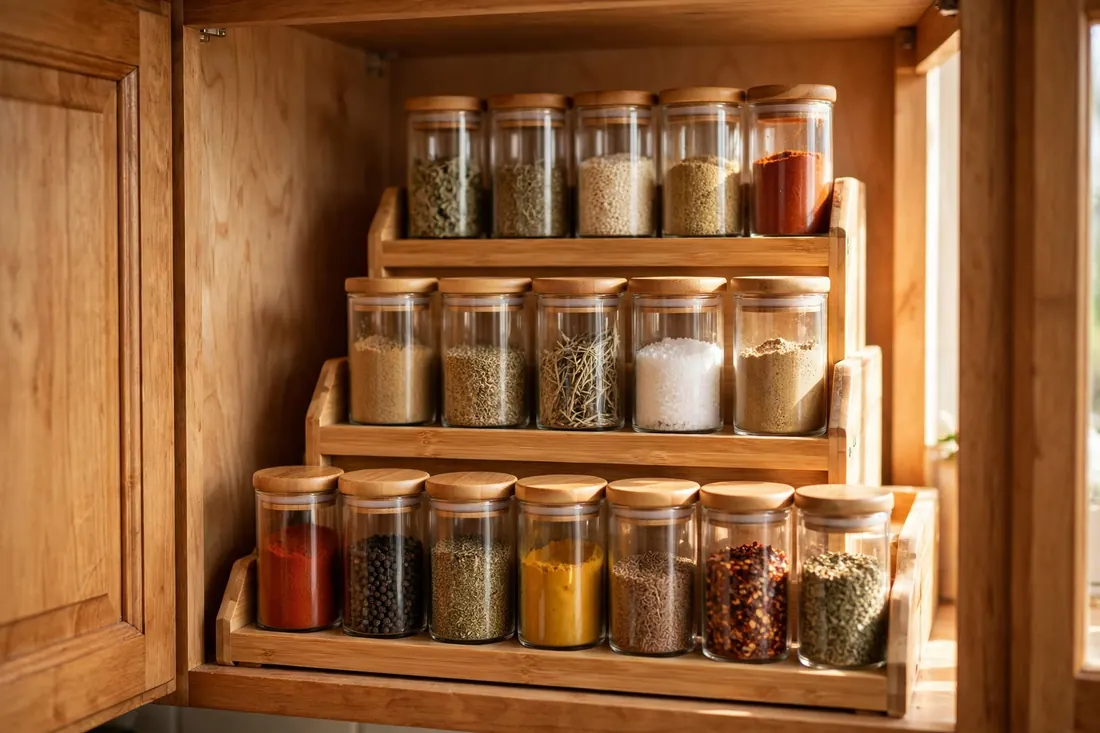
You need to see all of them at once, or you will keep buying paprika. That visibility rule anchors these kitchen cabinet organization ideas for the spice cabinet: a tiered stepped rack does this best inside a cabinet because each row sits higher than the one in front. Door-mounted spice racks work too if you checked the clearance rule above. Either way, keep the everyday six, salt, pepper, garlic powder, and whatever you actually cook with, at the front, and push the specialty jars behind them.
Should you decant spices into matching jars? My honest answer: only if you cook enough that speed matters. Decanting into airtight containers looks great and pours faster, but it’s a weekend project with ongoing refill work. If your spice collection is the 33% problem, a simple alphabetical row on a tiered rack beats a pretty decant you abandon by March. First in, first out (FIFO) applies here too: new jar goes behind the old one, always. And keep one small bin for the packets, gravy mixes and taco seasoning, because loose packets are what turn a tidy spice shelf back into a junk drawer.
Tiny kitchens need the full playbook: small kitchen storage ideas.
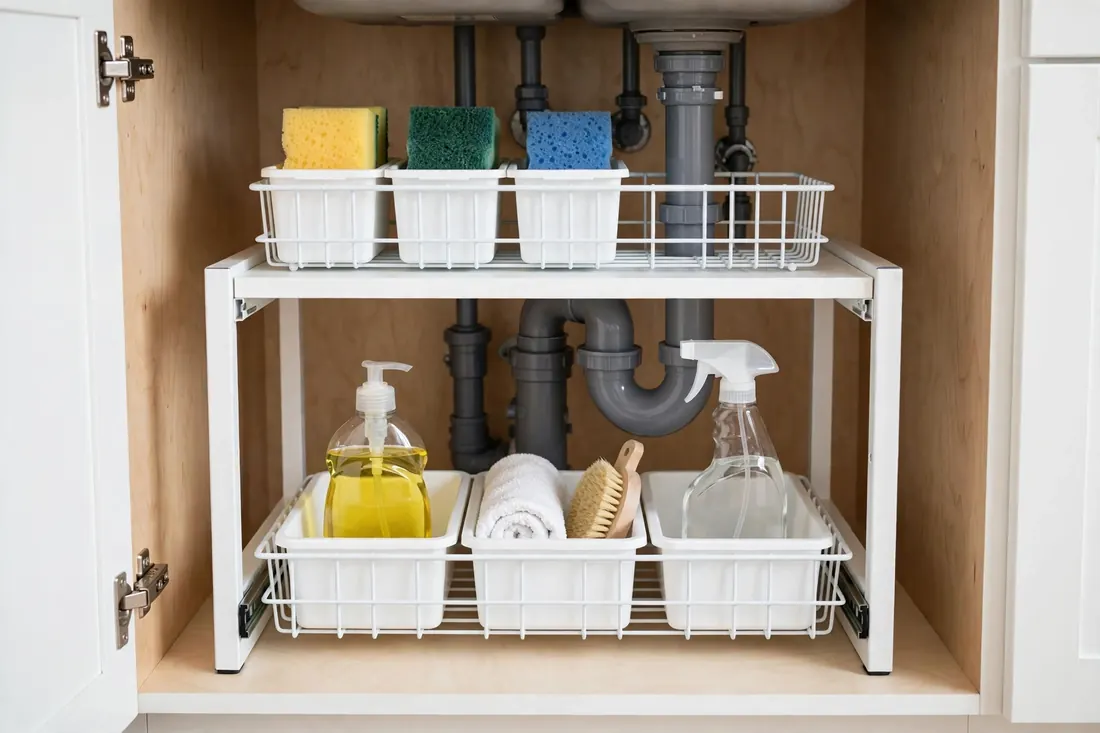
How do you organize the cabinet under the sink?
Work around the pipes instead of fighting them: that is the core of these kitchen cabinet organization ideas for the under-sink cabinet. A two-tier organizer made for under-sink cabinets straddles the drain pipes and gives you actual shelves where there used to be a dark pit. Small bins hold the categories: sponges and brushes in one, dishwasher pods in another, trash bags in a third. A door caddy takes the gloves and scrub brushes off the floor of the cabinet. Keep cleaning products upright and away from anything food-related.
The one rule that matters here: store less, not more, under the sink. This cabinet collects duplicate sprays and half-used bottles faster than anywhere else in the kitchen. If you have three open bottles of the same cleaner, finish one before the others earn shelf space. Lay a cheap plastic tray or shelf liner on the cabinet floor first, because this is the one cabinet where a slow leak hides behind your new organizer, and a tray turns a disaster into a wipe-down. Check under there every few months with a flashlight, not just when something smells wrong.
Should plates go in upper or lower cabinets?
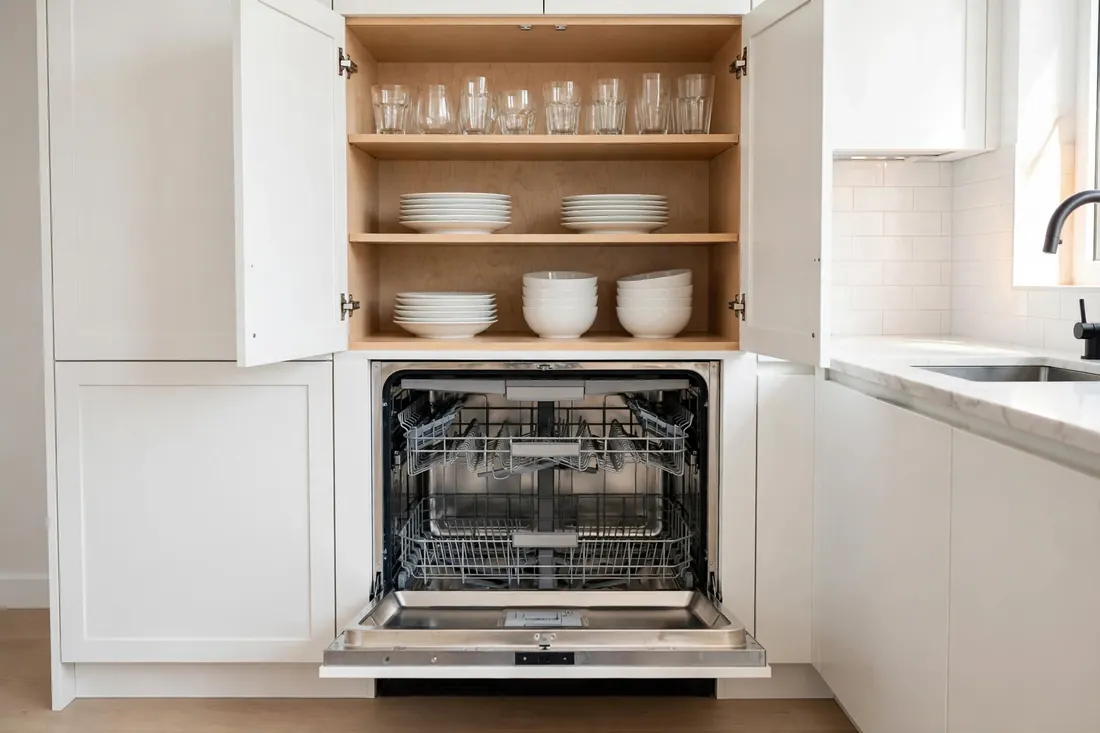
Daily plates go wherever the dishwasher is. It is the simplest of these kitchen cabinet organization ideas, and it costs nothing. If your dishwasher sits under the counter, the cabinet directly above it is the unloading zone: plates, bowls, and glasses live there and putting dishes away stops being a chore you avoid. This is the single best placement decision in the whole kitchen. Rarely used serving pieces and the good china go higher or further away, where reaching is a twice-a-year event.
The old rule said plates always go up high. Ignore it. Ergonomics beat tradition: heavy stacks of daily dishes are easier to lift from a lower cabinet or a drawer near the dishwasher than from over your head. If you have deep drawers, they are honestly better than cabinets for dishes. You see everything from above, nothing stacks more than two high, and unloading is one smooth motion.
What should you do when your cabinets are full but you still have stuff left?
Stop buying organizers and start removing things. The bluntest of these kitchen cabinet organization ideas: no product fixes a cabinet that holds twice what it should. The Reddit-tested rule is blunt: not everything you own needs to live in the kitchen. Holiday dishes, the bread maker you use at Thanksgiving, the backup blender, all of it can live in a hall closet, a garage shelf, or a high pantry shelf outside the cooking zone. Your kitchen cabinets are prime real estate. Tenants who don’t cook daily get evicted.
Rotate seasonally if space is tight. Summer’s iced-tea pitcher and popsicle molds don’t need January shelf space. Box the off-season items, label the box, and store it where you store holiday decorations. Donation runs deserve a permanent bag by the back door: the chipped mug, the duplicate whisk, and the gadget you haven’t touched in a year go in the bag the moment you notice them, not during some future grand purge. One honest pass usually frees 20 to 30 percent of a crowded cabinet, which is more space than any organizer on the market can create. The cheapest storage upgrade is always owning less in the room where you cook.
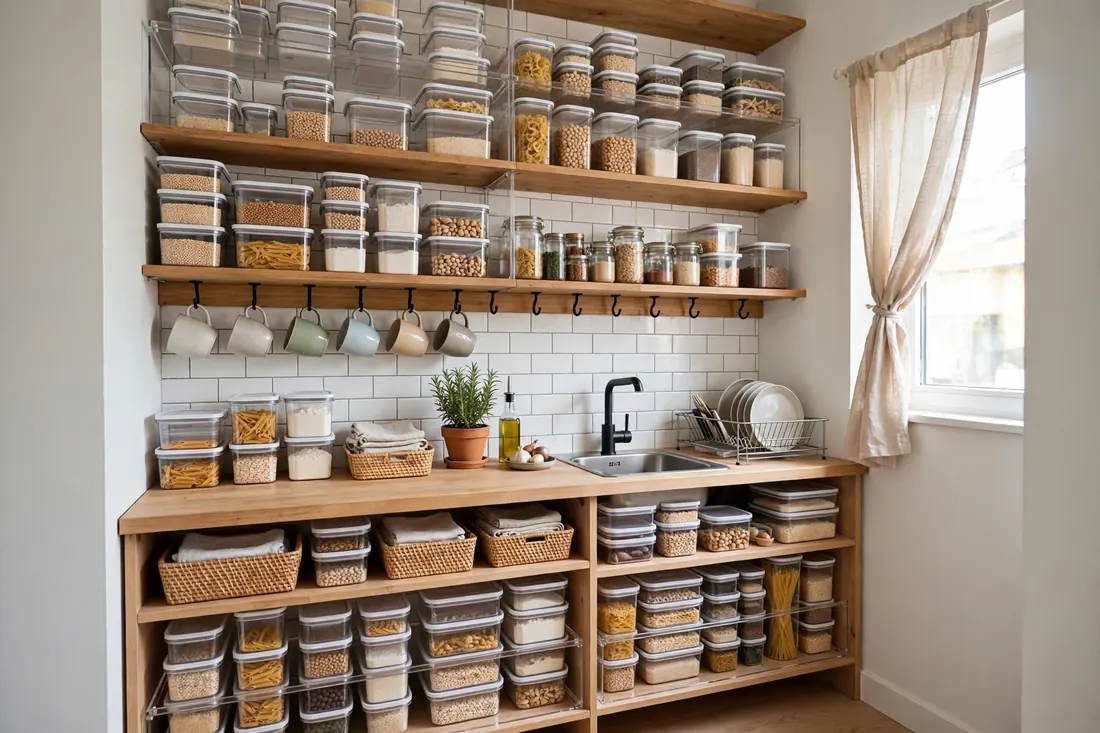
Once the cabinets are calm, keep the counters calm too with kitchen counter organization.
| Budget | What to do |
|---|---|
| Free | Empty, sort, zone by frequency, move rarely-used items out of the kitchen |
| Under $25 | Shelf risers, adhesive door hooks, a tension rod, a label maker |
| $25 to $75 | Lazy Susans, tiered spice racks, an under-sink two-tier organizer |
| $75 and up | Pull-out shelf kits, converting a lower cabinet to deep drawers |
How do you keep cabinets organized long-term?
Do a five-minute reset every week: the maintenance habit behind these kitchen cabinet organization ideas. Open each cabinet, put the three strays back where they belong, and toss the expired packet you keep ignoring. That is the whole maintenance program. Systems die when putting things away takes longer than leaving them out, so if a spot keeps collecting strays, the spot is wrong, not you. Move the item’s home to where you actually set it down.
Two more habits seal it. One in, one out: a new gadget means an old one leaves. And label the bins in any shared kitchen, because IKEA’s 2026 report found 38% of homes have someone who leaves things out expecting another person to deal with it. A label removes the argument about where the rice goes. Recheck your zones every few months, since routines change and the cabinet layout should change with them.
Which of these kitchen cabinet organization ideas should you start with?
If you buy one thing, buy shelf risers. They are cheap, need no tools, work in every cabinet, and the visual payoff is instant. If you give the project one weekend, do the full five-step system in order: empty one cabinet at a time, sort honestly, zone by frequency, add risers and one door rack, then set the weekly reset. Skip the pull-out shelves until you have lived with the system for a month; you may find the bins already solved the deep-cabinet problem.
The judgment call on these kitchen cabinet organization ideas is this: an organized cabinet isn’t a pretty cabinet. It is a cabinet where you can find the thing you need in ten seconds and put it back in five. Start with the cabinet that annoys you most, usually the pots or the under-sink pit, and let that one win carry you through the rest. Your future self, cooking dinner on a Tuesday, will feel the difference before the week is out.
How do I start organizing my kitchen cabinets?
Empty one cabinet at a time, sort everything into keep, donate, and toss piles, then group what is left by how often you use it. Decide your zones before buying any organizers, and measure every shelf before you shop so nothing comes home the wrong size.
What is the most efficient way to organize kitchen cabinets?
Zone by cooking task: cooking gear near the stove, prep tools near the counter, daily dishes near the dishwasher. Put daily items at eye level and in the front third of deep cabinets, and give every category a single home so nothing drifts.
How do I organize deep kitchen cabinets?
Use front-back frequency zones and never store loose items in the back third. Pull-out shelves are the best fix if the budget allows; long clear bins used as pull-out drawers are the renter-friendly version for under $15.
Should plates go in upper or lower cabinets?
Daily plates go in the cabinet nearest the dishwasher to make unloading fast, upper or lower. Heavy stacks are easier to lift from lower cabinets or deep drawers. Rarely used serving pieces can live on high shelves.
How do I keep my cabinets organized long-term?
Run a five-minute reset weekly, follow one-in-one-out for new gadgets, label bins in shared kitchens, and recheck your zones every few months as routines change. If a spot keeps collecting strays, move the item’s home instead of blaming yourself.
What shelf organizers work best for deep kitchen cabinets?
Pull-out or roll-out shelves for the full fix, long clear bins as the budget version, and lazy Susans for corner cabinets full of small bottles. Shelf risers help tall cabinets but don’t solve depth on their own.
Should I transfer food to containers or keep original packaging?
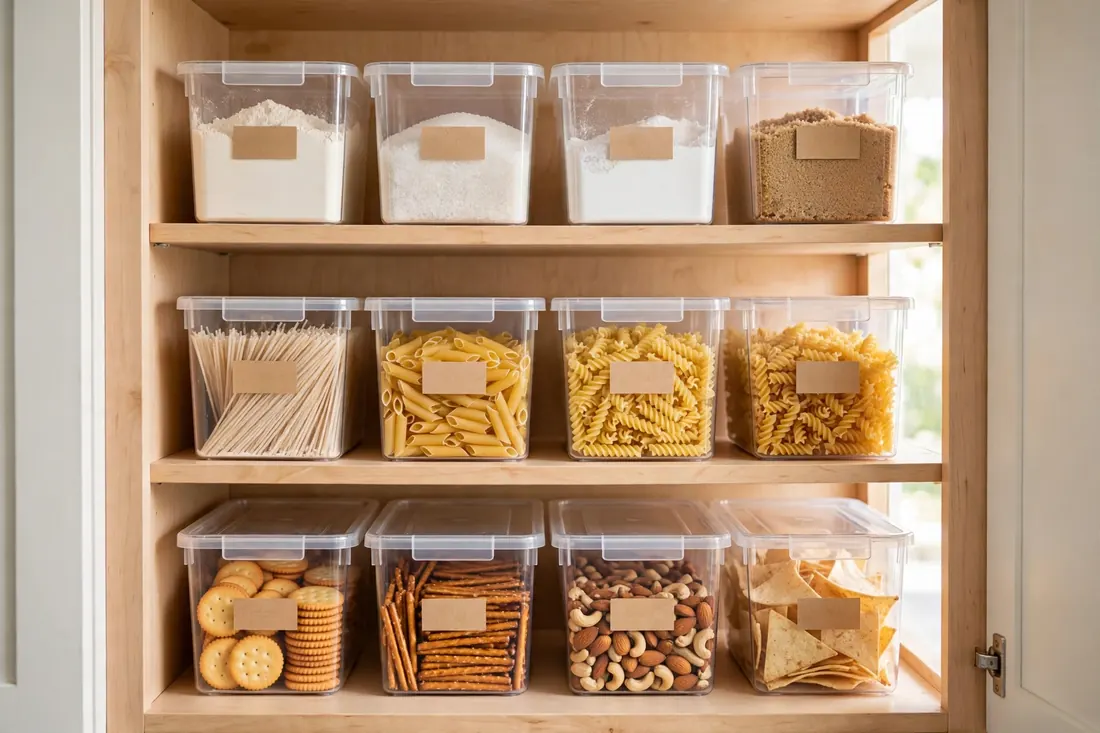
Both work. Transfer dry goods you use often, like rice, pasta, and flour, into clear containers so you can see what is left. Keep original packaging for items you use rarely, and always move older products to the front so they get used first.
How do you organize pots and lids in a small cabinet?
Store lids separately from pots, filed upright in a rack or on the inside of the cabinet door. Nest pots largest to smallest, keep heavy cast iron on low shelves, and put the weekly pots near the stove.
Can renters organize cabinets without drilling?
Yes. Shelf risers, freestanding dividers, tension rods, adhesive hooks, and over-door racks all need zero holes. Skip screw-in pull-out shelves and use long clear bins as pull-out drawers instead.
How often should I declutter my kitchen cabinets?
A quick reset weekly and a real declutter every three to four months. Pull the categories that drift fastest, usually food storage containers and gadgets, and recheck before the holidays when new items arrive.
For deep cabinets where things vanish at the back, see our guide on how to organize deep kitchen cabinets without losing things.
