
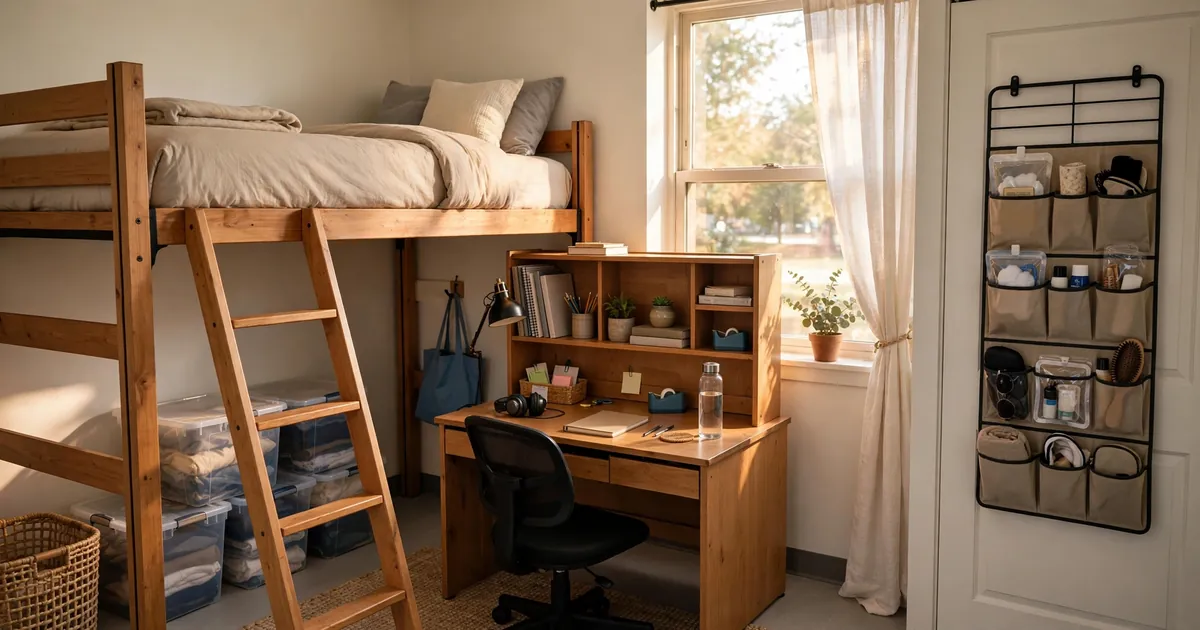

Yes, a 120-square-foot shared dorm room can hold a full semester of your stuff without turning into a laundry avalanche. The trick is treating dorm room storage organization ideas like an engineering problem instead of a shopping spree: check the housing rules first, claim the under-bed and vertical space, split the closet with your roommate on day one, and buy storage that collapses flat on move-out day.
Most US double dorm rooms run 120 to 200 square feet, according to the California Learning Resource Network, and the bed is almost always a twin XL at 38 by 80 inches, per the Community Literacy Center. Those two numbers decide everything you buy. This guide turns them into a five-zone system that survives the whole semester, with real measurements, real rules, and a budget for every wallet.
TL;DR
- Check your school’s housing rules before buying anything. Risers, candles, and some power strips are banned in more dorms than you think.
- Claim the two biggest free zones first: under the bed and the walls. Together they hold more than the closet.
- Split the closet with your roommate on move-in day with a tension rod divider, or you will be arguing about it in November.
- Buy collapsible, labeled storage that folds flat. Move-out day is the real test of every dorm room storage organization idea.
| Solution | Typical cost | Floor footprint | Install effort | Roommate-friendliness |
|---|---|---|---|---|
| Under-bed rolling bins | $15 to $40 | none, under bed | none | high, out of sight |
| Bed risers, set of 4 | $12 to $25 | none | 5 minutes | medium, check the rules first |
| Over-door organizer | $12 to $20 | none | hangs in seconds | high, one door per person |
| Command hooks and strips | $8 to $15 | none | minutes, no tools | high, damage-free |
| Hanging closet organizer | $10 to $18 | none | hangs on rod | medium, takes rod space |
| Slim hangers plus tension rod | $15 to $25 | none | minutes | high, splits the closet |
| Slim rolling cart | $25 to $40 | about 1 sq ft | none | high, rolls out of the way |
| Storage ottoman | $30 to $60 | about 2 sq ft | none | medium, doubles as a seat |
| Desk hutch | $30 to $50 | none, sits on desk | 15 minutes | high, personal zone |
| Shower caddy | $8 to $15 | none, carried | none | high, keeps bathroom stuff separate |
What does a dorm room actually give you to work with?
A standard US double gives you 120 to 200 square feet split between two people, a twin XL bed at 38 by 80 inches, a small closet or wardrobe, a desk, and a dresser. That is the entire inventory. Singles run 80 to 130 square feet. Everything you buy has to fit inside these numbers, so measure first and shop second.
I would sketch the room on paper before spending a dollar. Draw five zones: under the bed, the walls and doors, the closet, the desk, and the corners around the mini fridge. Small dorm room organization gets easy once you see that the bed and walls are the two biggest zones, and both are free.
Two realities to accept early. The walls are usually painted cinder block, which kills most adhesives unless you prep the surface. And the furniture belongs to the school, so you cannot drill into it or swap it out. Work with what is bolted down. The dorm room storage organization ideas in this guide are built for exactly these constraints.
If your school lofts beds by default, skip the bed-riser research entirely. You already have the best version of under-bed storage, and risers would be money spent on a problem you do not have.
What should you check before buying any storage?
Read your school’s housing handbook and the prohibited-items list before you buy a single bin. The most common bans are candles (even unlit ones), halogen lamps, and bed risers, and some schools restrict power strips to surge-protected models only. Ask your RA about wall mounting. Five minutes of reading beats a move-in-day confiscation.
The fire rules are stricter than most freshmen expect. Ohio University prohibits candles, even unlit or decorative ones, and halogen lamps in residence halls, and bans hanging anything from sprinkler heads (see their fire safety rules). Washington University’s prohibited items list covers the same ground. These are not suggestions; RAs do room checks.
Bed risers deserve their own warning. Seton Hall prohibits them outright in residence halls and requires a 36-inch clear path of egress, per the school’s fire safety policies. Other schools allow them but cap the lift height. If your handbook is silent, email housing with a photo of the exact risers. A “nobody will notice” riser becomes a fine at move-out inspection.
My rule: anything that plugs in, lifts the bed, or sticks to a wall gets a yes from the RA first. The email takes two minutes. The fine does not.
How do you split storage fairly with a roommate?
Divide the room into zones on move-in day, not in October. Each person gets half the closet, one wall, and their own under-bed space, and shared items get one shared bin. Write the split down somewhere you will both see it. A tension rod hung 12 to 18 inches below the main closet rod doubles hanging space and gives each of you a clear side.
The closet is where most roommate fights start, so settle it first with a tape measure and the rod. Then agree on the shared stuff: one bin for cleaning supplies, one shelf for shared snacks, and a rule that borrowing means asking. Among all dorm room storage organization ideas, the written agreement is the one with the highest return.
Give the doorway a job too. A narrow mat plus a couple of hooks by the door becomes the drop zone for keys, bags, and shoes, which keeps the rest of the room livable. Our entryway storage ideas for small spaces has more drop-zone tricks that scale down to a dorm doorway.
The ten-minute talk feels awkward. The nine-month friendship is worth it.
What goes under a lofted or raised bed?

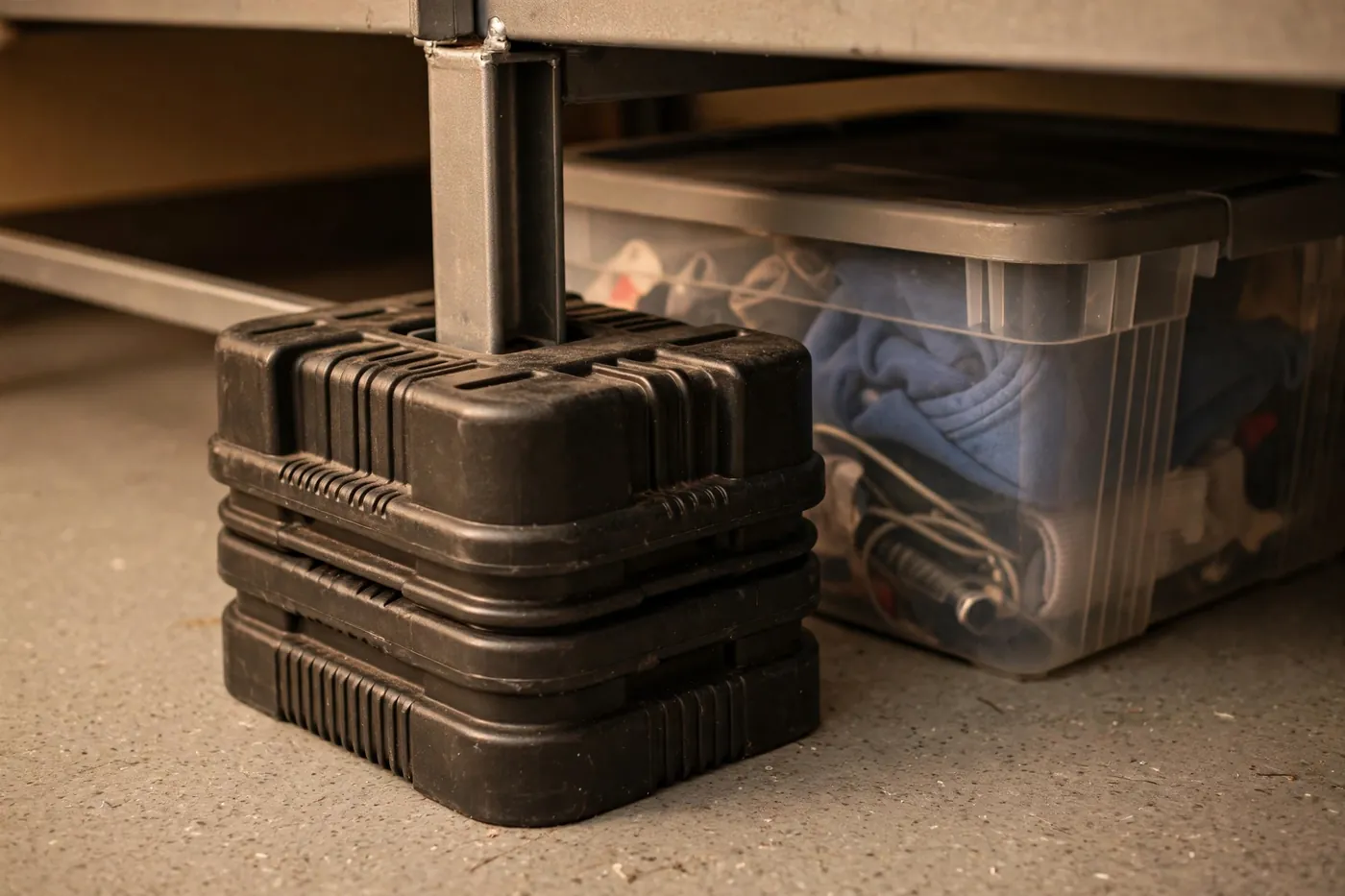
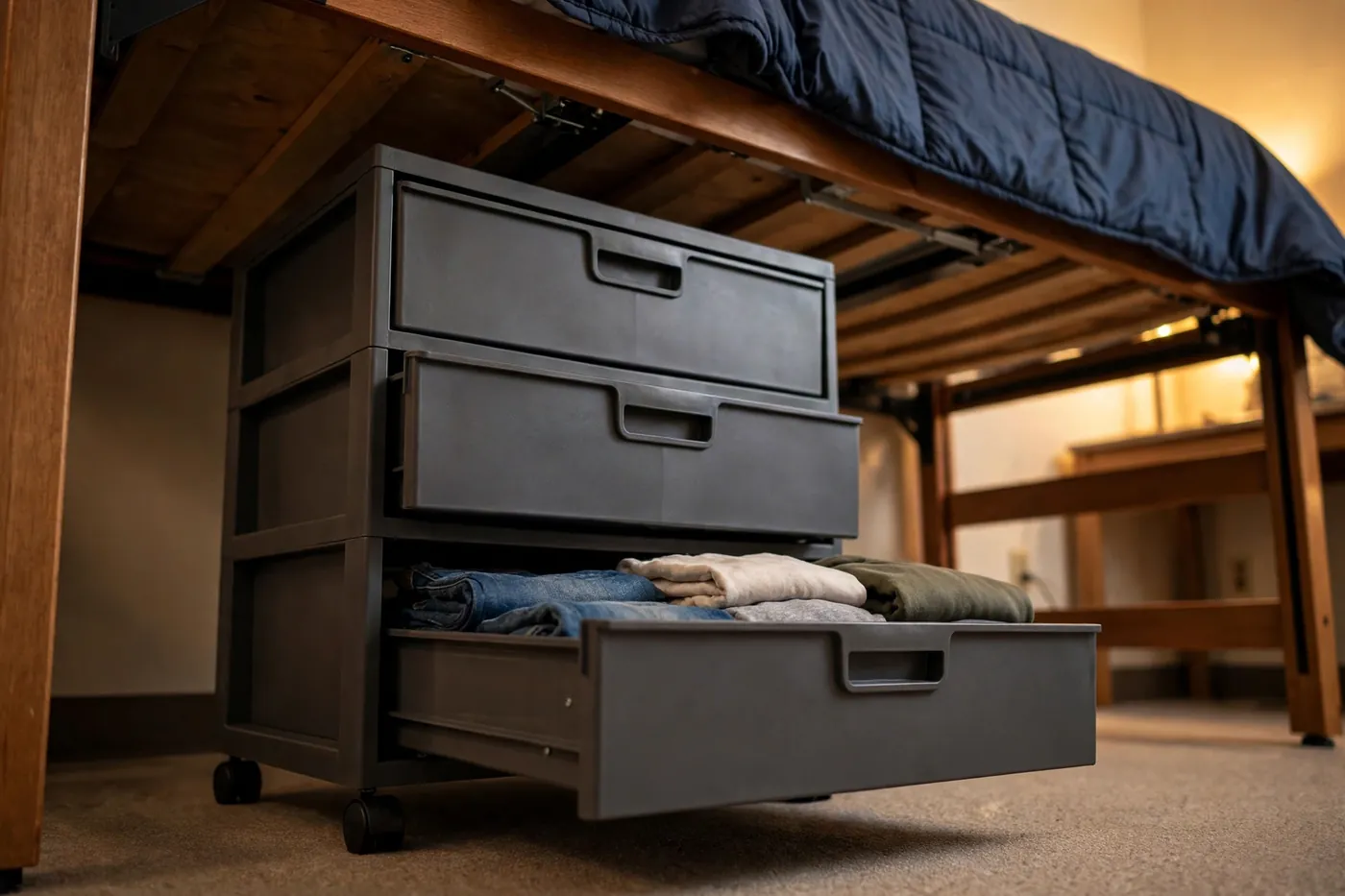
Under-bed space is the biggest storage zone in most dorm rooms, and it is free. Rolling bins, flat drawers, and vacuum-seal bags for off-season clothes all slide underneath. A standard set of bed risers adds 6 to 8 inches of clearance, while a lofted bed gives you 30-plus inches, enough for a dresser or even a desk underneath.
Measure the clearance before you buy a single bin. Too many students order 12-inch bins for an 8-inch gap. Rolling bins beat lidded totes here because you can pull them out with one hand while holding your phone in the other. A simple bed skirt hides the whole operation when parents visit. These dorm room storage organization ideas hide in plain sight, which is the point.
This zone swallows shoes, snacks, textbooks, extra bedding, and the laundry hamper. Keep daily items near the front and seasonal stuff in the back. For the full system, our under-bed storage ideas guide covers bins, drawers, and risers sized for real beds.
I would take a lofted bed over risers every time if the school gives you the choice. And risers are not for every dorm: some schools ban them, and cheap risers crack under a mattress plus a human, so check the weight rating printed on the box. Under bed dorm storage only works when the bed stays up all semester.
How do you make a tiny dorm closet hold a semester of clothes?
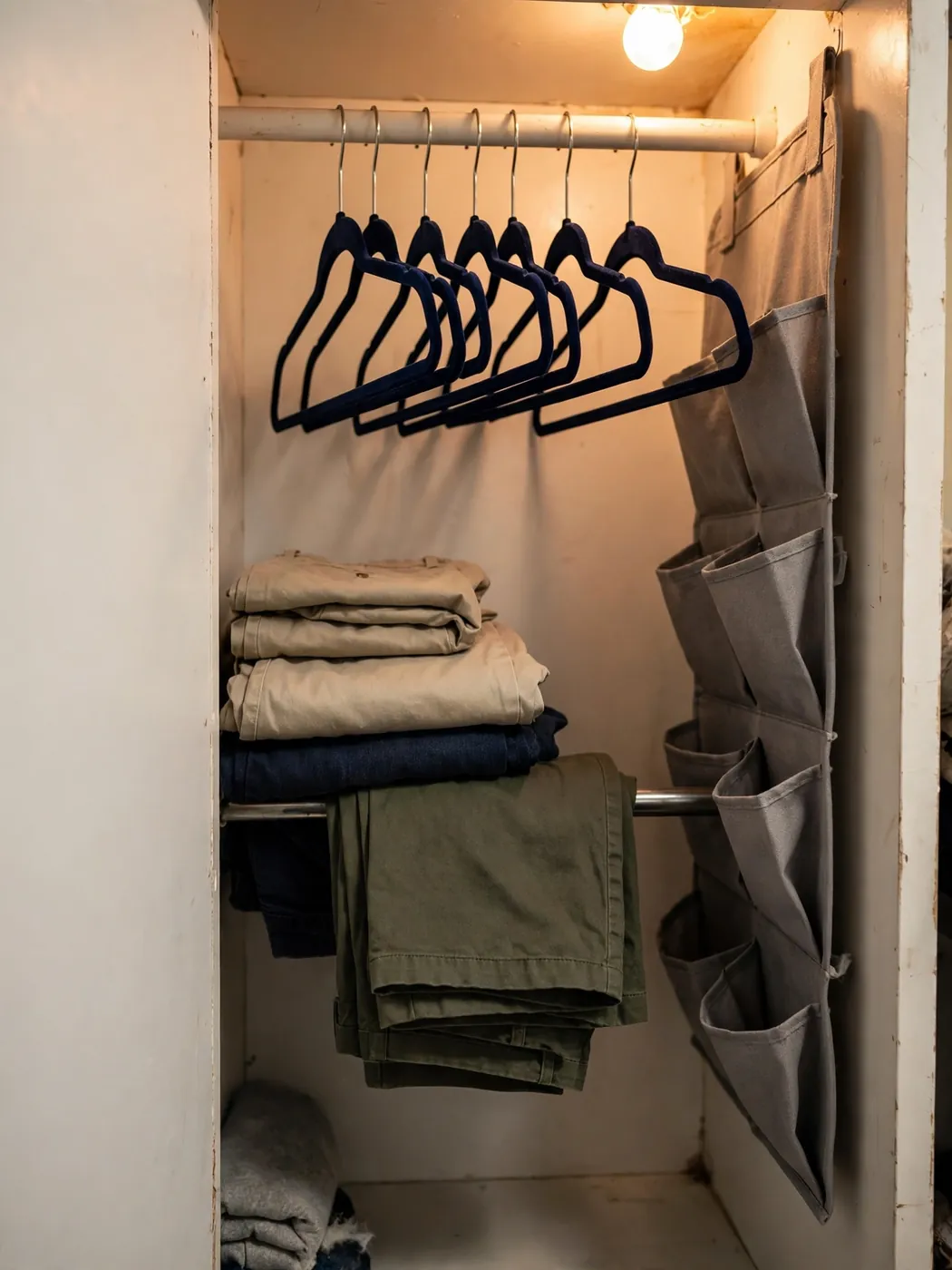
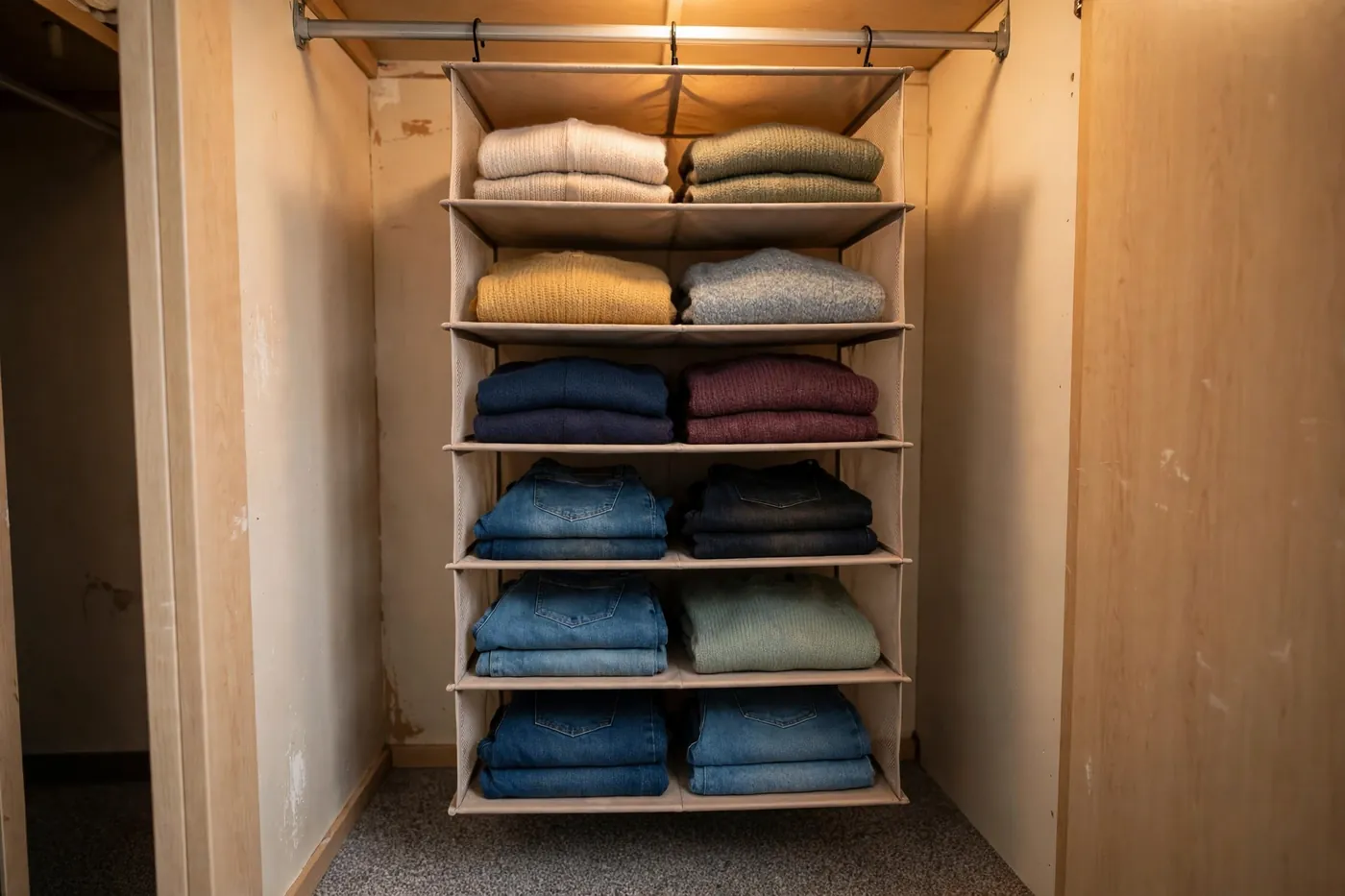
Shrink everything in the closet. Swap bulky plastic hangers for slim velvet hangers, hang a second tension rod 12 to 18 inches below the main rod for double-hanging, and use a fabric hanging organizer for folded items. File-fold shirts and jeans so you can see every item from the top, and move off-season clothes into vacuum-seal bags under the bed.
The second rod is the cheapest square footage you will ever buy. Tops go on the upper rod, pants and skirts on the lower one. A six-shelf hanging organizer takes the rod space of about four hangers and holds sweaters, jeans, and gym clothes that would otherwise eat drawer space. Shoes line the closet floor in a single row, or move to an over-door pocket organizer.
Dorm closet organization is mostly subtraction. If you have not worn it by fall break, it goes home at Thanksgiving. Two weeks of real outfits beats a closet full of maybes.
Pair this system with our small closet organization ideas for the folding methods, and our best closet organizers for small closets if you want product picks that fit dorm closets.
How do you hang things on the walls when drilling is banned?
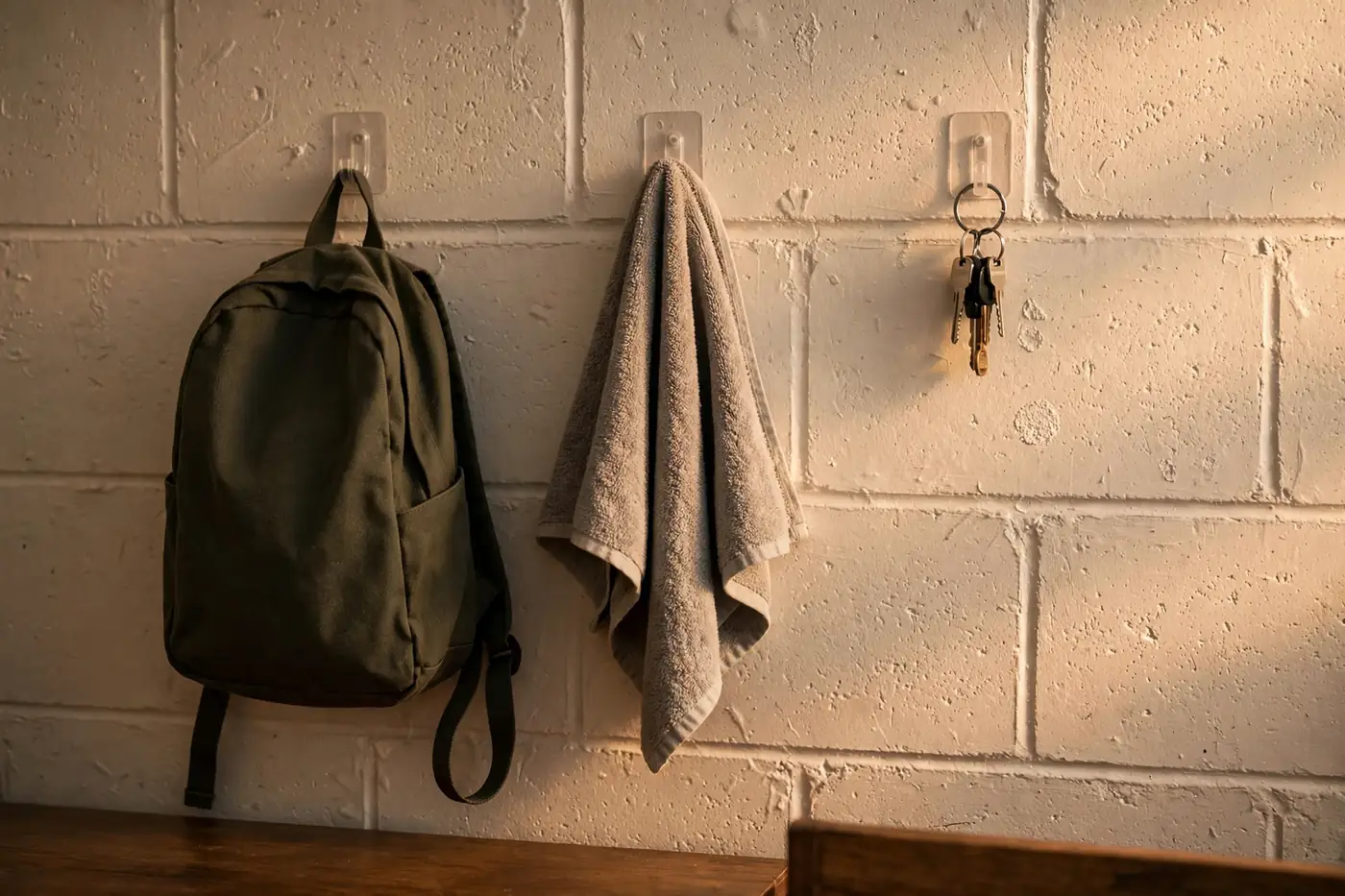
Use removable adhesive hooks and strips rated for the actual weight, and prep the surface first. Per 3M’s specifications, large picture-hanging strips hold up to 16 pounds per set of four pairs, but 3M specifically cautions against hanging items over beds (product specs). On painted cinder block, wipe the spot with rubbing alcohol, stick the strip, and wait an hour before hanging anything.
Western Michigan University’s official housing bring list recommends exactly this approach: sticky putty or 3M Command strips and hooks, plus stackable storage boxes. When a school’s own checklist names the product, you know it passes inspection.
Spread the load. Six hooks holding 3 pounds each will outlast one hook holding 16, and a failed hook at 2 a.m. is how textbooks meet tile floors. Over-door organizers take the heavy stuff (towels, jackets, the full-length mirror) because the door frame carries the weight, not adhesive.
Adhesive strips are not for textured, dirty, or freshly painted walls. They fail there, usually in week three. The best dorm room storage organization ideas for rentals all share one trait: they remove cleanly. And never hang anything from a sprinkler head or pipe; that is a fire-code violation, not a gray area.
How do you keep a dorm desk usable for studying?
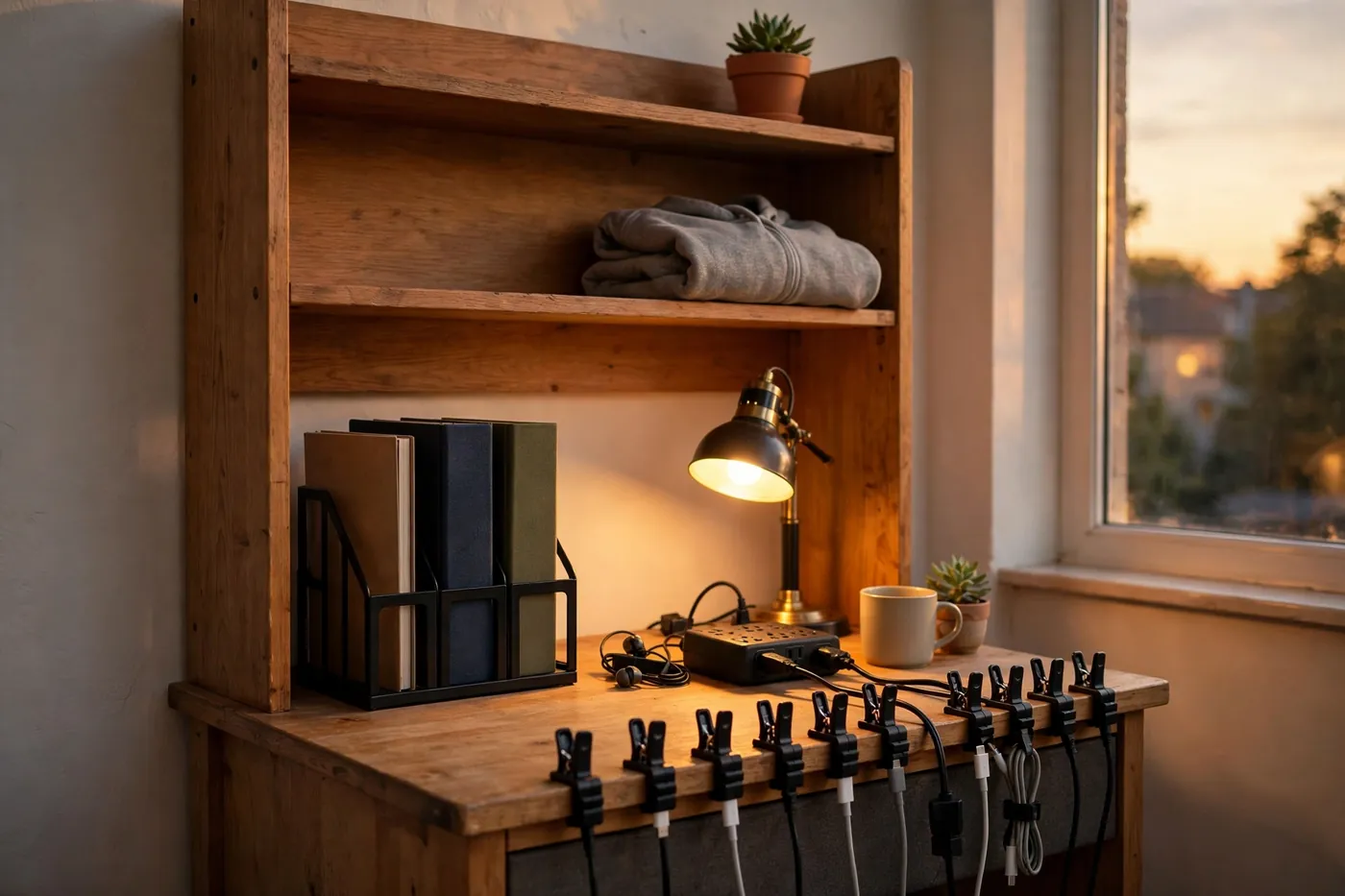
Give everything on the desk a vertical home. A desk hutch or riser shelf doubles the surface, a vertical file organizer holds notebooks upright, and drawer dividers stop the supply drawer from turning into a junk drawer. Run all chargers through one surge-protected power strip clipped to the desk leg so cables stop breeding.
The desk has three jobs: study surface, reference shelf, charging station. Keep them separate. The hutch holds the reference shelf. A small tray on the desk holds the day’s items. Everything else lives somewhere with a door or a lid.
If the desk drawers are shallow, a bedside caddy that hangs off the bunk rail takes the phone, glasses, and water bottle at night. Our nightstand organization ideas has caddy setups that work the same way in a dorm.
Here is my opinion, plainly: the desk is a work tool, not a storage unit. If it cannot hold an open laptop and a notebook at the same time, something sitting on it has to move somewhere else. That discipline is what makes dorm room storage organization ideas actually stick.
Where does everything else live?
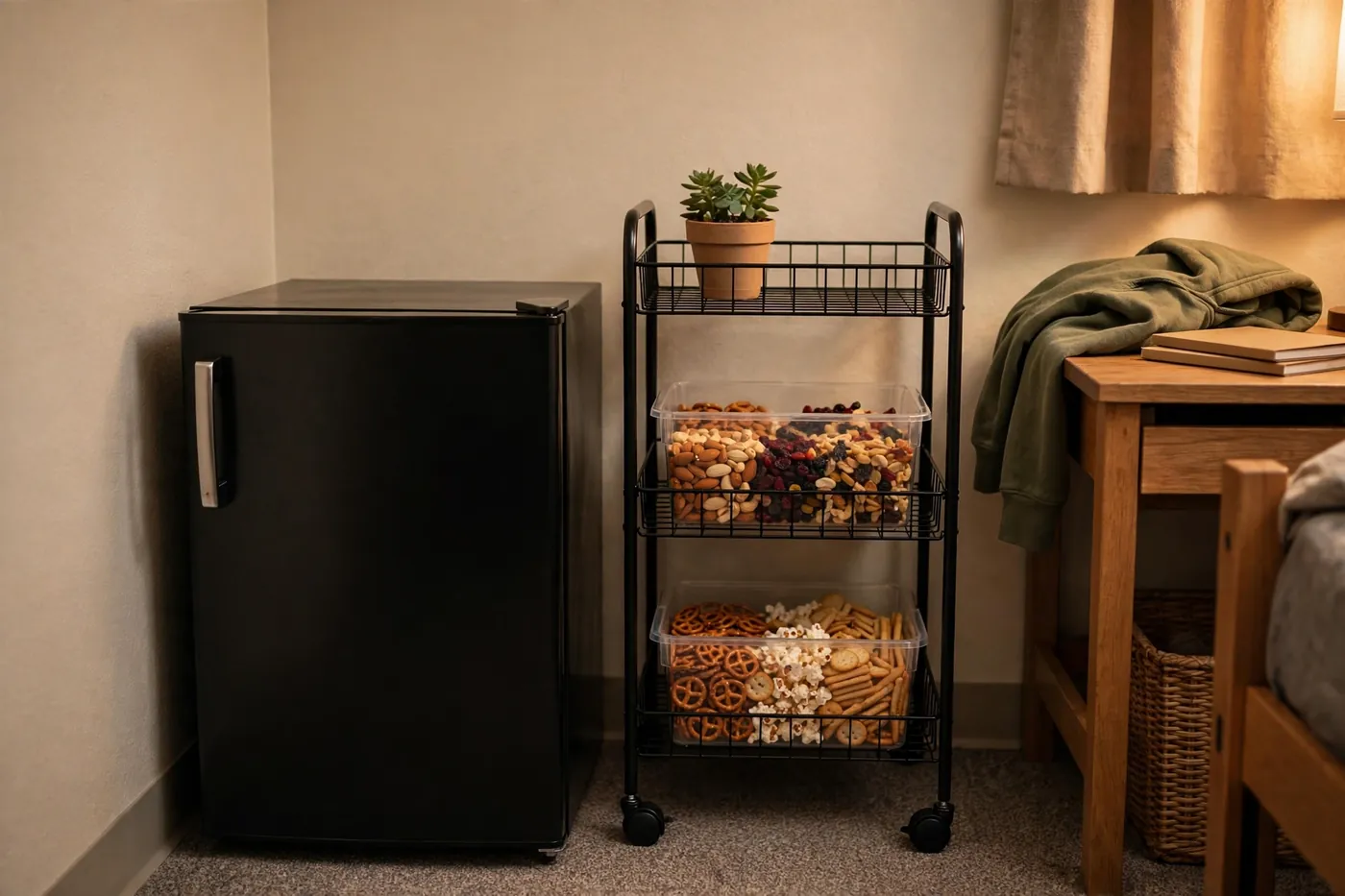
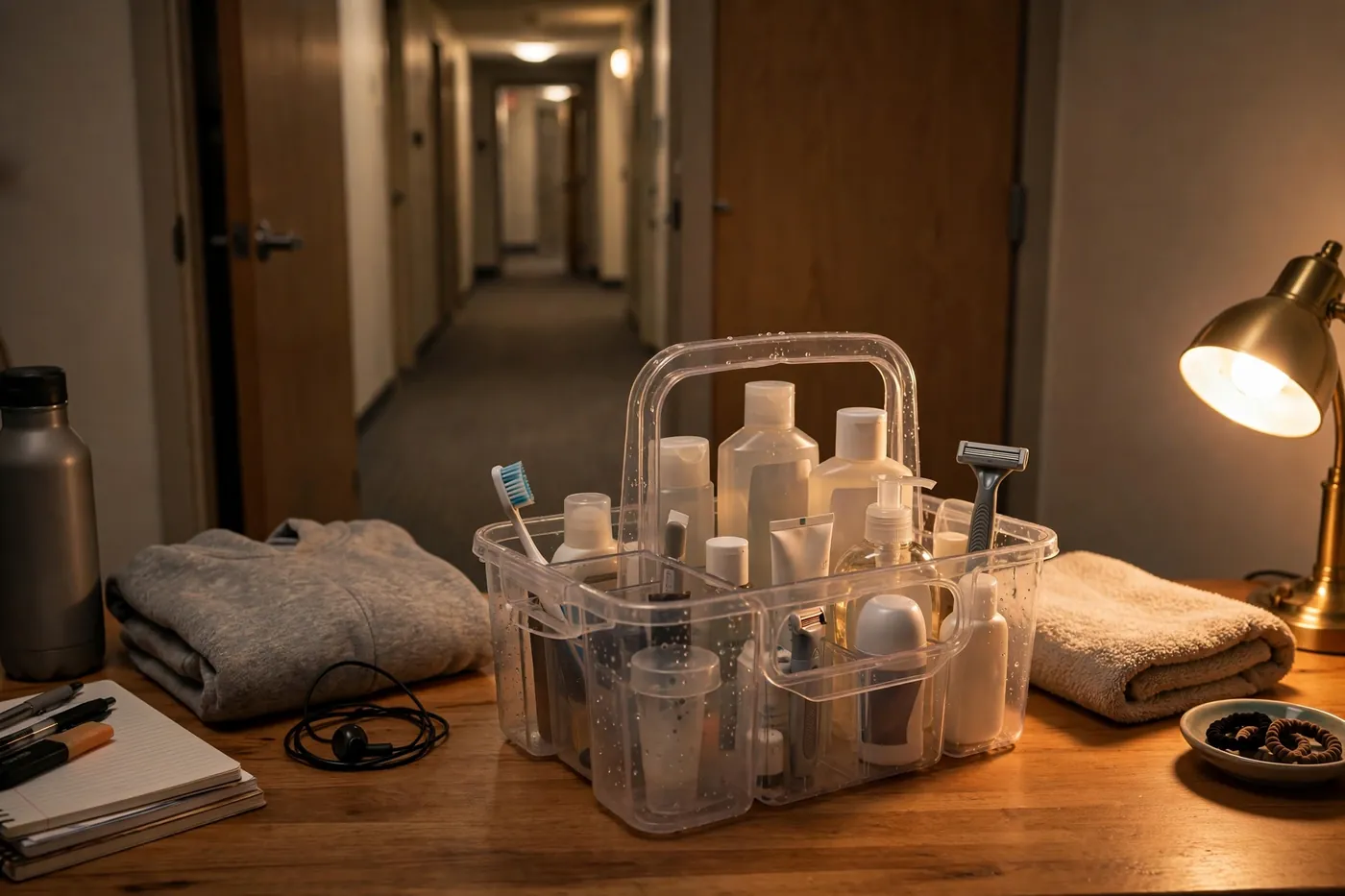
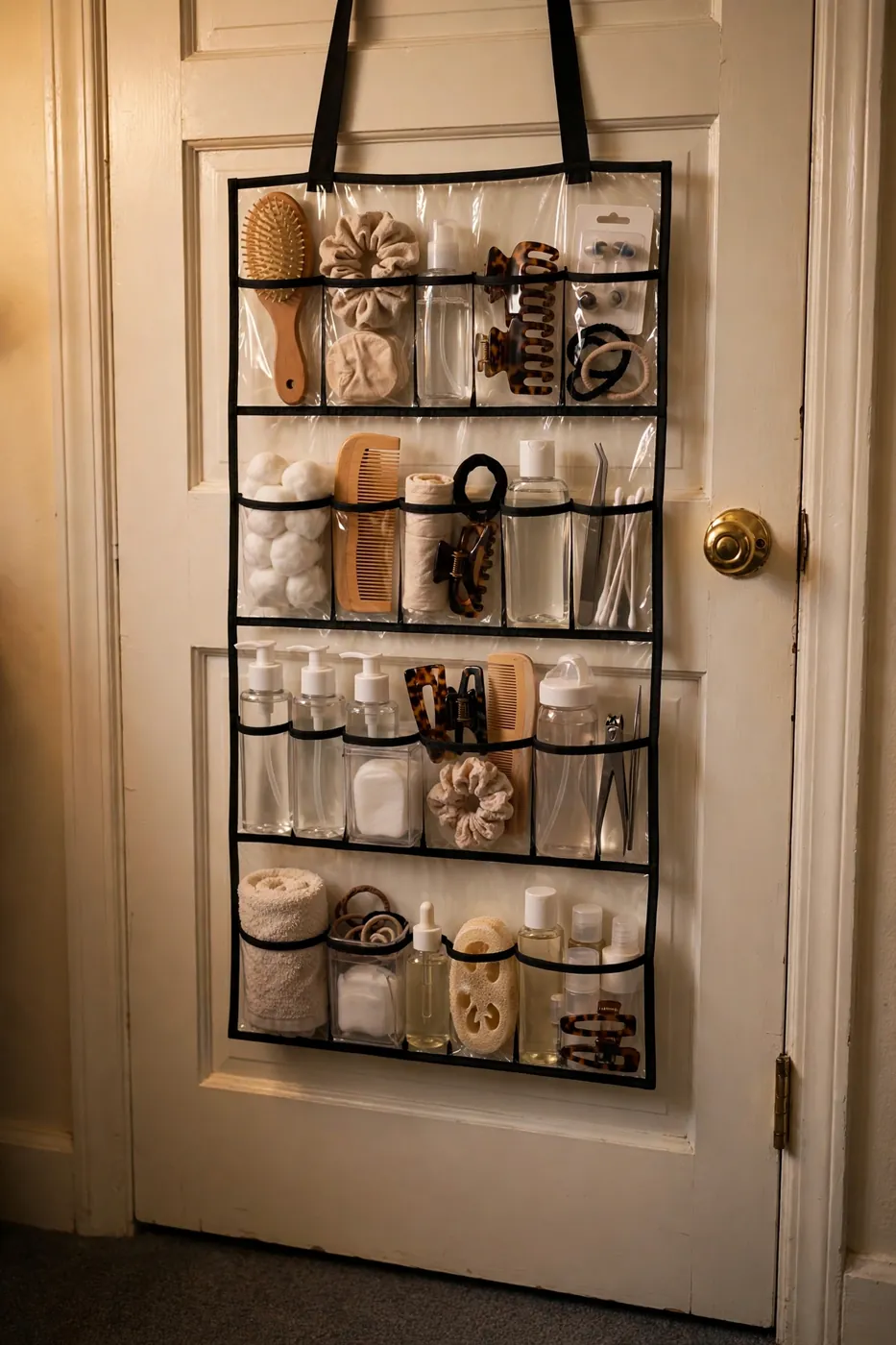
Doors, corners, and the mini-fridge zone absorb whatever the big zones cannot. An over-door shoe organizer with clear pockets holds toiletries, snacks, chargers, and school supplies. Shoes are optional. A slim rolling cart next to the mini fridge becomes a snack and coffee station. A corner shelf takes the items that need a home but not a drawer.
The over-door organizer is the most underrated square footage in a dorm, and I would buy two before I bought anything decorative. One goes on the closet door for accessories and toiletries, one on the bathroom-side door for the shower caddy and towels. For bins that fit these spots, our best storage baskets roundup has sizes that work in tight footprints.
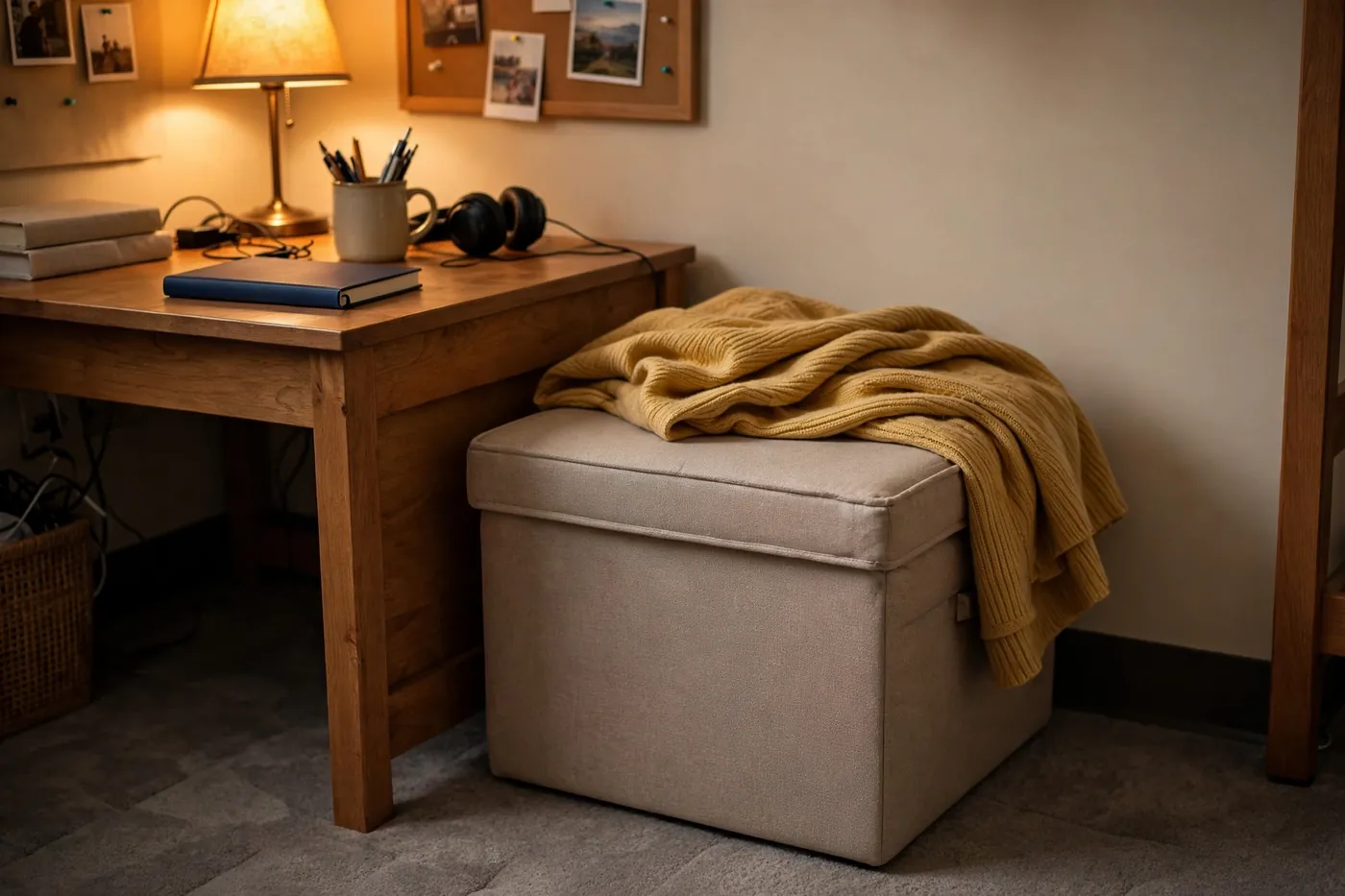
A storage ottoman earns its floor space by doing two jobs: seating for a guest and a lid that hides blankets or board games. Skip it if you are tall enough to need a real chair for studying, or if your room already has two desk chairs eating the floor.
The shower caddy is non-negotiable in a hall-bathroom dorm. Everything you need for the shower lives in one portable tote, so you are never the person dripping down the hallway looking for shampoo. It is one of the simplest dorm room storage organization ideas here, and the cheapest.
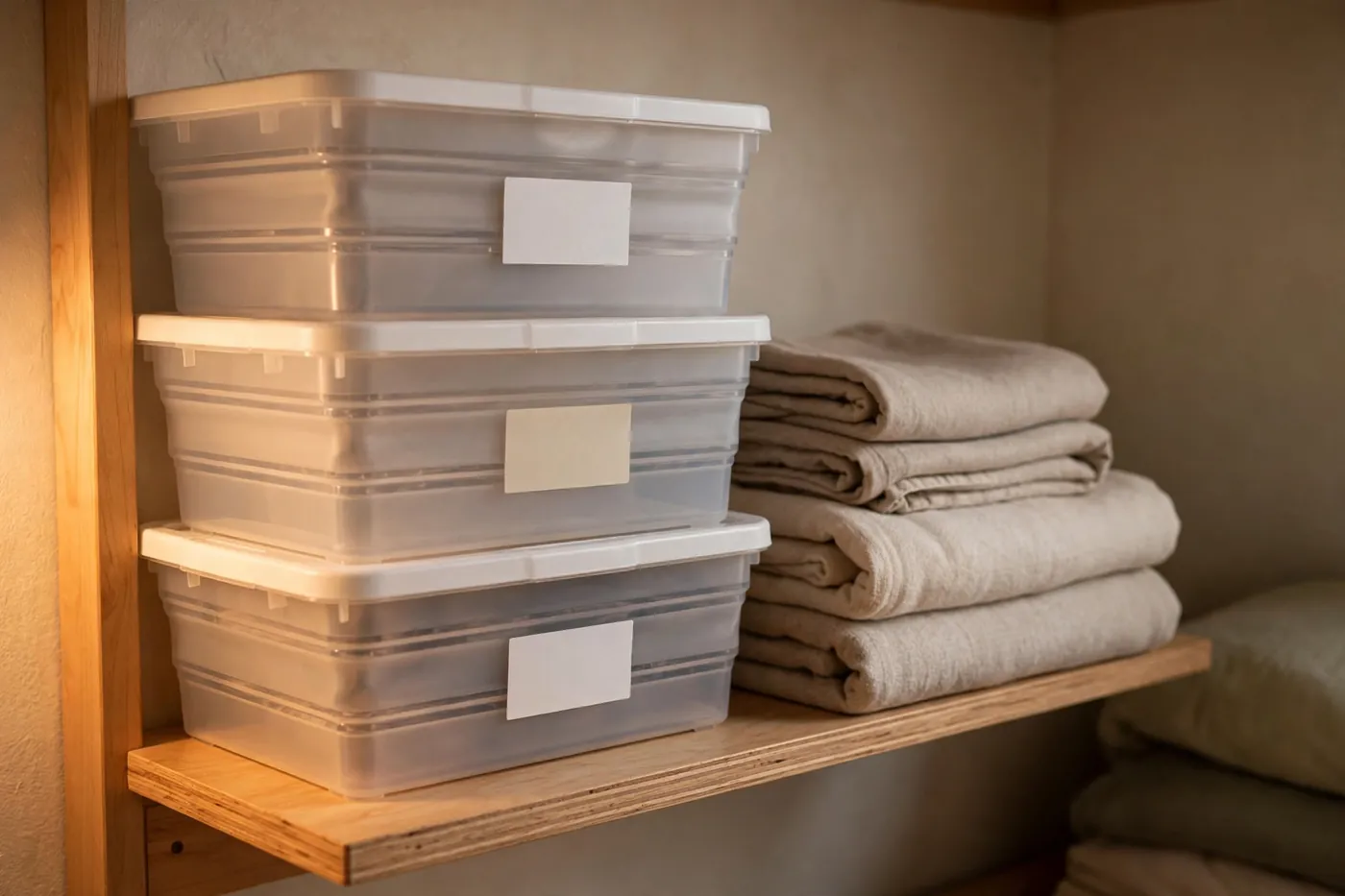
What dorm room storage organization ideas survive move-in and move-out in one piece?
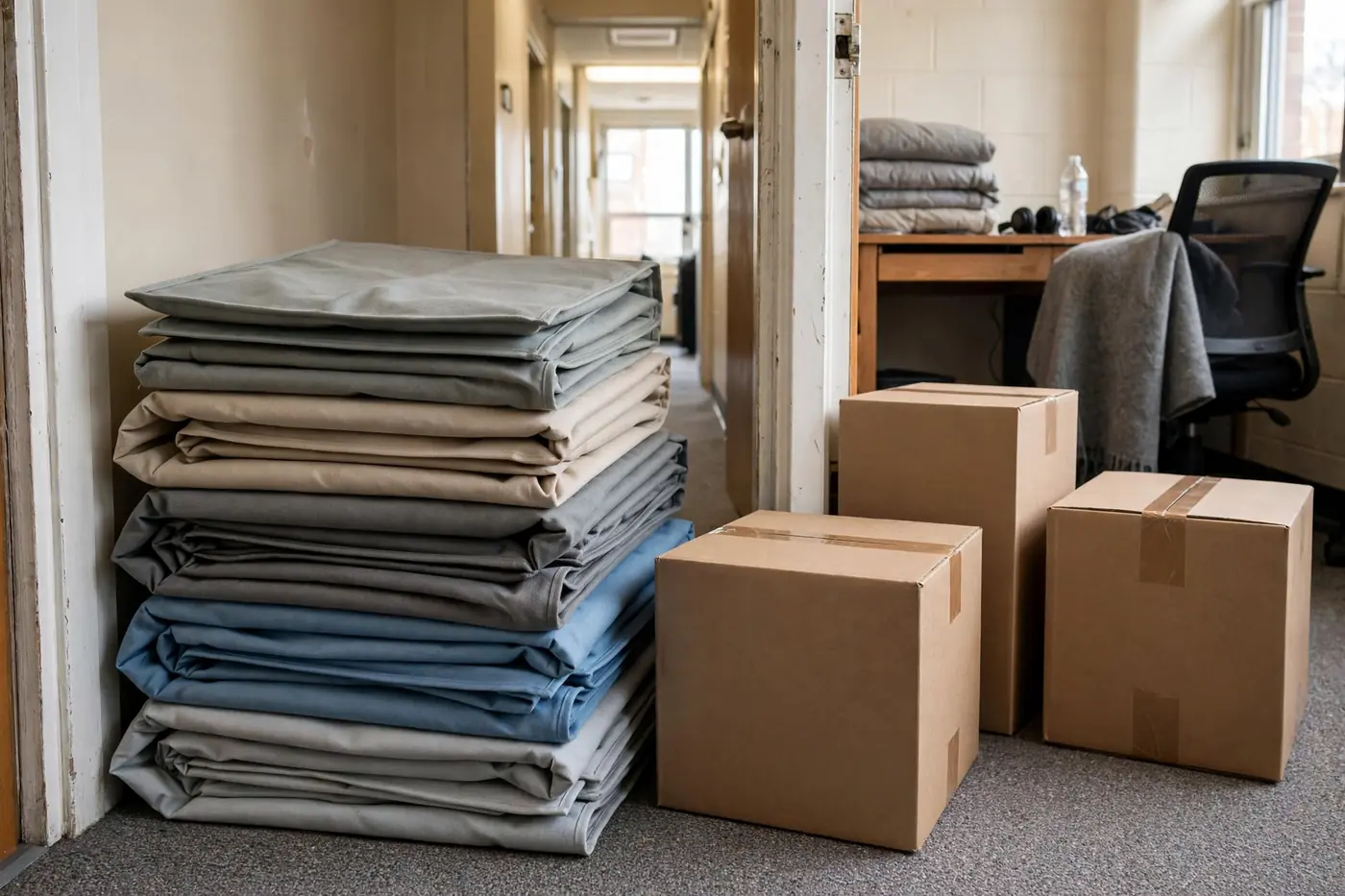
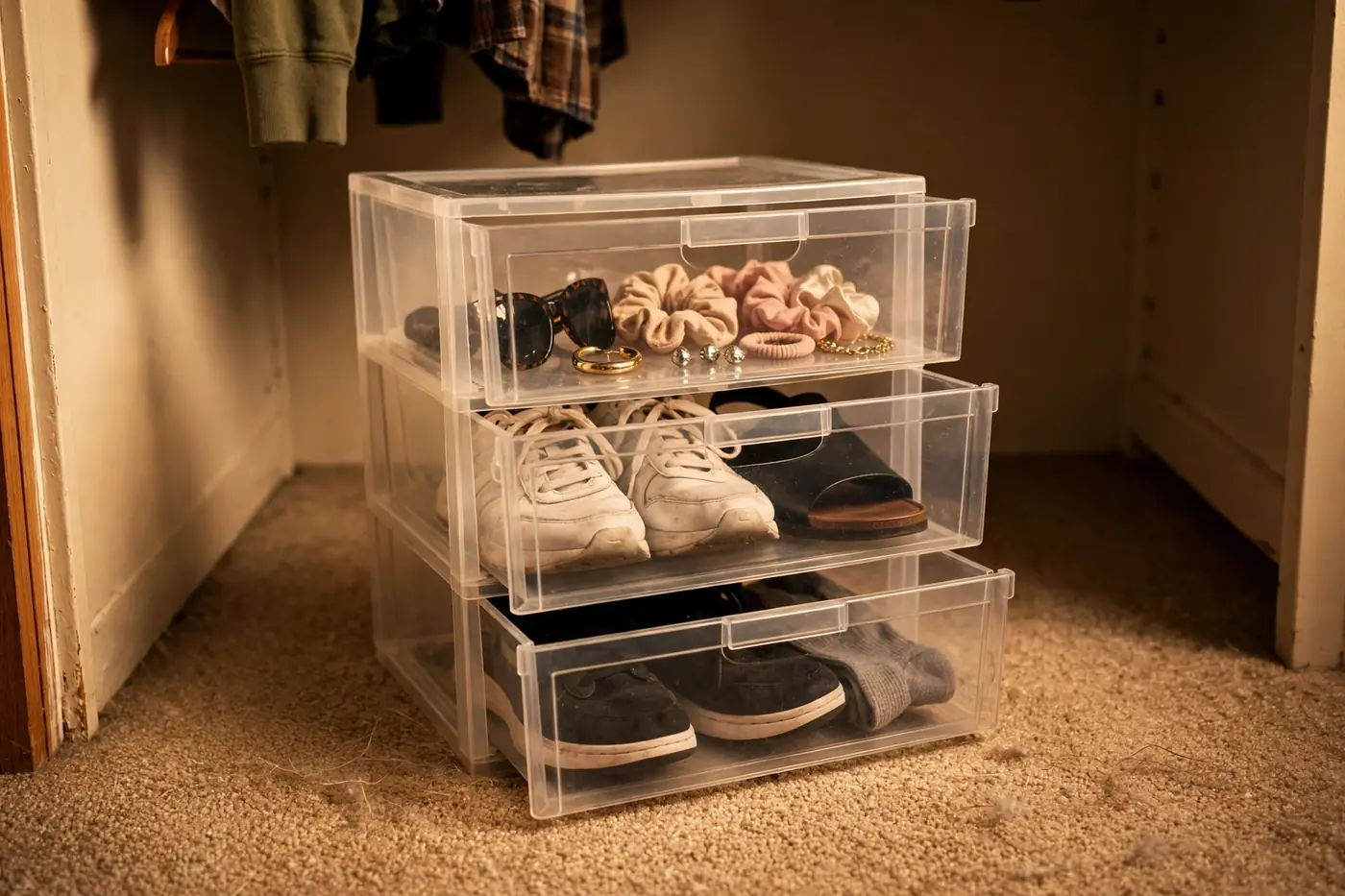
The storage that survives is collapsible, stackable, and labeled. Fabric cubes fold flat for the ride home, stackable drawers nest inside each other, and labeled bins mean you unpack in an afternoon instead of a week. What breaks: flimsy plastic drawers with thin frames, anything with tiny plastic wheels, and overstuffed hanging organizers that tear at the seams by March.
Think of it as pack-now-equals-pack-later. Every bin you buy in August is a bin you carry in May, so buy the version that folds, nests, or stacks. A cheap label maker, or even masking tape and a marker, pays for itself the first time you need winter clothes without opening six bins. Our dresser organization ideas guide has the file-folding method that keeps folded clothes neat through the move.
I would pay more for collapsible than for pretty. Pretty does not survive the elevator on move-out day, and nobody photographs the bins anyway.
| Zone | Must-have | Nice-to-have | Leave at home |
|---|---|---|---|
| Under bed | rolling bins, vacuum-seal bags | bed risers (if allowed) | full-size luggage |
| Closet | slim hangers, tension rod | hanging organizer | more than 2 weeks of clothes |
| Walls and door | Command hooks, over-door organizer | pegboard | nails, screws, wall anchors |
| Desk | hutch, file organizer | monitor riser | desktop printer |
| Shared | shower caddy, laundry hamper | label maker | bulk cleaning supplies |
How much should dorm storage cost?
A working system costs about $50 to $150 for most students. Under $50 covers the starter kit: adhesive hooks, an over-door organizer, and a set of bins. The $150-plus build-out adds a rolling cart, a desk hutch, and nicer stackable drawers. Past $200 you are buying furniture, and dorm furniture should be the school’s, not yours.
| Tier | What you buy | Rough cost |
|---|---|---|
| Starter | Command hooks and strips, over-door organizer, 2 under-bed bins, slim hangers | Under $50 |
| Full system | Starter kit plus rolling cart, desk hutch, hanging closet organizer, shower caddy | $50 to $150 |
| Build-out | Full system plus storage ottoman, stackable drawers, label maker, bed risers (if allowed) | $150 to $250 |
If under-bed storage is doing the heavy lifting in your plan, our under-bed storage ideas guide goes deeper on bins, drawers, and risers sized for real dorm beds.
Buy in this order and you will never waste money: measure first, then hooks and bins, then the cart and hutch only if the room still feels short. The students who overspend are the ones who shop before measuring. That is the golden rule behind all these dorm room storage organization ideas.
How do you keep it organized past October?

Run a five-minute reset every night: laundry in the hamper, desk cleared, dishes to the lounge, trash out. Once a month, pull everything out of one zone and put back only what you still use. The system that survives the semester is the one with the lowest daily effort, not the prettiest bins.
The chair pile is the early warning sign. When clean clothes start living on the chair, the laundry system is broken, not you. Fix it with a hamper that has compartments, or two bags: one for lights, one for darks. Do laundry on a schedule instead of when you run out of socks.
Do a seasonal swap at fall break. Summer clothes go into vacuum-seal bags under the bed, and the sweaters come out. Fifteen minutes, twice a semester, keeps the closet honest.
My honest take: I would trade every organizer in this guide for the five-minute reset. Habits beat hardware. The bins hold the system together, but the reset is the system. Pair the reset with the dorm room storage organization ideas above and October stops being the month the room falls apart.
What I would buy first if I were moving in tomorrow
If I had one Target run before move-in day, I would buy exactly five things, in this order. A tape measure, because every other purchase depends on two numbers: your bed clearance and your closet width. A multi-pack of Command hooks and strips, because damage-free hanging solves half of dorm storage. An over-door organizer, because it is an instant second closet. Two under-bed rolling bins, because that zone is free and huge. And a pack of slim velvet hangers, because they double a closet for about $15.
That is the whole starter kit, and it lands under $50. These dorm room storage organization ideas hold up because they start from the housing rules and the real measurements, not from a shopping list. Everything else in this guide is an upgrade you buy after living in the room for two weeks and learning what you actually reach for.
The rules-first approach is what makes this system last. Check the handbook, respect the 38-by-80 bed and the 16-pound hook limits, split the closet with your roommate on day one, and buy storage that folds flat in May. Do that and the room stays livable through finals week.
Start with the under-bed zone this weekend, then steal the folding system from our small closet organization ideas guide. Future you, packing up in May, says thanks.
Frequently asked questions
How do I organize a dorm room with almost no built-in storage?
Start with the free zones: under the bed and the walls. Rolling bins under a raised bed hold the equivalent of a small dresser, and adhesive hooks plus an over-door organizer add storage without a single hole. Then shrink the closet with slim hangers and a second tension rod. Most dorms feel small because the free zones go unused, not because the room is truly too small.
What are the best dorm room storage ideas that don’t damage walls?
Removable adhesive hooks and strips, over-door organizers, and tension rods. 3M Command strips hold up to 16 pounds per set of four pairs when the surface is prepped with rubbing alcohol, and they remove cleanly at move-out. Over-door organizers hang from the door frame with zero adhesive. Skip anything that needs screws, nails, or wall anchors. Those are the dorm room storage organization ideas that survive inspection.
How do I use under-bed storage in a dorm effectively?
Measure the clearance first, then buy rolling bins or flat drawers that fit with room to spare. Keep daily items near the front and seasonal stuff in the back, and use vacuum-seal bags for bulky off-season clothes. A bed skirt hides the whole zone. If your school allows risers, a set adds 6 to 8 inches of clearance; check the housing handbook first.
What’s the best way to organize a tiny dorm closet?
Swap bulky hangers for slim velvet hangers, hang a second tension rod 12 to 18 inches below the main rod, and add a fabric hanging organizer for folded items. File-fold everything so you can see each item from above. Move off-season clothes to vacuum-seal bags under the bed, and send unworn items home at fall break.
Can I use bed risers in my dorm room?
Check your school’s policy first. Some schools, such as Seton Hall, prohibit bed risers entirely, while others allow them with height limits. If they are allowed, buy a sturdy set with a printed weight rating and lift the bed with your roommate’s help. If they are banned, do not buy them hoping nobody notices; fines land at move-out inspection.
How do I share a dorm closet with a roommate?
Split it on move-in day with a tape measure and a tension rod hung below the main rod, giving each person a clear side. Agree on shared items (cleaning supplies, snacks) in one shared bin, and set a borrowing rule. Put the agreement somewhere visible. Settling the closet early prevents most roommate storage fights.
What should I not bring to a dorm room?
Leave candles (even unlit ones), halogen lamps, full-size kitchen appliances, and anything that needs wall anchors at home. Most schools ban these in the housing handbook, and RAs confiscate them during room checks. When in doubt, check the prohibited-items list or email your RA a photo before you pack it.
How do I keep my dorm room organized all semester?
Run a five-minute reset every night: laundry in the hamper, desk cleared, trash out. Once a month, empty one zone completely and put back only what you still use. Do a seasonal clothing swap at fall break. The nightly reset matters more than any organizer you can buy.
Are adhesive hooks safe on cinder block dorm walls?
Yes, with prep. Wipe the spot with rubbing alcohol, press the strip on firmly, and wait about an hour before hanging anything. Respect the weight rating, spread heavy loads across multiple hooks, and do not hang items over beds. They fail most often on dirty, textured, or freshly painted walls.
If the zone approach clicks for you, our studio apartment storage ideas take the same system further, with six defined zones, real measurements, and a buy-first budget order for a whole one-room apartment.
When cold weather hits a small shared room, our winter entryway system keeps coats, boots, and gloves from piling by the door.
