
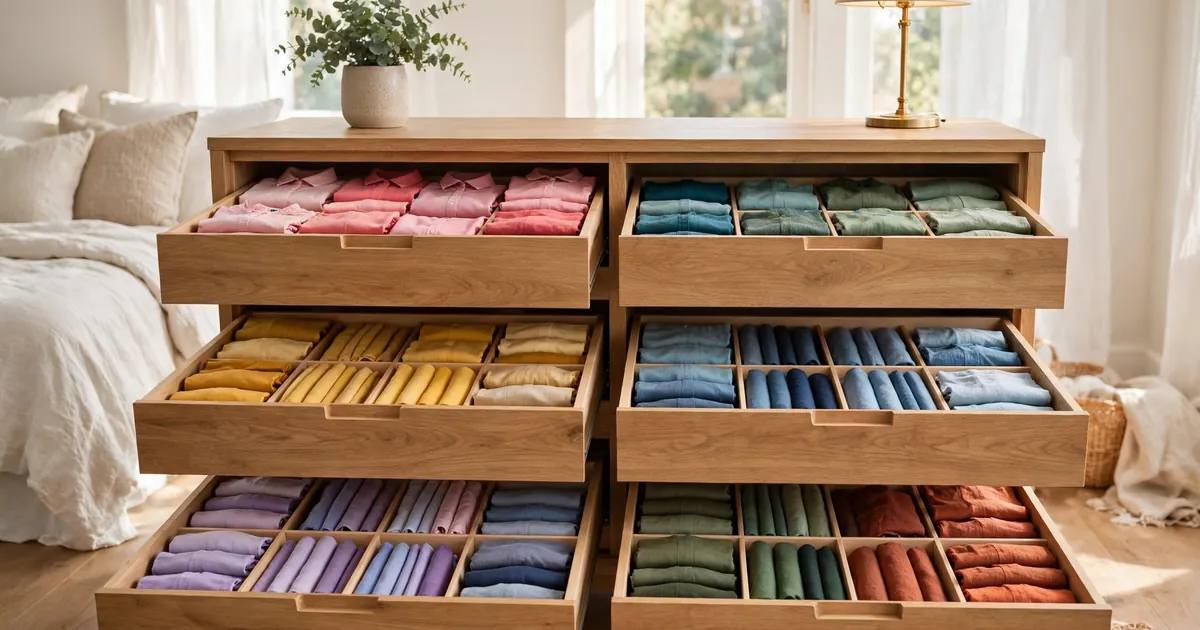

These dresser organization ideas work when every drawer has one job and everything inside stands where you can see it. The fastest way to get there: empty every drawer, keep only what you wear, then assign drawers by the order you get dressed. File fold the clothes, add dividers or cheap bins so nothing shifts, and give the dresser top three zones at most. It takes one focused hour for a standard six-drawer dresser.
The stakes are higher than a tidy bedroom. The average American spends 2.5 days a year looking for misplaced items, costing U.S. households $2.7 billion a year in replacements, according to Pixie’s 2017 Lost & Found survey. And researchers at UCLA’s Center on Everyday Lives of Families found that women who described their homes as cluttered showed daily cortisol patterns tied to chronic stress (Personality and Social Psychology Bulletin, reported by Psychology Today). A dresser you can open and read at a glance is a small win that lands every single morning.
TL;DR: the whole system in 60 seconds
- Empty every drawer and keep only clothes you actually wear (WRAP found about 30% of clothing in wardrobes hasn’t been worn for at least a year, so expect to let go of plenty).
- Assign each drawer by dressing order: top drawers for underwear and socks, middle for daily clothes, bottom for jeans and bulkier pieces.
- File fold everything so each item stands upright and visible; stacks hide what you own.
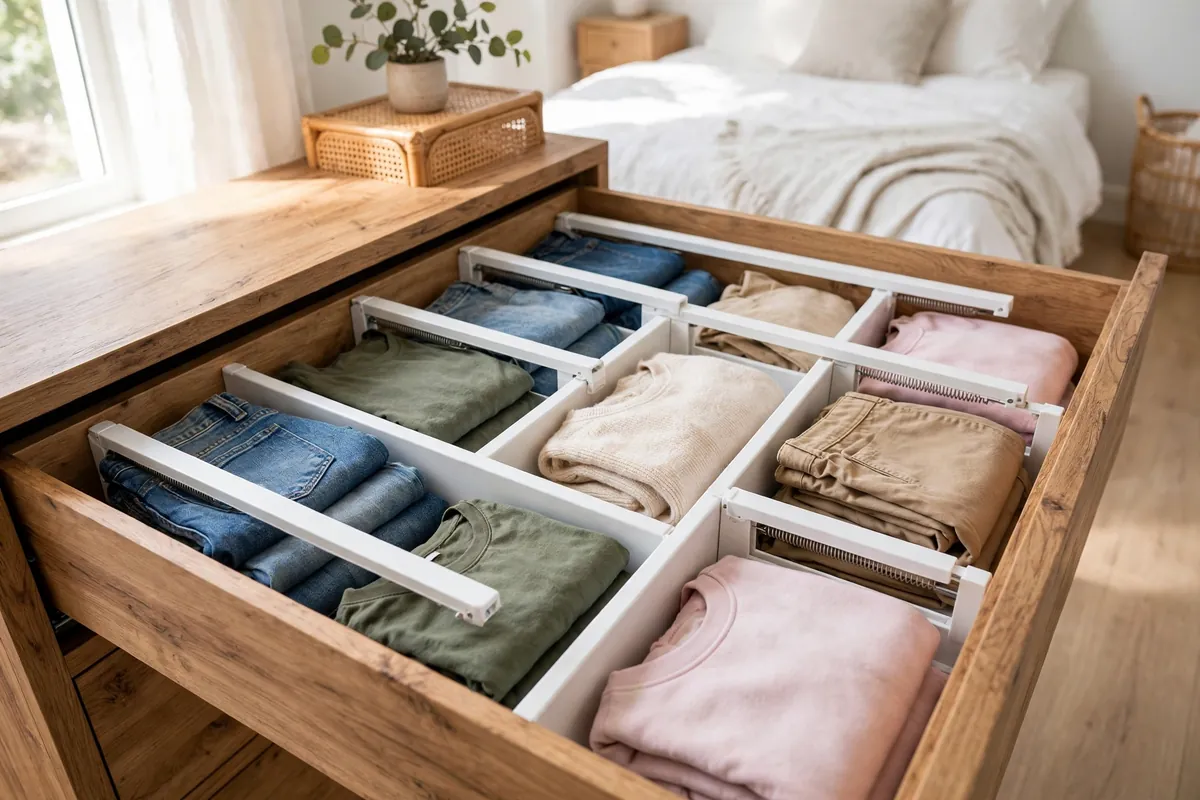
- Add dividers or bins to stop shifting; spring-loaded rails and honeycomb inserts cover almost every drawer.
- Keep the dresser top to three zones: one functional, one personal, one pretty. The rest goes away.
Drawer map: what goes where in the three standard dresser types
| Drawer position | 6-drawer low dresser (2 columns) | 3-drawer dresser | Tall 5-drawer chest |
|---|---|---|---|
| Top | Underwear + socks (left); bras, shapewear, pajamas (right) | Underwear, socks, small accessories | Underwear, socks, jewelry tray |
| Second | T-shirts + tanks, file folded | T-shirts, casual tops | T-shirts, workout clothes |
| Third | Workout clothes, leggings, lounge sets | Jeans, pants, heavier pieces | Jeans, pants |
| Fourth | Jeans, pants, light sweaters | (deep bottom drawer) pajamas, seasonal | Pajamas, seasonal |
| Bottom | Pajamas, seasonal, off-season overflow | Not applicable | Bulkiest items kept in dresser |
| Deepest drawer note | Split deep drawers with dividers | Use bins to stop shifting | Bottom drawer runs dark; use for least-worn |
How do you organize dresser drawers, step by step?
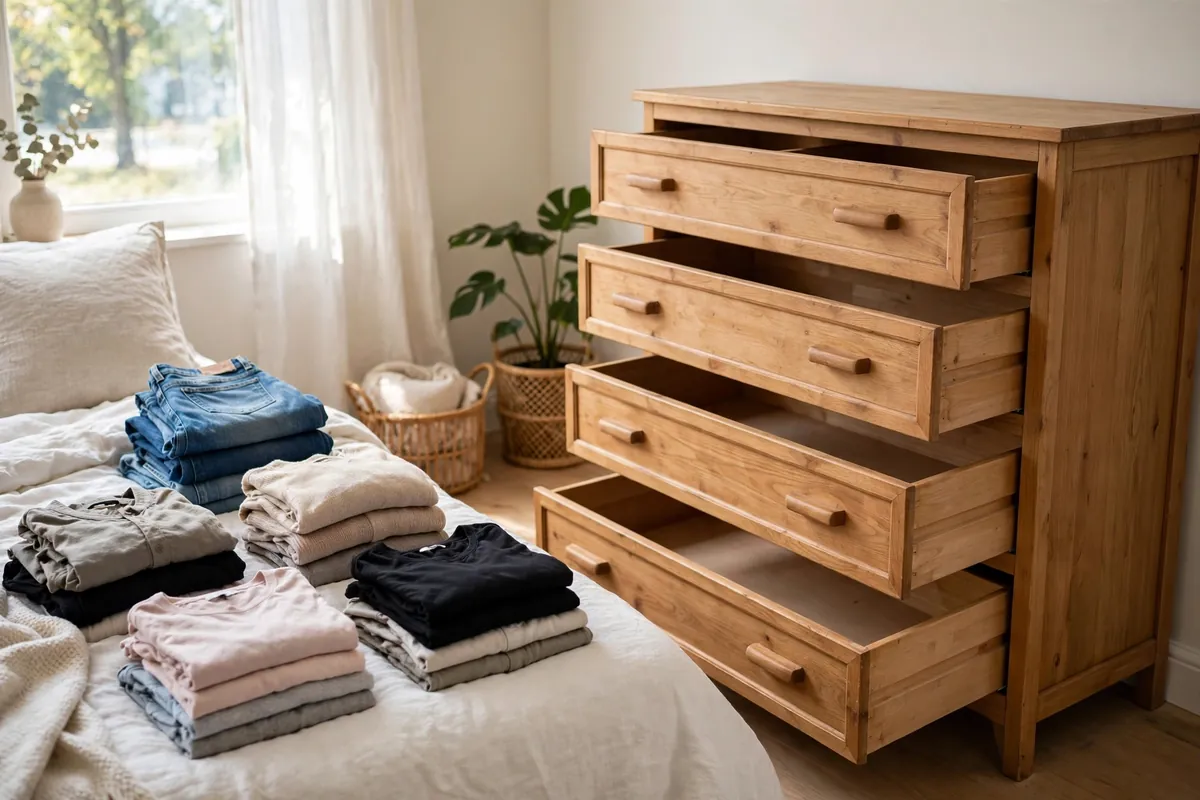
Empty every drawer first, onto the bed, all of it. This is the step everyone skips and the reason most dresser projects fail. You can’t organize what you can’t see, and half the mess in a dresser is items that belong in other rooms. Once everything is out, wipe each drawer down and let it dry.
Now the purge, and be honest about it. WRAP, the UK waste research group, found that about 30% of clothing in wardrobes hasn’t been worn for at least a year. Dresser drawers follow the same pattern. If you haven’t worn it in a year, it doesn’t fit, or it’s past repair, it leaves the dresser: donate, recycle, or trash. Every item you keep costs you drawer space for the rest of the year.
Then give each drawer a job using the map above. Put things back file folded, add dividers or bins before the drawers fill up, and stop at about 80% full. A drawer packed to the top will be a mess again within two weeks. My opinion: the purge is the project. The organizers are just the finishing touch people notice.
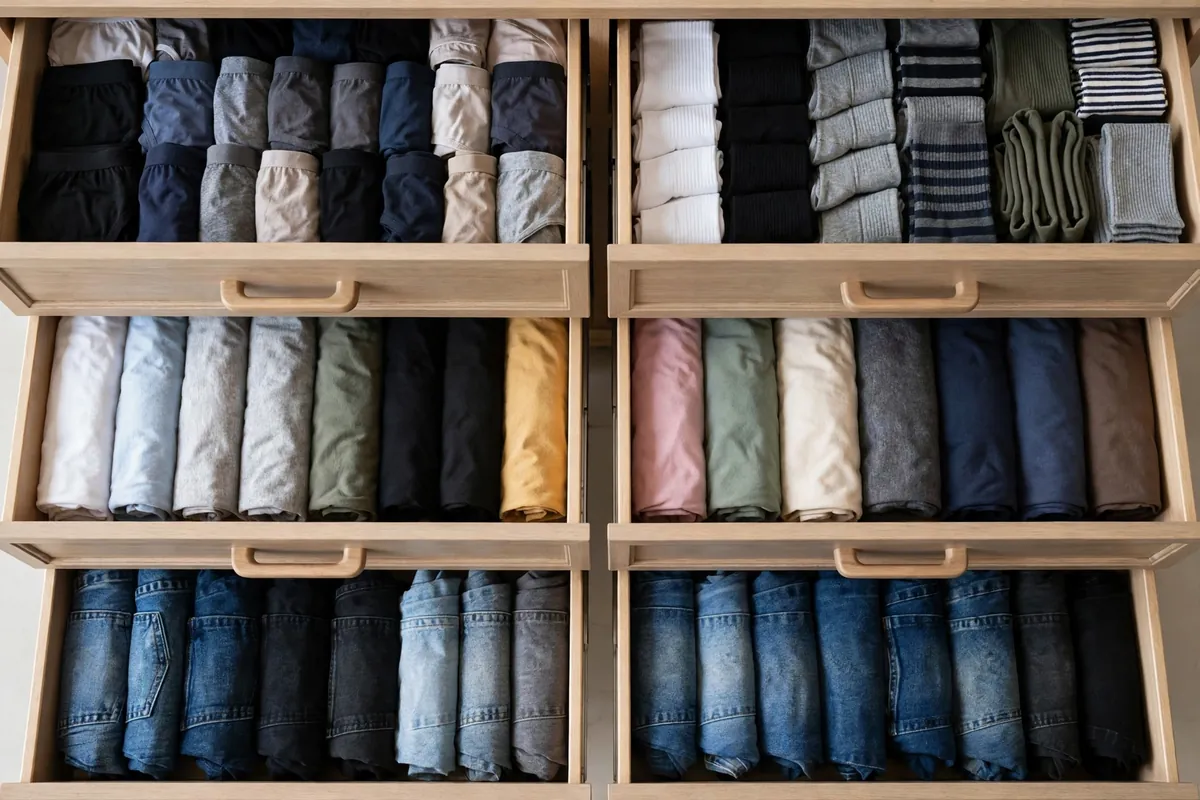
Drawer map legend: top drawers = underwear and socks; middle drawers = daily clothes; bottom drawers = jeans and bulkier pieces.
What should you store in each dresser drawer?
Follow dressing order: top drawers hold what you put on first, bottom drawers hold what you put on last. Underwear, socks, and bras go up top where your hands land first. T-shirts and daily clothes take the middle drawers. Jeans, pants, and the bulkiest pieces you still keep in the dresser go at the bottom.
The rule has a reason beyond convenience. Top drawers are shallow and easy to reach, which suits small, light items. Bottom drawers are deeper and darker, which suits bigger, less-worn pieces. When you dress in a hurry, your hands move top to bottom without thinking, so the system works even when you’re half asleep.
Depth matters more than most guides admit. Standard dresser drawers run 14 to 18 inches deep, and anything filed in the back half of a deep drawer disappears. Split deep drawers with front-to-back dividers so the back half is its own zone, not a graveyard. Shallow top drawers get honeycomb inserts for socks and underwear. If you own a lingerie chest, that tall dresser follows the same rules as the tall 5-drawer chest in the table above. My opinion: one drawer, one or two categories. The moment a drawer holds four categories, it stops being organized and starts being a pile with dividers in it.
How do you file fold clothes so everything stays visible?
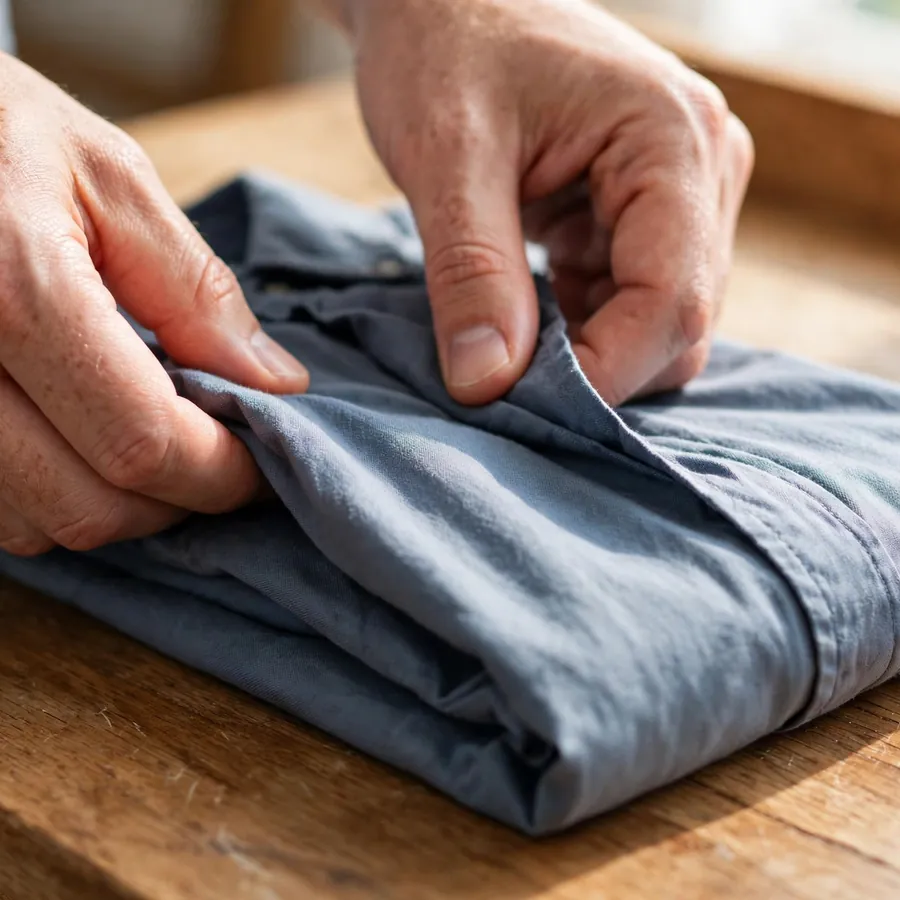
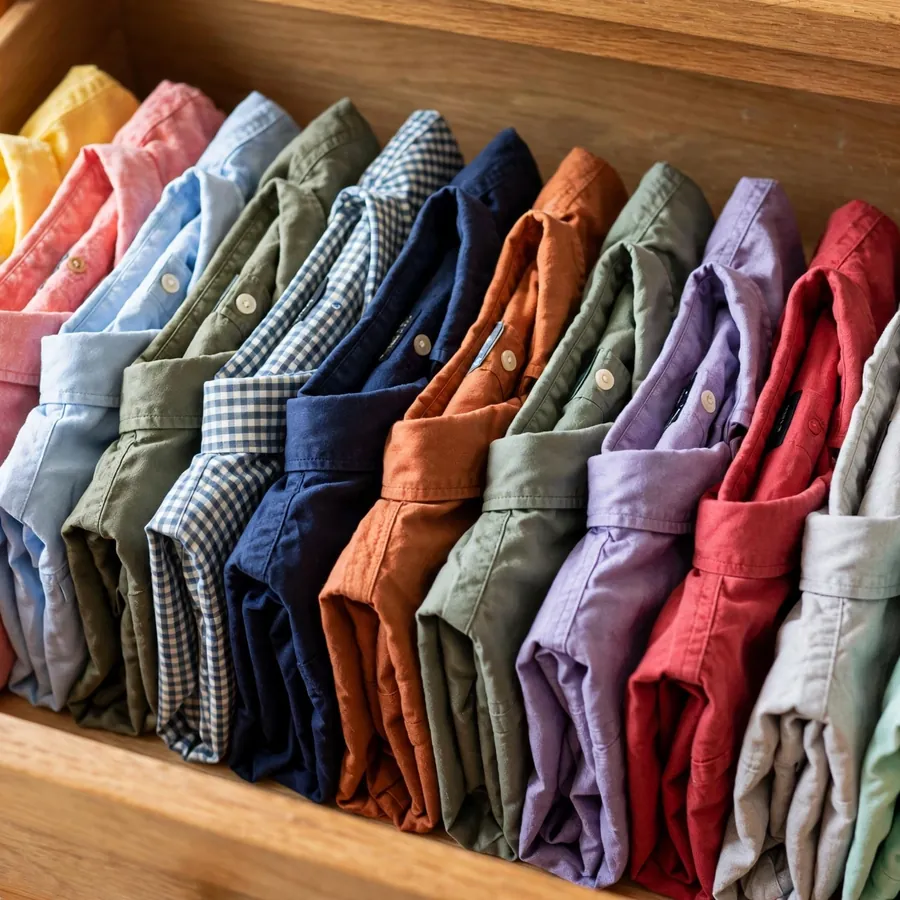
File folding means folding each item into a small rectangle that stands upright, then filing items side by side like folders in a drawer. You see every item at once, nothing hides under a stack, and pulling one shirt out doesn’t topple the rest. Marie Kondo popularized the method, and it’s the single technique that changes dressers the most.
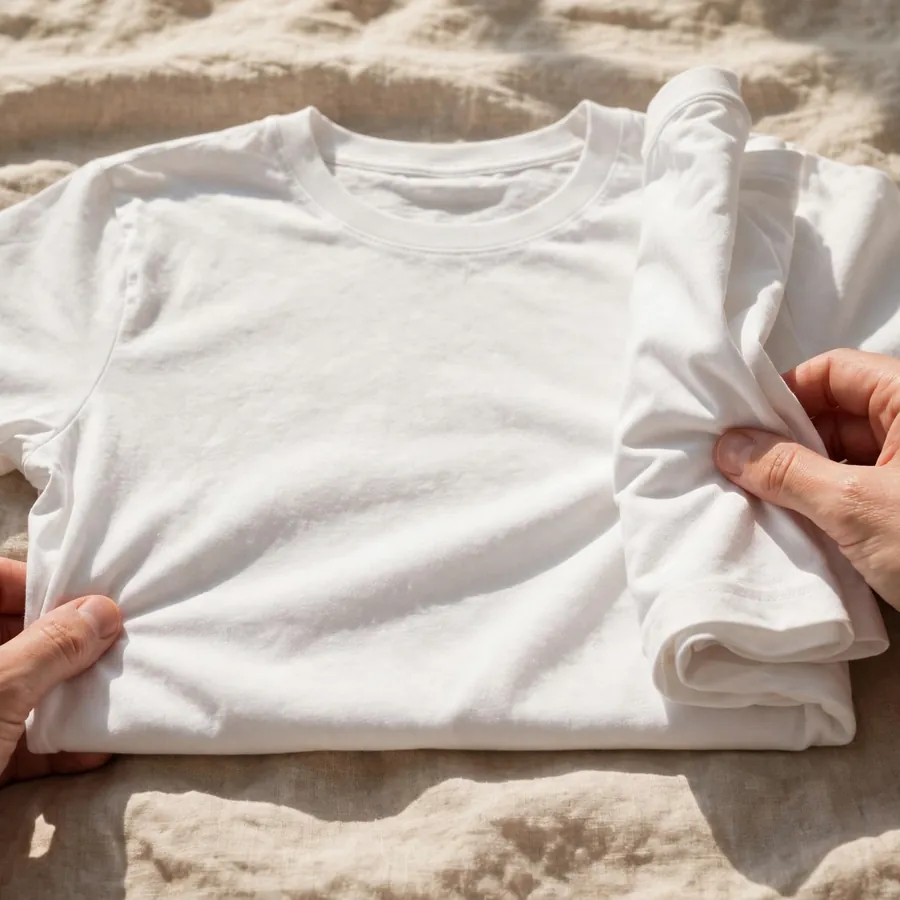
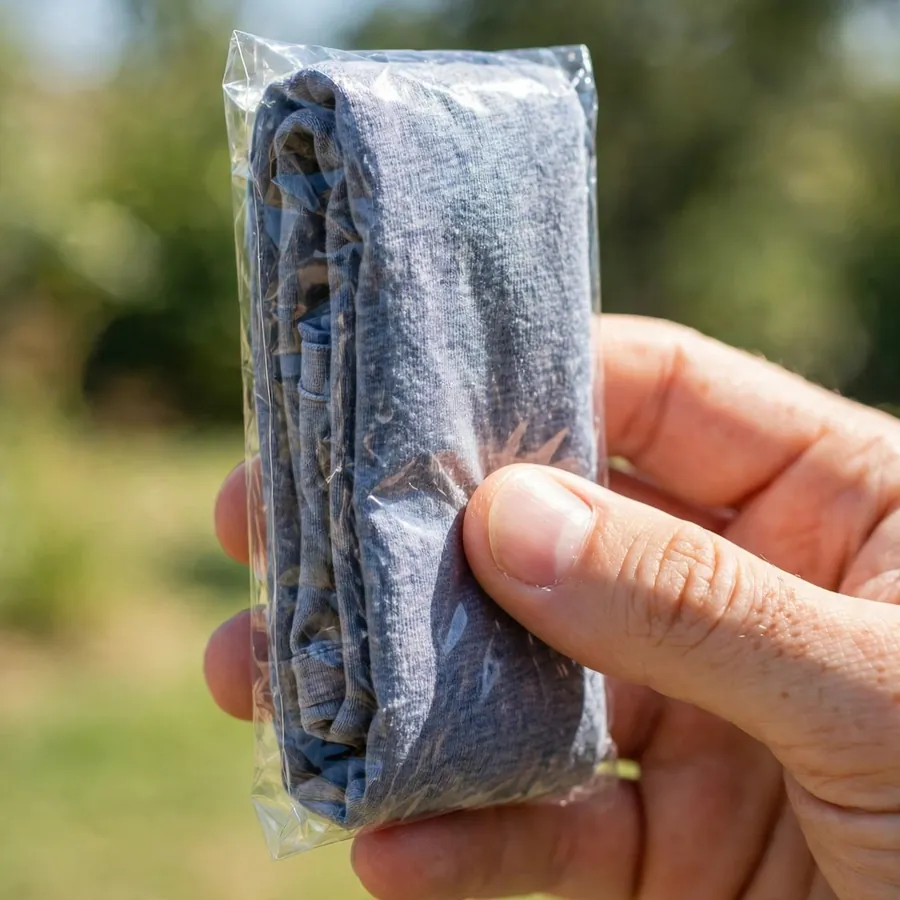
Here is the basic move for a T-shirt. Lay it flat, fold the sides into thirds so it becomes a long rectangle, then fold it in half, then in half or thirds again until it stands on its own edge. If it falls over, fold it smaller. The finished packet should be about as tall as your drawer is deep. Pants fold the same way: fold in half lengthwise, then into a rectangle that stands.
Not everything file folds well, and guides that pretend otherwise are lying. Stiff dress shirts, slippery silk, and thick hoodies resist the method; stack those or hang them. For cotton tees, tanks, leggings, underwear, and socks, file folding wins by a mile. My opinion: learn the fold on ten T-shirts before buying a single organizer. The fold does more than any product.
Which dresser drawer organizers are actually worth buying?
You need fewer products than the internet wants to sell you. Spring-loaded drawer dividers and honeycomb inserts cover about 90% of dresser drawers. The rails expand to fit, cost little, and stop folded clothes from sliding. The inserts give socks and underwear their own cells so you stop digging for a matching pair. The same divider system works for nightstand drawers.
File folding also keeps closet shelves tidy, and our closet shelf organization ideas cover spacing, dividers, and shelf zones in detail.
Fabric bins handle the deep drawers. Bamboo boxes look nice in the shallow top drawer and wipe clean. And before you buy anything, shop your home: shoe boxes, tissue boxes with the tops cut off, small gift boxes, and plastic drawer bins from the dollar store all work as free dividers. Professional organizers do this on real jobs. It isn’t a budget hack, it’s just sensible.
Skip the gimmicks. Under-drawer pull-out trays, LED drawer lights, and mirror-top organizer trays show up in listicles because they photograph well, not because they survive daily use. A $12 set of spring-loaded dividers will still be working in two years. The LED strips will be dead batteries in a drawer you now have to reorganize. My opinion on the whole category: buy the dividers, borrow the bins from your house, and spend the savings on nothing. That’s the correct amount of organizer shopping.
How much should you spend on these dresser organization ideas?
Most dressers get fully organized for the price of a takeout dinner, and the free options from around your house work just as well as store-bought ones. Spend your money where it changes behavior: dividers that stop shifting, inserts that give small items cells.
Organizer budget tiers: what to spend
| Budget | What to buy | Covers |
|---|---|---|
| Under $15 | Shoe boxes from home, 4-pack spring-loaded dividers, label maker tape | 2 to 3 drawers |
| $15 to $40 | Honeycomb sock/underwear inserts, fabric bin set, bamboo boxes | A full 6-drawer dresser |
| $40 to $100 | Matching bamboo set for every drawer, velvet jewelry tray, drawer liners | Whole dresser, styled to match |
If you buy only one thing, make it the spring-loaded dividers. They fit drawers 14 to 18 inches deep, which covers nearly every standard dresser, turning one messy drawer into three useful zones in a minute. Not for everyone: if your drawers are shallow (under 5 inches), skip the rails and use low honeycomb inserts instead, since tall dividers waste vertical space you don’t have. My opinion: the under-$15 tier is where most people should stop. The expensive matching sets look great in photos and change nothing about how the drawers work.
One more thing while deciding what leaves the dresser: bulky sweaters and jeans belong in the closet, not in drawers. Our guide to small closet organization ideas shows where to put them so the dresser stays lean.
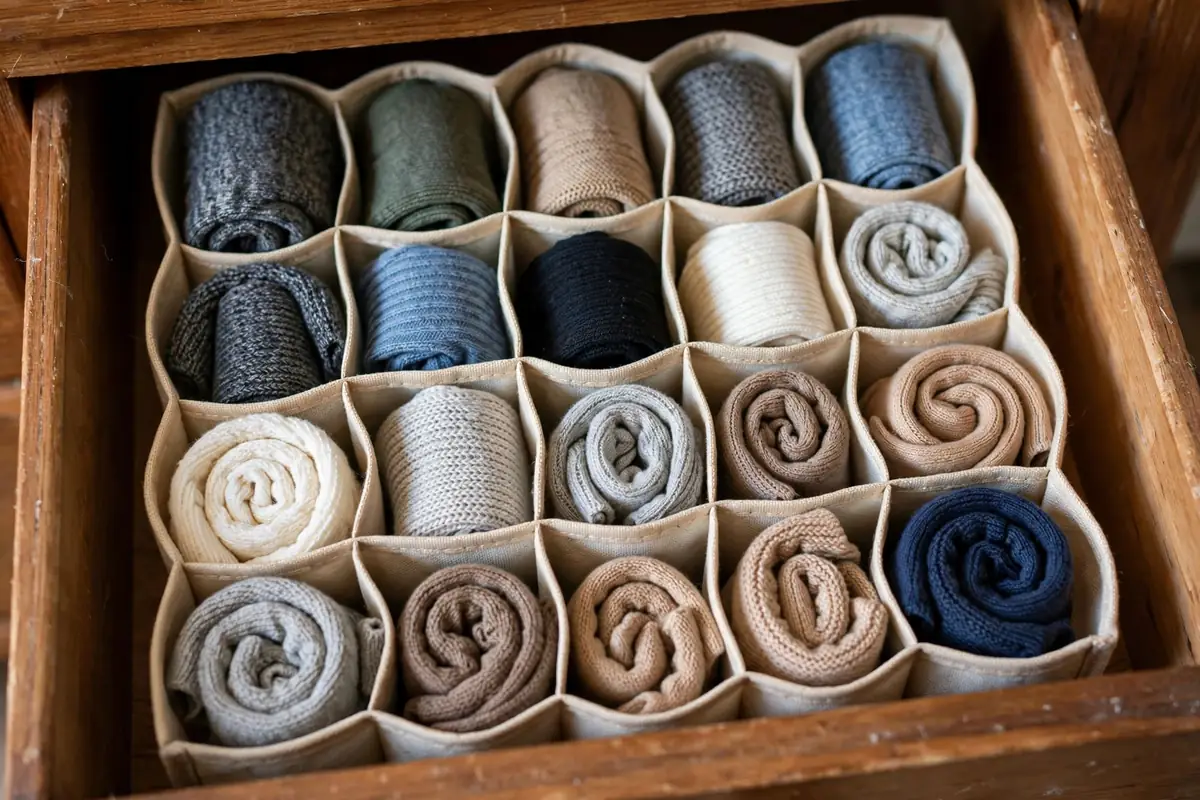
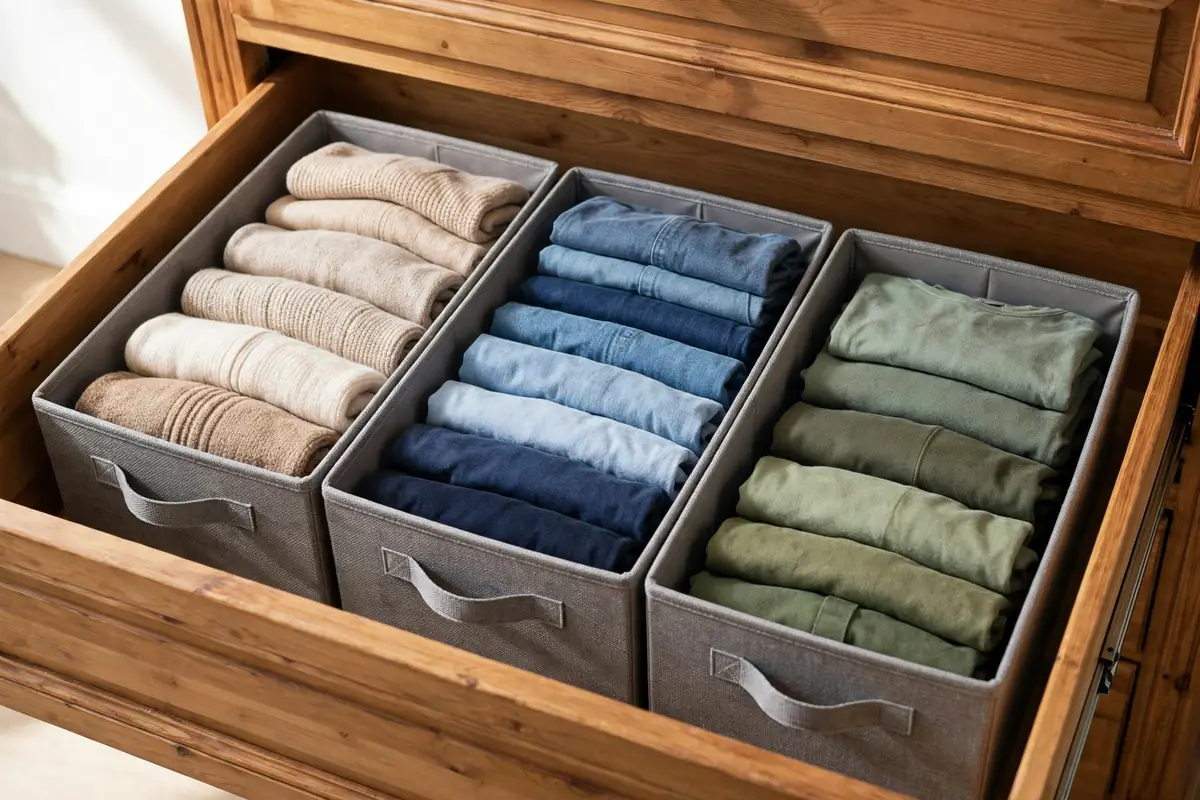
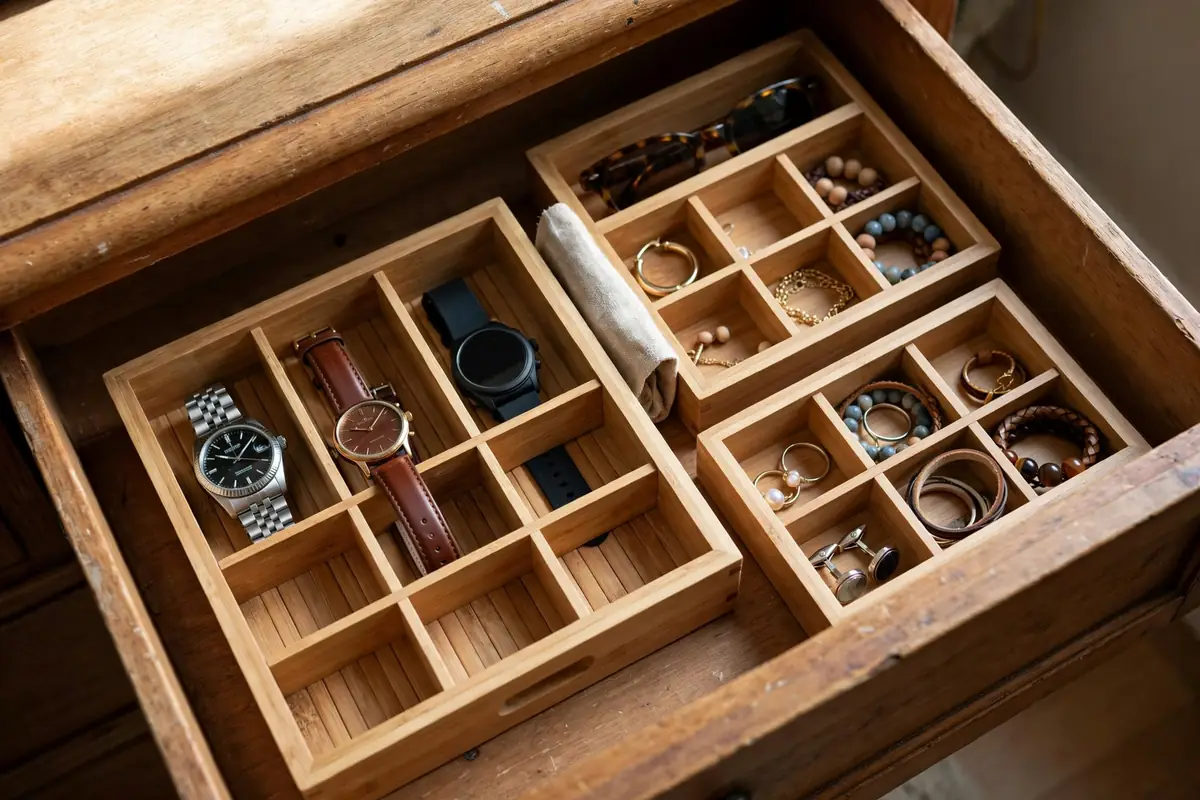
How do you organize the top of a dresser without creating clutter?
Give the top three zones and nothing more. One functional zone (a dresser-top tray for keys, wallet, glasses), one personal zone (a small stack of books, a framed photo), one pretty zone (a plant, a dresser mirror, or a lamp). Everything else lives in a drawer. When the top starts collecting random items, it stops being a surface and becomes a shelf you never clean.
This matters more than it looks. Neuroscientists at Princeton University reported in the Journal of Neuroscience that visual clutter competes for the brain’s limited attention and reduces its ability to focus (reported by Stacker). A dresser top you see first thing every morning is prime visual real estate. Keep it calm and the whole room feels calmer.
My opinion: the dresser top isn’t storage. The moment you treat it like a shelf, you have added a flat surface of clutter to a room you’re trying to simplify. Three zones, enforced weekly. If it doesn’t fit the three zones, it goes in a drawer or it leaves the room.
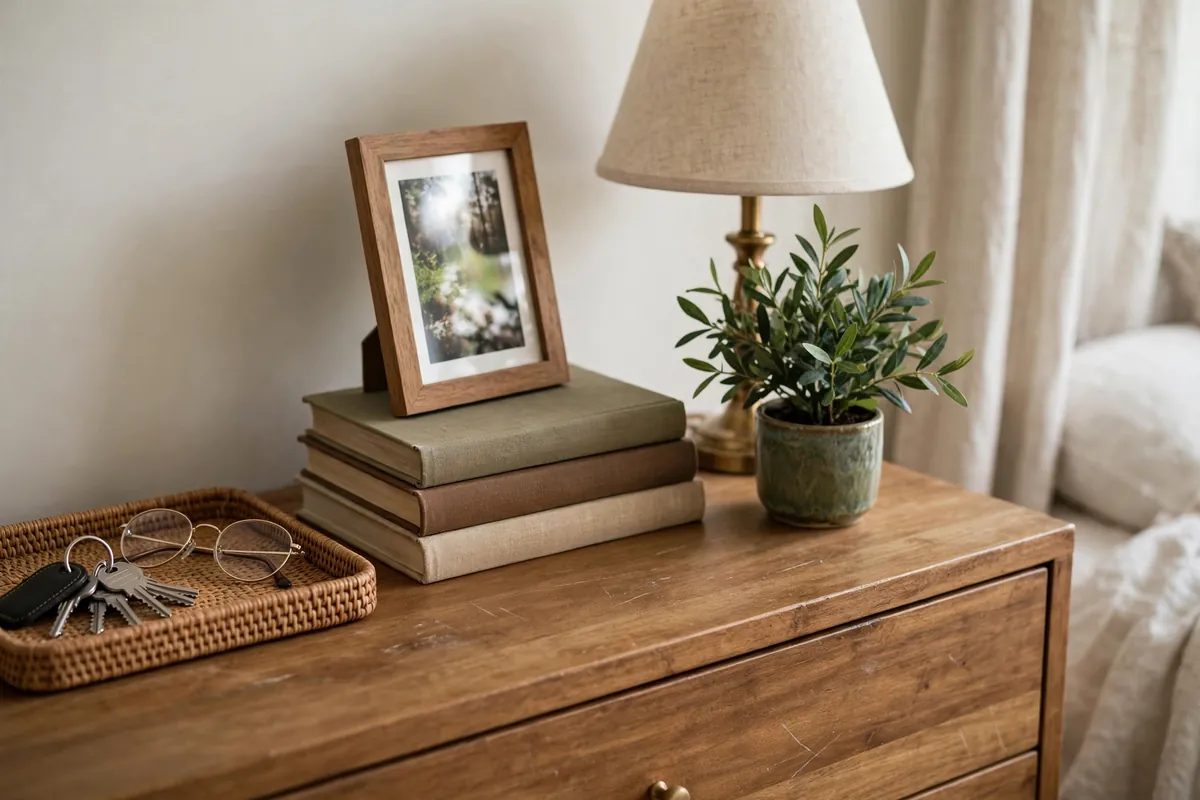
Where should jewelry, watches, and small accessories live?
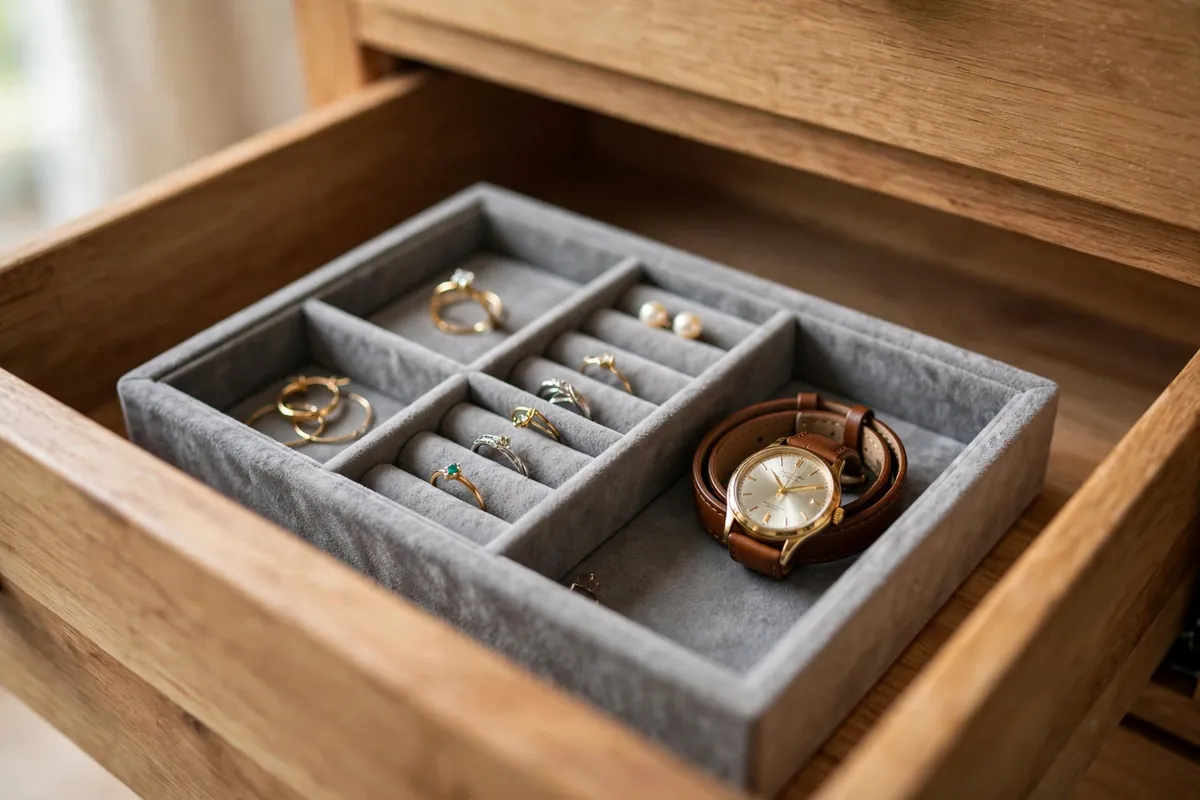
Daily-wear pieces go in a shallow velvet jewelry organizer tray insert in the top drawer, one compartment per category: rings, earrings, watches. The tray lifts out, so you carry it to the mirror instead of leaning over the drawer. It costs little and it ends the tangled-chain problem for good.
Necklaces are the exception. They tangle in drawers no matter what you buy, so hang them on small no-drill hooks on the dresser’s side panel or the wall beside it. Wall hooks hold 2 to 3 pounds each, which is plenty for a necklace collection, and they turn the pieces into decor instead of a knotted pile.
Sunglasses, belts, and ties do fine rolled in a fabric bin in the second drawer. Perfume stays on the dresser top in its one pretty zone or moves to the bathroom. My opinion: if a piece of jewelry needs its own special organizer to survive the drawer, it probably shouldn’t live in the drawer. Hooks for necklaces, tray for the rest, done.
How do two people share one dresser without mixing everything up?
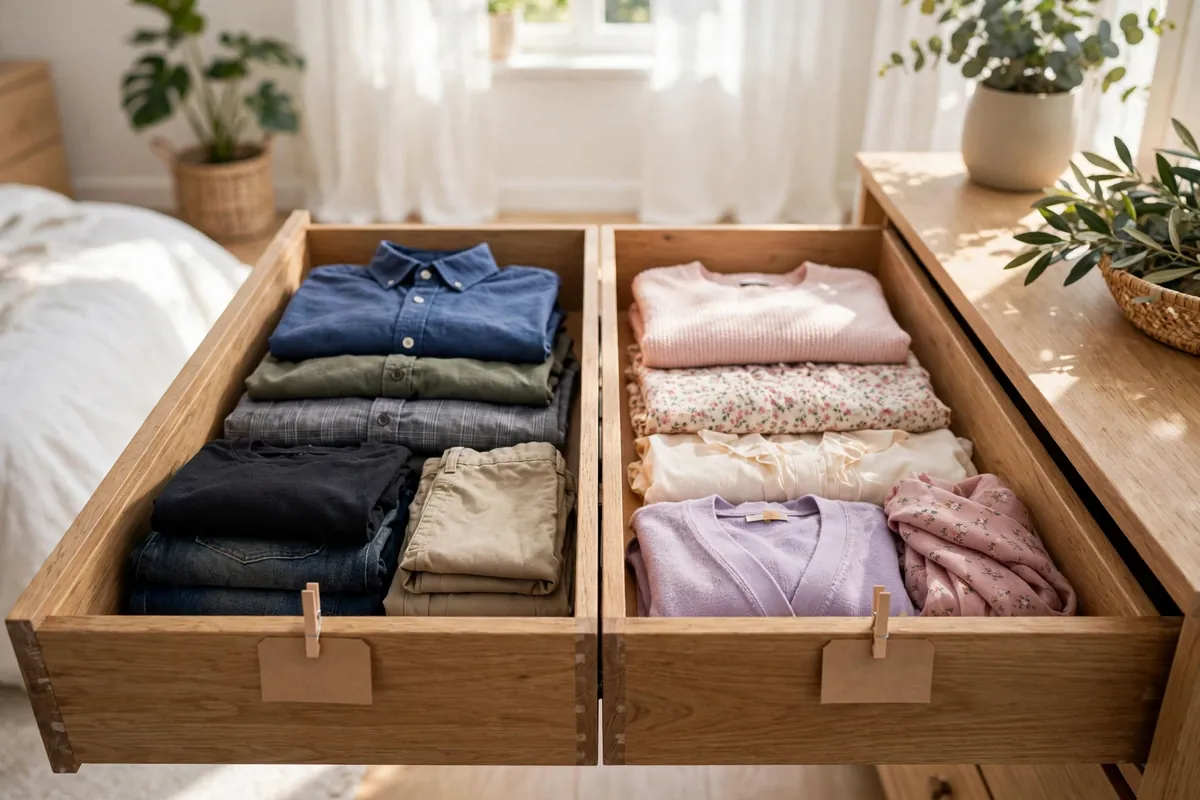
Split by person, not by category. Give each person their own drawers or their own clearly divided half of every drawer, and label the split. Category-splitting (“all socks together”) sounds fair and fails within a week, because nobody remembers whose sock is whose at 6 a.m. Person-splitting survives because the boundary is obvious.
In a standard six-drawer dresser, the clean split is three drawers each, or left column versus right column. Each person then runs their own mini version of the dressing-order system inside their zone. If one person owns more clothes, split four and two and say so out loud. The argument you avoid is worth the awkward conversation.
Label the zones for the first month. A strip of masking tape with a name on each drawer front looks silly and works perfectly, and by the time you peel it off the habit is set. Shared small items like chargers and lint rollers get one neutral drawer or move to the nightstand. My opinion: couples who label feel ridiculous for a week and organized forever. Skip the labels and you get the clutter war instead.
How do you keep a kid’s dresser organized?
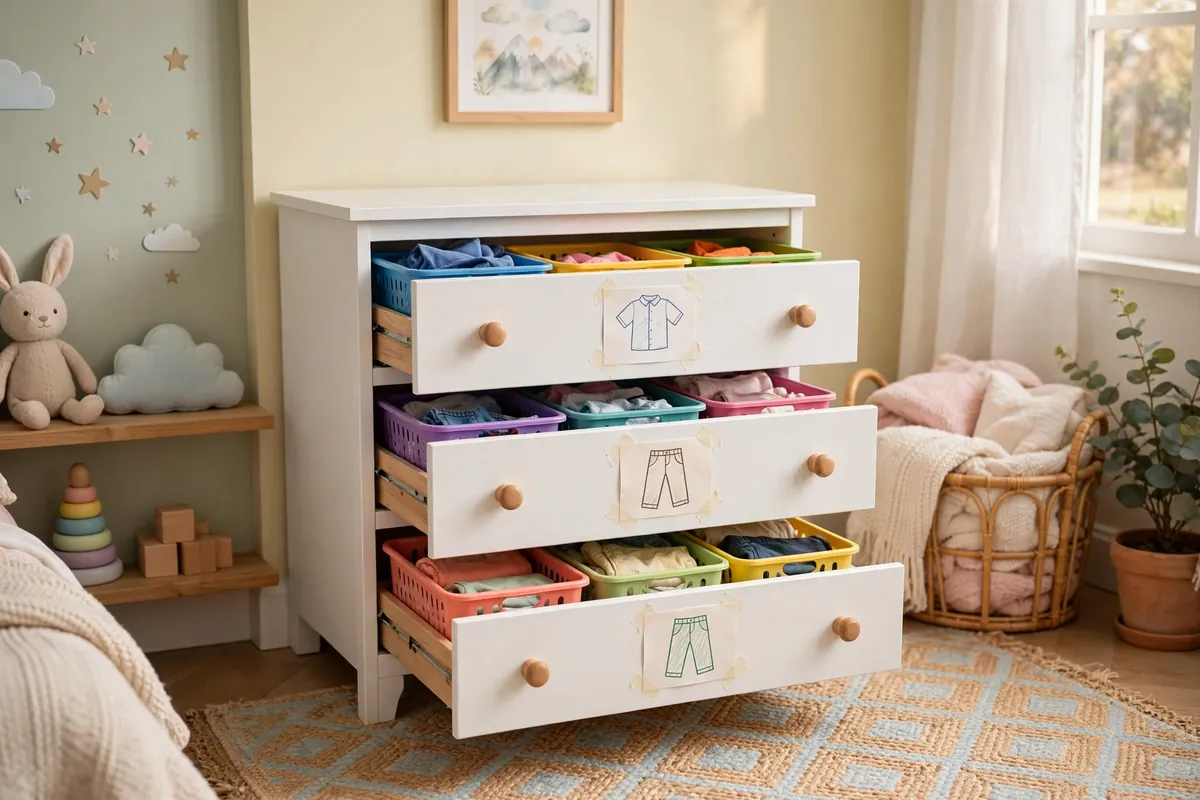
Give each drawer one clothing type and label it with a picture, not words. A photo of folded shirts taped to the shirt drawer, a photo of pants on the pants drawer. Kids who can’t read yet can still put laundry away correctly, and that’s the whole game with a kid’s dresser: the system has to survive the child, not impress the parent.
Use individual slotted bins inside each drawer so categories stay separated when small hands dig. One bin for shirts, one for pants, one for pajamas. When laundry day comes, the kid carries the bin, fills it, and slides it back. No folding standards, no lectures.
Keep the dresser short enough for the kid to reach every drawer, and cap each drawer at one week’s worth of clothes. The rest of the wardrobe lives in your closet or storage. A kid with twelve shirts will wear three and bury the rest. My opinion: a kid’s dresser is a tool for independence, not a display. If they can do it alone, it’s organized enough.
What should you never store in a dresser?
Bulky sweaters and jeans. They eat a whole drawer each, they don’t breathe folded deep, and they come out wrinkled. Hang them or move bulky sweaters and jeans to the closet. Your dresser is for lighter pieces: tees, tanks, leggings, underwear, socks, pajamas. This is the single biggest space win in the whole project.
Important documents, passports, and anything you would cry about losing in a fire don’t belong in a bedroom dresser. Neither does food, snacks, or anything damp. Dressers sit in bedrooms, bedrooms run warm, and crumbs in a sock drawer end badly. Medications belong in their proper storage, not mixed with T-shirts.
Off-season clothes deserve an honest decision. If you won’t touch a heavy sweater for five months, it doesn’t earn drawer space all winter. Store it under the bed in vacuum storage bags for the seasonal rotation and give the drawer to something you wear now. The EPA estimated that clothing and footwear alone generated 13 million tons of waste in 2018, with only 13% recycled (epa.gov). Every piece you keep but never wear is just future landfill taking up your drawer. My opinion: a dresser is for the current season plus one transition drawer. Anything else is storage, and storage has its own furniture.
How do you keep dresser drawers from smelling stale?
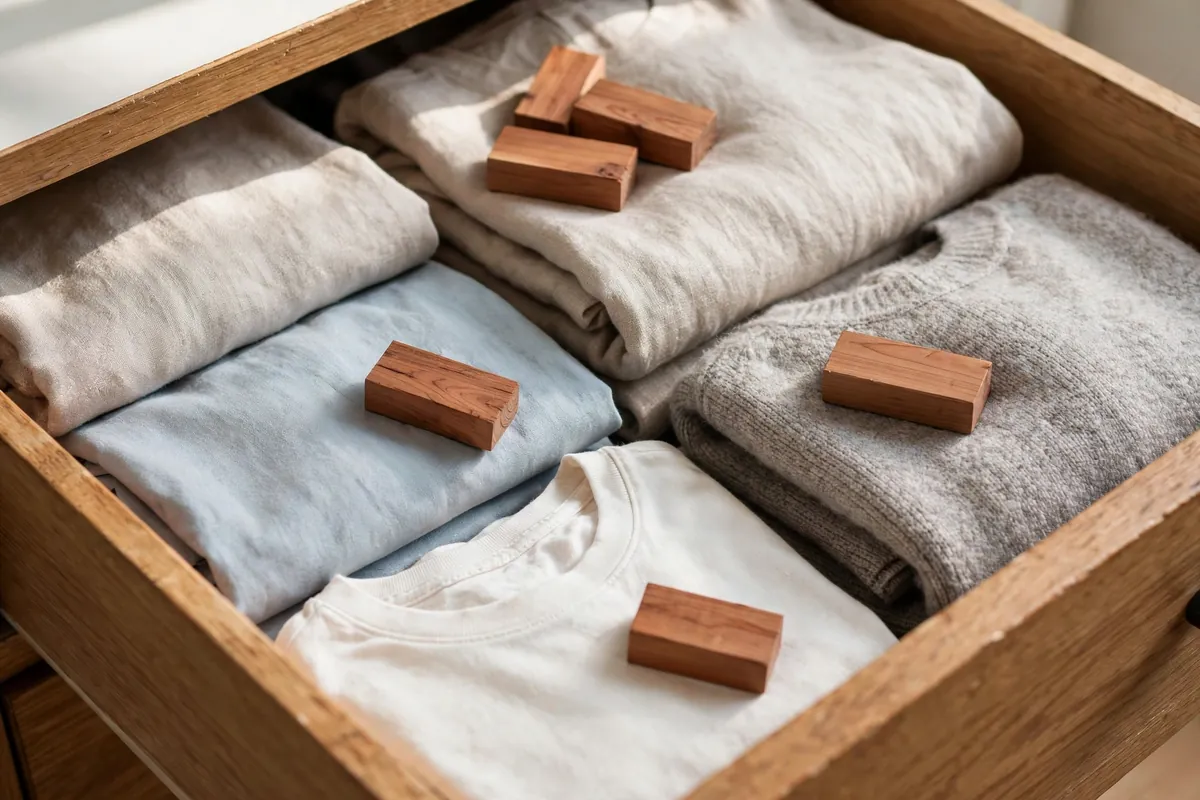
Wood and fabric trap odor, especially in drawers that stay closed for weeks. Cedar blocks or rings are the classic fix: they absorb moisture and smell clean without coating your clothes in perfume. Toss two or three in each drawer and sand them lightly once a year to refresh the scent.
Lavender sachets work too, but keep them away from direct contact with light-colored clothes, since the oils can spot fabric over time. Baking soda in a small open container handles a musty drawer in about a week. And the unglamorous truth: drawers smell stale because the clothes inside sit too long. Wash what you store, and don’t pack drawers airtight.
Skip the heavy plug-in style fresheners and scented drawer liners with strong fragrance. They mask odor instead of fixing it, and the scent transfers to everything you own. My opinion: cedar beats sachets, sachets beat sprays, and airing the drawer out for a day beats all three.
How do you keep the dresser organized once it’s set up?
Run a five-minute reset every week. Open each drawer, straighten the rows, pull out anything in the wrong drawer and put it back. Five minutes, once a week, on laundry day. Sort laundry as you fold it back in so clean clothes land in the right drawer the first time. That’s the entire maintenance plan, and it beats a seasonal reorganization every time.
The system breaks for predictable reasons. You buy something new and shove it in without a home: use the one-in-one-out rule, where every new item means one old item leaves. You get lazy about file folding and start stacking: the rows tell on you fast. Someone else in the house “borrows” a drawer: the labels settle that.
Do a real purge twice a year, when you swap seasons. If you keep a capsule wardrobe, this is when you audit it: does every piece still earn its spot? Pull each drawer, hold every item, and ask the honest question. The UCLA cortisol research mentioned at the start found that cluttered homes track with chronic stress patterns, which means maintenance isn’t vanity. It’s ten minutes a week for better mornings. My opinion: systems don’t fail because they are wrong. They fail because nobody spends five minutes. Put the reset on the calendar.
Where should you start if your dresser is overflowing today?
Start with the purge, not the shopping. Set a timer for one hour, pull everything out, and sort into keep, donate, trash. Aim to remove a third. Then assign drawers by dressing order, file fold what stays, then look at what organizers you actually need. Most overflowing dressers need fewer clothes, not more products.
Buy in this order if you buy at all: spring-loaded dividers first, honeycomb inserts second, fabric bins for deep drawers third. Measure drawer depth before ordering; most dividers fit 14 to 18 inch drawers, and a wrong-size organizer is just expensive clutter.
Your next step after the dresser: the closet, where the bulky pieces you just evicted need a real home. Our small closet organization ideas guide picks up exactly where this one ends, and under-bed storage handles the off-season overflow. One room at a time, starting with the drawers you open every morning.
What is the best way to organize a dresser?
Empty every drawer, keep only what you wear, and assign each drawer a category by dressing order: underwear and socks on top, daily clothes in the middle, jeans and bulkier pieces at the bottom. File fold everything so each item stands visible, add dividers or bins to stop shifting, and keep drawers about 80% full.
What should I put in my dresser drawers?
Follow the order you get dressed. Top drawers: underwear, socks, bras. Middle drawers: T-shirts, tanks, workout clothes. Bottom drawers: jeans, pants, pajamas, seasonal pieces. Keep bulky sweaters and heavy jeans in the closet instead.
How do you organize a small dresser?
Keep only one season of clothes in it and move the rest under the bed or to the closet. Use honeycomb inserts in shallow drawers and split deep drawers with dividers so nothing hides in the back. Cap every drawer at 80% full.
How do I organize my dresser drawers cheaply?
Shop your home first: shoe boxes, tissue boxes with tops cut off, and small gift boxes make free dividers. A 4-pack of spring-loaded dividers costs under $15 and covers two to three drawers. Learn file folding, which costs nothing and does more than any product.
How do you organize a dresser for two people?
Split by person, not by category: three drawers each in a six-drawer dresser, or left column versus right column. Label each zone for the first month. Each person runs their own dressing-order system inside their zone.
Should socks go in the top drawer?
Yes. Socks and underwear belong in the top drawer because they are small, light, and the first things you put on. Use a honeycomb insert so each pair has its own cell.
How do you keep dresser drawers smelling fresh?
Put two to three cedar blocks in each drawer and sand them lightly once a year. Baking soda in a small open container fixes a musty drawer in about a week. Wash clothes before storing them and don’t pack drawers airtight.
How often should you declutter a dresser?
Do a five-minute straighten weekly on laundry day and a full purge twice a year when you swap seasons. Use the one-in-one-out rule: every new item means one old item leaves.
What is file folding?
A folding method popularized by Marie Kondo’s KonMari method, where each item becomes a small rectangle that stands upright, filed side by side like folders so you see everything at once. It works best for T-shirts, tanks, leggings, underwear, and socks.
How do you organize the top of a dresser?
Limit it to three zones: one functional (a dresser-top tray for keys and glasses), one personal (books or a photo), and one pretty (a plant or lamp). Everything else lives in a drawer.
