
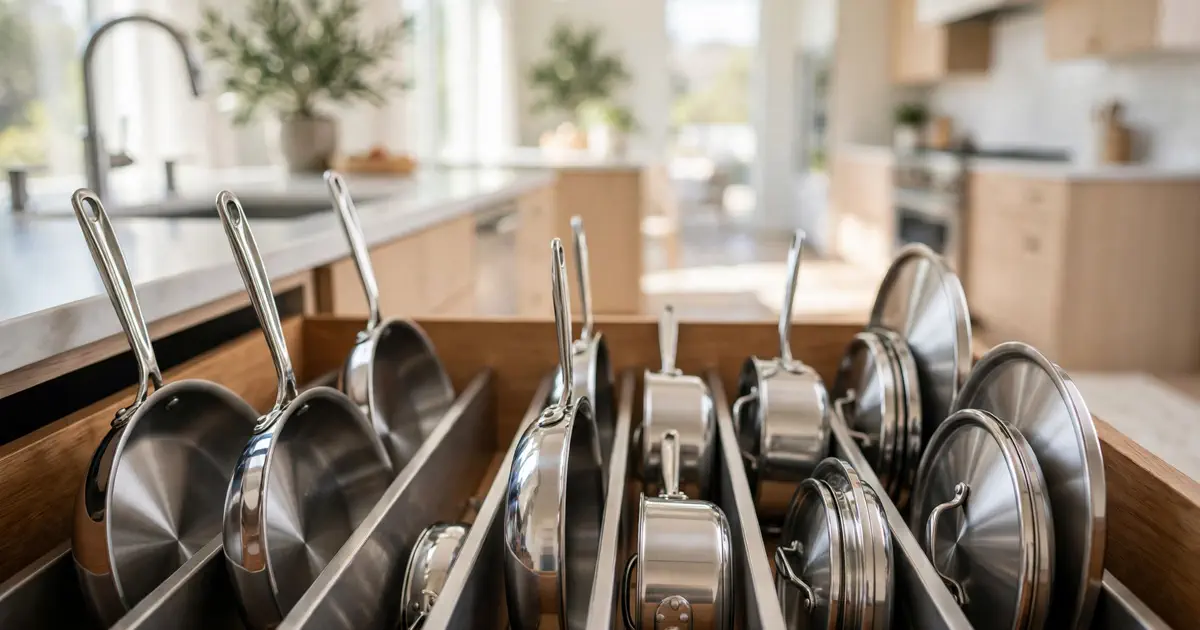

The best way to store pots and pans is upright in a deep drawer or on vertical dividers, with each lid kept with its pot and a soft protector between nonstick surfaces. That one change ends the digging, the scratching, and the lid avalanche. These 16 pots and pans storage ideas cover small kitchens, rentals, tight cabinets, and cast iron, with real measurements in inches and honest notes on what each method costs in money and effort.
The short version:
- Best overall method: a deep drawer fitted with vertical dividers. Pans slide out like files, nothing gets buried, and lids stand beside their pots. Home cooks on Reddit call deep drawers the dream setup, and a January 2024 r/Cooking thread with 30 comments backs that up.
- Best for small kitchens: go vertical. A narrow pull-out next to the stove or a wall rail frees a whole cabinet.
- Best for renters: tension rods, over-the-door lid racks, and a rolling cart. Zero holes, zero deposit drama.
- Best for lids: store each lid with its pot, upright in a rack or door-mounted holder. Lids are the true pain point, not the pans. Plastic food container lids follow different rules, covered in our food container lid storage guide.
- Cast iron rule: never stack it bare on nonstick, and never trust a flimsy vertical slot with a 12-inch skillet. Weight wins every argument.
- The one thing to avoid: stacking unprotected nonstick pans. The coating scratches, and scratched nonstick cooks worse and lasts fewer years.
- Measure first: most US base cabinets run about 24 inches deep with roughly 21 to 22 inches of usable depth. Buy the organizer after you measure, not before.
Pots and pans storage methods compared
| Storage method | Best for | Cost tier | Renter-friendly | Effort |
|---|---|---|---|---|
| Deep drawer with dividers | Daily cooks, any kitchen with a deep drawer | Budget to mid | Yes | Low |
| Cabinet stacking with protectors | Big cabinets, tight budgets | Budget | Yes | Low |
| Vertical pan rack | Small cabinets, easy access | Budget | Yes | Low |
| Pull-out cabinet organizer | Deep base cabinets | Mid | No (screws) | Medium |
| Lid rack or door organizer | Lid chaos | Budget | Yes | Low |
| Wall rail with hooks | Small kitchens, display-worthy cookware | Budget to mid | No (screws) | Medium |
| Ceiling hanging rack | High ceilings, serious cooks | Mid to premium | No | High |
| Pegboard | DIY lovers, awkward walls | Budget | Maybe | Medium |
| Over-the-door organizer | Renters, pantry doors | Budget | Yes | Low |
| Freestanding rolling cart | No cabinet space at all | Mid | Yes | Low |
| In-oven storage | Rarely used pieces, tiny kitchens | Free | Yes | Low |
| Lazy Susan or turntable | Corner cabinets (deep shelves and blind corners), deep shelves | Budget to mid | Yes | Low |
If these pots and pans storage ideas save you one scratched pan, they did their job. Save the guide or send it to whoever shares your kitchen.
What are the best pots and pans storage ideas for a small kitchen?
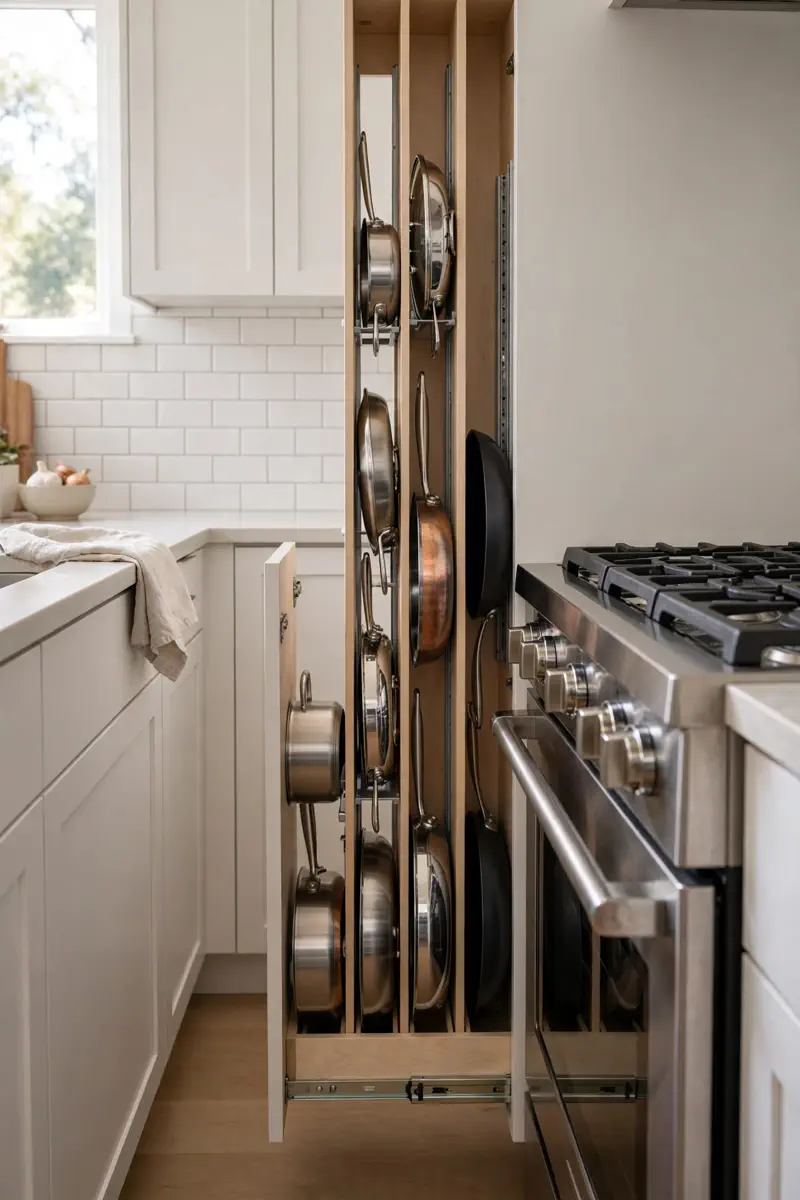
Small kitchens punish horizontal storage. Every flat stack eats a full shelf, so the best pots and pans storage ideas for small spaces turn your cookware vertical and claim the dead zones: the 6-inch gap beside the stove and the inside of cabinet doors.
Start with a narrow pull-out organizer in the gap beside your range, if you have one. These slim vertical slots hold skillets and lids upright in space that otherwise holds nothing. No gap? A wall-mounted rail with S-hooks above the counter does the same job for the pans you grab daily, and it costs less than a takeout dinner.
Here is my honest take: in a small kitchen, you do not have a storage problem as much as an inventory problem. Most home cooks reach for the same 3 or 4 pieces every week. Pull everything out, keep the daily drivers within reach, and move the turkey roaster to the highest shelf. A January 2022 r/organization thread with 27 comments kept circling back to this: people owned more cookware than their kitchens could hold, and the organizing only worked after the purge.
Pair that with our guide to small kitchen storage ideas for the rest of the room.
What is the best way to store pots and pans in a cabinet?
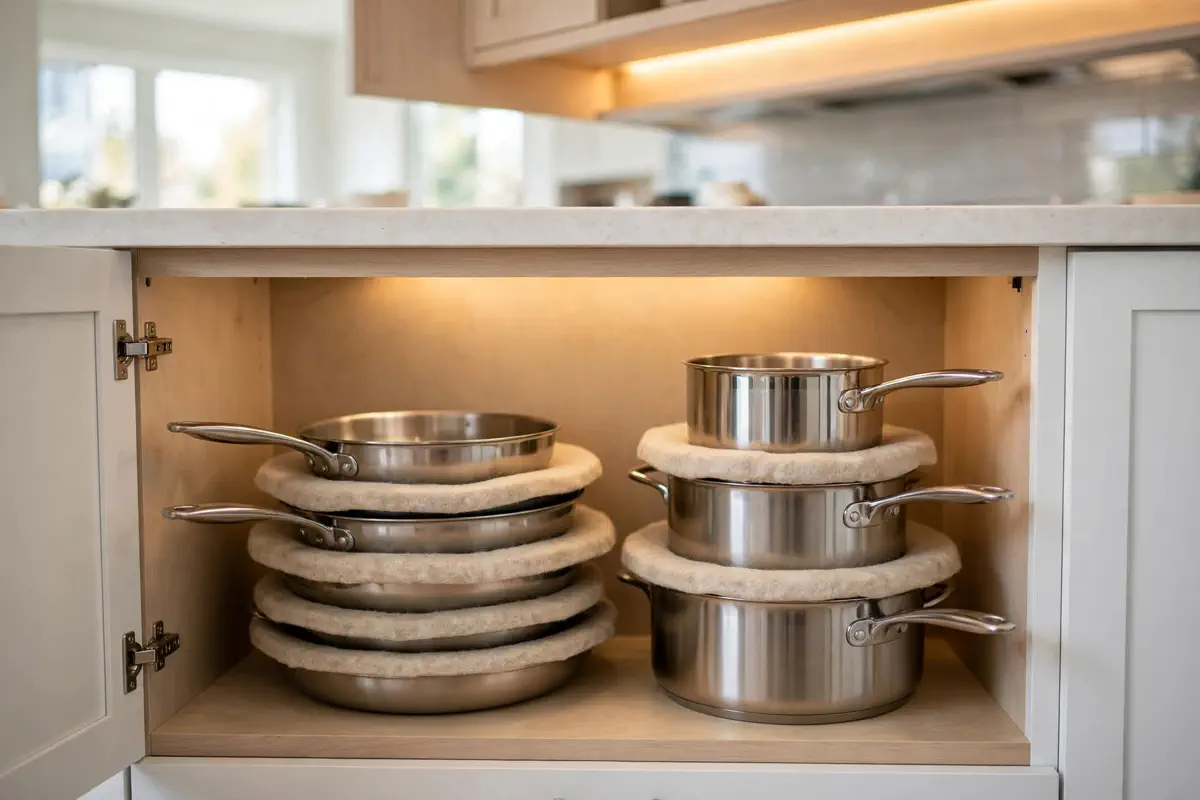
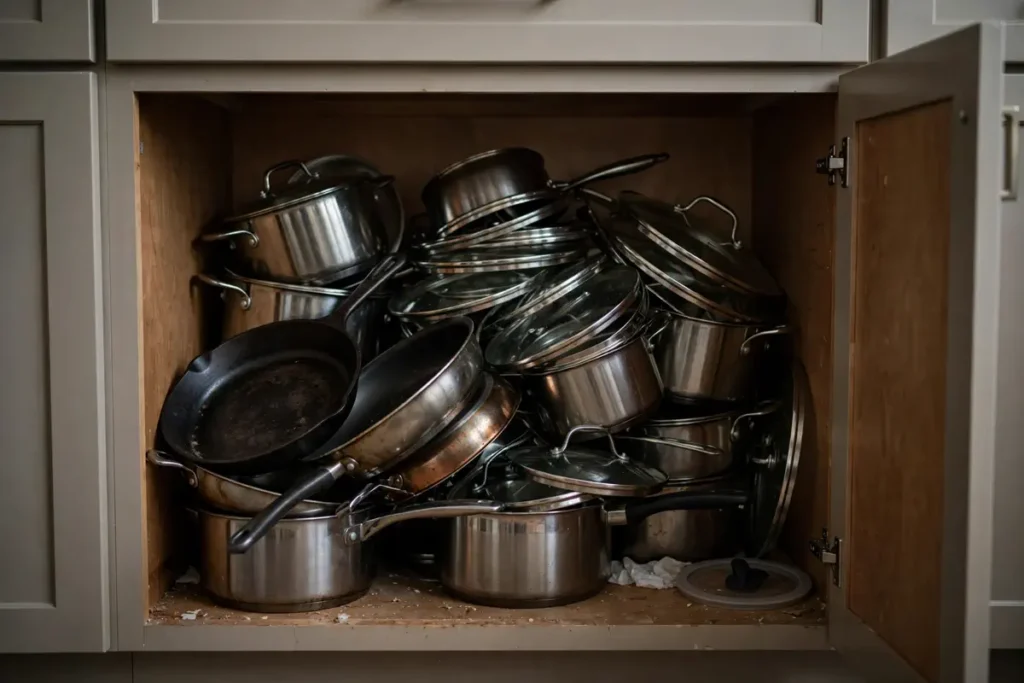
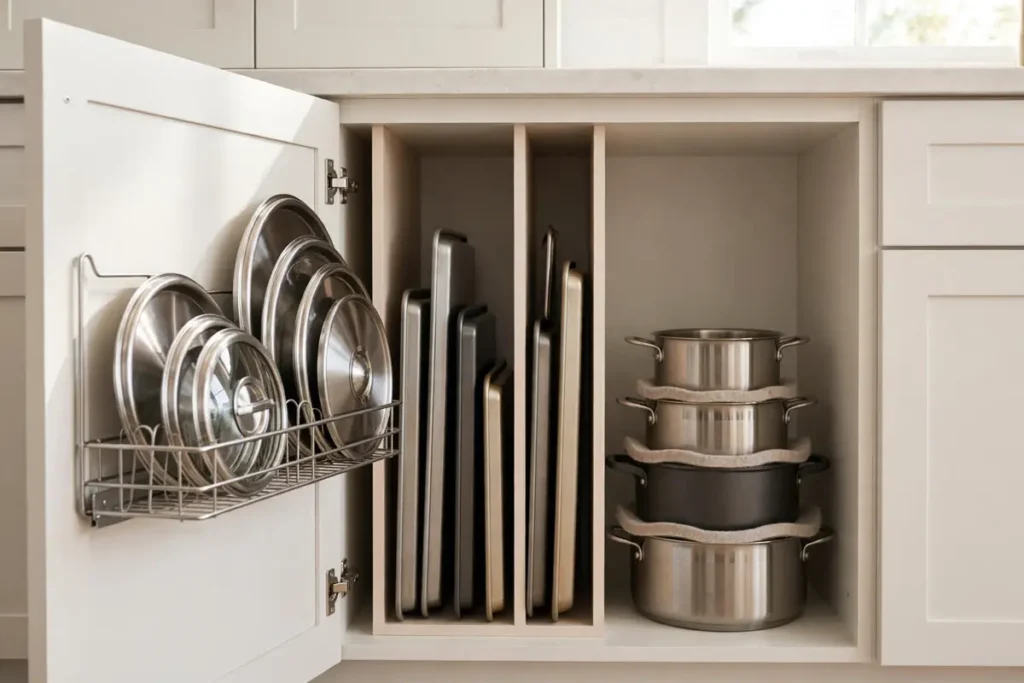
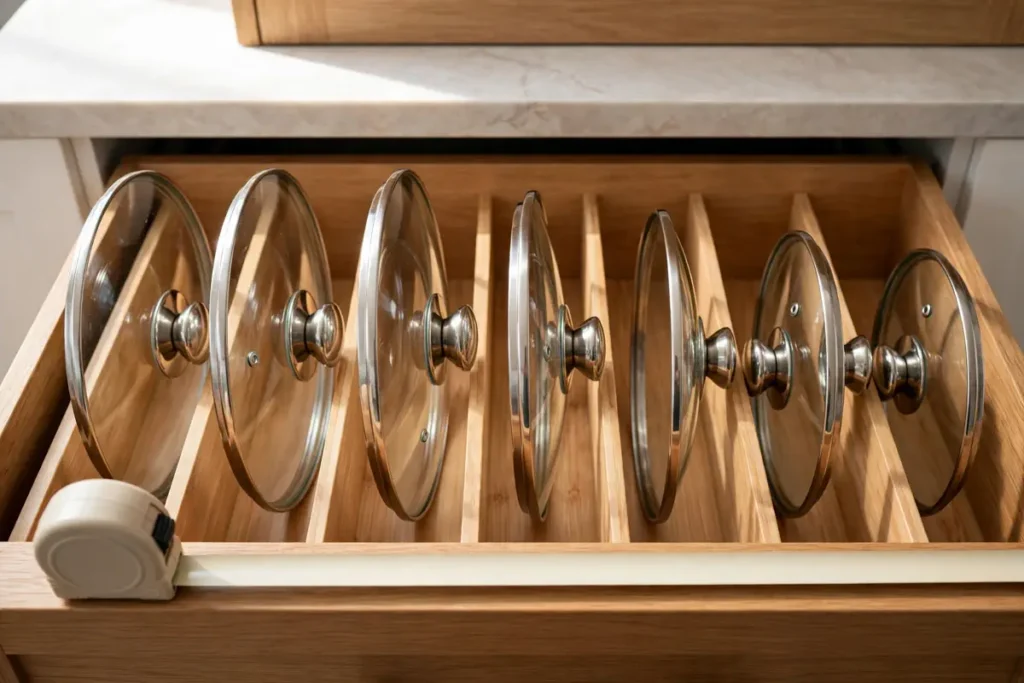
The cabinet is where most pots and pans live, and where most of them suffer. The winning setup has three parts: stack smart, protect surfaces, and put lids somewhere they cannot slide.
Stack smart means largest pot on the bottom, handles all facing the same way, and nothing nested so tight you need two hands and a prayer to separate it. Slide a felt or fabric protector between every pan, nonstick or not. Stainless can take more abuse, but protectors stop the clanging and keep rims from denting.
Measure your cabinet before you buy anything. Standard US base cabinets run about 24 inches deep, which leaves roughly 21 to 22 inches of usable depth once the door and hinges are accounted for. A vertical pan rack needs about 10 to 12 inches of depth, so it fits easily; a pull-out organizer needs the full depth plus clearance. One commenter in that r/organization thread described 18-inch-deep shallow cabinets that forced awkward stacking, which is exactly what happens when you buy first and measure later.
Free up the cabinet by moving small items out. If spice jars are squatting in your pot cabinet, our spice storage ideas will relocate them in an afternoon. For more cabinet-specific ideas, Lowe’s keeps an updated guide to pots and pans storage for small kitchens that is worth a skim.
Should you store pots and pans in a drawer or a cabinet?
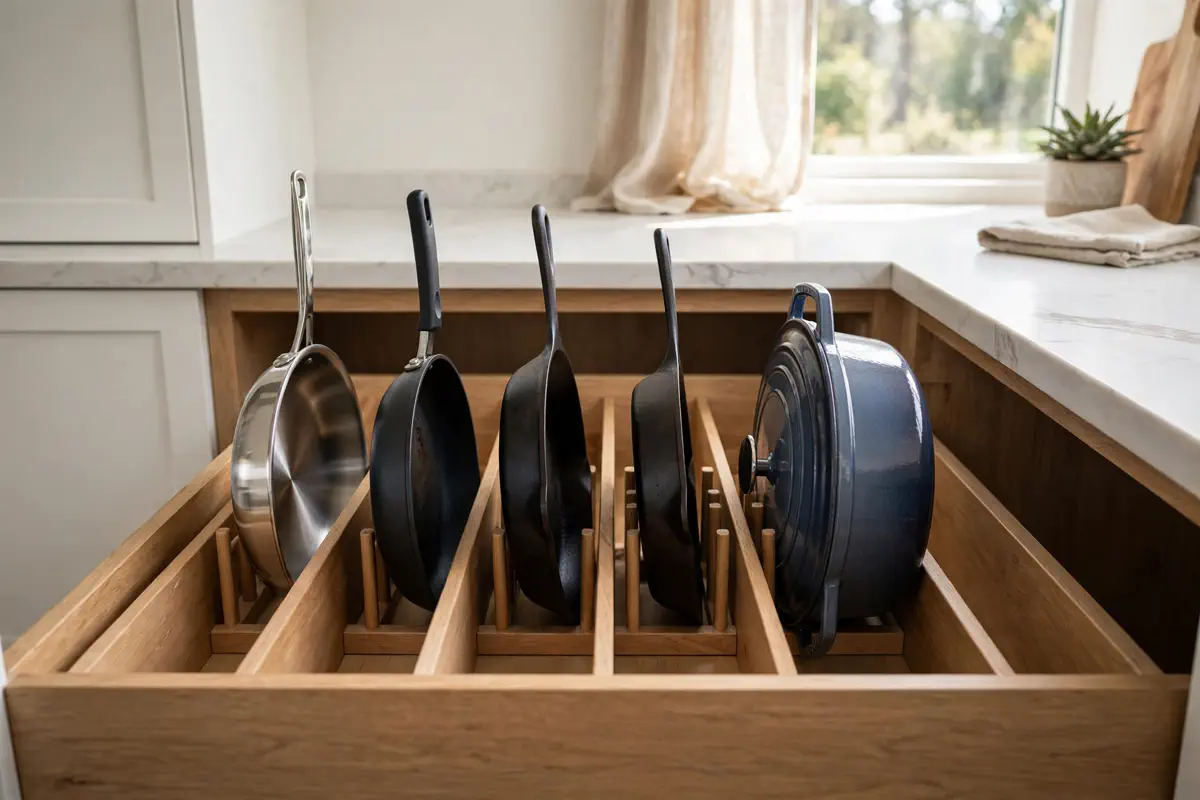
If you have a deep drawer, use it. This is the closest thing to a settled debate in kitchen organization: drawers beat cabinets for pots and pans for most people.
A drawer pulls the entire contents toward you. Nothing hides in the back, nothing requires kneeling and reaching, and a $15 to $30 set of adjustable dividers turns it into a filing system for skillets. A cabinet keeps everything at arm’s length behind a door, which means the back half becomes a graveyard of good intentions.
Cabinets win in exactly two cases: yours are unusually deep and already fitted with pull-out shelves, or you own oversized pieces like a 16-quart stockpot that no drawer can swallow. Renters should note that a drawer setup needs no screws and no landlord permission, which makes it the rare upgrade that is both the best option and the easiest one.
My judgment: when people remodel kitchens, the deep pot drawer is the feature they brag about. If you are choosing where to put effort this weekend, the drawer wins.
Is it OK to stack pots and pans?
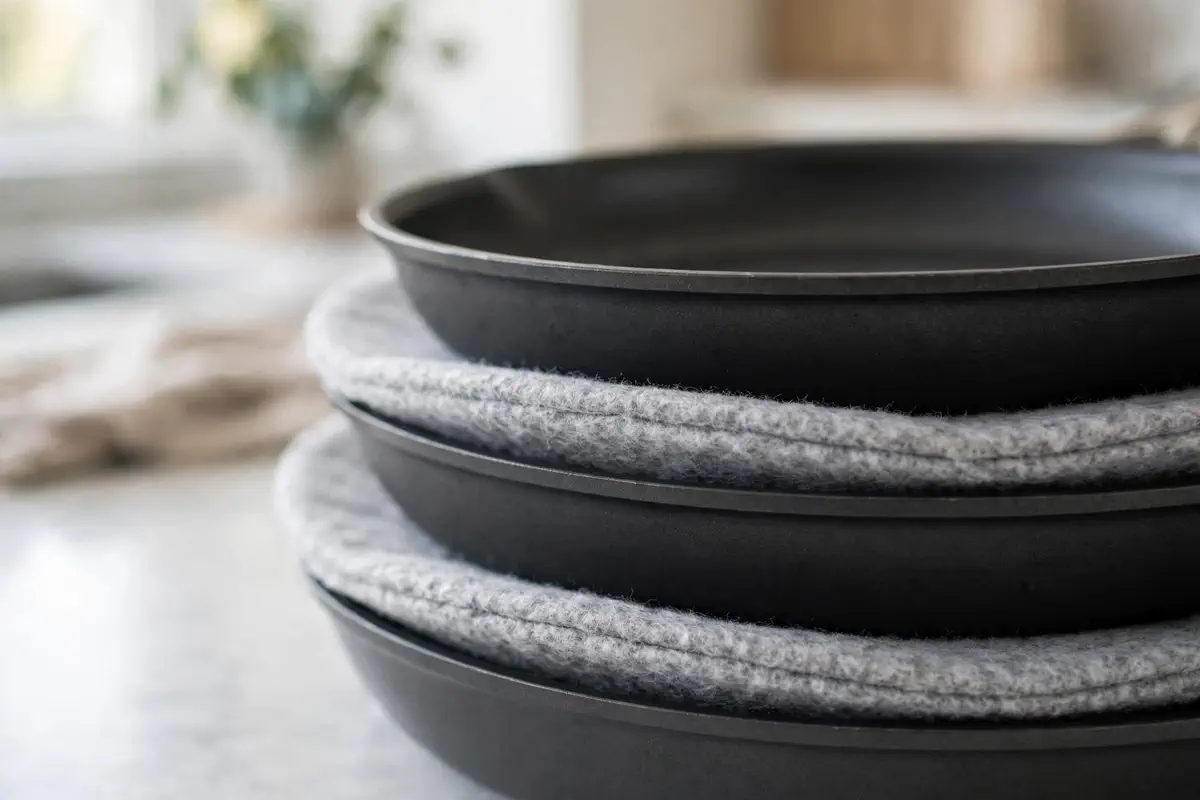
Yes, with protectors. No, bare. That is the whole answer, and it surprises people who grew up watching parents stack everything directly.
Stacking works when a soft layer sits between every cooking surface. Felt protectors, folded dish towels, even paper plates in a pinch, anything that stops metal grinding on coating. Nested stainless steel with nothing between the pieces will survive, though it will clang and scratch cosmetically over time.
Bare nonstick stacked on bare nonstick is the one to quit. The coating is the entire reason you bought the pan, and every slide of one pan across another wears it down. Home cooks in the r/Cooking thread described exactly this damage and the fix they landed on: cloths or pads between pans, every time.
Cast iron plays by its own rules, which the next sections cover. The short version: heavy pieces go on the bottom of any stack, always.
How do you store pot lids so they are easy to find?
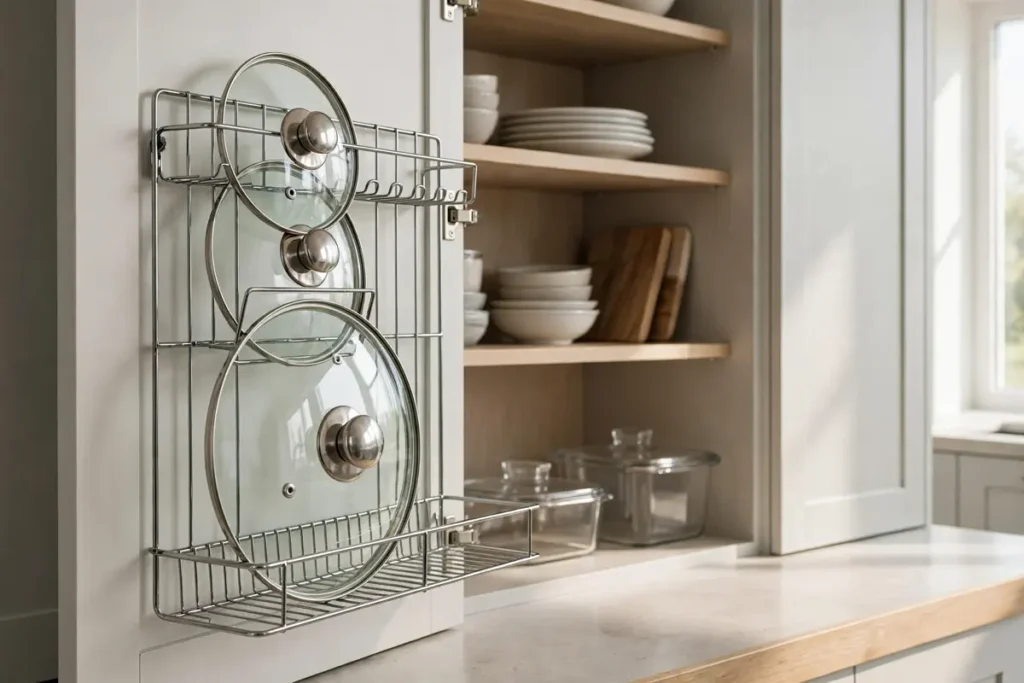
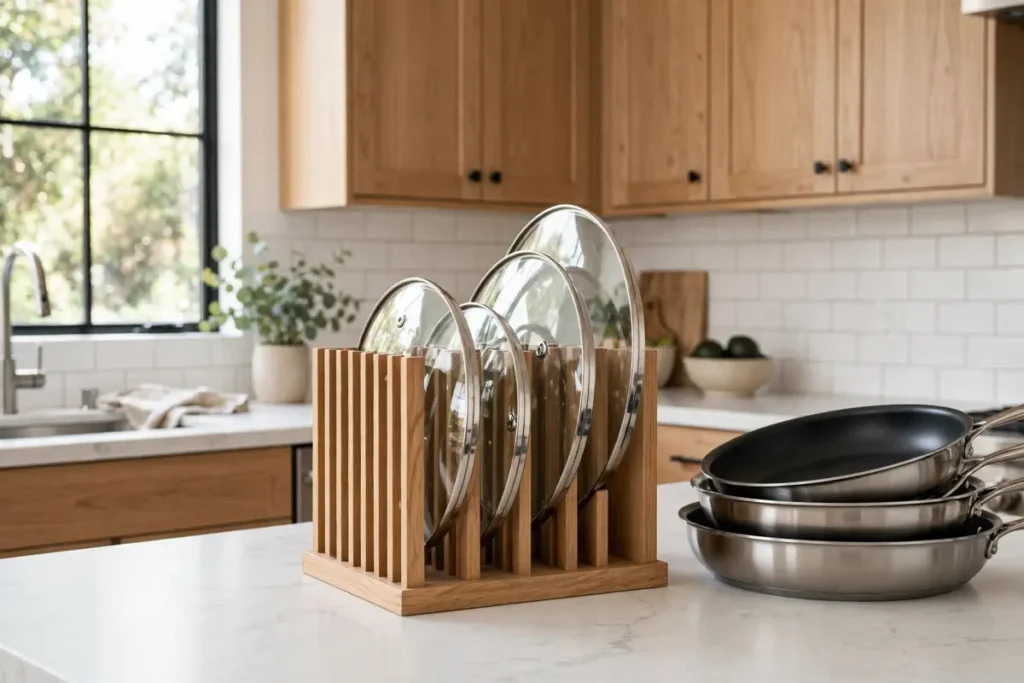
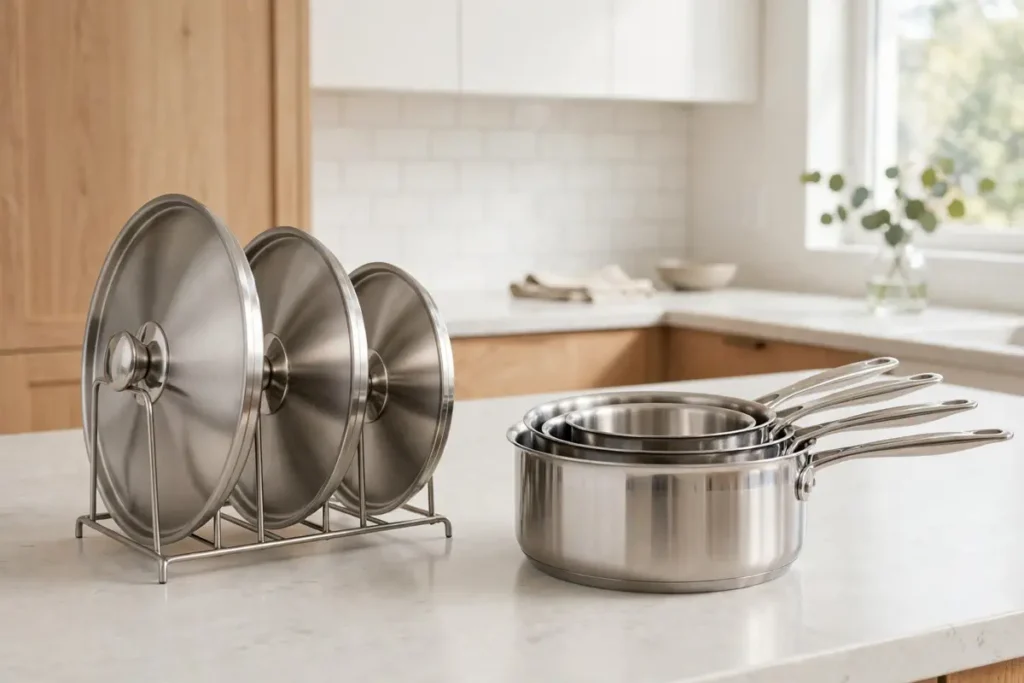
Lids cause more daily annoyance than the pans themselves. They slide, they nest badly, and they always hide the one you need. Of all the pots and pans storage ideas in this guide, the lid fixes pay off the most day to day.
The best fix is a lid rack, and the best lid rack is the one that keeps each lid with its pot. Door-mounted racks use the dead space inside the cabinet door and cost less than lunch. Countertop or in-cabinet vertical racks file lids upright like records. A tension rod wedged across a cabinet turns into a lid corral for about five dollars and zero holes, which renters love.
Here is the rule I would tattoo on every kitchen: one pot, one lid, stored together. The moment lids get their own separate zone across the kitchen, you will spend weeknights hunting. Universal lids that fit multiple pan sizes cut the lid count in half, and they are worth it if your lids outnumber your burners.
Do not buy a lid organizer before counting your lids. Three lids need a three-slot solution, not a ten-slot tower that eats half a shelf.
What is the best organizer for pots and pans?
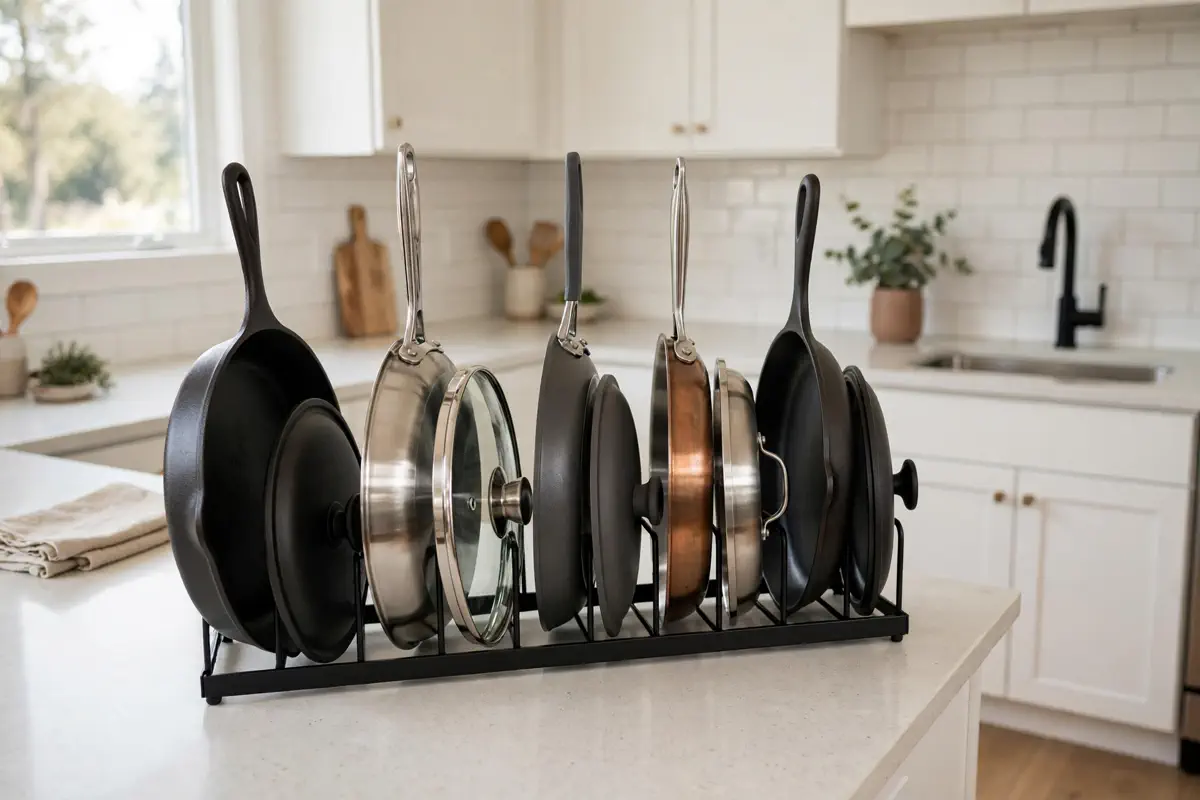
Of all the pots and pans storage ideas here, this one matters most: the best organizer is the one that matches your cabinet, not the one with the most five-star reviews. Organizers fail when people buy for the fantasy kitchen instead of the real one.
Vertical pan racks suit standard-depth cabinets and anyone who hates unstacking. They hold skillets upright in slots, and the good ones adjust to different pan sizes. Pull-out cabinet organizers suit deep base cabinets where the back half is currently unreachable; they bring the pans to you on a sliding shelf. Drawer dividers suit deep drawers and cost the least. Lid holders, door-mounted or freestanding, solve the lid problem separately.
Measure three things before you click buy: the cabinet’s interior width, its usable depth, and the height of your tallest lidded pot. Write the numbers on your phone. Then check the product’s listed dimensions against them. This single habit would prevent most organizer regret, and it takes ninety seconds.
My opinion: the boring $20 horizontal pan organizer that a commenter praised in the r/organization thread beats most clever gadgets. Simple steel, holds the weight, nothing to break. Fancy is fine, but weight capacity matters more than features. IKEA’s cookware organization guide is a good second opinion on rails and inserts if you want more product ideas.
Hanging storage: rails, hooks, and ceiling racks
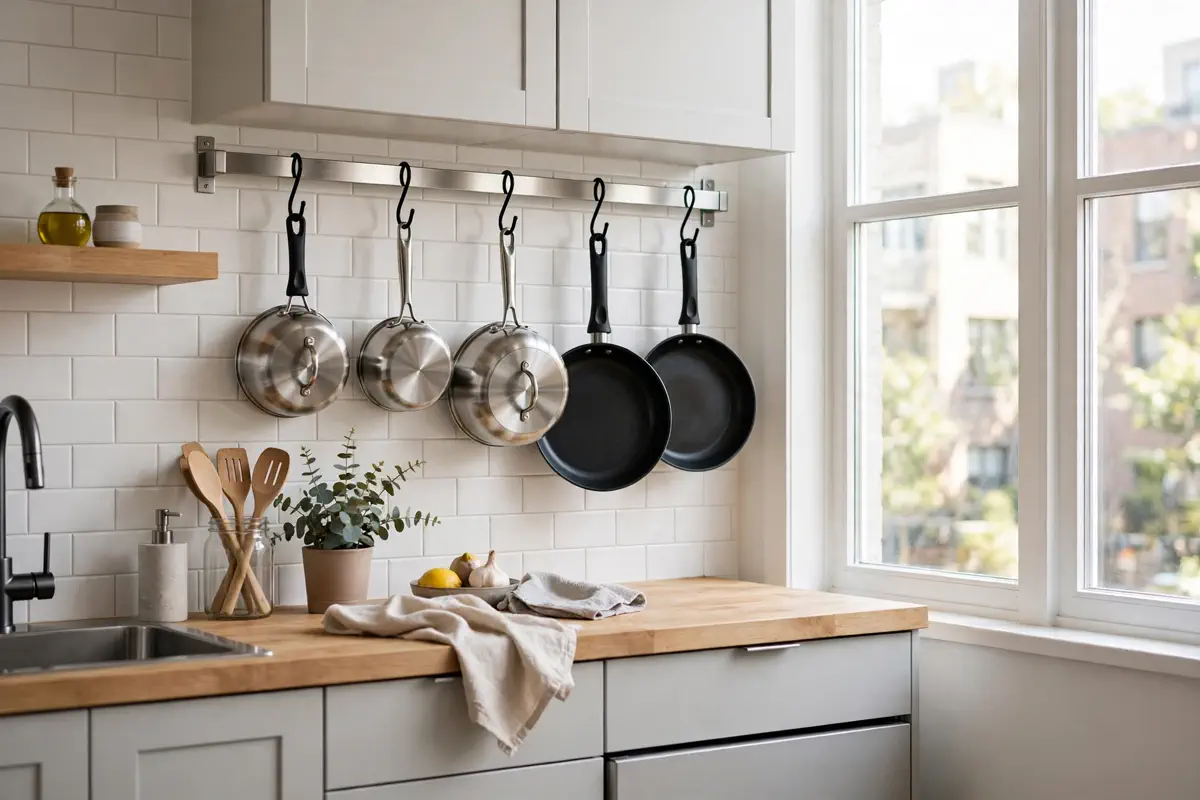
Hanging turns your cookware into wall art and frees entire cabinets. It suits people with sturdy walls, decent ceilings, and pans they do not mind seeing every day.
A wall rail with S-hooks is the entry point. Mount it into studs, not just drywall, because a rail of cast iron is shockingly heavy. A 12-inch cast iron skillet weighs around 8 pounds, and four of those plus hooks will rip a drywall anchor out of the wall. Pegboard does the same job on awkward walls and lets you rearrange hooks whenever the collection changes.
Ceiling racks are the statement piece. They suit high ceilings and serious cooks, and they are genuinely practical in kitchens with zero spare cabinets. They are not for everyone: not for renters, not for ceilings under 8 feet unless you enjoy ducking, not for anyone who hates dusting, and not for mismatched cookware you would rather not display. Be honest about which category you fall into.
If hanging appeals but the walls are off-limits, our kitchen counter organization ideas cover open-shelf alternatives that need no drilling.
How do you store cast iron and nonstick pans without scratching them?
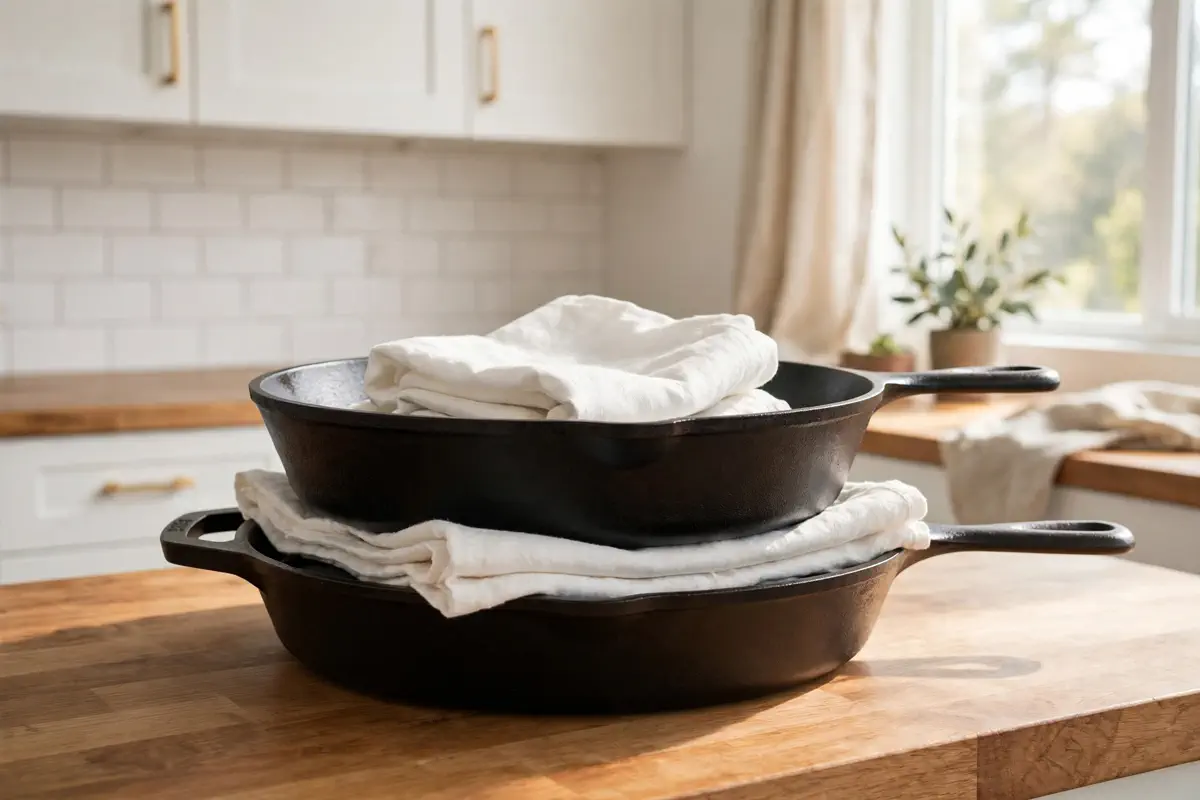
Cast iron and nonstick are the two pans people ruin in storage, in opposite ways. Cast iron is nearly indestructible but brutally heavy; nonstick is light but its coating is fragile. Store for the weakness, not the strength.
For nonstick, the rule is simple: a protector between every pan, every time. Felt pads made for this cost a few dollars for a set and last years. Stack nonstick only on nonstick or on protectors, never directly on cast iron or stainless rims.
For cast iron, weight is the whole game. Store it low, where a slip will not injure anyone, and never in a flimsy vertical slot. Multiple home cooks in the r/organization thread warned that cheap vertical organizers bend or collapse under cast iron, with one writing that they do not work for cast iron at all. A daily-use cast iron skillet can live on the stovetop, which is what plenty of cooks actually do, and a rarely used Dutch oven belongs on a low, sturdy shelf.
Do not nest a small nonstick pan inside a cast iron skillet to save space. The weight will press the coating into the rough iron every time the stack shifts. Some space savings are not worth it.
Renter-friendly and no-drill storage ideas
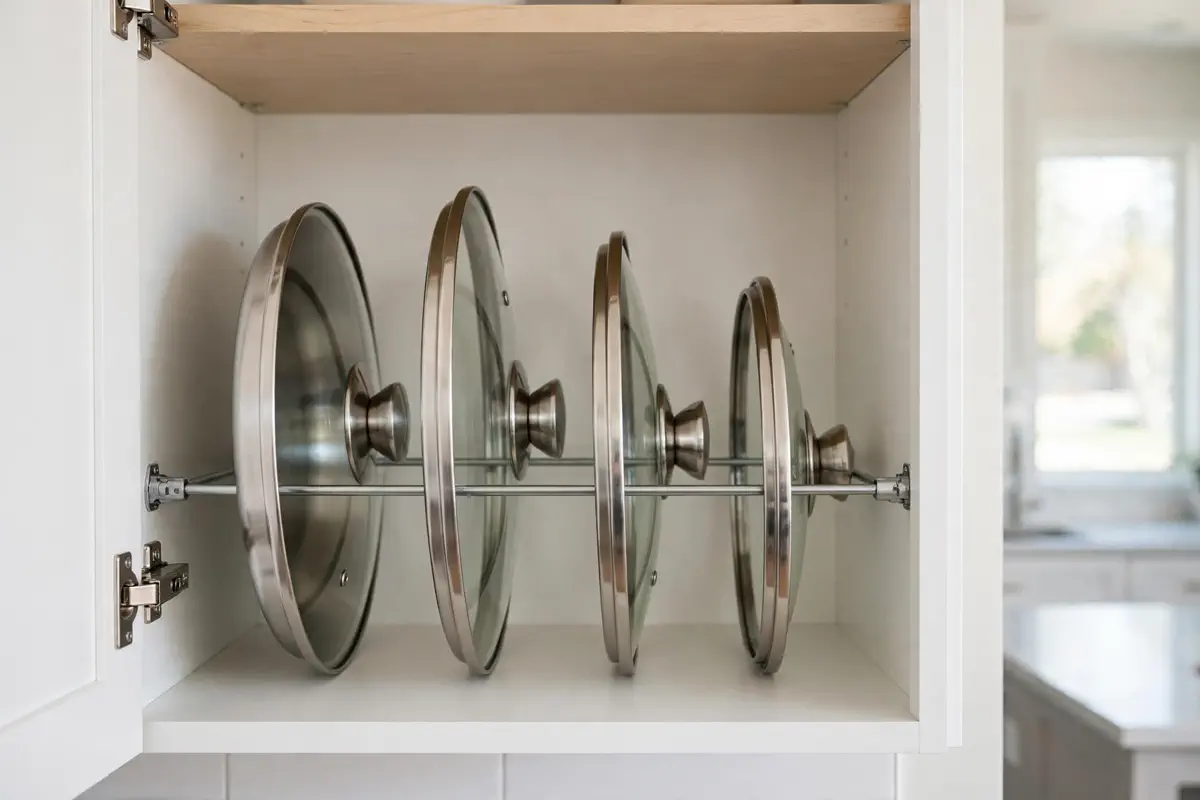
These renter-friendly pots and pans storage ideas need no drilling and put zero holes in the walls. The trick is choosing methods that grip, wedge, or stand on their own.
Tension rods are the renter’s best friend here. Wedge one across a cabinet to corral lids upright, or run two parallel rods to cradle baking sheets and cutting boards vertically. Over-the-door organizers hang on any standard interior door and hold lids, wraps, and light pans with zero screws. A freestanding rolling cart creates a whole new storage zone wherever you have 18 inches of floor, and it rolls aside when you need the space.
Command-style adhesive hooks hold lighter items inside cabinet doors: measuring cups, trivets, a small colander. Check the weight rating and stay well under it, because a hook that fails at 2 a.m. will wake the whole apartment.
My take for renters: spend your effort on the inside of cabinets, not the walls. Everything inside the cabinet leaves with you or stays invisible at move-out, and landlords never argue about what they cannot see. The deposit stays safe and the kitchen still works.
How do you store pots and pans with no cabinet space?
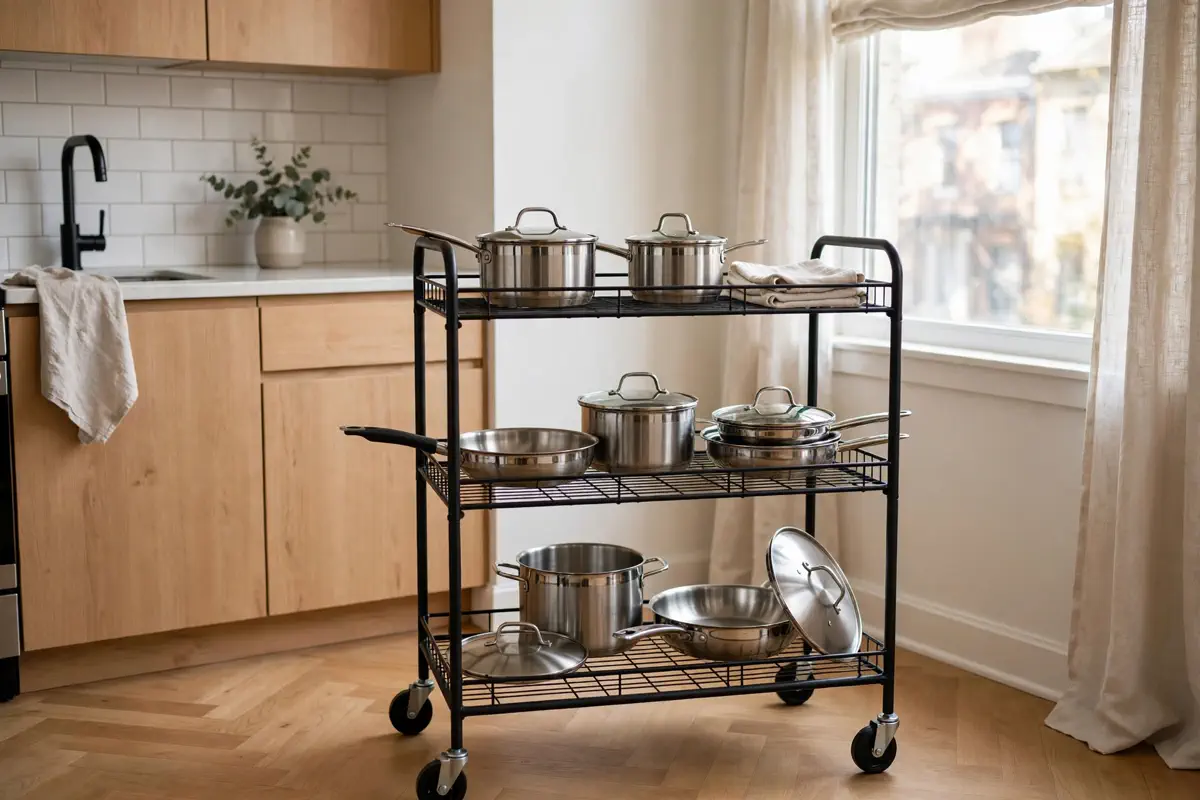
Some kitchens simply have no spare cabinet. These pots and pans storage ideas for zero-cabinet kitchens build storage in the open instead, and it works better than people expect.
A freestanding rolling cart is the fastest fix. Three tiers hold a surprising amount of cookware, the wheels let you pull it to the stove, and a butcher-block top doubles as prep space. Open shelving, even a single sturdy shelf with brackets, holds daily-use pots where you can see them. The oven itself stores rarely used pieces: baking sheets, the roasting pan, the pizza stone. Just build the habit of checking the oven before you preheat, because everyone forgets once.
The pantry can absorb overflow too. If yours has shelf space going to waste, our small pantry organization ideas will help you carve out a cookware zone without losing food storage.
One honest warning: open storage means visible storage. If your cookware is a mismatched collection of hand-me-downs, a cart in the living-room corner will bother you every day. In that case, a lidded storage bench or a closet shelf beats an open cart. Match the method to the cookware you actually own.
Small-space and corner-cabinet solutions
Corner cabinets are where pots and pans go to disappear. A blind corner with a 20 to 24 inch opening, the size one r/organization commenter described, swallows full-size skillets and gives nothing back. The fix is motion: anything that brings the back of the cabinet to you.
A Lazy Susan turntable is the classic answer that works. A two-tier turntable in a corner cabinet holds lids and small pans on top, big pots below, and one spin shows you everything. For standard deep cabinets, a pull-out sliding shelf does the same job in a straight line. Toe-kick drawers, hidden in the cabinet’s bottom trim, fit baking sheets, cutting boards, and flat lids in space that otherwise holds dust.
Under-cabinet hooks are the small win people forget. Screw a short rail or a few sturdy hooks under a wall cabinet and hang measuring cups, small saucepans, or the colander. It costs almost nothing and frees a surprising amount of shelf space above.
My judgment on corner cabinets: do not buy a fancy blind-corner pull-out system before trying a $25 turntable. The simple fix solves 80 percent of the problem for 10 percent of the price, and you will know within a week whether you need more.
Declutter first: how many pots and pans do you actually need?
No organizer can fix too much cookware. Before you spend a dollar on these pots and pans storage ideas, pull every pot, pan, and lid onto the counter and face the collection honestly.
Most home cooks use the same core set: a large skillet, a small skillet, a saucepan, a stockpot or Dutch oven, and a sheet pan. Everything beyond that should earn its shelf space. The specialty pan you use twice a year is a candidate for the donation box, the high shelf, or a relative’s kitchen.
Use the one-in-one-out rule going forward. A new pan enters only when an old one leaves. Donate usable cookware to a thrift store or a shelter kitchen; recycle warped and flaking pieces through your city’s scrap metal program. Check what your city accepts before you haul anything to the curb.
This step feels like a detour, but it is the move that pays off most in the whole guide. Organizing twelve pans you never use takes longer and costs more than organizing the five you cook with. If under-sink chaos is part of the same purge, our under-sink kitchen organization guide tackles that cabinet next.
Your next step: pick one cabinet and reorganize it this weekend
Here is my honest verdict after all sixteen of these pots and pans storage ideas: a single deep drawer or a vertical divider setup beats every stacking system, every gadget, and every clever hack. Accessibility wins. The storage method you will actually maintain is the one that puts the right pan in your hand in five seconds.
So do not reorganize the whole kitchen. Pick one cabinet, the one that annoys you most, and give it thirty minutes this weekend. Pull everything out, wipe the shelf, keep what you use, add protectors or a divider, and put it back with lids beside their pots. One cabinet done well teaches you more than a whole kitchen done hastily.
Tell us in the comments which cabinet you tackled and what worked. And if this guide helped, save it for the next kitchen, because the same system works wherever you cook next.
Cabinet-fit quick guide
Pair these pots and pans storage ideas with typical US cabinet dimensions, so you can check fit before buying. Measure your own cabinets, these are starting points, not guarantees.
| Storage method | Needs this much depth | Needs this much width | Notes |
|---|---|---|---|
| Vertical pan rack | About 10 to 12 inches | About 8 to 12 inches | Fits most base cabinets |
| Pull-out organizer | Full cabinet depth, about 21 to 22 inches | 12 inches and up | Check slide clearance |
| Door-mounted lid rack | Door thickness only | 8 inches and up | Measure door panel, not frame |
| Deep drawer dividers | Drawer depth, usually 18 to 21 inches | Any | Adjustable dividers fit most |
| Wall rail with hooks | Wall space, not cabinet | 24 inches and up | Must hit studs |
| Lazy Susan turntable | About 18 inches | 18 inches and up | Round footprint |
Organizer picks by situation
| Organizer type | Best for | Price tier |
|---|---|---|
| Felt pan protector set | Any stacking, especially nonstick | Budget |
| Vertical pan rack | Skillets in standard cabinets | Budget |
| Horizontal pan organizer | Heavy pans, deep shelves | Budget (a $20 pick praised on r/organization) |
| Drawer dividers | Deep drawers | Budget |
| Door-mounted lid rack | Lid chaos | Budget |
| Pull-out cabinet shelf | Deep base cabinets | Mid |
| Wall rail with S-hooks | Small kitchens, display storage | Budget to mid |
| Rolling kitchen cart | No cabinet space | Mid |
| Universal lids | Cutting your lid count in half | Budget to mid |
What is the most efficient way to store pots and pans?
The most efficient of these pots and pans storage ideas: store pans upright in a deep drawer with dividers or on a vertical pan rack inside a cabinet, with each lid kept beside its pot. This beats stacking because nothing gets buried and nonstick coatings stay scratch-free. It works in most standard US cabinets.
What is the best way to store pots and pans in a cabinet?
Stack largest to smallest with the handles facing one way and a felt protector between every pan. Keep lids in a door-mounted rack or upright beside the stack. Measure your cabinet’s usable depth, usually about 21 to 22 inches, before buying any organizer.
What is the best organizer for pots and pans?
It depends on your cabinet. Vertical pan racks suit standard cabinets, pull-out shelves suit deep base cabinets, and adjustable dividers suit deep drawers. Measure your cabinet’s width, depth, and tallest lidded pot first, then match the organizer to those numbers.
Is it OK to stack pots and pans?
Yes, as long as a soft protector sits between every cooking surface. Stacking bare nonstick pans scratches the coating and shortens the pan’s life. Put heavy pieces like cast iron on the bottom of any stack and never stack bare nonstick on rough cast iron.
How do you store pots and pans with no storage space?
Use a freestanding rolling cart, a wall rail with hooks, or open shelving for daily pieces, and store rarely used items in the oven or pantry. Check the oven before preheating. Open storage suits cookware you do not mind seeing every day.
How do you store pot lids?
Keep each lid with its pot, stored upright in a rack, a door-mounted holder, or a tension-rod corral inside the cabinet. Avoid tossing lids loose on top of stacks, which is how they slide, chip, and disappear. Universal lids that fit several pans cut the total count.
Should pots and pans be stored in a drawer or a cabinet?
A deep drawer wins for most people because it pulls everything toward you and nothing hides in the back. Cabinets win for oversized pieces like a 16-quart stockpot or when pull-out shelves are already installed. Renters can set up a drawer system with no screws.
How do chefs store pots and pans?
Most professional kitchens hang pots on wall or ceiling racks for speed, since cooks grab them dozens of times per service. At home, the same logic applies on a smaller scale: store the 3 or 4 pieces you use daily where you can reach them fastest, and the rest further away.
How do you store cast iron pans?
Store cast iron low, where it cannot fall on anyone, and never in a flimsy vertical slot that can bend or collapse under the weight. Put a cloth or paper towel between stacked pieces to prevent rust from trapped moisture, and keep daily-use skillets on the stovetop if that suits your kitchen.
What type of cabinet is best for pots and pans?
A deep base cabinet or a deep drawer works best, ideally 24 inches deep with full-extension pull-outs or dividers. For corner cabinets, add a Lazy Susan turntable so nothing disappears in the back. Avoid shallow 18-inch cabinets for large stockpots, which will not fit comfortably.
If your pots live in a deep cabinet, the front and back zone system in our guide on how to organize deep kitchen cabinets keeps the daily pot in front.
