
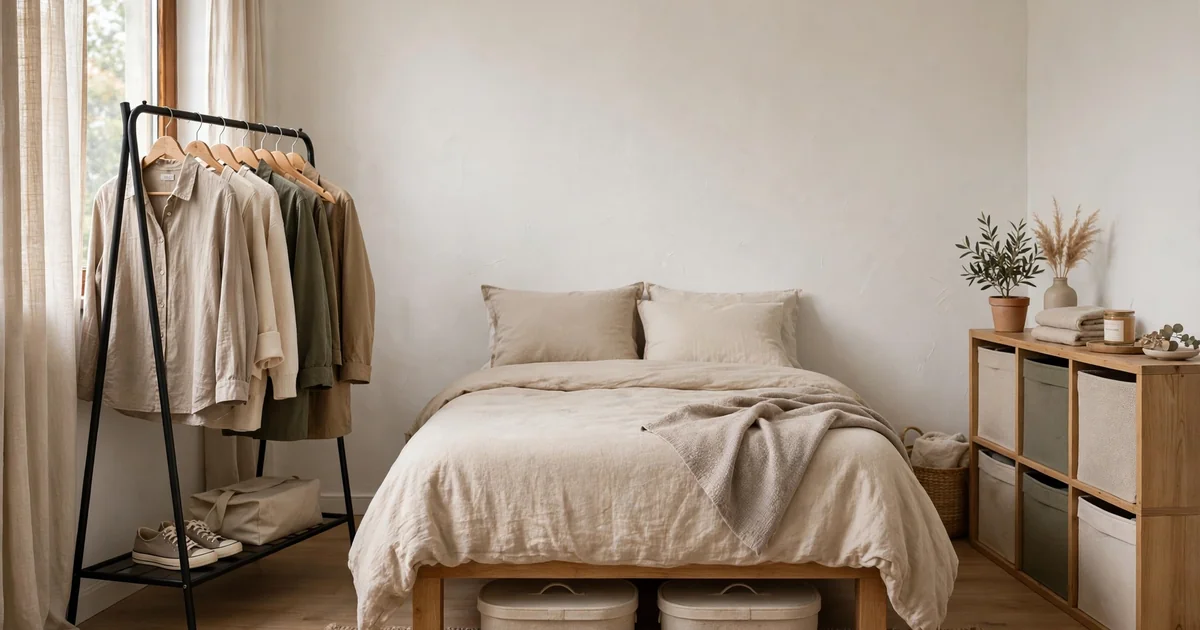

Organizing a bedroom without a closet is not a storage problem. It's a zoning problem. You already own the space a closet would have used, it's just spread across your walls, your bed, and your floor, and right now your clothes are using all of it badly.
The fix is a simple system with five zones: hang what creases, fold what does not, put shoes in one place, keep tomorrow's outfit ready, and get off-season clothes out of sight. Do those five jobs in five places and the room stops looking like a laundry pile, even if you never build a thing. This guide shows how to organize a bedroom without a closet so every item has a home you can reach in the morning without thinking.
TL;DR: Organizing a bedroom without a closet means skipping the single big wardrobe and building five zones instead: a hanging zone for crease-prone clothes, a folding zone for knits and tees, a shoe zone that keeps pairs off the floor, a daily zone by the door for coats and tomorrow's outfit, and an off-season zone under the bed or on a high shelf. Measure your hanging clothes first, since rod feet and shelf inches decide which furniture fits. Renters can do the whole system with no drilling, using a garment rack, a tension rod, hooks, and under-bed bins.
| Zone | Job | Where it lives | First buy |
|---|---|---|---|
| Hang | Shirts, dresses, coats that crease | Garment rack, wardrobe, or curtain closet | Garment rack or tension rod |
| Fold | Tees, knits, jeans, loungewear | Shelves, cubes, or a drawer unit | Cube shelf with fabric bins |
| Shoes | Every pair, off the walkway | Wall shelf, vertical rack, or under-bed case | Over-door or vertical shoe rack |
| Daily | Coat, bag, tomorrow's outfit | Hook rail or valet stand by the door | Peg rail or over-door hooks |
| Off-season | Clothes you won't wear for months | Under-bed bins or a high shelf | Lidded under-bed bins |
What is the no-closet system, in plain terms?
Forget the idea of replacing your missing closet with one big piece of furniture. A closet works because it does five jobs at once, and one wardrobe rarely does all five well in a small room. The no-closet system splits those jobs across the room on purpose. Hanging clothes go on a rack, a rod, or inside a wardrobe on one wall.
Folded clothes go on shelves or in a drawer unit somewhere else, so you're not digging through a tall pile to find one tee. Shoes get their own zone, because shoes on the floor are what make a bedroom look messy fastest. That is organizing a bedroom without a closet in one line: five zones, each with one job.
Coats and bags get a hook rail by the door, so they never land on the chair. Off-season clothes leave the room's daily rotation entirely and go under the bed or up high. My opinion is blunt: if you buy one piece first, buy the hanging zone, since wrinkled shirts are the daily pain, and everything else can wait a week. This system is not for a room that already has a good closet. It's for the room that has none. Done this way, organizing a bedroom without a closet stays tidy on tired evenings too.
How do you start organizing a bedroom without a closet when clothes are everywhere?
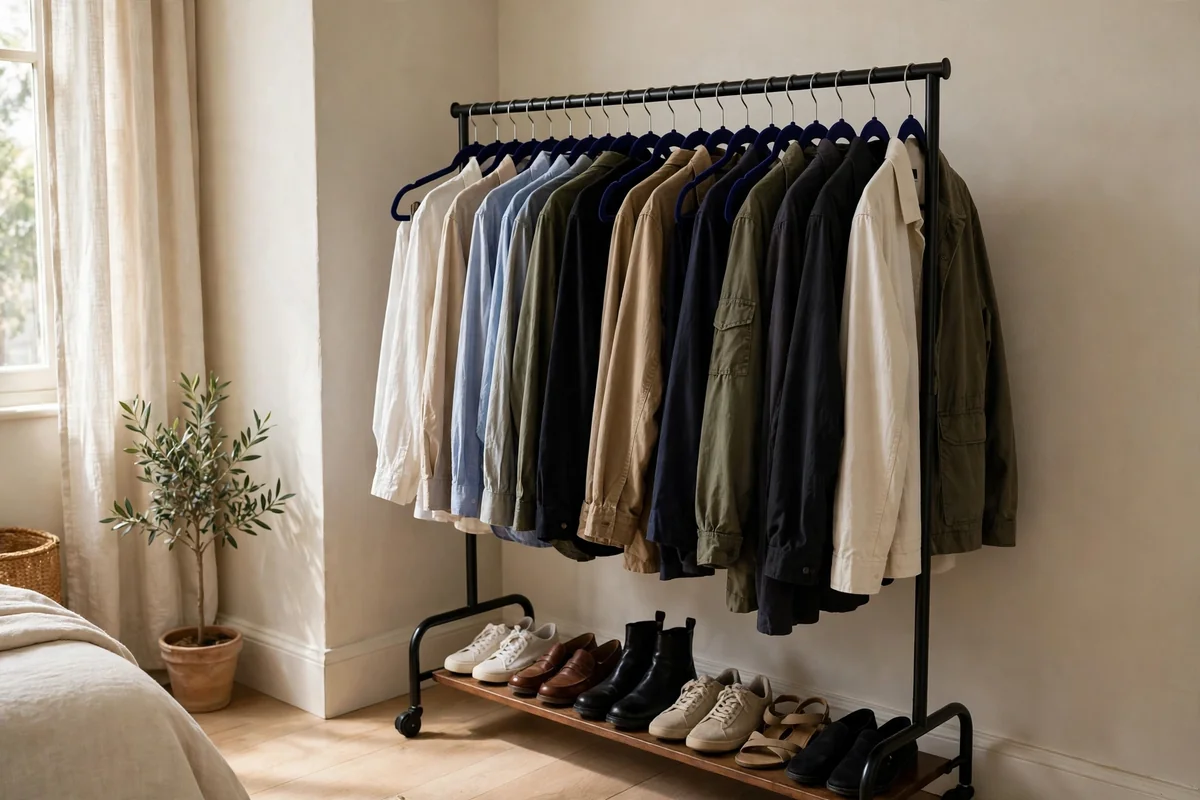
Start by taking every item of clothing out of its current hiding place and putting it on the bed, all of it, including the chair pile and the bag by the door. This looks worse for twenty minutes, then it gets better, because you can finally see what you own. Sort into three piles: wear now, store for another season, and let go.
Small Space Tips suggests a capsule of 25 to 35 items for the current season, and that range is a good target for a no-closet room, since open storage punishes excess fast. Anything you have not worn in a year goes in the let-go pile unless it's a true special-occasion piece, and be honest about how many of those you really own. The purge is the unglamorous first half of organizing a bedroom without a closet, and it decides everything after it.
Put the off-season pile straight into labeled bins under the bed before you buy anything else. What is left is your real wardrobe, and it's almost always smaller than you feared. Count the hanging items and the folded items separately, since those two counts decide how much rod and shelf space you need. This step is not for people who want to keep everything. If you skip the purge, no rack or wardrobe will save the room, because the room simply holds more clothes than it has places for. Count first, because organizing a bedroom without a closet fails when the rack is too short for the clothes.
How much hanging space do you actually need?
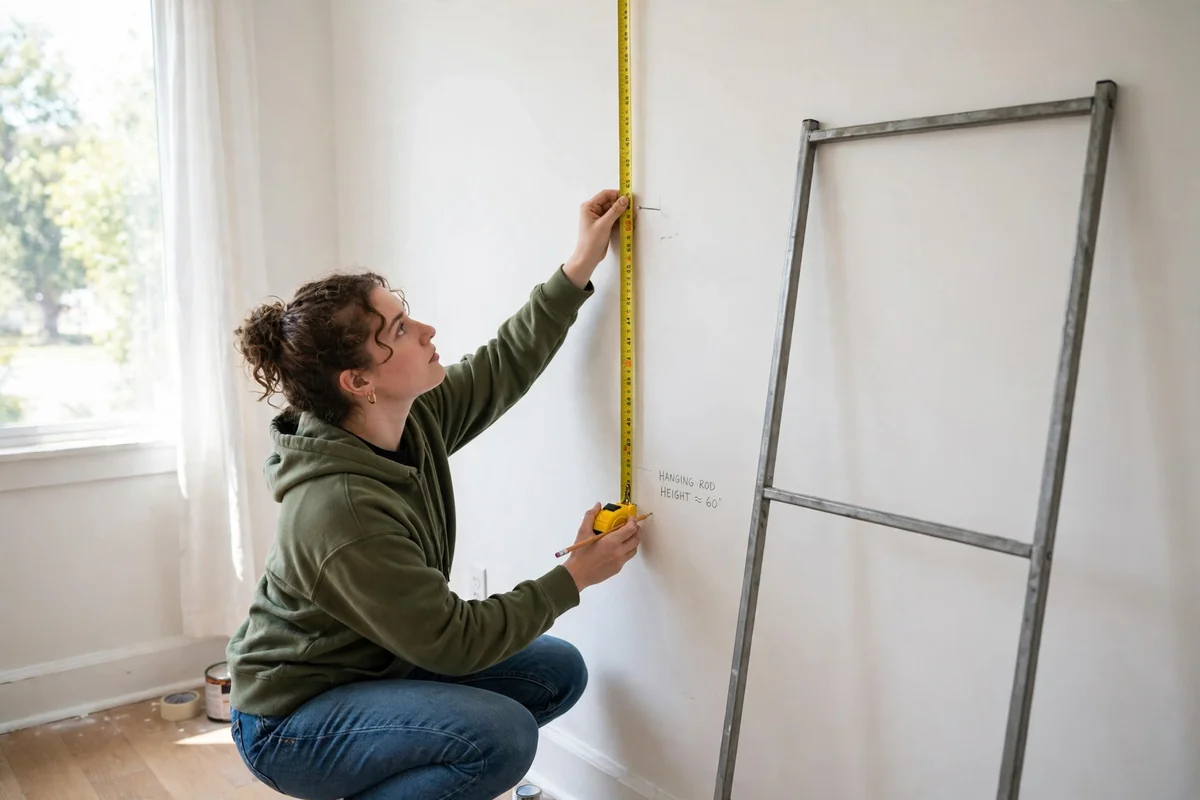
Hanging space is measured in rod feet, not in furniture pieces, and a quick count saves you from buying a rack that holds half your clothes. Count your hanging items, then multiply by about 1.5 inches per garment, which is the rule of thumb for hangers on a rod. Forty shirts and pants need about 60 inches, or 5 feet, of rod.
A single 4-foot rack won't hold them, which is why so many people end up with a second chair pile. The IKEA PAX and KOMPLEMENT buying guide gives the heights to plan around: about 39 inches for coats, 32 inches for blouses, 47 inches for short dresses, and up to 75 inches for really long garments. That math is the quiet heart of organizing a bedroom without a closet, and it beats guessing in the aisle.
Hunker puts a single rod at 60 to 68 inches above the floor, and a double rod with the lower rod at 40 inches and the upper rod at 80 inches, which doubles hanging space for shirts and pants in the same wall width. That double-hang trick is the best buy in a no-closet room, since shirts and folded pants are most of what most people hang. Measure your longest dress or coat before you set any rod height.
My call: plan for double hang wherever you can, and keep one short single-hang section for long items only. Whichever option you pick, organizing a bedroom without a closet starts with that choice, not with a shopping spree.
Should you buy a garment rack, a wardrobe, or a curtain closet?
These three options cover almost every no-closet room, and the right one depends on your budget, your dust tolerance, and whether you can put screws in the wall. A garment rack is the cheapest and fastest start. Small Space Tips lists garment racks at $20 to $80, and a rack with a bottom shelf for shoes gives you two zones for one price.
The trade-off is dust and visual noise. A freestanding wardrobe or armoire costs more, with Small Space Tips listing $120 to $400 and up, but its doors hide the mess and keep dust off, which matters if you hate looking at clothes. For renters, organizing a bedroom without a closet this way means the whole system moves with you.
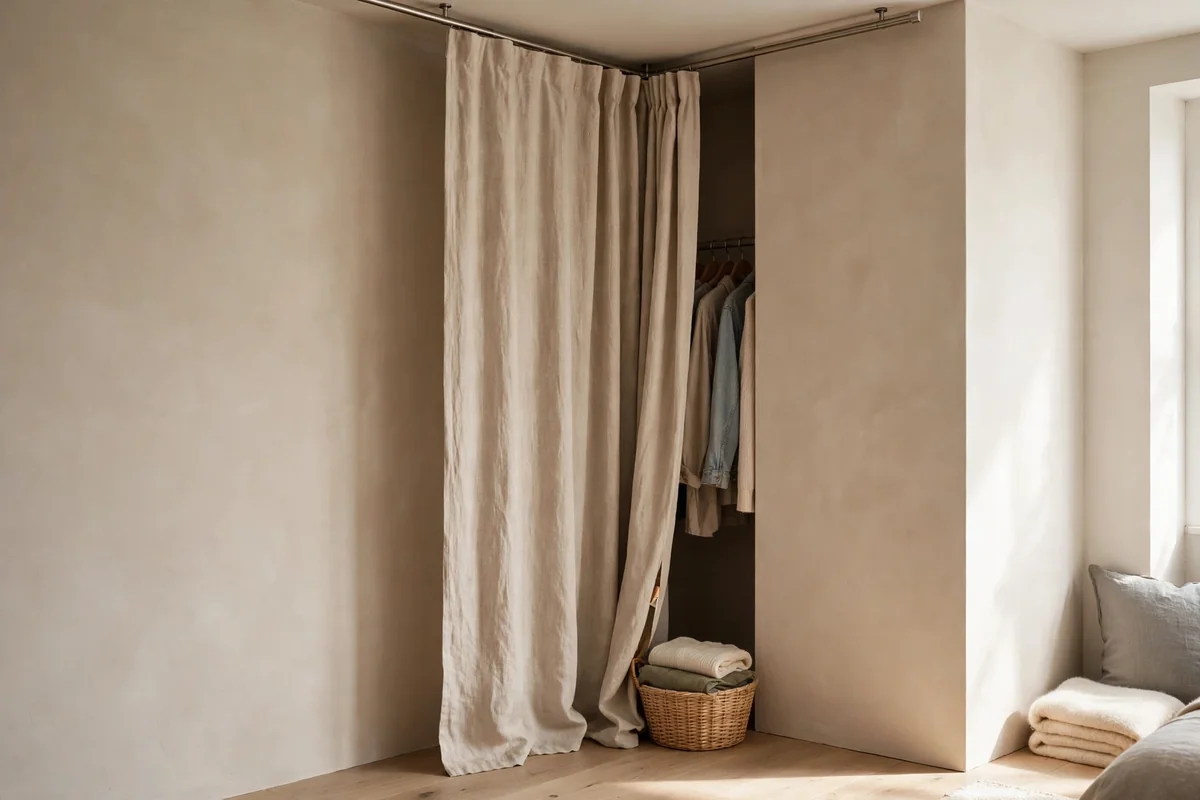
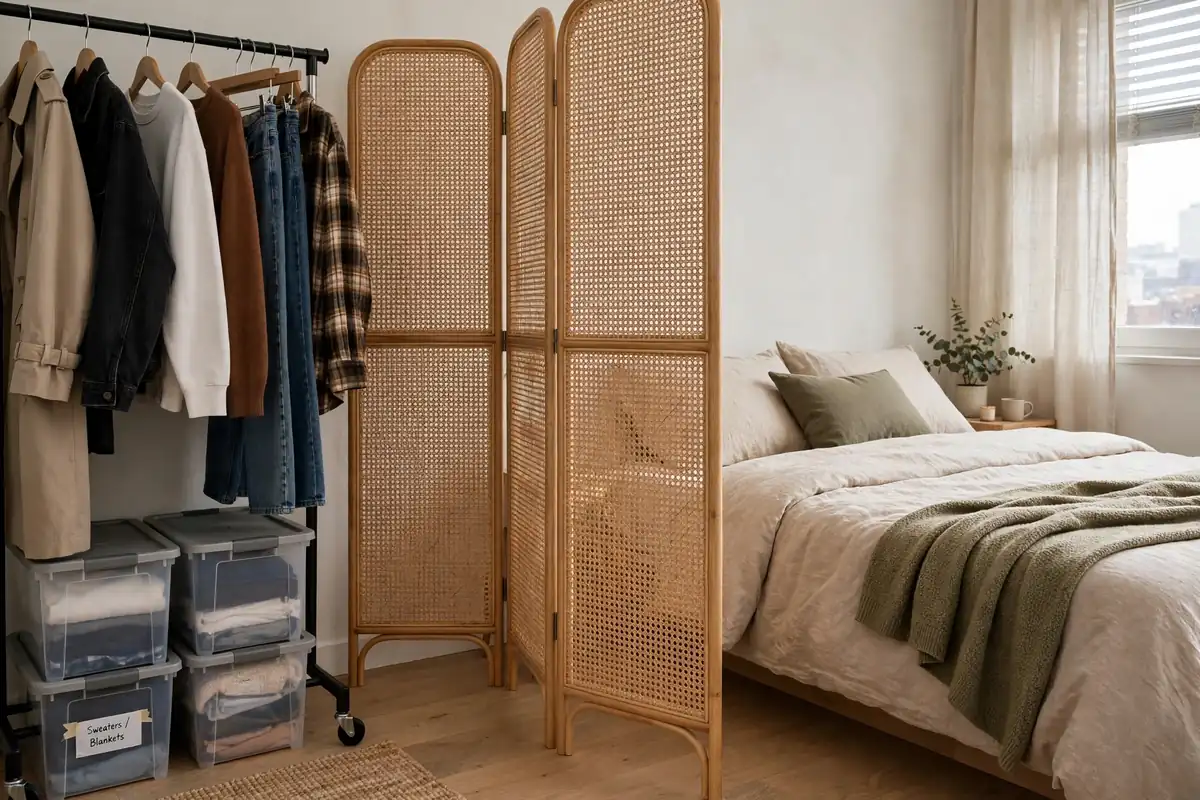
A curtain closet sits between the two: a ceiling or wall track with a rod and a linen curtain, which hides the clothes for far less than a wardrobe and comes down cleanly when you move. Check your lease before you drill for the track, and use a freestanding frame if drilling is banned. My judgment: start with a rack if money is tight, buy a wardrobe for dust control, and build a curtain closet for a hidden renter look.
See our small closet organization ideas. This choice is not for a room with a wide empty wall and a big budget, where a full PAX system wins outright. Folded storage is the quiet half of organizing a bedroom without a closet, and it deserves the same plan as hanging.
| Option | Typical cost | Best for | Watch out for |
|---|---|---|---|
| Garment rack | $20 to $80 | Renters, tight budgets, capsule wardrobes | Dust, everything visible |
| Freestanding wardrobe | $120 to $400+ | Dust control, a tidy look, long-term rooms | Big footprint, hard to move |
| Curtain closet | $30 to $150 for track, rod, and curtain | Hidden look on a renter budget | Needs a track mount, curtain swings |
| PAX-style system | $200 and up | A full wall, a long stay, lots of clothes | Price, assembly time, delivery |
How do you hang clothes without drilling a single hole?
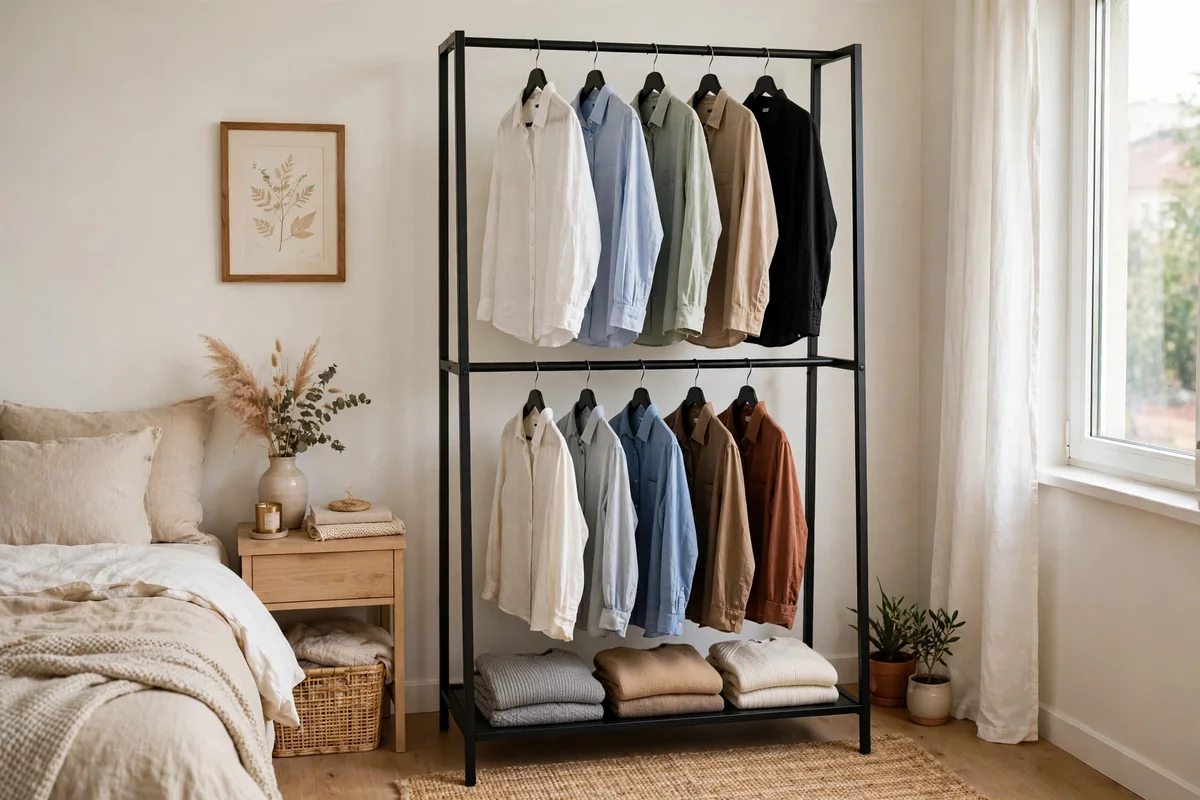
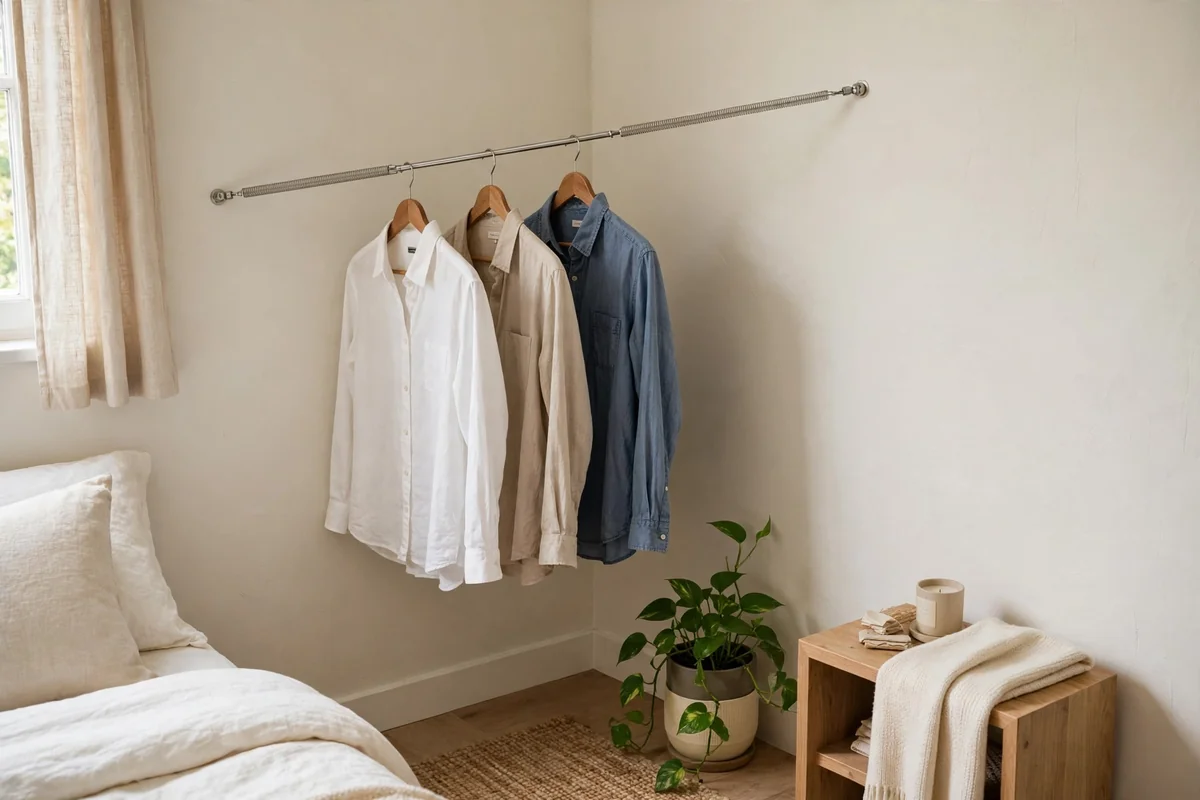
You can hang a full wardrobe with zero holes in the wall, and renters should start here before asking a landlord for anything. A freestanding garment rack is the obvious first piece, and a rolling one can move to a corner when you need floor space, which is gold in a studio. A tension rod across a wall corner or a narrow alcove gives you a second hanging section for almost no money, as long as the walls are solid and the rod is rated for the load, so test it with a few heavy coats before you trust it with everything.
Over-door hooks and over-door hanging shelves add 10 to 15 items, according to the Gorenvil tiny bedroom guide, and they use a door you already own. Done right, organizing a bedroom without a closet keeps the daily rotation small and the rest out of sight.
A freestanding wardrobe frame with no wall fixing works too, though it eats more floor. Shirts need about 40 inches of drop and long dresses need about 60 inches, so a short rack leaves hems on the floor. My take: no-drill hanging is a complete solution, not a compromise, for most renters. It's not for heavy collections of coats in one spot, since a tension rod or a cheap rack will bow under that weight, and that job needs a wardrobe frame or a wall-fixed rod into studs. Shoes are where organizing a bedroom without a closet usually falls apart, so give them a zone first.
Where do folded clothes go when there is no dresser?
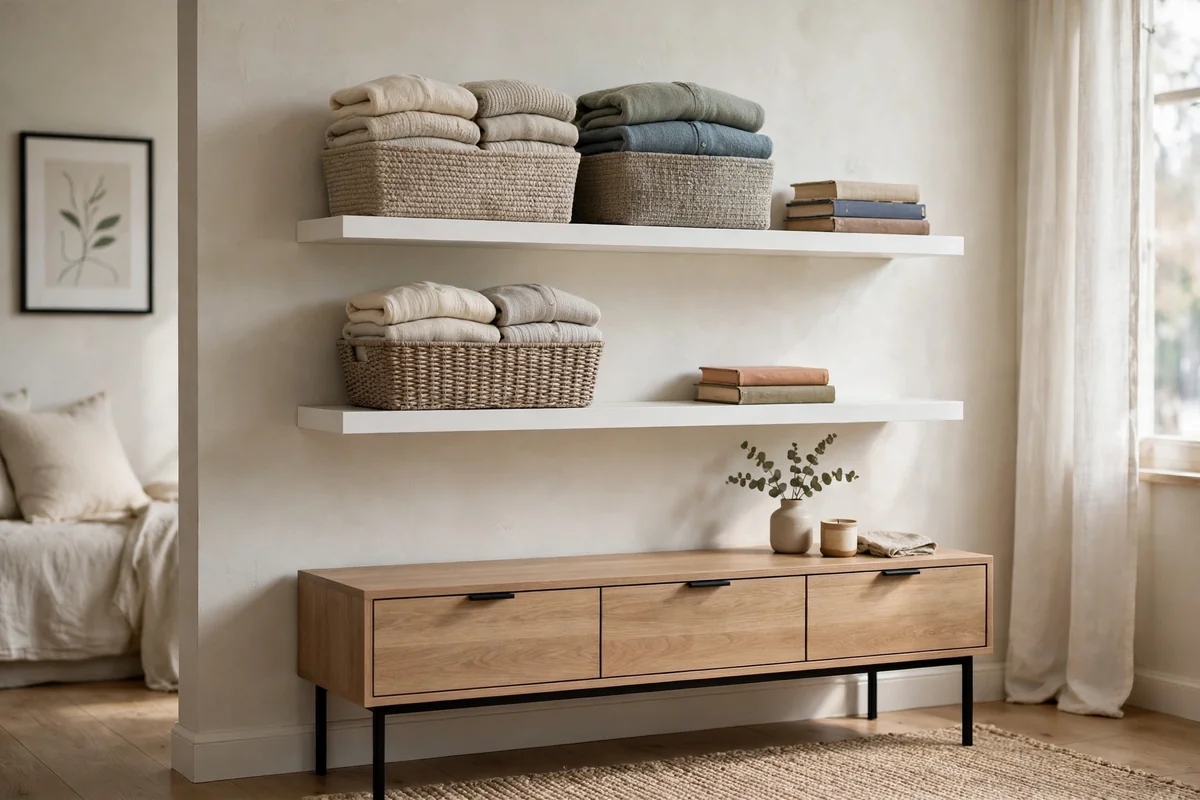
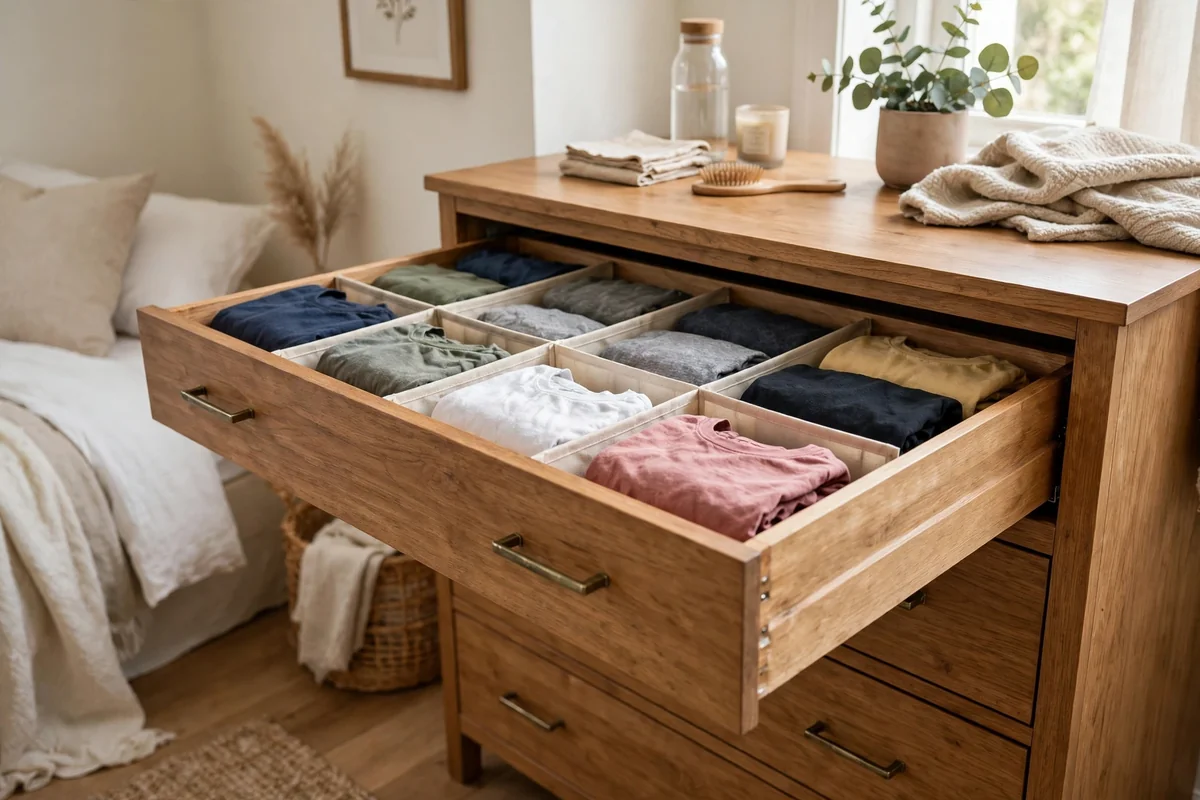
Folded clothes need shelves or drawers, and the best choice is the one that matches how you actually dress in the morning. A cube shelf with fabric bins is the cheapest full solution: each cube holds one category, tees in one, jeans in another, loungewear in a third, and you can see every cube at a glance. A slim tallboy works better if you hate looking at folded stacks, and a 3-drawer rolling cart fits in 12 to 18 inches of width, according to Gorenvil.
Fold knits vertically, like files in a drawer, so you can pull one tee without toppling the stack, and keep the stacks short, since a stack taller than about 10 inches falls over when you grab from the middle. Looks matter here because organizing a bedroom without a closet puts your wardrobe on display.
The IKEA PAX guide plans about 10 inches of shelf height for ten folded t-shirts and about 12 inches for ten folded sweaters, which is a useful check when you set shelf spacing. For a room with a closet but no shelves, see our guide to organizing a closet with no shelves. This approach is not for people who own mostly hanging clothes, since shelves will sit empty while the rack overflows, and those rooms should spend the money on rod space instead. The daily zone is the small habit that keeps organizing a bedroom without a closet working week after week.
What goes under the bed, and what should never go there?
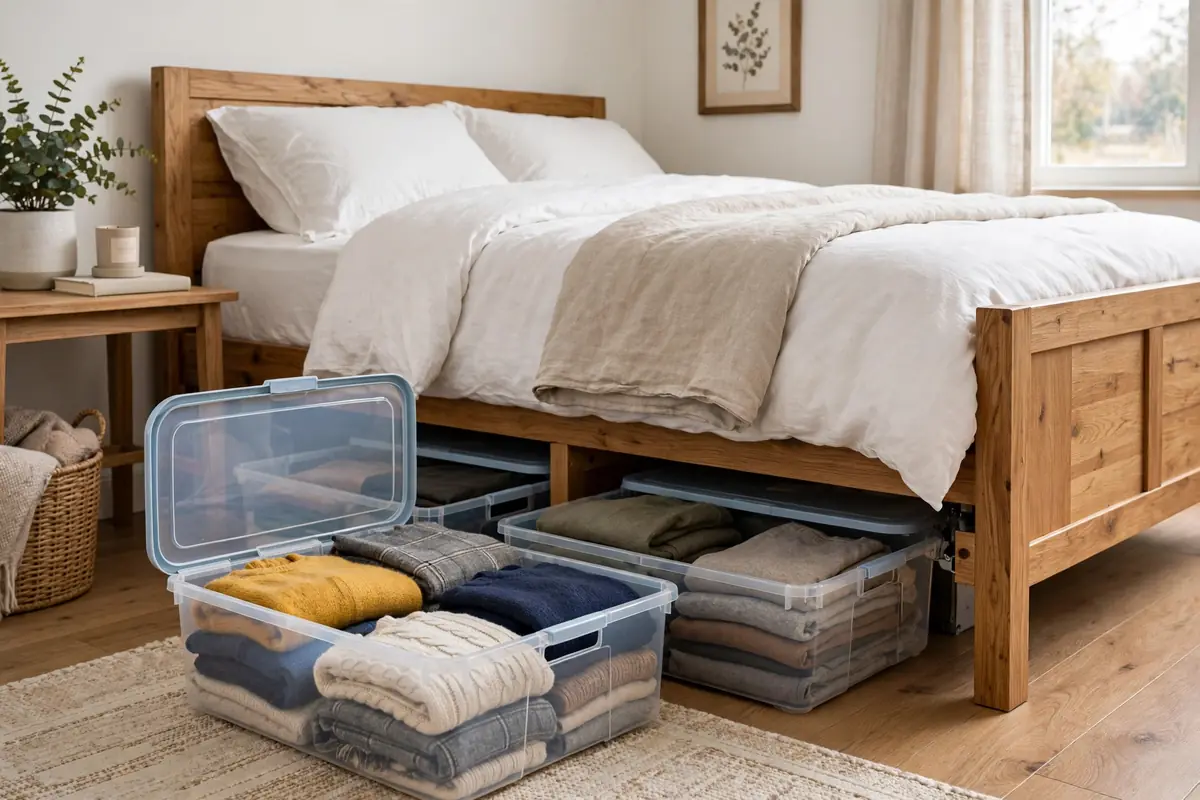
Under the bed is the biggest hidden volume in most bedrooms, and it should hold exactly two kinds of things: off-season clothes and spare bedding. Adorno puts the space under a standard double or queen frame at roughly 25 to 30 cubic feet, with clearance usually 7 to 12 inches, so measure before you buy bins, since a bin taller than your clearance is useless. Bed risers add 4 to 6 inches of clearance, according to Gorenvil, but check that the bed still feels right to sit on.
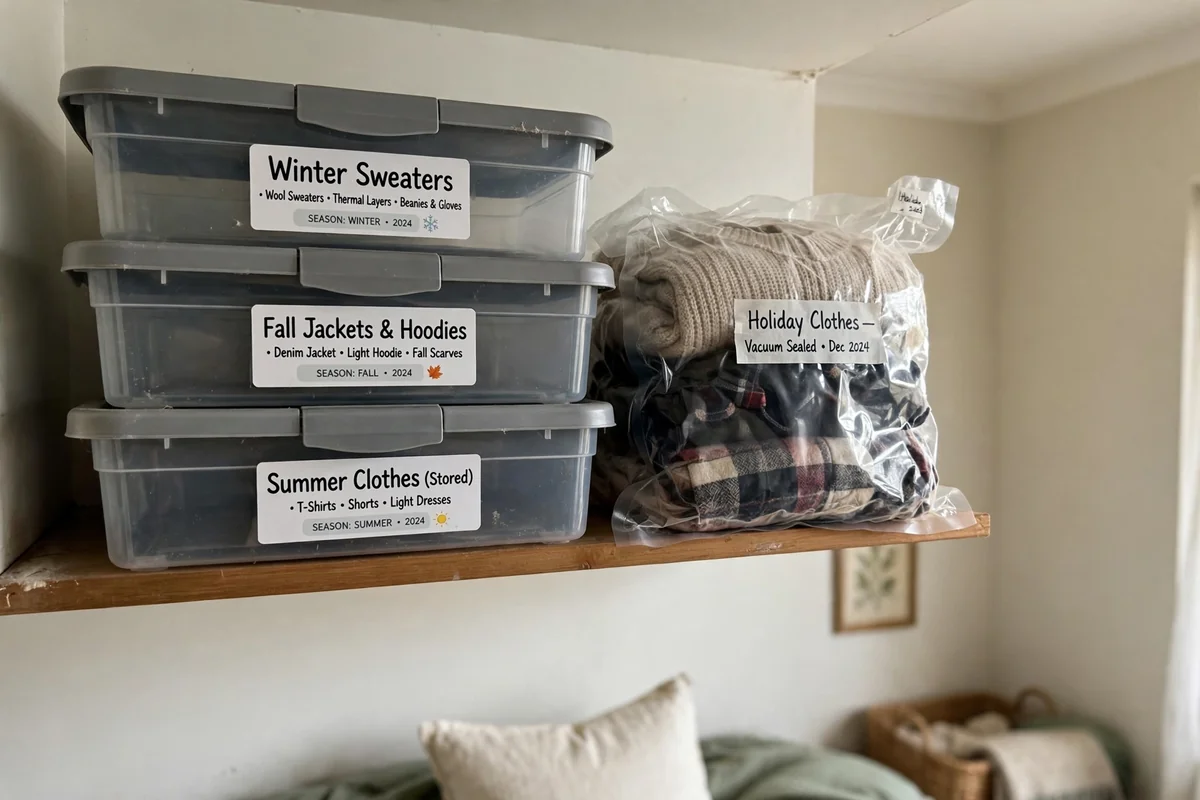
Use lidded bins, not open baskets, since dust and pet hair collect fast under a bed, and label each bin by season and category so you're not opening four bins to find one sweater. For couples, organizing a bedroom without a closet only works when the split is physical, not promised.
Vacuum bags shrink bulky coats and comforters further, but don't seal leather or anything you need this week, since the bags are a pain to reopen daily. Never store shoes you wear daily, paperwork, electronics, or anything damp under the bed, since daily shoes belong in the shoe zone and damp items will smell. My opinion: under-bed storage is for things you touch monthly or less, and the moment you store daily items there, you have just built a second closet you have to crawl into every morning. Whether the room is a studio or an older bedroom, organizing a bedroom without a closet follows the same five zones.
How do you store shoes in a bedroom with no closet?
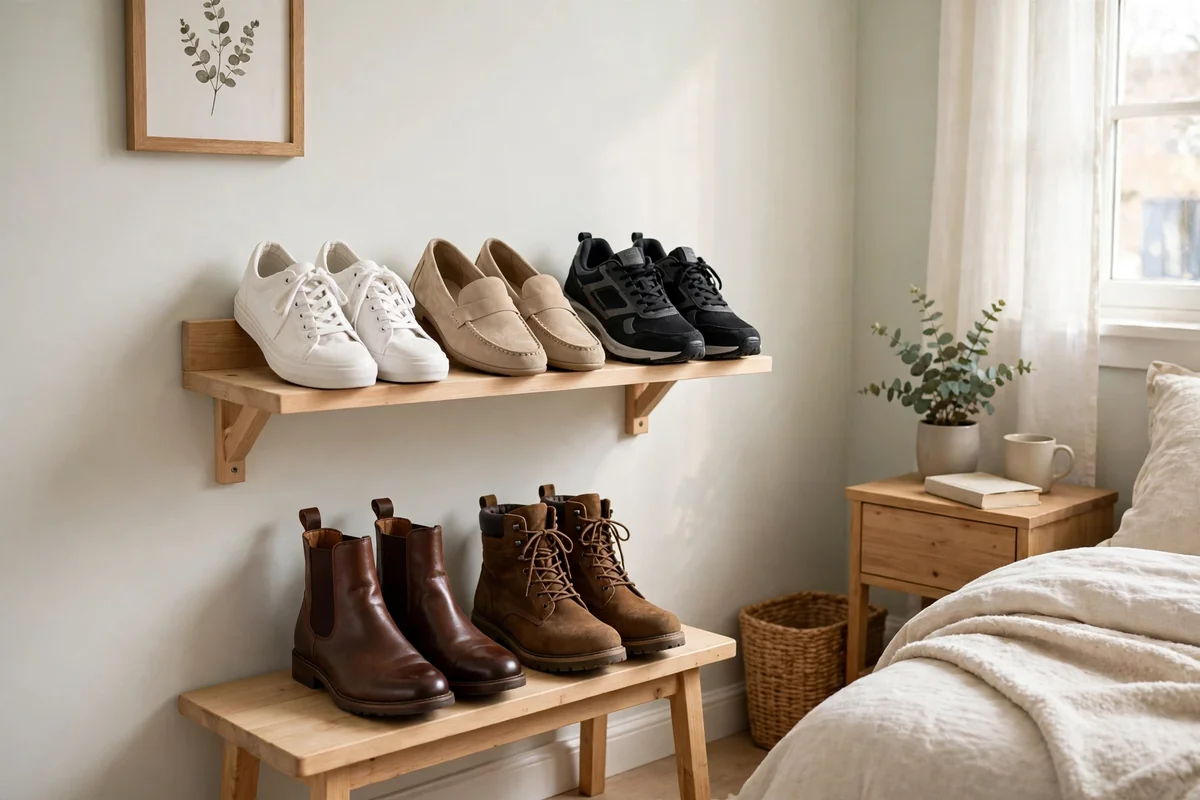
Shoes need one zone and one rule: no pair lives on the open floor. A vertical shoe rack uses a narrow slice of wall and holds a lot, with Small Space Tips listing 10-tier racks at $25 to $90 for 30 to 50 pairs, though most people need far fewer tiers, so buy the height that fits your collection and secure a tall rack to the wall if you have kids or pets. A high wall shelf suits the pairs you wear most, since you can grab them without bending.
Under-bed lidded cases suit off-season shoes and boots, and Hunker puts shoe shelves at 6 to 7 inches tall for most shoes, with boots needing 15 to 18 inches, so measure your tallest boots before you buy a shelf. Rotation is the calendar half of organizing a bedroom without a closet, and twice a year is enough.
An over-door organizer holds flats well, but it sags under heavy boots, so keep boots on a shelf or a rack. Keep one pair by the door and the rest in the zone. For more shoe layouts in tight closets, see our shoe storage for small closets. This zone is not for a collection of 40 pairs in a tiny room, since that collection needs a real closet or a serious purge, and no rack will hide it. Start there, and organizing a bedroom without a closet stops feeling like a project and starts feeling like a room again.
How do you keep the room from looking like a clothing store?
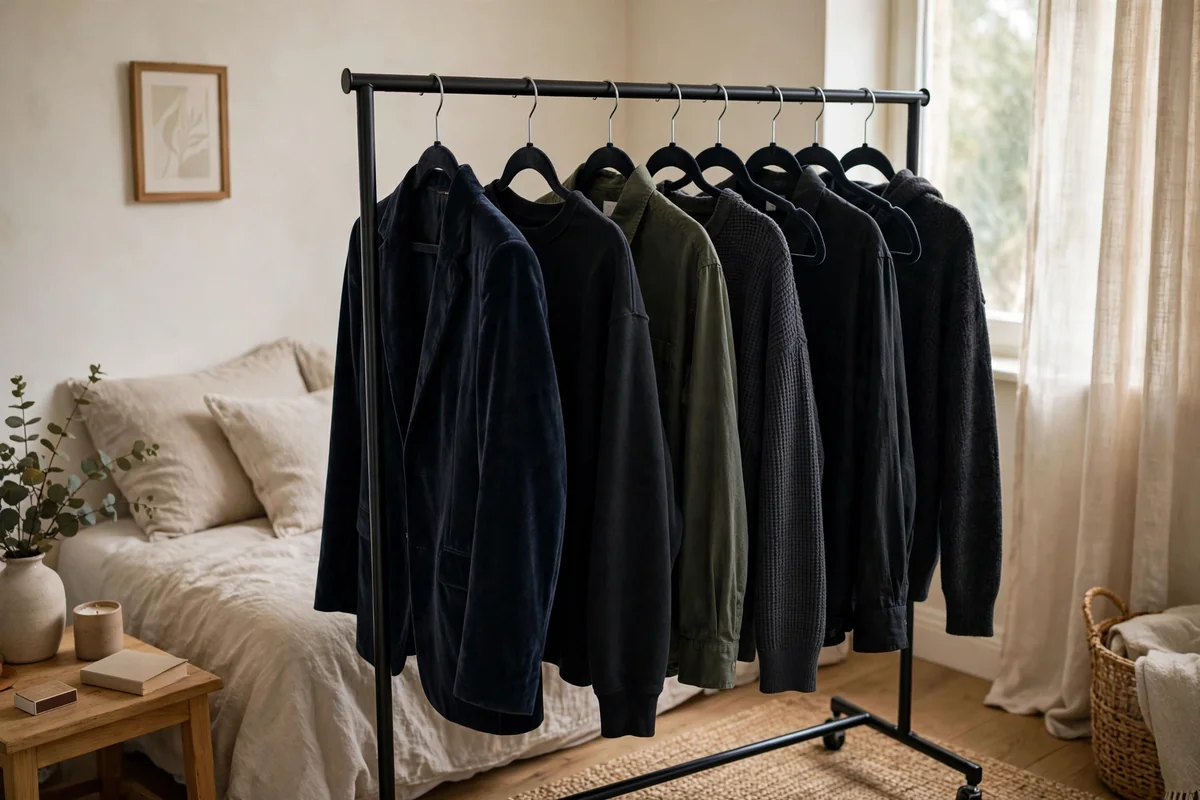
Open storage looks tidy when it looks intentional, and it looks like a shop when it looks accidental. The fastest fix is matching hangers, since a rack of mixed wire, plastic, and wooden hangers reads as chaos even when the clothes are clean. Velvet hangers save rod space and stop clothes sliding off, though heavy coats need sturdy wooden hangers.
Keep only the current season on the rack and box the rest, since a rack holding four seasons at once will always look crowded. Use one color family for bins and baskets, so the eye reads a calm row instead of ten competing patterns. A second rack is not failure; organizing a bedroom without a closet sometimes just needs more rod feet.
A curtain over the rack hides the whole zone in one move. Put the rack on the wall you see least from the bed, not the wall you face. My judgment: a tidy open rack beats a messy closed wardrobe every time, and the goal is not to hide your clothes, it's to make the room feel calm enough to sleep in. This look is not for maximalists with a huge colorful wardrobe, since that wardrobe will always read as busy, and a closed wardrobe is the honest buy there. Labels are small, but organizing a bedroom without a closet leans on them more than a closed closet does.
What do you do with coats, bags, and tomorrow's outfit?
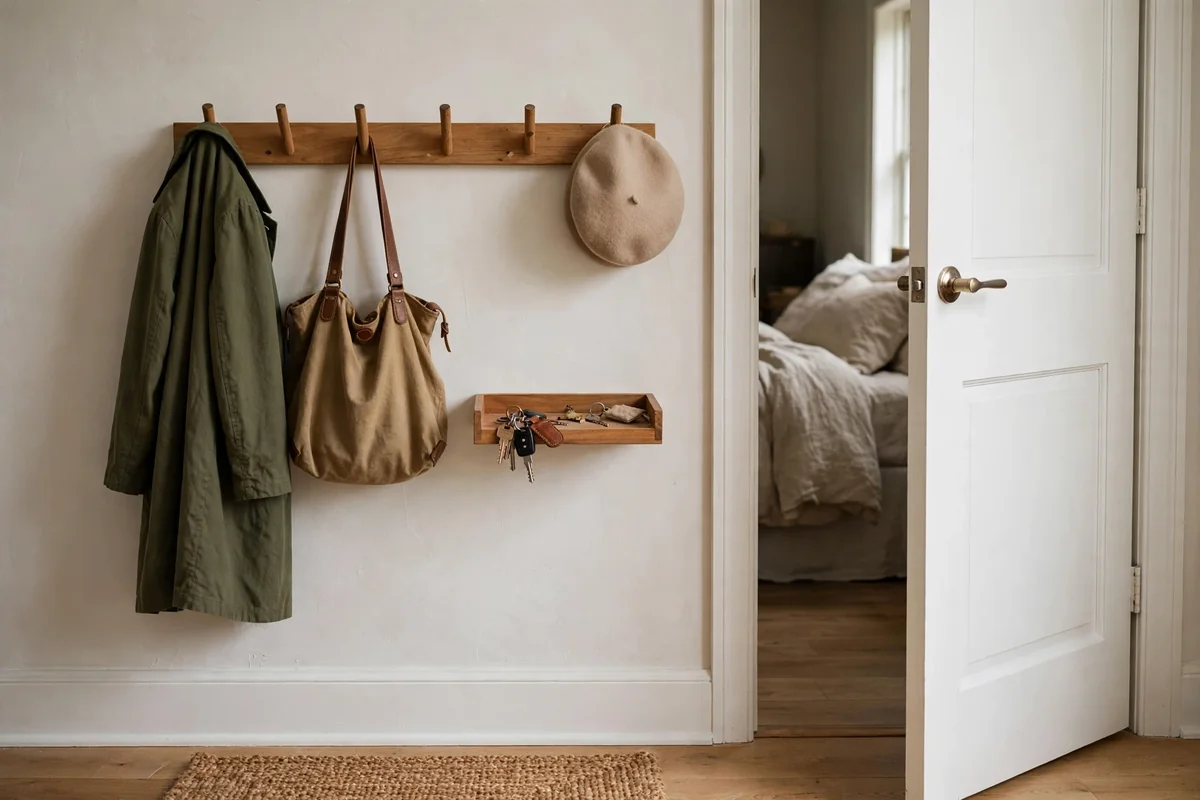
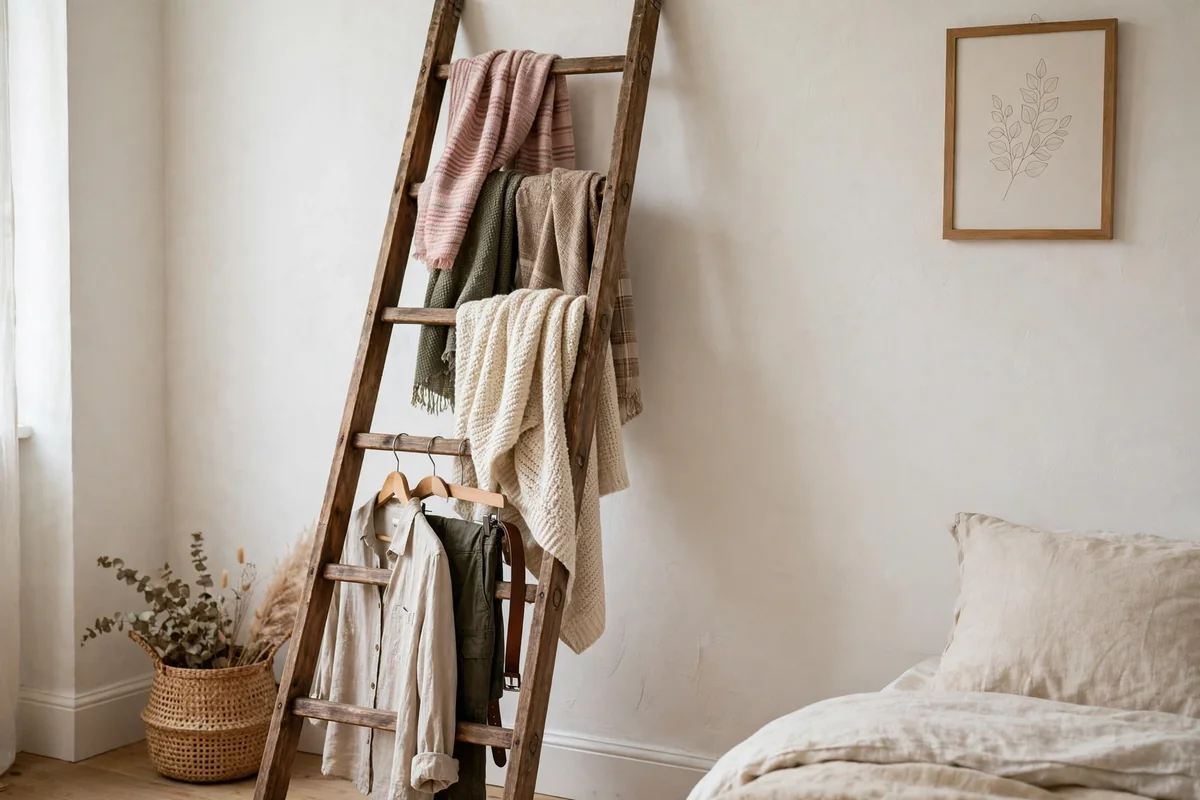
Coats, bags, and tomorrow's outfit need a daily zone by the door, because they are the items that create the chair pile. A peg rail or a row of hooks by the bedroom door holds a coat, a bag, and a hat without any floor space, and Small Space Tips lists hooks or a peg rail at $10 to $30, which makes it the cheapest zone in the whole system. A valet stand or ladder hanger by the door holds tomorrow's outfit, so you dress in minutes instead of hunting through the rack.
Keep the daily zone to one outfit and one coat, since the moment it holds three coats and two bags, it has become a second rack. Measure twice here, since organizing a bedroom without a closet punishes guessed sizes fast.
If two people share the room, give each person their own hooks, clearly split, since shared hooks always turn into one person's pile. A storage ottoman by the door doubles as a seat for shoes and a bin for bags. My take: the daily zone is the highest-return zone in the system, since it kills the chair pile, and it costs less than a single dinner out.
It's not for heavy winter coats in a small room, since those belong on the main rack or in a hall closet if one exists. The weekend test is simple: organizing a bedroom without a closet works if the floor stays clear for two weeks.
How do couples share one bedroom with no closet?
Two people in a no-closet bedroom need two systems, not one bigger system, and that split should be physical, not just a promise. Give each person their own hanging section, even if that means two narrow racks instead of one wide one, since a shared rack always drifts toward whoever dresses first. Split the folding shelves the same way, with one person's cubes on the left and the other's on the right, and label them if the split keeps sliding.
Shoes split by person too, with each person's daily pair by their side of the bed and the rest in their own section of the shoe zone. Shared items, like spare bedding, go in the under-bed zone, labeled by contents, not by person. If the rack still overflows, organizing a bedroom without a closet needs a purge, not prettier bins.
Agree on a capsule count together, since two full wardrobes in one small room will overflow any system. Keep one person's overflow out of the other's zone, since it's better to purge than to annex. My opinion is firm: a fair split that both people keep beats a generous split that one person ignores.
This plan is not for couples with very different wardrobes, like one person with 60 hanging items and one with 10, since that room needs an uneven split sized to reality, not a 50-50 split that wastes rod space. Keep the curtain in mind, since organizing a bedroom without a closet can hide the whole zone in one move.
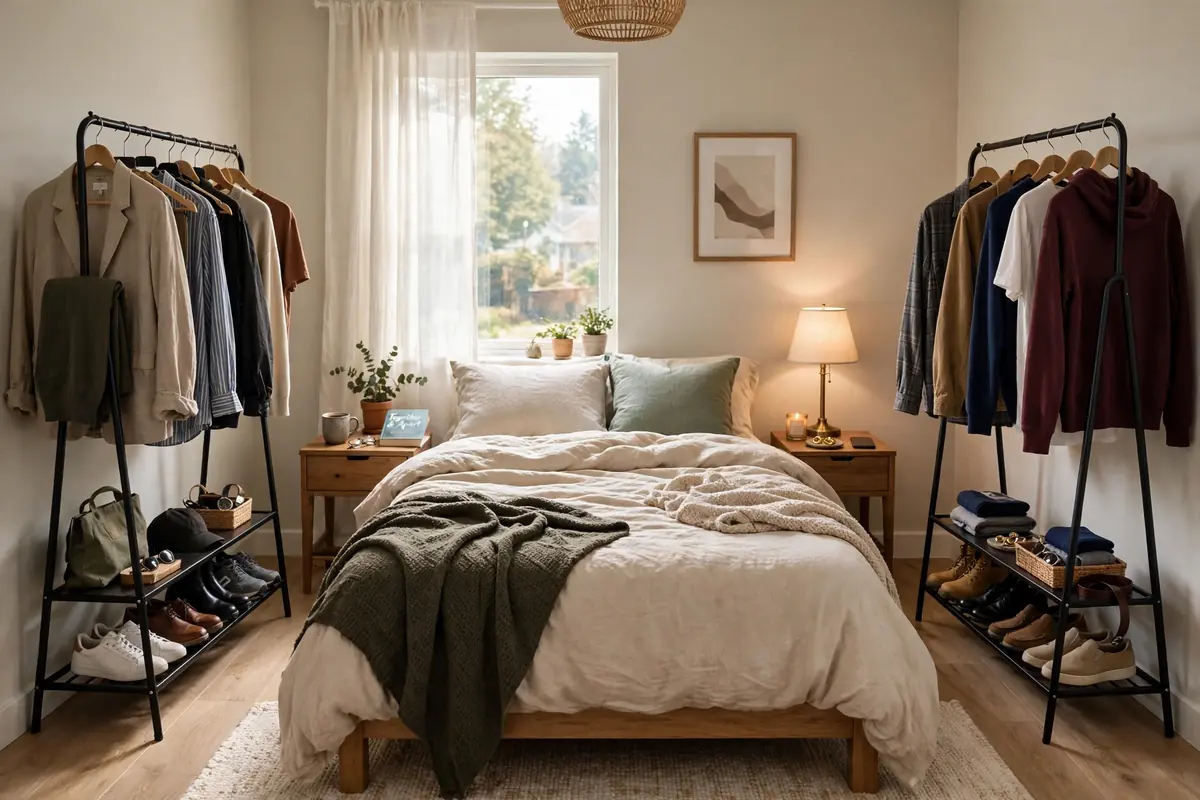
What works in a tiny studio versus a larger older bedroom?
A tiny studio and a larger older bedroom both lack closets, but they need different systems, since floor space is the constraint in one and wall space is the gift in the other. In a tiny studio, use a rolling garment rack you can move, a curtain closet in one corner, and under-bed bins, since every piece must move or hide when the room changes jobs from bedroom to living room. Keep the rack narrow and the shoe zone vertical.
In a larger older bedroom, use a freestanding wardrobe or a PAX-style system on the longest wall, since you have the floor to spare and the doors will make the room feel finished. Older homes often have high ceilings, so use the high shelf above the wardrobe for off-season bins. Two narrow racks beat one wide one when organizing a bedroom without a closet for two people.
Both rooms share the same zone rules and purge step, and both fail when off-season clothes stay in the daily rotation. For studio layouts that pair with this system, see our studio apartment storage ideas. My call: studios should buy mobility first and storage second, while older bedrooms should buy closed storage first, since a wardrobe that fits the room will outlast three racks. This split is not for a medium room with one awkward wall, which should just take the rack and the curtain and stop overthinking it. High shelves earn their keep when organizing a bedroom without a closet, since off-season bins belong up high.
| Budget tier | What you get | Rough total |
|---|---|---|
| Under $100 | Garment rack, hooks, under-bed bins | $60 to $100 |
| $100 to $300 | Rack or curtain closet, cube shelf with bins, shoe rack | $150 to $300 |
| $300 and up | Freestanding wardrobe or PAX-style system, bins, hooks | $300 to $600+ |
How do you handle off-season clothes and bulky bedding?
Off-season clothes and bulky bedding belong in the same place: sealed, labeled, and out of the daily rotation, since they are the items that silently eat a no-closet room. Vacuum bags shrink winter coats and comforters to a fraction of their size, which is a real win under a bed or on a high shelf, but don't vacuum-seal items you will need in the next few weeks, since reopening and resealing them is a chore you will skip. Lidded bins beat bags for clothes you rotate often, since a bin opens in seconds and a vacuum bag does not.
Label every bin with the season and the contents, not just "winter," since "winter coats and scarves" saves you from opening three bins in November. Put bulky bedding in its own bin, not mixed with clothes, since a comforter will hide everything under it. A hook rail by the door is the cheapest win in organizing a bedroom without a closet, and the easiest to skip.
Store off-season shoes in the same rotation, in lidded cases, so the shoe zone holds only the season you're in. Rotate twice a year, in spring and fall, and treat the rotation as a purge moment. For a full seasonal rotation plan, see our guide to storing summer clothes for winter. This system is not for climates with no real seasons, since those rooms should rotate by activity instead, like work clothes versus outdoor gear. Under-bed bins are the hidden half of organizing a bedroom without a closet, so label them well.
What is the first weekend setup worth doing, and what can wait?
Do the weekend setup in this order, and stop when the room works, since a finished system beats a perfect plan every time. First, purge to a capsule and bin the off-season clothes, since no furniture fixes a wardrobe that's too big for the room. Second, set up the hanging zone, one rack or one rod, and hang only the current season, since that single change ends the chair pile. Third, add the daily zone by the door, hooks and tomorrow's outfit, since that zone is cheap and it protects the rest of the system.
Fourth, add under-bed bins and a shoe zone, since those clear the floor. What can wait: matching bins, a wardrobe upgrade, a curtain, and a PAX system, since those improve the look but don't change whether the system works. One outfit by the door is a system, and organizing a bedroom without a closet depends on that small rule.
Live with the weekend setup for two weeks before you buy more, and notice what still annoys you. If the rack overflows, you need a purge or a second rack, not prettier bins. If the room feels busy, a curtain will fix it. My final judgment: a no-closet bedroom doesn't need a closet, it needs five zones, a capsule, and a weekly ten-minute reset, and that's enough to make the room feel like a bedroom again. Start with the purge this weekend. The chair pile is the warning sign that organizing a bedroom without a closet has slipped, so clear it nightly.
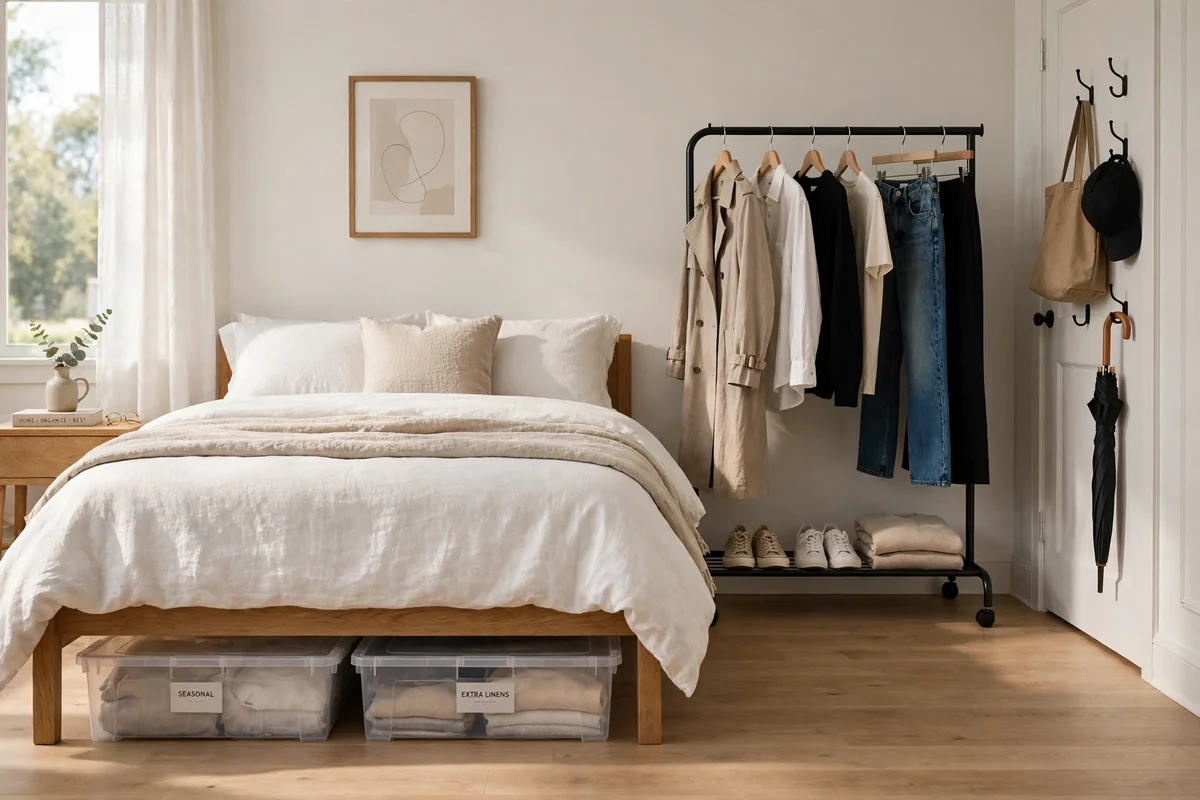
How do you organize a bedroom with no closet?
Build five zones instead of one big wardrobe: a hanging zone for clothes that crease, a folding zone for knits and tees, a shoe zone that keeps pairs off the floor, a daily zone by the door for coats and tomorrow's outfit, and an off-season zone under the bed or on a high shelf. Purge to a current-season capsule first, since open storage punishes excess fast.
What is the best renter-friendly way to hang clothes without a closet?
A freestanding garment rack plus over-door hooks is the fastest setup, since neither needs drilling. Add a tension rod across a corner or narrow alcove for a second hanging section, and keep heavy coats on the rack or a wardrobe frame, since a tension rod will bow under too much weight.
How much hanging space do I need for a bedroom without a closet?
Count your hanging items and multiply by about 1.5 inches per garment. Forty shirts and pants need about 60 inches, or 5 feet, of rod. Plan about 40 inches of drop for shirts and 60 inches for long dresses, and use double hang for shirts and pants wherever you can, with one short single-hang section for long items.
Should I buy a garment rack or a wardrobe for a room with no closet?
Buy a garment rack if money is tight and you want the fastest start, since racks run about $20 to $80. Buy a freestanding wardrobe if dust control and a tidy closed look matter most, since wardrobes run about $120 to $400 and up. Build a curtain closet if you want the hidden look on a renter budget.
How do I store shoes in a tiny bedroom with no closet?
Give shoes one zone and keep every pair off the open floor. Use a vertical rack on a narrow wall slice, a high wall shelf for daily pairs, or lidded cases under the bed for off-season shoes. Keep one daily pair by the door and the rest in the zone, and measure tall boots before buying a shelf, since boots need 15 to 18 inches.
How do I keep open clothing storage from looking messy?
Use matching hangers, keep only the current season on the rack, and use one color family for bins and baskets. Put the rack on the wall you see least from the bed, and hide the whole zone with a curtain or room divider if you love open storage for dressing but hate looking at it while falling asleep.
Where do folded clothes go when there is no dresser?
Use a cube shelf with fabric bins, one category per cube, or a slim tallboy if you hate looking at folded stacks. Fold knits vertically like files so you can pull one tee without toppling the stack, and keep stacks short, since a stack taller than about 10 inches falls over when you grab from the middle.
What should I store under the bed in a bedroom with no closet?
Store off-season clothes and spare bedding in lidded, labeled bins, since under-bed space suits things you touch monthly or less. Do not store daily shoes, paperwork, electronics, or anything damp there. Measure your clearance first, since most beds offer 7 to 12 inches, and bed risers can add 4 to 6 inches.
How do couples share a bedroom with no closet?
Give each person their own hanging section and their own folding cubes, even if that means two narrow racks instead of one wide one. Split shoes by person too, share only the under-bed zone for spare bedding and off-season bins, and agree on a capsule count together, since two full wardrobes in one small room will overflow any system.
