
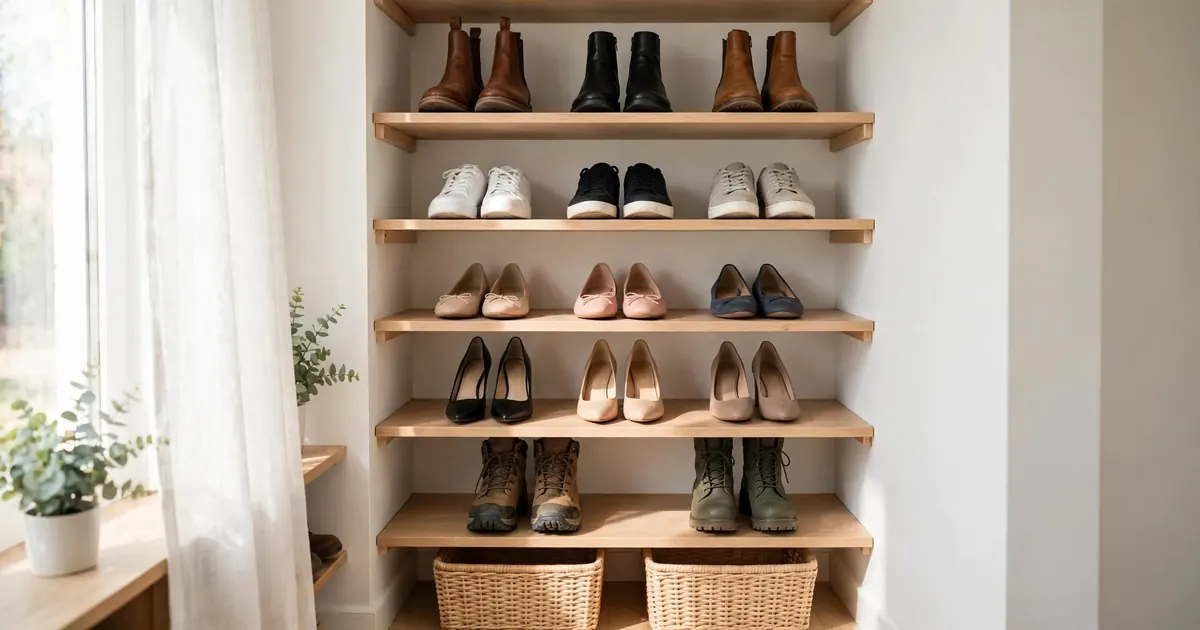

Your closet can hold more shoes than you think. It just cannot hold them on the floor. A standard 2-foot-deep reach-in closet fits 8 to 12 pairs on one shelf row, and most small closets waste the door, the walls, and the top shelf entirely. The fix is simple: measure three things (width, depth, and door clearance), count your pairs, then pick one main system that matches that number and send the rest to overflow spots. That is the whole system, and renters can do all of it. This is shoe storage for small closets done the practical way: measure first, count second, buy last.
If you want to compare actual racks before you buy, see our best shoe rack for small closet roundup, which lists real sizes for towers, door organizers, and low racks.
TL;DR
- Shoe storage for small closets works when you stop using the floor: the door, the walls, a tension rod, and the top shelf hold more pairs than the floor ever will.
- Count your pairs first. Surveys summarized by Footwear Magazine put the average US woman at about 19 pairs and the average man at 12, and most closets are sized for half that.
- Pick ONE primary system for daily pairs plus ONE overflow spot for off-season pairs. Two systems beat five gadgets.
- Every option below is renter-safe or has a renter-safe version. Nothing here requires drilling if your lease forbids it.
| # | Way | Floor used | Pairs held | Best for |
|---|---|---|---|---|
| 1 | Over-the-door pocket organizer | none | 12-24 | flats, flip-flops, kids' shoes |
| 2 | Wall-mounted shoe rails | none | 6-12 per rail pair | heels and display pairs |
| 3 | Low tension rod | none | 6-10 | flats and low heels, renters |
| 4 | Slim tilt-out cabinet | ~10 in strip | 12-18 | hiding everything, entryways |
| 5 | Stackable open shoe rack | 1-2 sq ft | 8-16 | daily pairs on the closet floor |
| 6 | Drop-front clear boxes | shelf space | 6-12 stacked | dust-free sneaker storage |
| 7 | Under-bed shoe boxes | none (under bed) | 6-12 | off-season overflow |
| 8 | Top-shelf labeled bins | none | 4-8 | rarely worn pairs |
| 9 | Angled heel rails | none | 4-8 | heels that topple on flat shelves |
| 10 | Boot shapers in the tall corner | 1 sq ft | 2-4 | tall boots standing upright |
| 11 | Hanging closet-rod cubbies | none | 8-12 | soft fabric option, temporary |
| 12 | Under-shelf slide-out rack | none | 4-6 | dead vertical gaps between shelves |
How many pairs of shoes can a small closet actually hold?
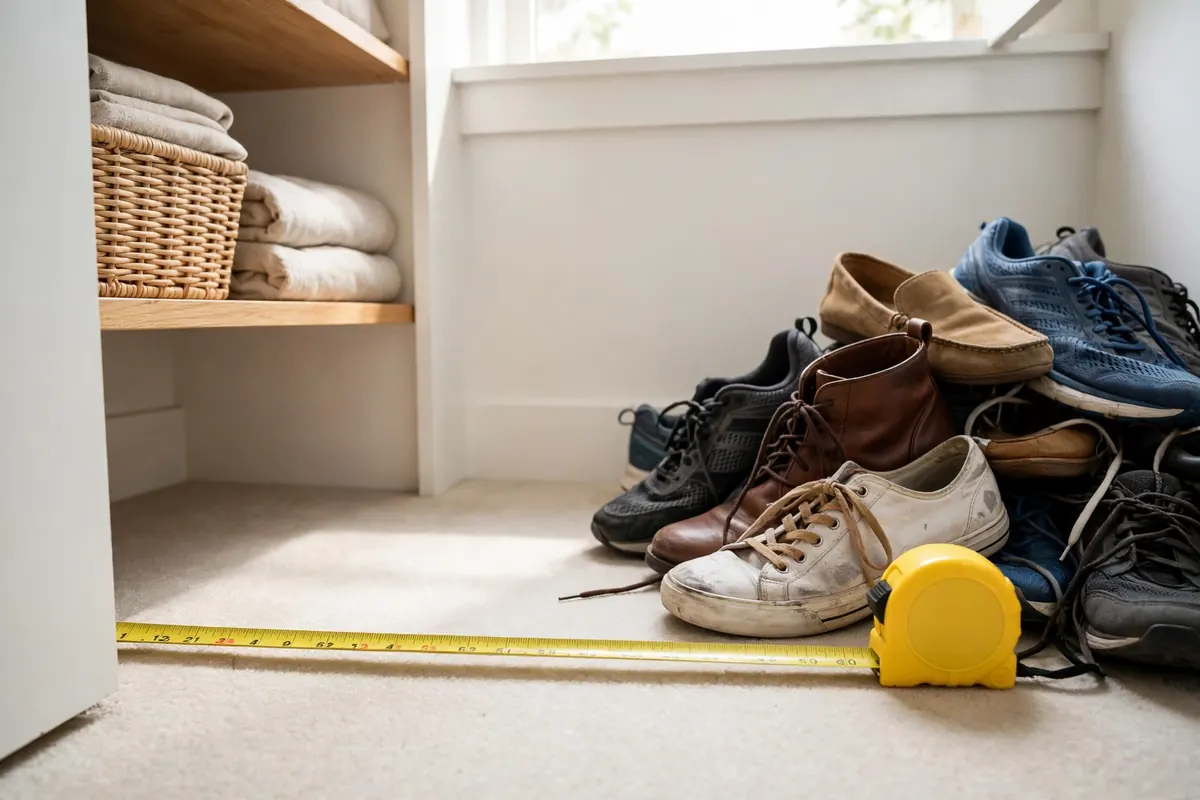
The short answer on shoe storage for small closets is capacity math: a 4-foot-wide reach-in closet holds roughly 16 to 24 pairs once you use the door and the walls, and 8 to 12 pairs if you only use the floor. Surveys summarized by Footwear Magazine put the average US woman at about 19 pairs and the average man at 12, while surveys cited by ShoeFootBoot found women keep an average of seven pairs they never wear.
Do the math before you shop. Measure the inside width of the closet in inches and divide by 4. That is your pairs-per-row for adult shoes, since most pairs need about 4 inches of width. A 36-inch-wide closet gives you 9 pairs per shelf row. Then count your vertical rows: a standard closet gives you the floor row, one shelf row, and the door, which is three rows before you touch the walls. Most shoe storage for small closets fail because people buy organizers before they measure the closet.
The capacity number is your rationing system. Write it inside the closet door: “This closet holds 18 pairs.” Every future purchase gets measured against that number. If your closet holds 18 pairs and you own 26, eight pairs live under the bed or in top-shelf bins, not on the floor. People who skip this step buy organizers for shoes they should have relocated, then blame the organizer. The math was missing, not the organizer. Most shoe storage for small closets fail because people buy organizers before they measure the closet.
Should you count your shoes before you buy any organizer?
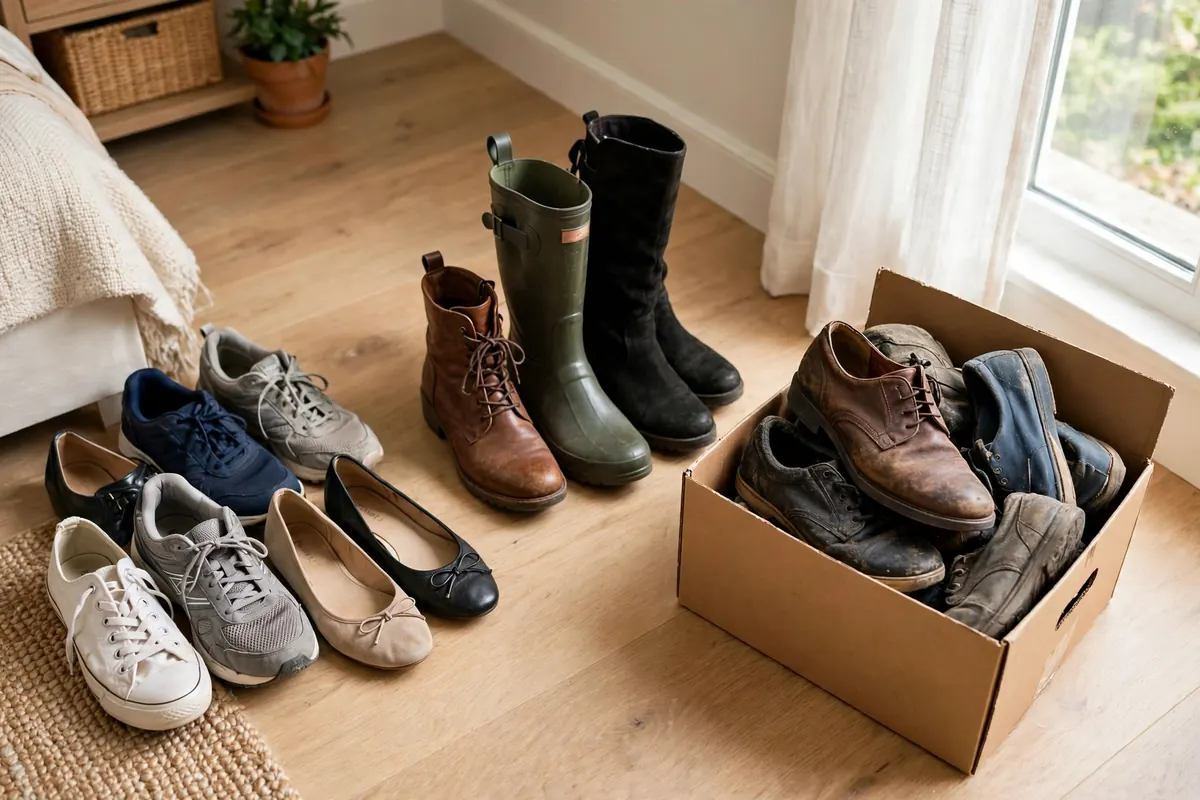
Yes, and it takes ten minutes. Pull every pair out, yes, every pair, including the ones behind the winter coats, and sort them into three piles: daily (the 3 to 5 pairs you actually wear weekly), seasonal (boots, sandals, occasion shoes), and retire (worn out, painful, or unworn for a year). Be honest about the third pile, because an organizer cannot fix a collection problem.
Here is my opinion, stated plainly: the rack is the limit. If your primary system holds 12 pairs, you own 12 daily and seasonal pairs, and the rest go to overflow or out the door. An eBay survey of roughly 2,000 US adults found the average American woman owns six pairs of sneakers and the average man owns seven, so most daily rotations fit in one over-door organizer with pockets to spare. The floor pile is not a storage failure. It is a counting failure. For the retire pile, use the one-year rule, except occasion shoes you truly wear yearly, which earn a labeled bin. Weak shoe storage for small closets ignore the door; the strong ones treat it as a full extra wall.
For the rest of the closet beyond shoes, our small closet organization ideas guide covers shelves, rods, and drawers around the shoe zone. That is the core discipline of shoe storage for small closets: count first, buy second, and you will buy half as much. The best shoe storage for small closets include a rotation system: daily pairs up front, seasonal pairs up high.
What is the best shoe storage for a closet with zero floor space?
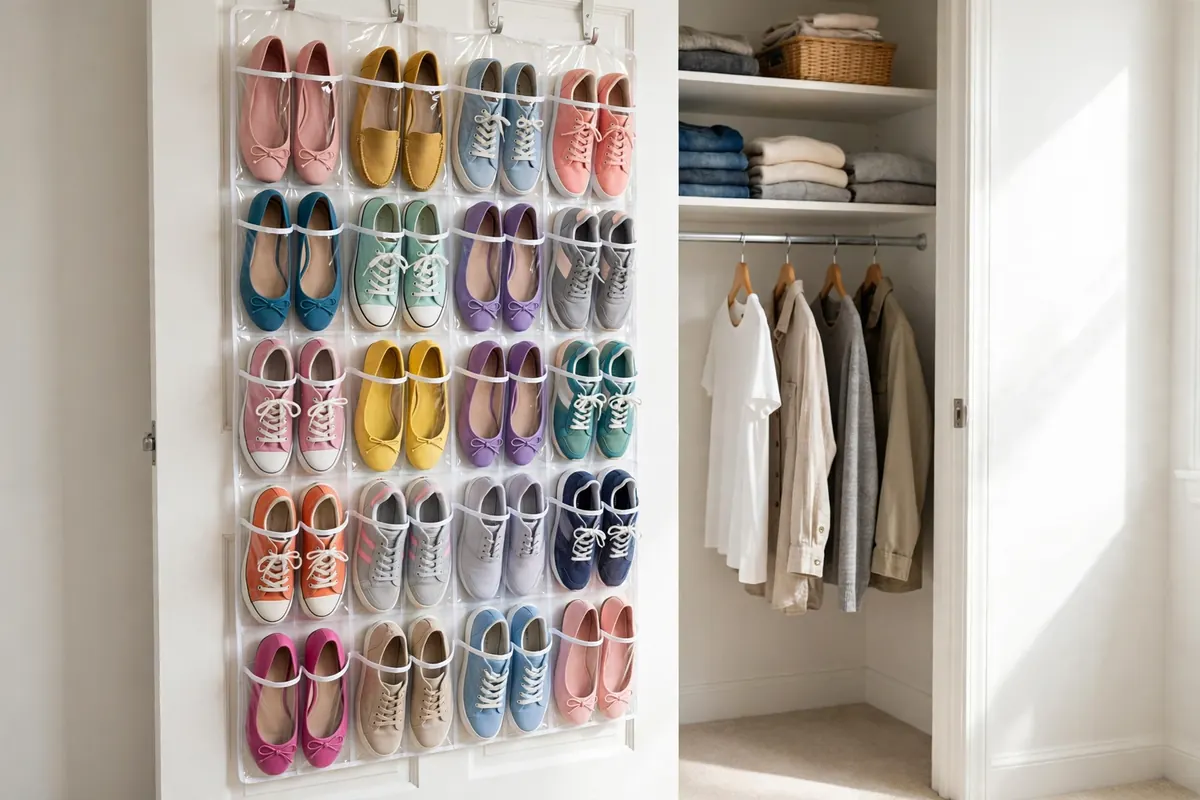
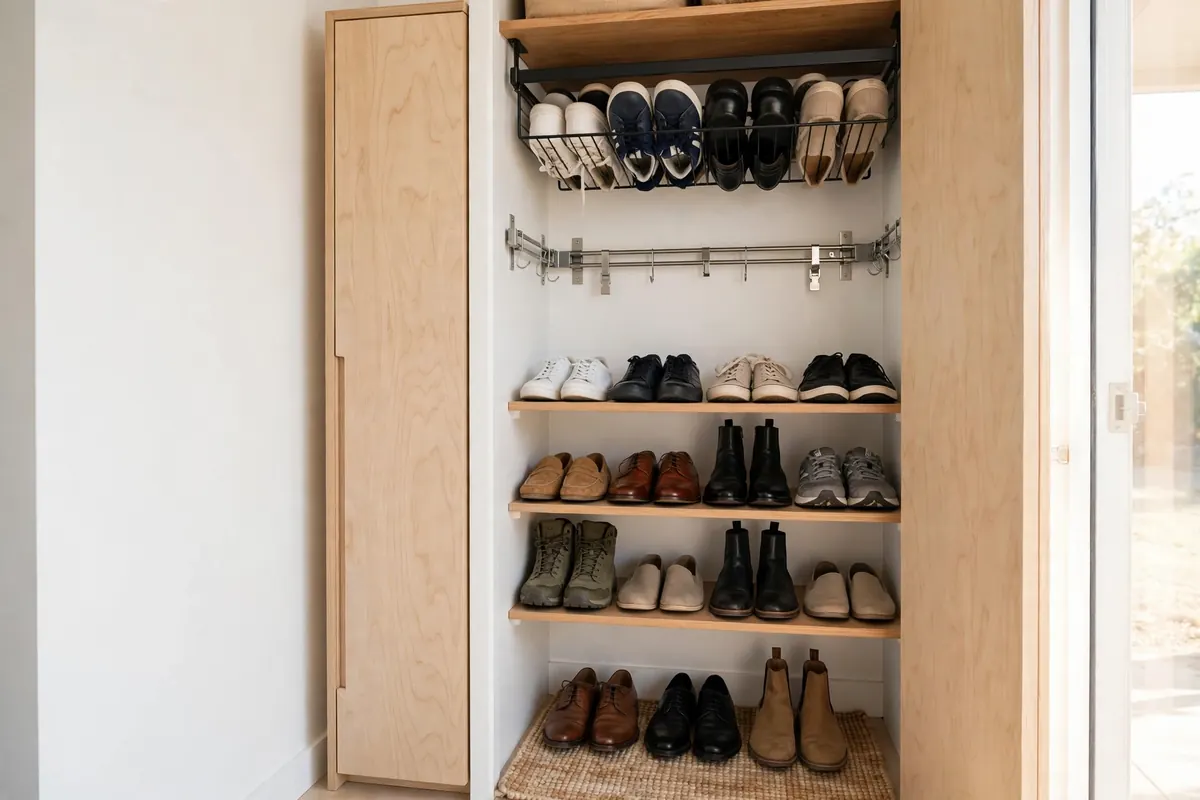
For shoe storage for small closets with genuinely zero floor space, an over-the-door pocket organizer wins, and it is not close. It uses zero floor, holds 12 to 24 pairs depending on pocket size, costs less than dinner out, and installs in minutes on any standard interior door. For a closet with genuinely no floor to spare, this is the highest pairs-per-dollar option that exists.
Pick the right kind of shoe storage for small closets. Clear pockets beat fabric ones because you can see every pair, and seeing them is what stops the morning dig. Reinforced hooks matter more than pocket count: a full organizer gets heavy, and cheap hooks bend, which is how doors get scratched. If your door is thin or hollow-core, use foam pads behind the hooks so they do not rattle every time the door moves. Weak shoe storage for small closets ignore the door; the strong ones treat it as a full extra wall.
One honest admission: over-door organizers are not for heavy boots or chunky winter shoes. The pockets stretch, the weight pulls the door off balance, and tall boots do not fit the pocket depth anyway. Boots get their own corner (more on that in the boots section). Flats, sneakers, sandals, and kids’ shoes are the sweet spot, and that covers most people’s daily rotation. Weak shoe storage for small closets ignore the door; the strong ones treat it as a full extra wall.
How do you hang shoes on a closet wall without drilling?
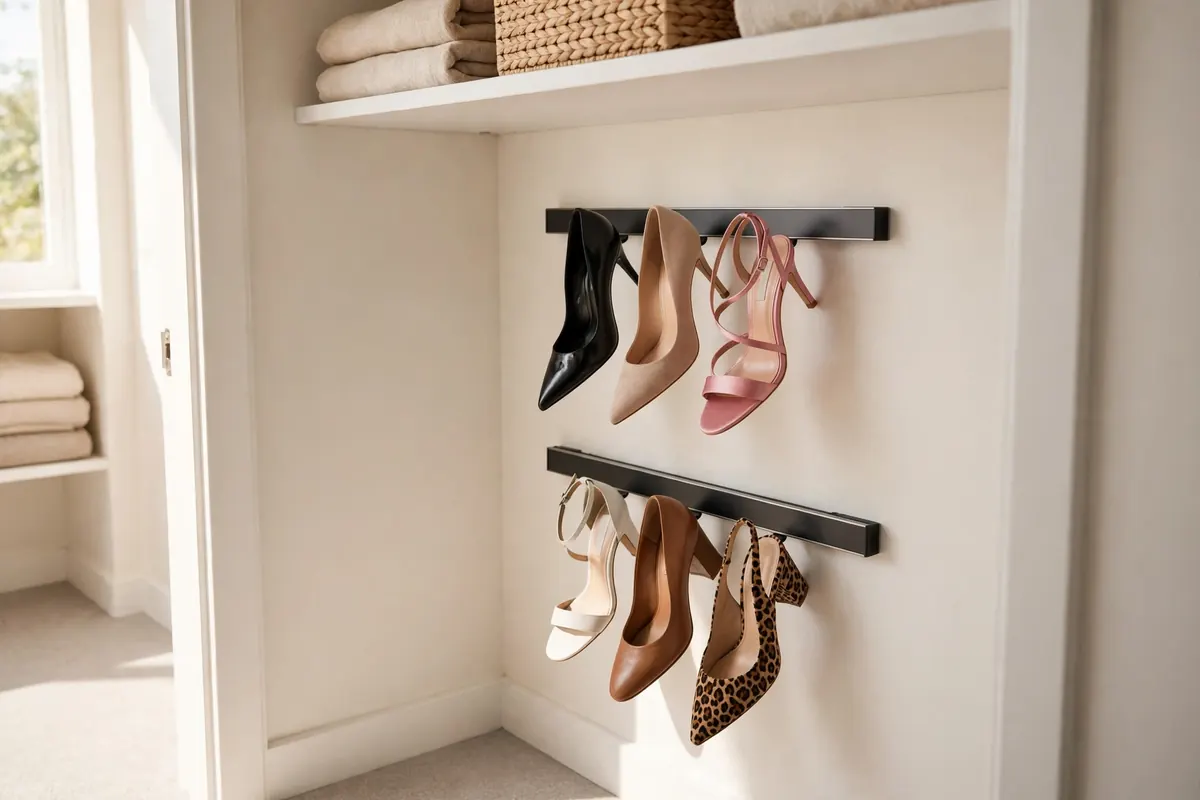
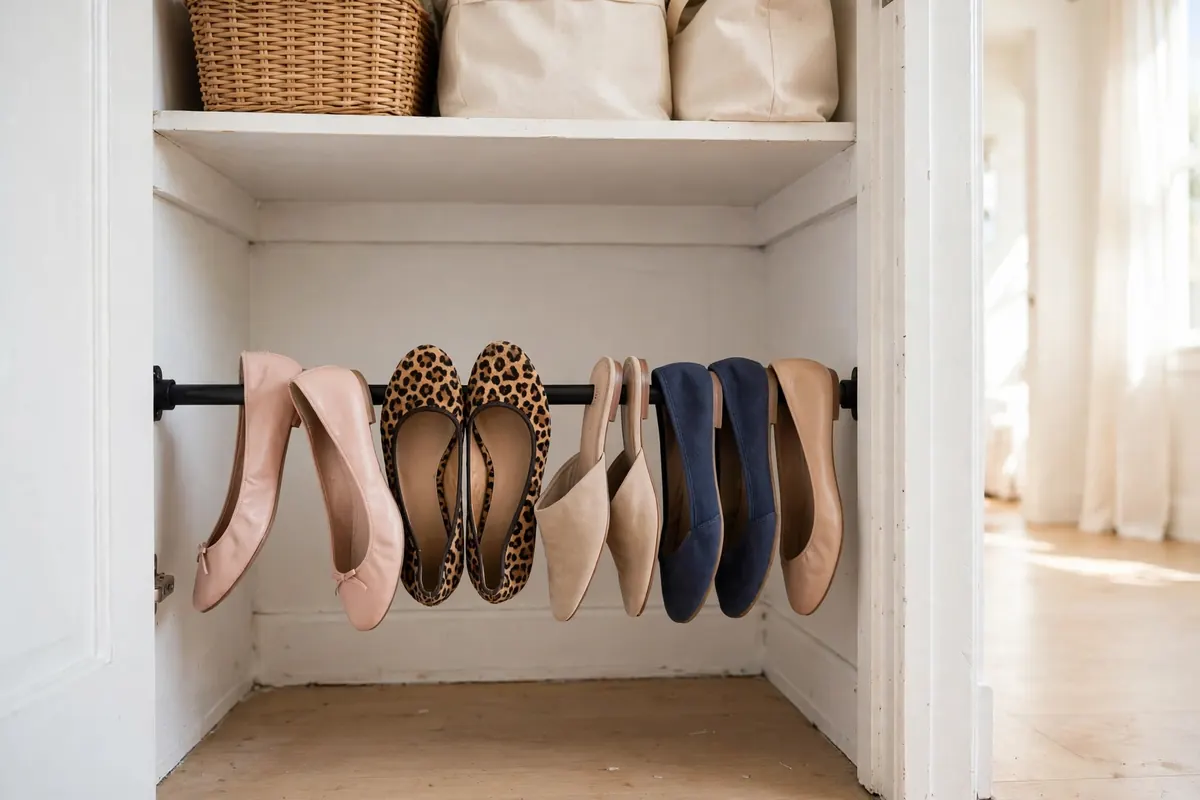
Shoe storage for small closets in a rental usually means no drilling, so here are four no-drill options ranked by how much your landlord will care. A tension rod wedged low in the closet is the safest: flats and low heels drape over it heel-to-toe, it installs in two minutes, and it leaves zero marks. Over-door hooks on the closet door itself come next, since they touch only the door. Adhesive rails and strips are third: they hold light pairs fine, but removing them can pull paint, so test one in a hidden spot first. Freestanding leaning racks need no wall contact at all but do use floor, so they lose on space.
| Option | Damage risk | Holds | My take |
|---|---|---|---|
| Tension rod | zero | 6-10 pairs of flats | best renter pick, cheapest |
| Over-door hooks | zero | 12-24 pairs | best capacity, door must close |
| Adhesive rails | low-medium | 4-8 light pairs | test removal first |
| Freestanding leaning rack | zero | 8-12 pairs | costs floor space |
Tension rods deserve a clear opinion: for under $15 they beat most $40 gadgets, and I would hand one to any renter before suggesting anything else. If your whole closet has no shelves at all, our renter-friendly closet system builds the full setup around no-drill pieces like this one. Renters especially like these shoe storage for small closets because nothing needs drilling.
A word on adhesive strips: most hold 3 to 5 pounds per strip, enough for a light pair or two per rail, and removal is clean on smooth painted drywall but risky on flat or chalky paint. Do the landlord test: stick one strip inside the closet where nobody sees it, pull it off after two days, and check the paint. Renters especially like these shoe storage for small closets because nothing needs drilling.
Are over-the-door shoe organizers actually worth it?
Yes, for the right shoes, and that qualifier does all the work. For flats, sneakers, sandals, flip-flops, and kids’ shoes, an over-door organizer is the best value in shoe storage. It is cheap, it holds a full rotation, and every pair stays visible. Visibility is underrated: the shoes you can see are the shoes you wear, which quietly shrinks the “nothing to wear” pile.
The complaints are real but specific. Cheap fabric organizers sag by month two, and a sagging pocket tips shoes forward like it is presenting evidence. Fix: buy the kind with rigid pocket dividers or a metal frame, not the floppy fabric sheet. Heavy pairs stretch pockets permanently, so keep boots and chunky sneakers out. And measure your door thickness before ordering, because hooks sized for standard 1-3/8 inch doors wobble on thicker ones. Most shoe storage for small closets fail because people buy organizers before they measure the closet.
Compared with a floor shoe rack, the trade is simple: the rack is sturdier and holds heavier pairs, but it eats 1 to 2 square feet of the scarcest resource in a small closet. If floor space is the constraint, the door wins. If shoe weight is the constraint, the rack wins. Most small closets are constrained by floor, so in shoe storage for small closets the door wins most of the time. If you only try three shoe storage for small closets, make them an over-door rack, stackable boxes, and a donation bag.
What is the best way to store heels in a small closet?
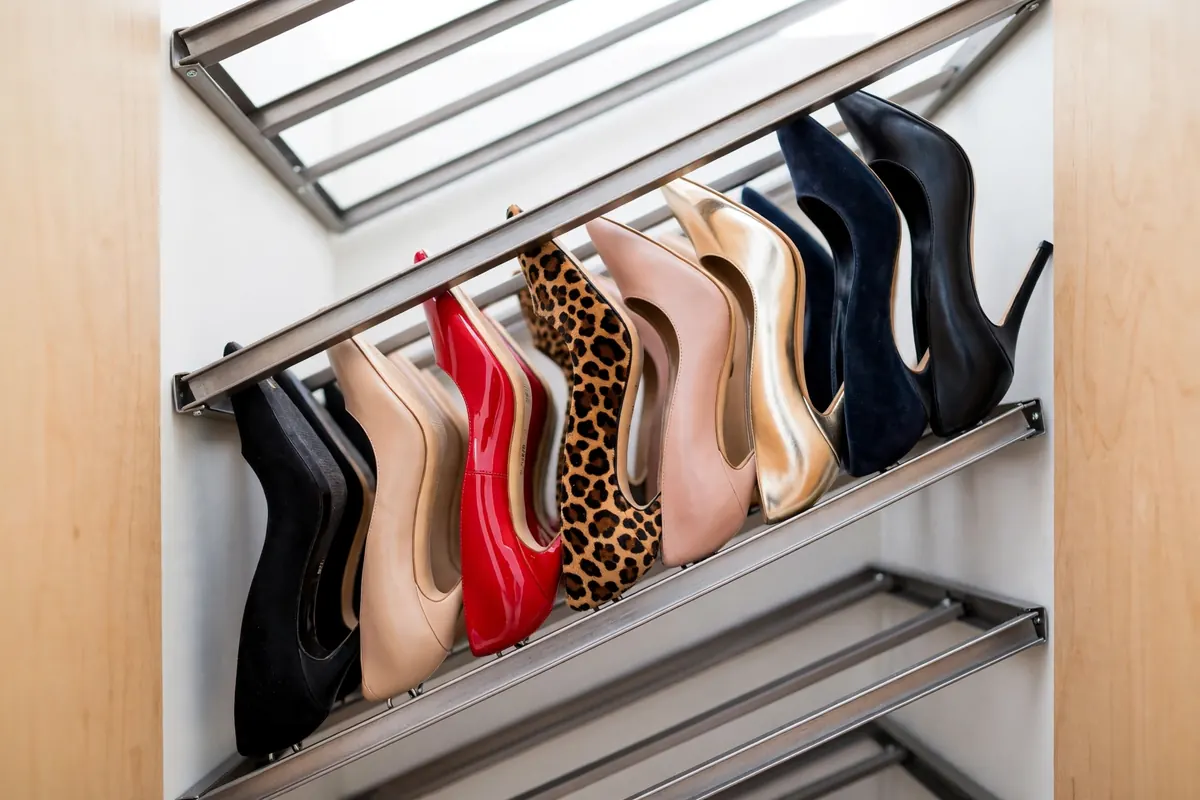
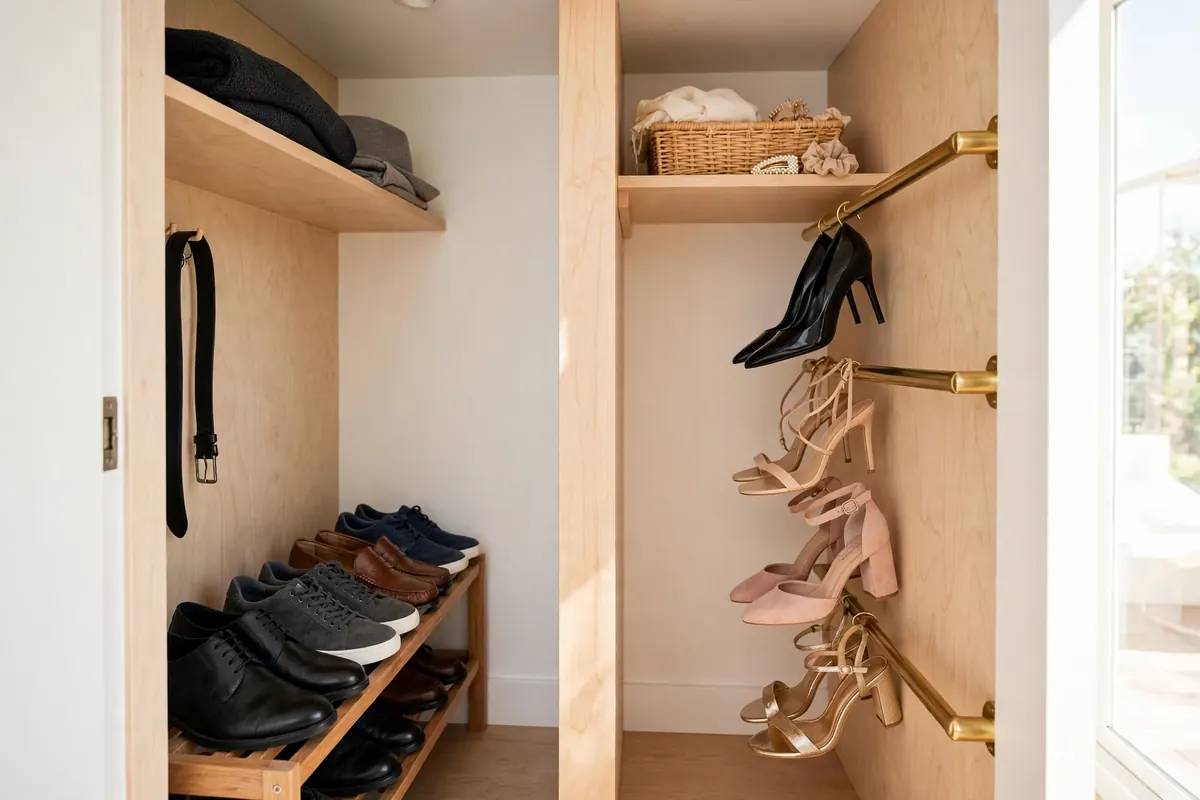
Angled rails, with the heel hooked over the rail so the shoe hangs toe-down. This is the method shoe stores use, and it works in closets for the same reason: heels waste enormous space lying flat because the heel juts up and blocks the pair behind it. Hung at a slight downward angle, each pair needs about 4 inches of width and almost no depth, and nothing topples. These shoe storage for small closets assume a standard reach-in closet, roughly 24 inches deep.
Wall-mounted rails need a drill, so renters should use the tension-rod version: wedge two rods a few inches apart low on the closet wall and hook heels over the front rod. It holds fewer pairs than screwed-in rails, maybe 4 to 6, but it costs almost nothing and vanishes at move-out. Either way, give heels their own zone in your shoe storage for small closets setup. Mixing heels with flats on one shelf is how heels get scuffed and flats get crushed.
One more honest note: stilettos with delicate straps snag on everything, including rails. Keep those in individual drop-front boxes instead of hanging them with the workhorse heels. Your future self, the one not untangling straps at 7 a.m., says thanks. What separates good shoe storage for small closets from clutter is the one-in-one-out rule.
How do you store boots when the closet is tiny?
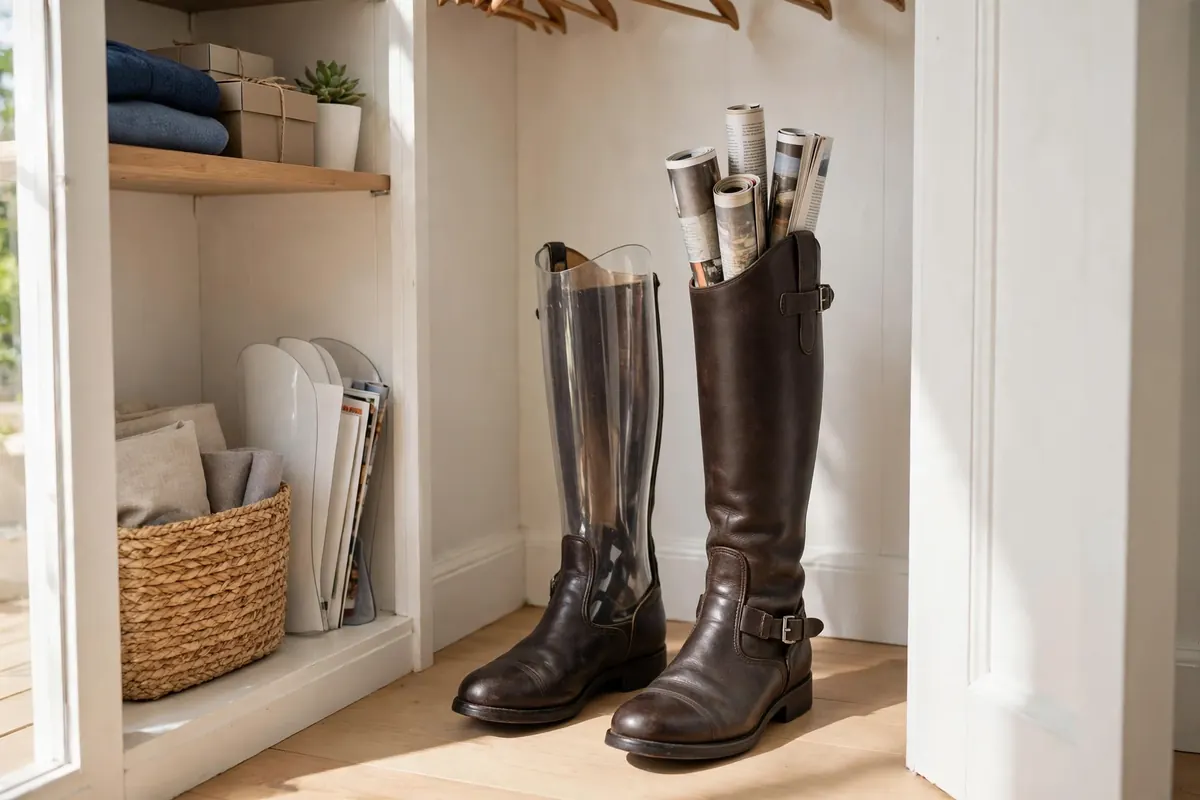
Standing up, in one tall corner, with something inside the shaft. That is the entire method, and it is the part of shoe storage for small closets most people get wrong. Boots stored flopped over develop a permanent crease at the ankle, and boots stored lying down eat a shocking amount of shelf space. One upright pair needs about 1 square foot of floor and 15 to 18 inches of height, which most closets have in exactly one spot, usually a side corner. Going vertical is the golden rule of shoe storage for small closets: the floor is the scarcest inch.
Boot shapers or tall inserts keep the shaft straight; rolled-up magazines work free and honestly work fine. Clean road salt off before storing, because salt stains leather and draws moisture, and keep boots out of direct sunlight, which fades and dries the material. Off-season boots are the first candidates for under-bed boxes or top-shelf bins, since you will not touch them for months.
Here is the admission: if you own more than three pairs of tall boots and a genuinely small closet, something has to give. Boots are the least space-efficient footwear per pair, full stop. Two everyday pairs in the closet, the rest in overflow, and nobody’s closet has to suffer for your boot collection. This is one of the cheapest shoe storage for small closets in the whole guide.
Mid-post CTA: Off-season pairs piling up? Our under-bed storage ideas guide shows which boxes actually fit under standard bed frames. The best shoe storage for small closets include a rotation system: daily pairs up front, seasonal pairs up high.
Do sneakers need different storage than regular shoes?
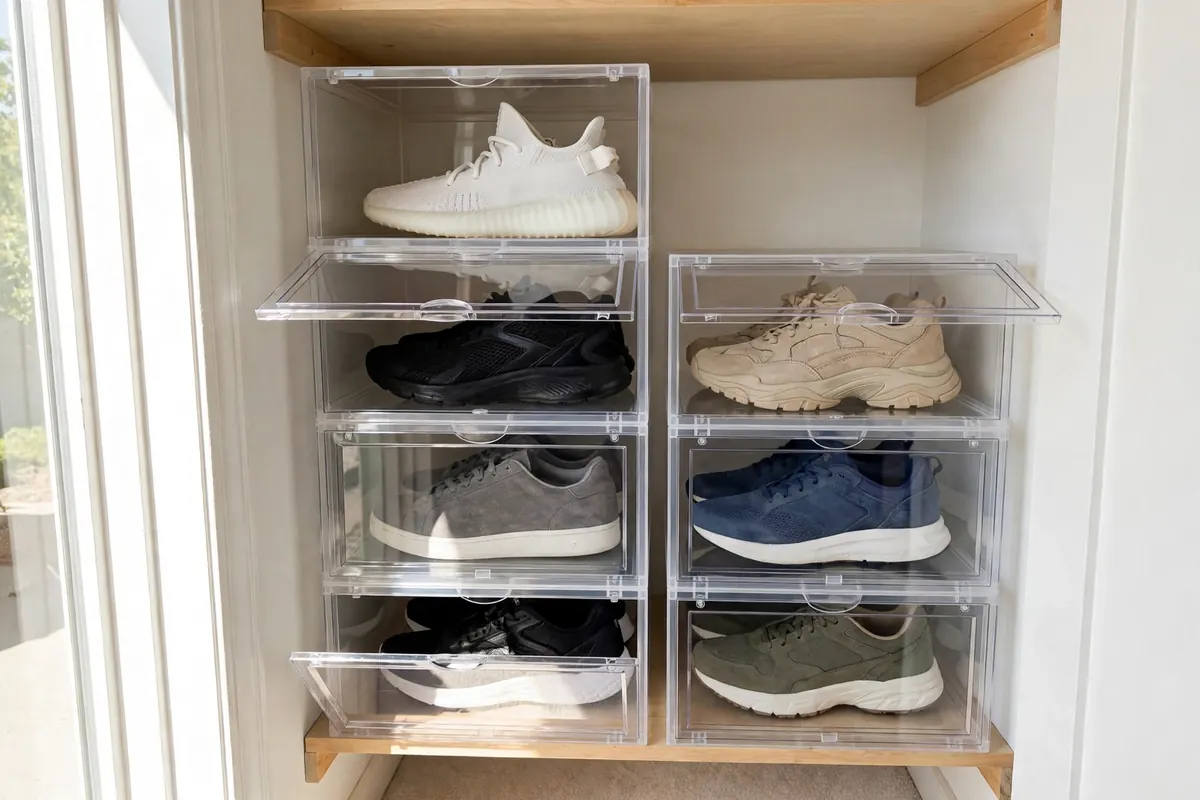
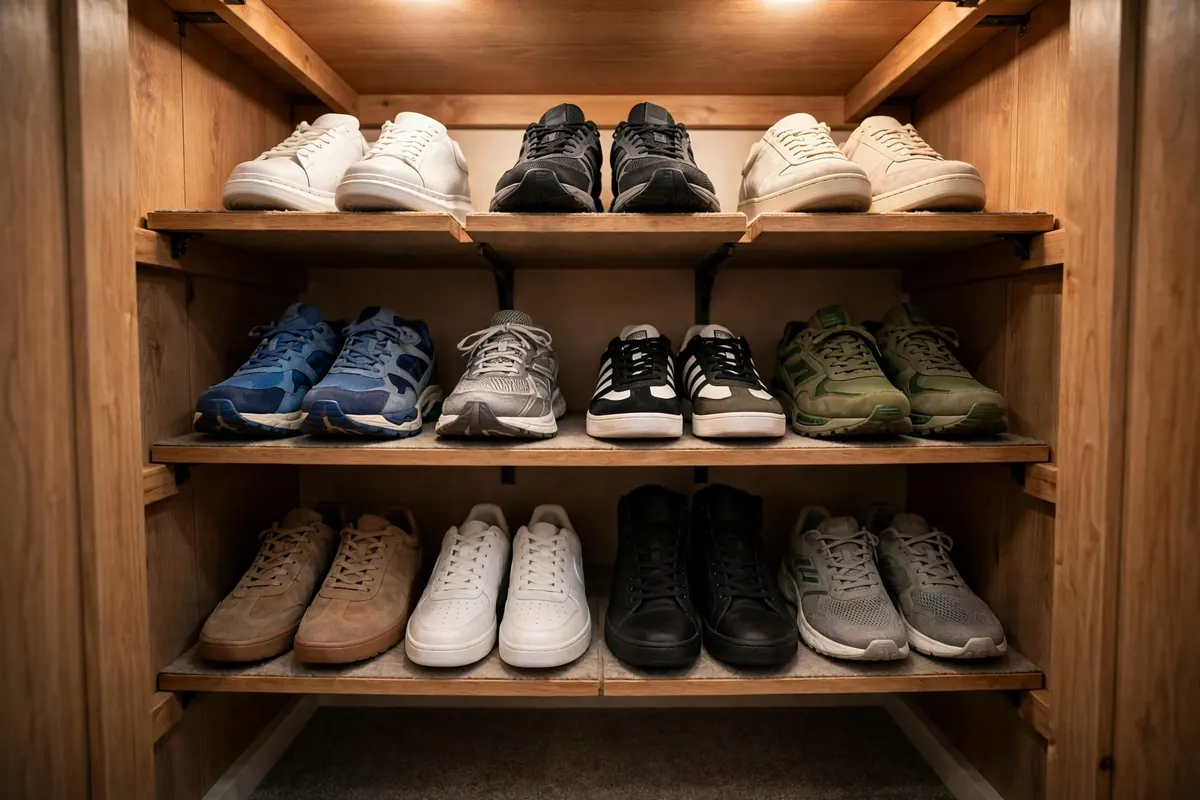
If you wear them, no. If you collect them, yes. In shoe storage for small closets, daily sneakers live like any other daily pair: open shelf, easy grab, air circulation. But sneakers kept as a collection need display plus preservation, because sunlight yellows midsoles with the patience of a hobbyist, and dust settles into knit uppers.
The setup that works: open shelving at eye level for the current rotation, clear drop-front boxes for the pairs with a backstory, and everything out of direct sun. Size the shelves right, because sneakers run bigger than flats. Closet World’s closet guide puts it plainly: 12 inches of depth handles most women’s and kids’ shoes, while men’s sizes and bulky sneakers need 13 to 14 inches, and anything deeper starts hiding a second row. A hidden row of sneakers is just the floor pile with better posture. A typical adult sneaker runs 11 to 12 inches long, per NestSorted’s measurements guide, so measure before you buy the shelf. Renters especially like these shoe storage for small closets because nothing needs drilling.
And the industry context for why this matters: Packlane’s footwear roundup puts 2024 US footwear sales at $89.2 billion, with 99% of shoes sold in the US imported. We buy a lot of shoes. Storing the expensive ones properly is not fussy, it is just math. This is one of the cheapest shoe storage for small closets in the whole guide.
Can a tension rod really hold shoes, or is that a gimmick?
It really holds shoes, within its limits, and knowing the limits is the whole trick. A standard spring tension rod wedged between two closet walls holds 6 to 10 pairs of flats or low heels draped over it, and it costs less than a pizza. It fails exactly where you would expect: heavy boots, chunky platform sneakers, and wide spans over 36 inches, where the middle sags.
Install it low, about 6 inches off the closet floor, so shoes hang into the dead space under your hanging clothes. That strip of closet is wasted in almost every small closet I have ever seen, and a tension rod converts it into a shoe row for pocket change. Twist it tight, really tight, and check it monthly, because temperature swings loosen the spring. These shoe storage for small closets also work when two people share one small closet.
My opinion: the tension rod is the single best dollar-for-dollar shoe storage buy for renters. It is not a replacement for a real system if you own 20-plus pairs. It is the fastest way to get six pairs off the floor today, and today counts. Measure your span before buying: most rods cover 18 to 36 inches, and anything past 30 inches sags under real weight. Two short rods beat one long rod every time. This is one of the cheapest shoe storage for small closets in the whole guide.
Should shoes stay in their boxes or sit on open shelves?
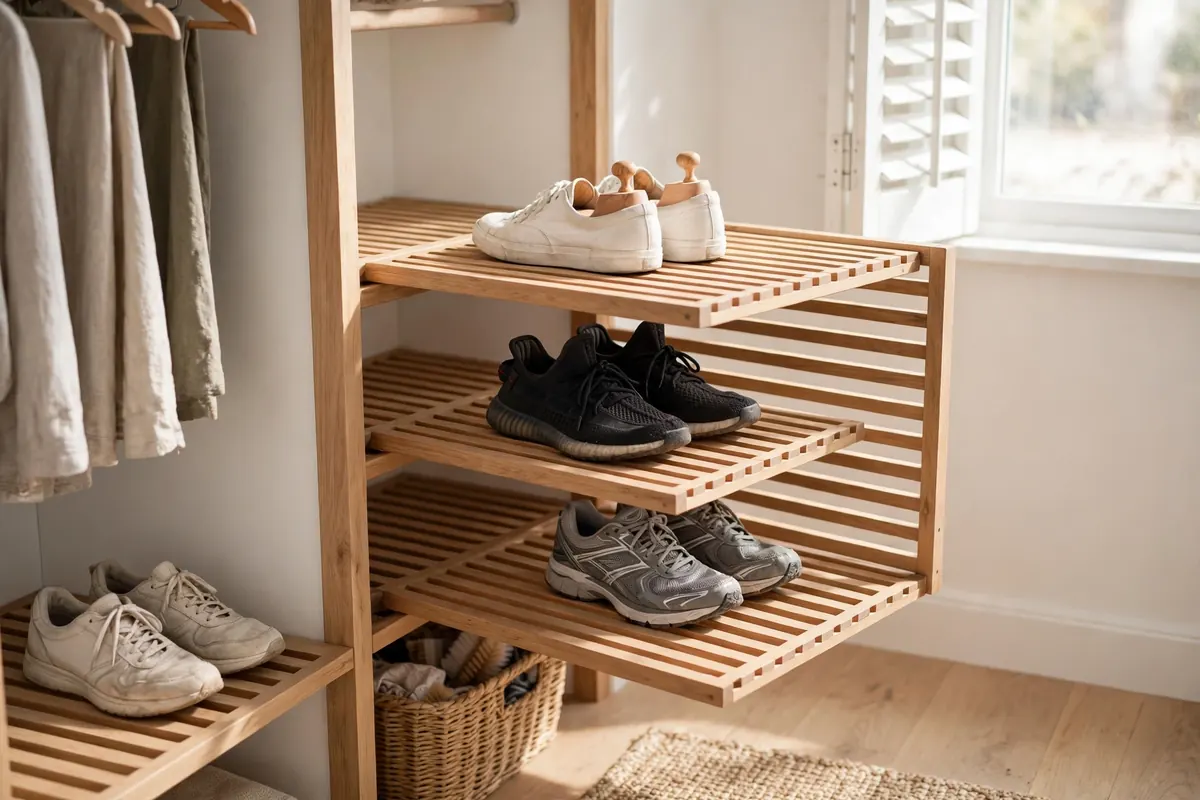
Daily pairs go on open shelves. Off-season pairs go in boxes. That split answers the whole shoe storage for small closets debate, because the two camps are arguing about different shoes. Open shelves win for anything in regular rotation: shoes dry faster, you see what you own, and grabbing a pair takes seconds. Boxes win for anything stored months at a time: they block dust, stack neatly, and keep delicate materials from getting crushed.
The moisture rule is non-negotiable either way. Never put a damp shoe in a closed box. Shoes need roughly 24 hours of open air after wearing before they go into anything enclosed, or trapped damp turns into odor and mildew, and mildew in a closed closet spreads to everything nearby. This is the mistake behind most “my shoe boxes smell” complaints. The box was innocent. Airflow is the reason shoe storage for small closets always include cedar inserts or a breathable shelf.
If you box, use clear drop-front boxes or label every box with the pair inside. An unlabeled stack of shoe boxes is a lucky-dip machine, and you will stop using it within a month. Sometimes Storage’s shoe FAQ makes the same point from the UK side: open racks for rotation, clear or labeled boxes for the rest, and never sealed plastic around leather. The best shoe storage for small closets include a rotation system: daily pairs up front, seasonal pairs up high.
How do you stop shoe storage from smelling in a closed closet?
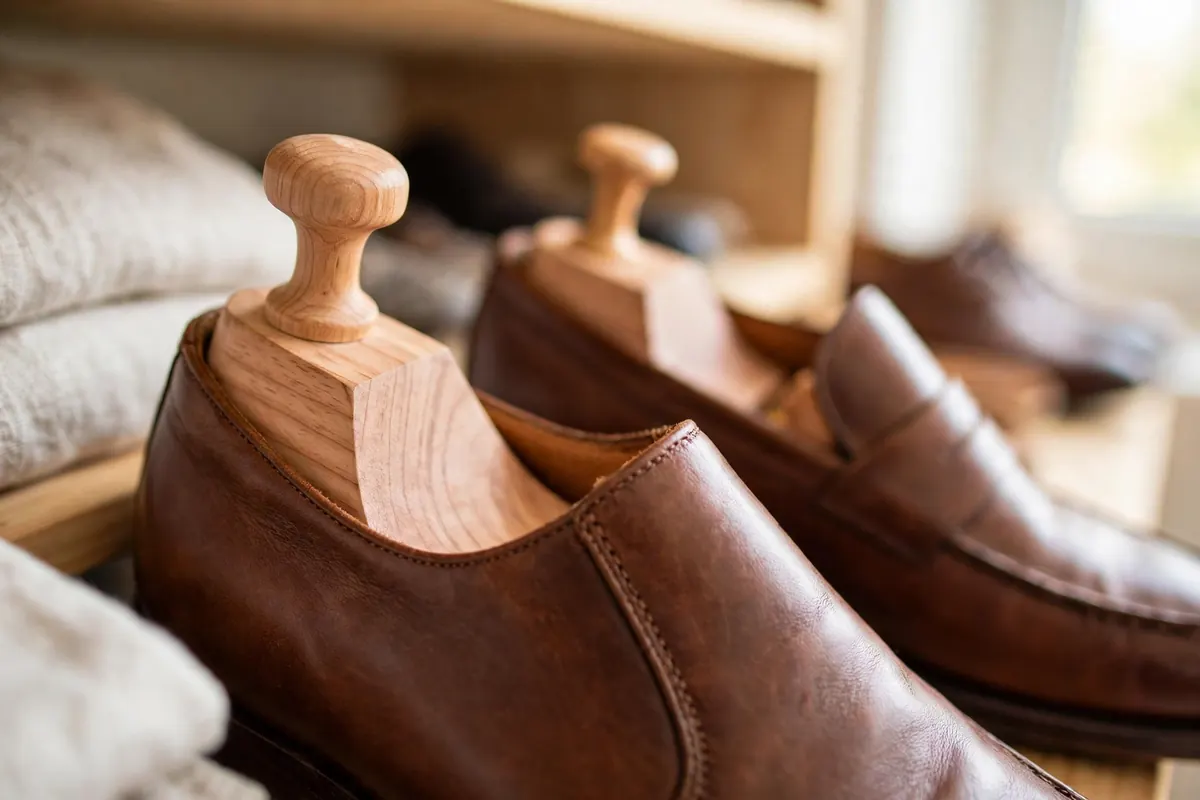
In shoe storage for small closets, ventilation beats deodorizer every time. The smell is trapped damp, not a cleaning problem, so the fix is airflow plus drying time, not sprays. Give worn shoes 24 hours in open air before they go into any enclosed container. Choose open or slatted shelving over closed cabinets for daily pairs. Slip cedar shoe trees into leather shoes: they absorb moisture, hold the shape, and smell better than any spray. Airflow is the reason shoe storage for small closets always include cedar inserts or a breathable shelf.
For the closet itself, leave the door open when you can, and avoid packing shoes so tight that air cannot move between pairs. Silica gel packets in storage boxes help for off-season pairs. Baking soda in an open container on the shelf absorbs ambient odor passively. What does not work long term: sealing smelly shoes in an airtight box and hoping. That just marinates them.
One dry note: if a pair still smells after proper drying and cedar trees, the insoles are done. Replace the insoles or replace the shoes. No organizer fixes dead insoles. Airflow is the reason shoe storage for small closets always include cedar inserts or a breathable shelf.
Tie this to your seasonal switch. Twice a year, when you rotate pairs, pull everything out, wipe the shelves, check corners for damp spots or mildew, and toss dead insoles. Ten minutes, twice a year, and the closet never needs a rescue mission. What separates good shoe storage for small closets from clutter is the one-in-one-out rule.
How do two people share one small closet without a shoe war?
Shoe storage for small closets shared by two people needs zones: split the closet and stop sharing shelves. One side for each person, divided at the middle of the rod, with each person’s shoes living directly below their own hanging clothes. Shared shelves are where pairs migrate, get buried, and start arguments. Zoned shelves end the migration.
Give the person with more pairs the door organizer and the top shelf, and give the other person the floor rack, or split by shoe type: one person’s daily pairs on the door, the other’s on the wall rails. The specific split matters less than the principle: every pair has an assigned home, and the homes do not overlap. Label the zones if you have to. There is no shame in labels; there is shame in a 7 a.m. argument about whose sneakers are whose. Going vertical is the golden rule of shoe storage for small closets: the floor is the scarcest inch.
Cap the shared closet the same way as a solo one: measure capacity, and overflow goes under the bed. Two people means two overflows, not one closet doing double duty. A split that works: partner A gets the door organizer and left wall rails, partner B gets the floor rack and right wall rails, and top-shelf bins are labeled by name. Couples who accept zoning early keep the closet. The rest end up with shoes in the hallway. Going vertical is the golden rule of shoe storage for small closets: the floor is the scarcest inch.
How do you keep the system working after month three?
With a five-minute monthly reset and a one-in-one-out rule. Once a month, put every stray pair back in its home, wipe the shelf, and check the tension rod’s grip. That is the whole maintenance routine. Shoe storage for small closets does not fail because the organizer breaks; it fails because three pairs drift onto the floor and nobody moves them back.
The one-in-one-out rule protects the capacity math you did on day one. A new pair comes in, an old pair goes to overflow or donation the same day. Without this rule, the average collection creeps back up: remember the surveys finding women keep seven unworn pairs on average. Those seven did not arrive all at once. They arrived one “great deal” at a time, and each one quietly stole a slot from a pair you actually wear. What separates good shoe storage for small closets from clutter is the one-in-one-out rule.
My honest take: skip the monthly reset and even the best system slides back to a floor pile within a season. Do the reset and a $15 tension rod outperforms a $150 cabinet that nobody maintains. Maintenance is the system. The organizer is just furniture. Tiny closets reward the simplest shoe storage for small closets: fewer, bigger containers.
What is the one system I would buy if I started over?
An over-the-door organizer for daily pairs, a low tension rod for flats, and under-bed boxes for the off-season overflow. Three pieces, all renter-safe, total cost well under a nice dinner out, and it covers the full lifecycle of a pair: worn this week, worn this season, worn next year. Everything else is optimization.
If you hate visible shoes, swap the door organizer for a slim tilt-out cabinet, the kind about 10 inches deep that hides pairs behind fold-down fronts. You lose some capacity and gain a calm-looking closet. That trade is worth it for a lot of people, and there is no wrong answer, only the closet you actually have to look at every morning. What I would skip: fabric hanging cubbies as a permanent solution. They sag, they tip shoes forward, and they are a temporary fix wearing a permanent costume. It sounds boring, but labeling is one of those shoe storage for small closets that actually sticks.
Start your shoe storage for small closets reset today with the count. Ten minutes, three piles, one tape measure. Your closet already has the space; it is just spending it on the floor. For the shelves and rods around the shoe zone, our closet shelf organization guide finishes the job. If you only try three shoe storage for small closets, make them an over-door rack, stackable boxes, and a donation bag.
How many pairs of shoes should one person keep in a small closet?
For shoe storage for small closets, match your pairs to the closet’s real capacity: measure inside width in inches, divide by 4 for pairs per shelf row, and count your rows (floor, shelf, door). Most 4-foot reach-in closets hold 16 to 24 pairs once the door and walls are used. Own more than that, and the extras belong in under-bed or top-shelf overflow, not on the floor.
What is the best no-drill shoe storage for a rental closet?
A low tension rod for flats plus an over-the-door pocket organizer for the daily rotation. This is the classic shoe storage for small closets rental combo: both install in minutes, hold 18 to 30 pairs combined, leave zero marks, and cost very little. Adhesive rails work for light pairs but can pull paint on removal, so test one in a hidden spot first.
Do over-the-door shoe organizers ruin doors?
Not when sized right. For shoe storage for small closets, use hooks matched to your door thickness (standard interior doors are 1-3/8 inches), add foam pads behind the hooks to stop rattling, and keep heavy boots out of the pockets. A full organizer is heavy, so reinforced hooks matter more than pocket count.
How deep should closet shelves be for shoes?
Good shoe storage for small closets starts with 12 inches of depth for most women’s and kids’ shoes; men’s sizes and bulky sneakers need 13 to 14 inches, per Closet World’s closet guide. Anything deeper hides a second row. Pair that depth with 6 to 7 inches of vertical clearance for flats and sneakers, 8 inches for heels, and one tall section for boots.
Can I store shoes in their original boxes long term?
Shoe storage for small closets works in boxes for off-season pairs, with two rules: let shoes air-dry about 24 hours after wearing before boxing them, and use clear or labeled boxes so you can find pairs later. Never seal damp shoes or leather in airtight plastic, since trapped moisture causes odor and mildew.
How do I keep boots from flopping over in a small closet?
Stand them upright in one tall corner with boot shapers or tall inserts inside the shaft; rolled-up magazines work free. One upright pair needs about 1 square foot of floor and 15 to 18 inches of height. Clean road salt off first, and keep boots out of direct sunlight.
Why do my white sneakers turn yellow in storage?
In shoe storage for small closets, sunlight is the enemy: it yellows midsoles over time, and heat speeds it up. Store collected sneakers out of direct sun, ideally in clear drop-front boxes at stable room temperature. Daily-wear sneakers on open shelves are fine; it is long-term display near windows that does the damage.
How do you store shoes so they do not smell?
Airflow plus drying time: give worn shoes 24 hours of open air before enclosing them, use open or slatted shelving for daily pairs, and put cedar shoe trees in leather shoes to absorb moisture. The smell is trapped damp, not a cleaning problem, so ventilation beats deodorizer sprays.
Will a tension rod damage my closet walls?
A tension rod is the gentlest shoe storage for small closets: no damage when installed correctly. A spring tension rod presses against the walls with no screws or adhesive, so it leaves zero marks. Twist it tight, keep the span under 36 inches to avoid middle sag, and stick to flats and low heels rather than heavy boots.
Where should off-season shoes go in a small apartment?
The classic shoe storage for small closets overflow: under the bed in low-profile boxes or on the closet’s top shelf in labeled bins. Move pairs there during the seasonal switch (roughly twice a year) and bring the current season’s pairs into your most accessible spot. This keeps daily storage from overcrowding year-round.
Shoes that do not fit the closet can live under the bed instead: the best under bed storage containers for small apartments includes a divided rolling bin made for shoes plus clothes.
