
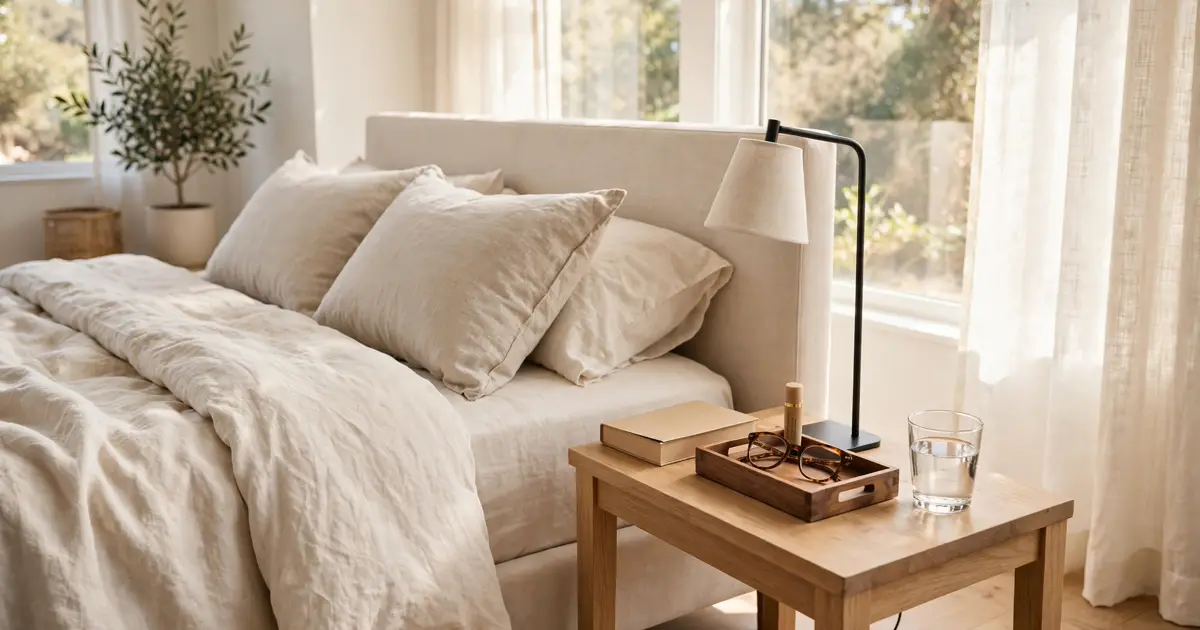

Looking for nightstand organization ideas that actually work? Your nightstand should hold the handful of things you reach for at night, and nothing else. The fix is a five-minute reset: empty it, keep only what you use every night, give each item a home with dividers or a tray, and run a weekly refresh. One Reddit thread on bedside-table photos drew 5.6K upvotes and 1,100 comments, which tells you this isn’t a small problem.
TL;DR
- A nightstand is a nightly toolkit, not storage overflow. Keep only what you touch between getting into bed and waking up.
- Drawer dividers beat bins for shallow drawers; a single tray beats clutter on the top.
- Cords are the number one complaint after clutter, and they’re fixable without drilling a single hole.
- No drawers, no room, or no nightstand at all each have real workarounds below.
- A five-minute weekly reset keeps the whole system working.
| Nightstand style | Best organizer setup | Budget approach |
|---|---|---|
| One or two shallow drawers | Adjustable bamboo or plastic drawer dividers, one small tray per drawer | Cut cardboard dividers or repurpose phone boxes |
| Open shelf (no drawers) | Stacking trays + one lidded box for private items | Dollar-store trays, one per shelf |
| Tabletop only, no storage | A single catch-all tray on top + wall shelf above | A thrifted plate or shallow bowl as the tray |
| No room for a nightstand | Floating wall shelf or rolling cart beside the bed | IKEA Raskog-style cart or a sturdy stool |
| Shared between two people | Split drawer with dividers, or two small trays, one per person | Two different-colored trays so sides stay separate |
What should you actually keep in your nightstand?
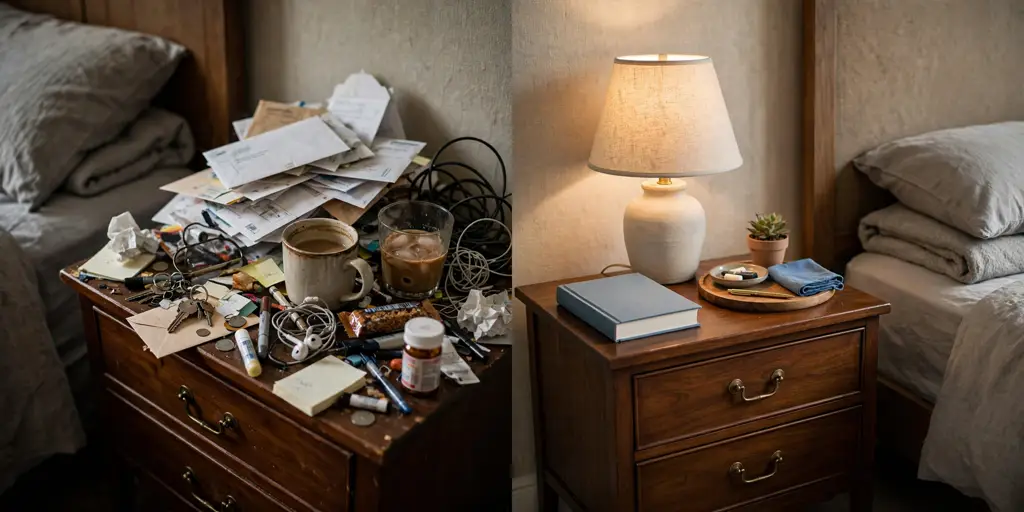
Start with a hard rule: if you don’t touch it between getting into bed and getting out of it, it doesn’t live here. That one sentence decides more nightstand battles than any organizer ever will. It’s the first principle behind these nightstand organization ideas, and the one everything else builds on.
The usual keepers are a lamp, your phone and charger, a book or e-reader, water, reading glasses, lip balm or hand lotion, tissues, and any medication you take at night. One popular Reddit thread asking people to share their bedside tables pulled in 1,100 comments, and those items showed up again and again. If your nightstand holds these and nothing else, you’ve already nailed the hardest of these nightstand organization ideas.
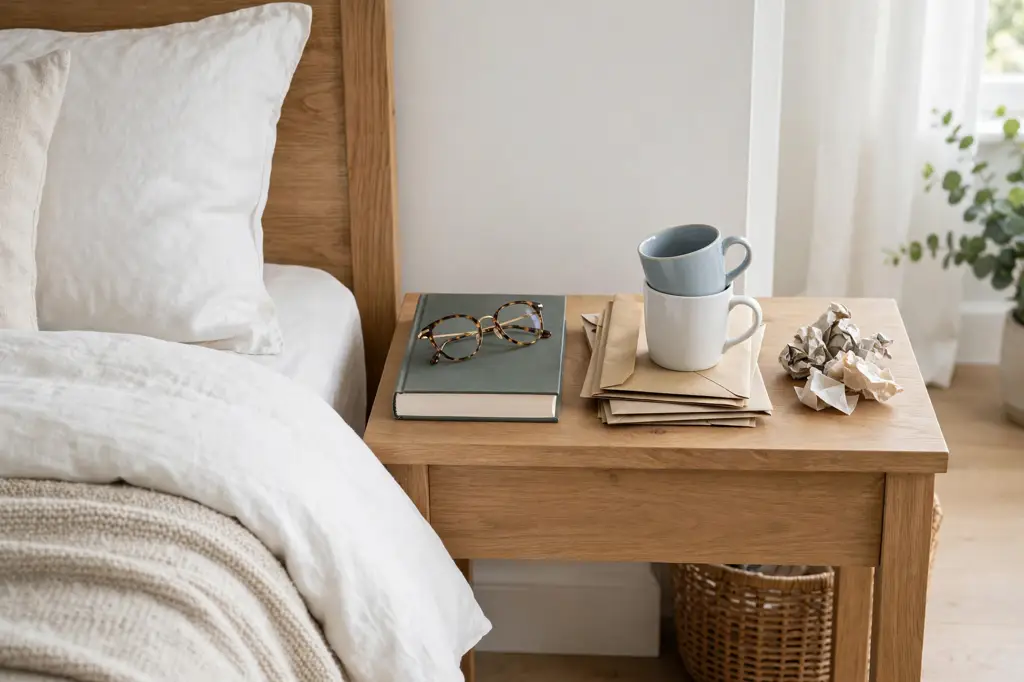
Everything else is a maybe. A journal works if you actually write in it. But the mail, the receipts, the random screws, the three pens, and the dead earbuds have to go live somewhere else. This is the “not for” part: a nightstand isn’t for project supplies, not for paperwork, and not for things you use once a month. They feel fine sitting there for a week, and that’s exactly how the catch-all starts.
My honest take: most people need fewer things here than they think. Start with less. You can always add something back if you genuinely miss it.

How do you declutter a nightstand that has become a catch-all?
Every drawer on the internet is a time capsule of everything its owner has ever owned. One r/declutter post about exactly this problem collected 121 upvotes and 44 comments in days, and the pattern was the same everywhere: flat surfaces attract clutter, drawers become junk drawers, and sorting it feels too big to start.
So make it small. Pull everything onto the bed, wipe the surfaces, then sort into three piles: nightly use, belongs elsewhere, trash. Catch-all clutter is almost always other rooms’ stuff squatting in your bedroom: dishes go to the kitchen, mail goes to the entryway. This five-minute sort is the gateway to all the other nightstand organization ideas below.
Be ruthless with the top surface. A lamp, one book, water, and a tray for the small stuff is plenty. If the top looks crowded, it’s crowded. Most nightstand organization ideas fail right here, at the top surface, because the boundary was never set.
Here is the step people skip: decide where the relocated items live before you walk them out of the room. Mail goes to a tray by the door, not the dining table. Cups go in the sink, not the hallway. Moving clutter from one flat surface to another just relocates the problem. Our entryway guide covers the drop-zone habit that stops mail and keys from migrating to the bedroom in the first place.
How do you organize a nightstand drawer so it stays neat?
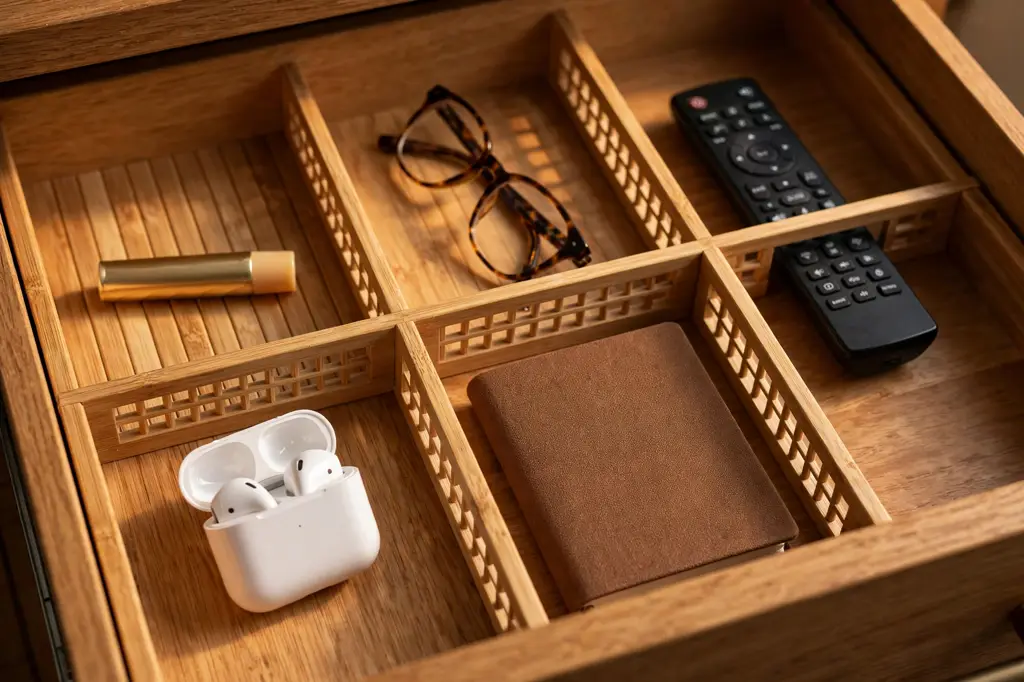
Drawer dividers are the single best purchase for this job. An undivided drawer is just a box with a handle; dividers turn it into six or seven small boxes, and small boxes are self-cleaning because each one can only hold a few things. It’s the simplest of these nightstand organization ideas, and the highest-impact.
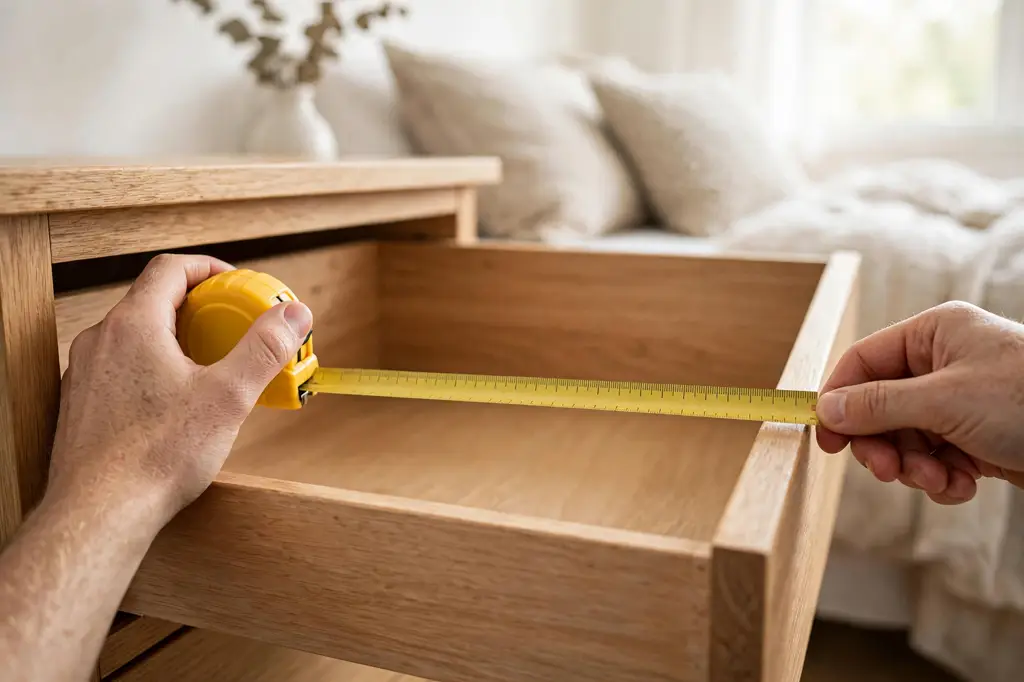
Measure first. Nightstand drawers are usually shallow, and the most common mistake is buying dividers meant for kitchen drawers that sit too tall. Adjustable spring-loaded dividers are forgiving for odd sizes.
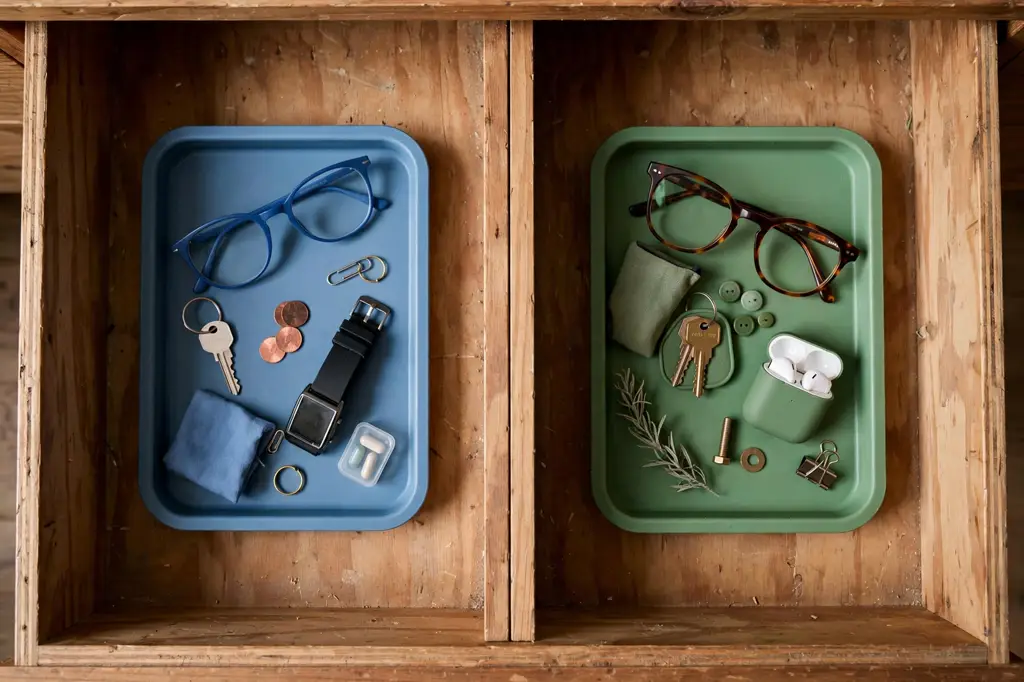
Give every zone a job. Front of the drawer is for the daily stuff: lip balm, glasses, the remote. The back is for the weekly stuff: the journal, the spare earbuds. When each zone has a job, putting things back takes two seconds, which is the whole secret.
If your drawer is deep, use a two-layer system: a shallow tray on top for the dailies, books and notebooks underneath. You lift one tray instead of digging. Line the drawer with non-slip shelf liner so the trays don’t slide. Our dresser organization guide uses the same drawer-zone method for full dressers.
What works best on top of the nightstand without looking cluttered?
The top of your nightstand is the most visible three square feet in your bedroom. It gets judged every morning, so treat it like a display with rules.
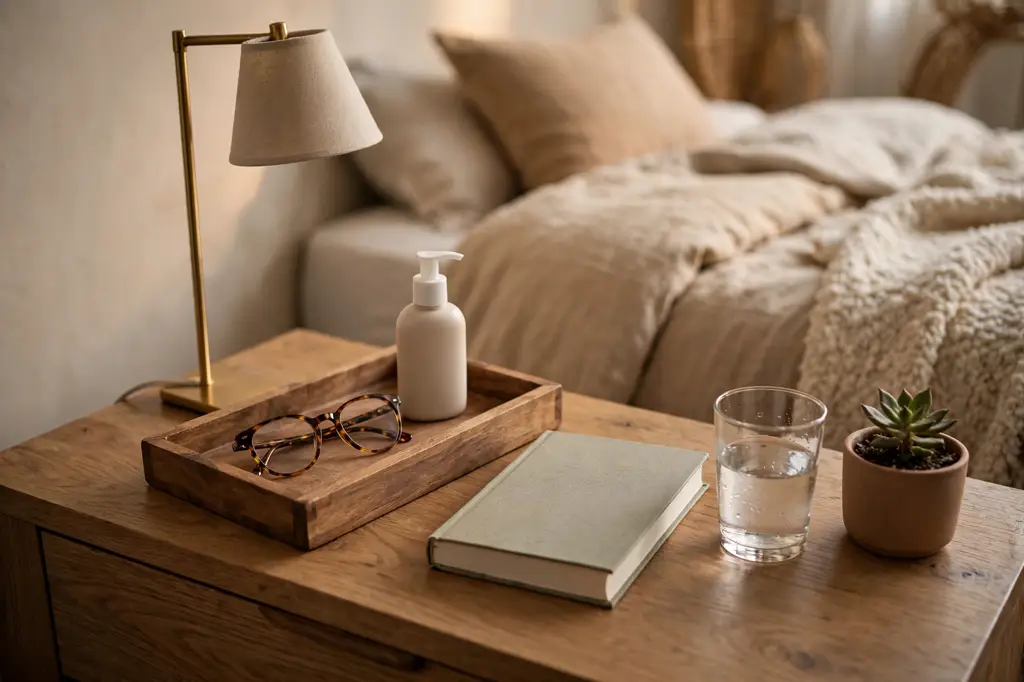
The formula is lamp, one tray, one book, water. The tray is the whole system: everything small lives in the tray, and the tray is the boundary. If it doesn’t fit in the tray, it doesn’t live on top. Of all the nightstand organization ideas here, the tray boundary is the one I’d teach first.
Keep the lamp slim. A chunky lamp base eats a third of a small nightstand. A wall-mounted light or a clip lamp frees the entire surface, and it’s a renter-friendly move if you use an adhesive hook or a clamp.
My take on styling: pretty matters, but only if the function holds. A small framed photo or one plant cutting is fine. Two plants, a candle collection, and a stack of decorative books is a styled shelf, not a nightstand, and you will knock something over reaching for water in the dark. Pretty and practical can share, but practical gets first pick of the real estate. That’s the styling philosophy behind the best nightstand organization ideas: function first, then one pretty thing.
How do you organize a nightstand with no drawers?
A tabletop nightstand with no drawers or shelves is the hardest version of this problem, and it’s also the most common in small bedrooms. Autocomplete shows real demand for the opposite of drawer advice: “how to organize nightstand without drawers” and “how to organize nightstand top” are both live suggestions.
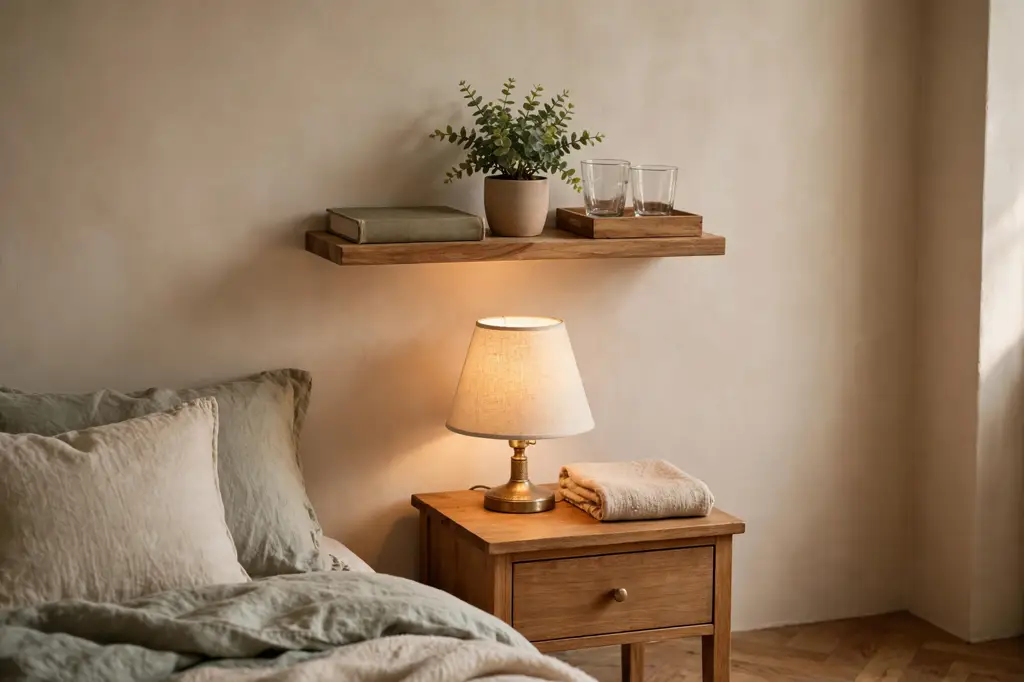
You have three moves. First, add a wall shelf above or beside the nightstand. A single 8 to 12 inch floating shelf holds the book, the glasses, and the lotion, leaving the surface for the lamp and water. Second, use the side: a stick-on or clamp-on caddy hangs chargers and a remote off the side. Third, corral the top with one tray, and accept that the top is the whole system.
What doesn’t work is buying lots of little containers. Five small boxes on a drawerless nightstand look worse than the original clutter. One tray, one shelf, one side caddy. That’s the whole kit.
If your nightstand is really just a stool or a stack of books, the wall shelf becomes the nightstand. Mount it at mattress height, keep the tray on it, and you’re done. Floating shelves are cheap, renter-friendly with the right anchors, and easier to clean than a drawer you never open. When floor space is zero, these are the nightstand organization ideas that still work.
What is the best way to hide cords and chargers by the bed?
After clutter, cords are the number one nightstand complaint. “How to organize nightstand cords” is a live autocomplete suggestion, and a nest of cables ruins even a perfectly tidy drawer.
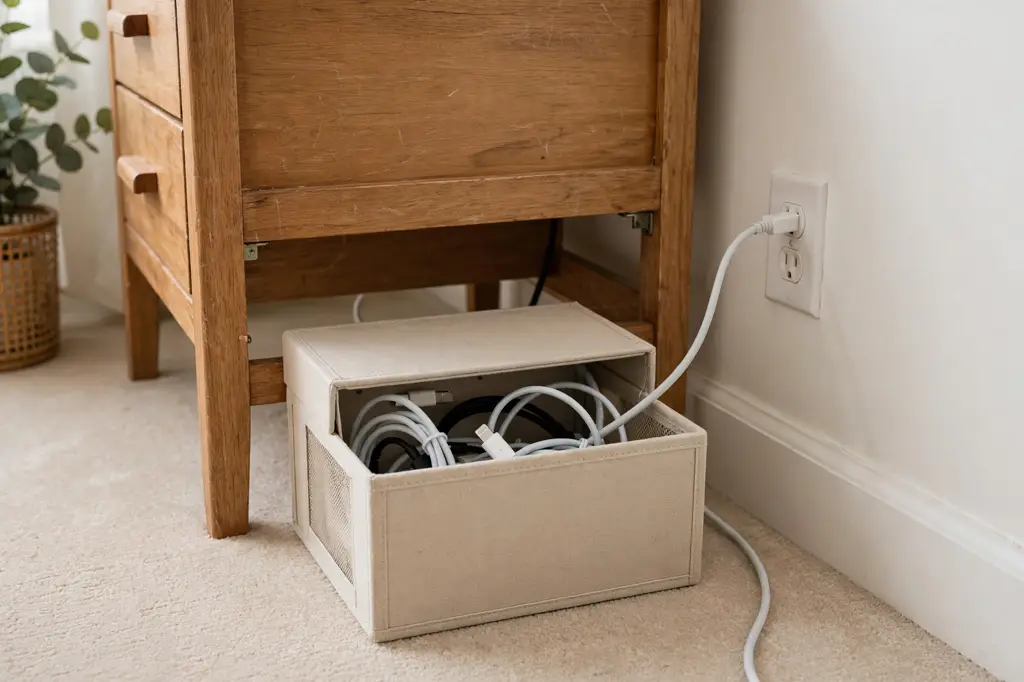
The simplest system is a cable box or a small lidded basket behind or under the nightstand. Run a short power strip into the box, plug in your chargers, and close the lid. One box, one visible cable going to the wall. No drilling, nothing permanent, which makes it the best option for renters.
If you have a drawer, the in-drawer charging station is the cleanest look: a power strip in the back, cables routed through a small notch in the back panel. But here is my honest warning: one popular blogger’s version requires drilling into the nightstand. If you rent, do the cable box version and skip the drill.
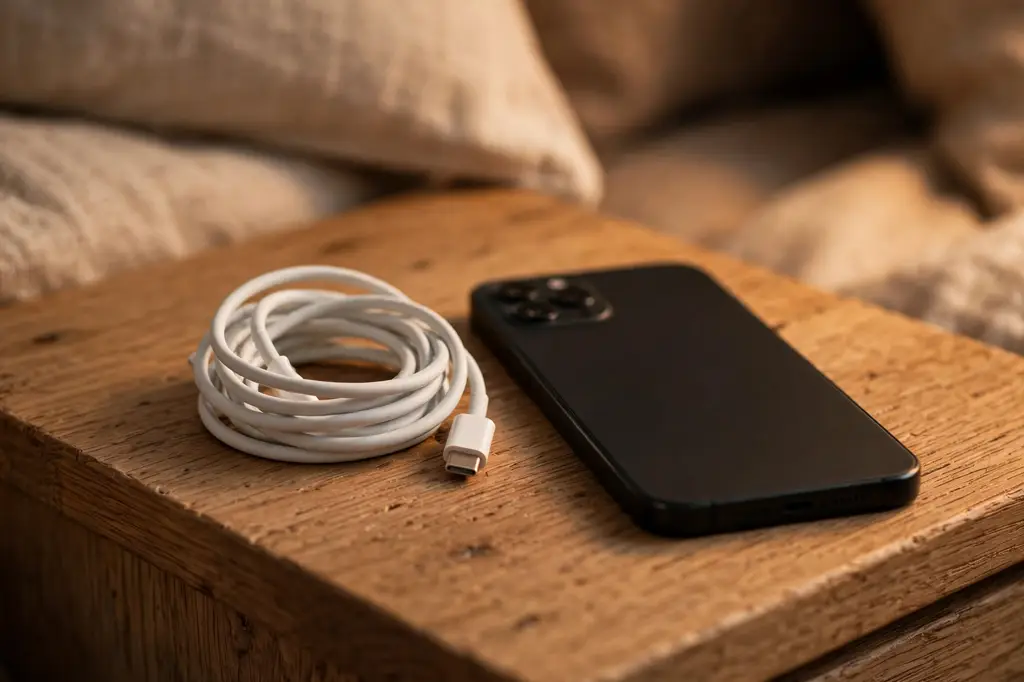
Stop charging the phone on the nightstand top if you can. A small charging tray on the wall shelf, or a stand that holds the phone upright in the drawer, keeps the cord short and the surface clear. Short cables are an underrated purchase: a 1-foot cable can’t tangle into a nest. Buy the short cable before you buy the organizer. It’s one of the cheapest nightstand organization ideas here.
| Budget tier | Cord setup | Cost approach |
|---|---|---|
| Tight budget | One lidded shoebox with holes cut in the back, power strip inside | Repurpose what you have |
| Mid range | Purpose-made cable management box + 1-foot charging cables | Small one-time purchase |
| Splurge | Nightstand with built-in USB ports or wireless charging top | Buy once, skip the box |
Where do gaming controllers, remotes, and laptops go?
Be honest about how you actually use your bed. A huge share of nightstand clutter is entertainment gear: TV remotes, game controllers, a Switch, a laptop. Pretending the nightstand is a phone-books-lamp zone doesn’t change that.
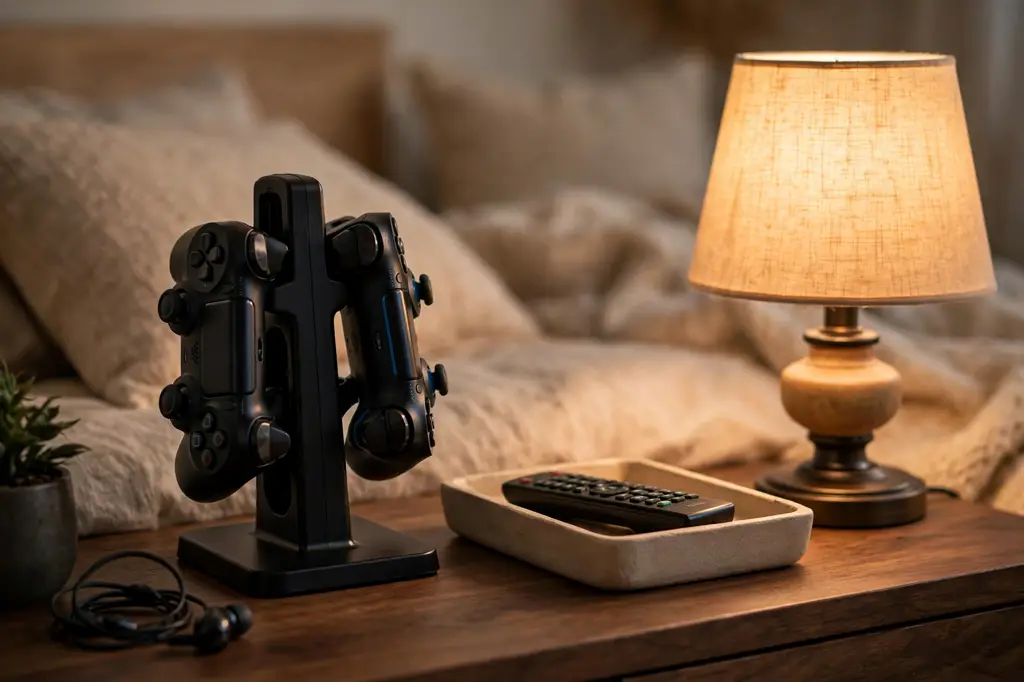
The answer is a dock, not a drawer. Controllers and remotes are awkward drawer items: they’re bulky, they tangle, and you reach for them in the dark. A vertical stand or a single tray on the top holds two controllers and a remote in the same footprint as a book. Laptops don’t belong in the drawer either; a sleeve standing upright between the nightstand and the bed beats a bent hinge.
My rule: if the device is in your hand every night, it gets a home on or next to the nightstand. If it’s in your hand twice a week, it lives across the room. The Switch you play nightly gets the dock. The tablet you open on Sundays goes on the bookshelf. Frequency decides, not guilt.
And the cables? That’s the cable box from the last section doing double duty. This is where people go wrong: they organize the devices and leave the cables, and it still looks messy. Small details like this separate good nightstand organization ideas from great ones.
How do you fit a CPAP machine on a small nightstand?
This is the section the glossy organizer blogs skip, and it matters. CPAP machines, nebulizers, and other medical devices eat nightstand space by necessity, not by choice. One Reddit commenter put it plainly: meds and lotion that “belong” in the bathroom stay by the bed because getting up is the hard part. Accessibility decides what lives here, not aesthetics.
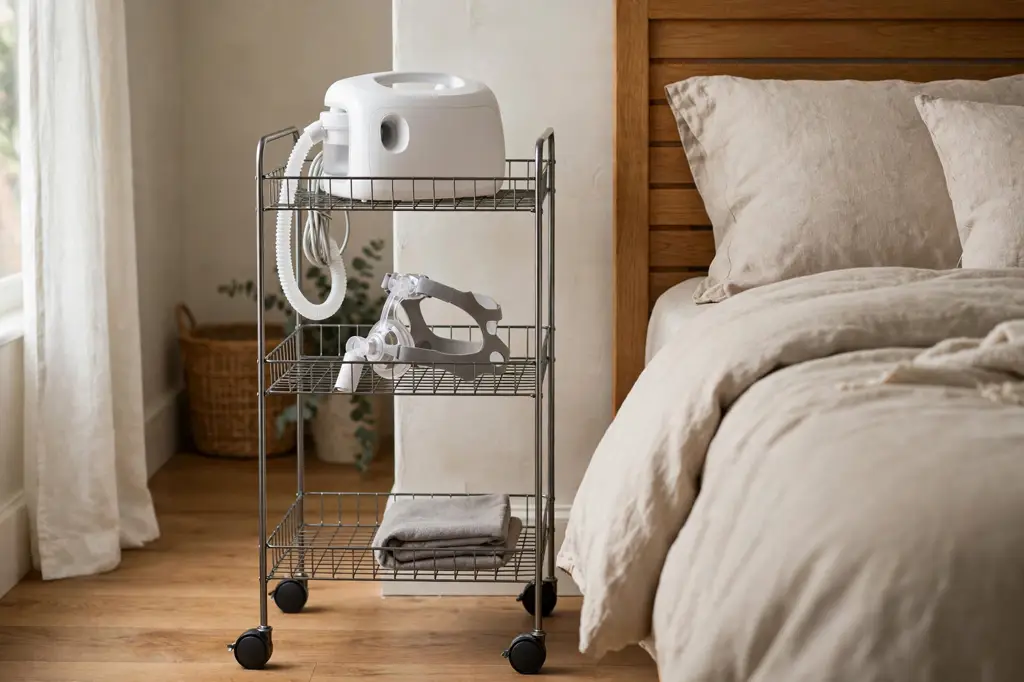
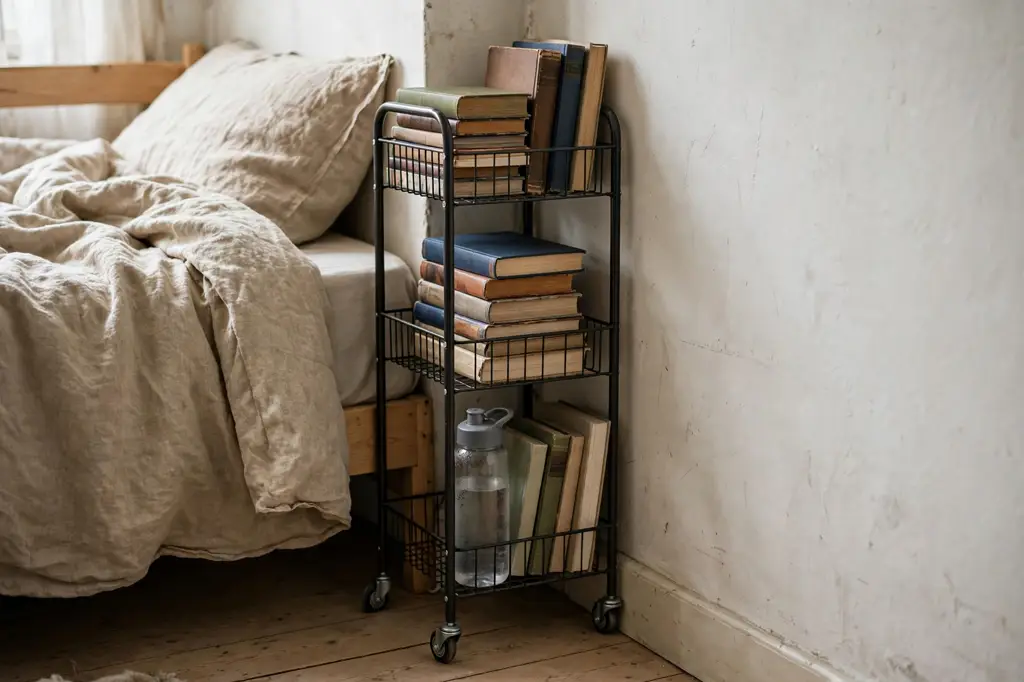
First, give the machine its own surface. A CPAP is shoebox-sized, and it will win any fight with a lamp for tabletop space. Park a small rolling cart beside the bed as a second nightstand: machine on top, mask and hose on the middle tier, supplies below. People on Reddit specifically recommend this setup because the machine stops competing with your stuff.
Second, manage the hose. A hose draped across the nightstand knocks over water glasses. A hose hanger or a Command hook above the bed keeps it routed up and out of the way, and it’s fully renter-friendly.
Third, accept the trade. If a medical device is here, something decorative leaves. That isn’t a failure of your system; it’s the system working correctly. The prettiest nightstand in the world is useless if the machine you need to breathe doesn’t fit. Designing around real needs is the most honest of these nightstand organization ideas.
What should you do when there is no room for a nightstand at all?
Some bedrooms genuinely have no space for a nightstand, and this isn’t a fringe problem. A r/DesignMyRoom thread about having no room for a nightstand pulled 564 upvotes and 401 comments, enormous engagement for a furniture question. If that’s you, stop shopping for nightstands and build the function instead.
The function of a nightstand is three things: a surface at mattress height, a light, and a home for the nightly items. You can get all three without floor space. A floating shelf mounted at mattress height is the closest replacement: it holds the tray, the water, and the book with zero floor space. A clamp lamp on the headboard or the shelf replaces the table lamp. Hitting all three without floor space is the real test of these nightstand organization ideas.
The rolling cart is the other answer, and it’s the one I recommend most for renters. A slim three-tier cart slides into a gap as narrow as 12 inches, holds more than most nightstands, and rolls out for cleaning. It’s also the best answer for the CPAP problem above.
Don’t settle for a chair piled with clothes and a phone balanced on top. That’s an accident waiting for a water glass. One shelf and one tray cost less than organizers that don’t fit, and they solve the actual problem. Sometimes the best nightstand organization ideas aren’t organizers at all.
How do you share one nightstand without fighting over space?
Couples sharing one small nightstand is a real and specific pain. Two people’s nightly stuff on one surface gets territorial fast.
The fairest system is a hard split. If the nightstand has one drawer, put a divider down the middle: your side, their side. If it’s a tabletop, use two trays in two colors so the boundary is obvious without a conversation. Shared items (the lamp, the alarm, the tissues) sit in the middle; personal items stay on their side.
The harder conversation is volume. One partner’s “essentials” are the other’s clutter. Agree on a number: three personal items each on the top, or one tray each, and anything beyond that lives on their own side of the room. It sounds rigid, and it is, and that’s why it works. Vague agreements about “keeping it tidy” fail because tidy means different things to two people.
My take: if you’re fighting about a nightstand, the nightstand is too small, and no organizer fixes that. A second floating shelf on the other side of the bed, or the rolling cart from the last section, ends more arguments than any divider. Buy the extra surface before you buy the couples therapy of drawer dividers. It’s the least obvious of these nightstand organization ideas, and the one that ends the most arguments.
How do you keep a nightstand organized week after week?
The initial declutter is the easy part. The maintenance is the whole game, and this is where most systems quietly die. My favorite takes five minutes: a weekly nightstand refresh. It’s the right scale for the job. A system you maintain beats a perfect system, which is why the reset is the most important of these nightstand organization ideas.
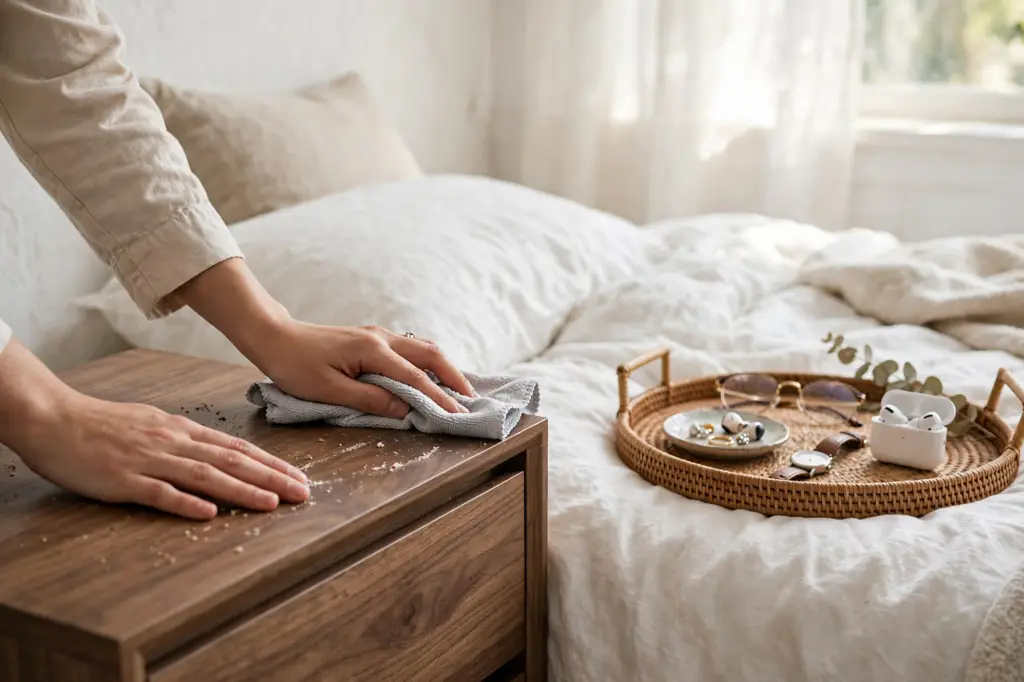
Set a weekly reset, same day, same time. Sunday night works: pull the tray out, toss the trash, return anything that migrated here from other rooms, wipe the surface. Five minutes, timer on. Clutter compounds: one stray item is invisible, ten stray items are a project. Weekly resets keep it at one.
Do a monthly drawer check, not a reorganization. Open the drawer, pull out anything that doesn’t belong, done. If a divider zone keeps collecting random stuff, that zone’s job is wrong; rename it. Systems fail at the point of friction, so make the right spot easier instead of trying harder.
Every few months, empty it and re-ask the nightly-use question. Nightstands accumulate aspirational items: the journal you will start, the book you will finish, the vitamins you will take. If it has been there three months untouched, it’s decoration. Move it anywhere else. Our small closet guide has the same reset logic for the whole bedroom.
How do you style a nightstand so it looks good and stays practical?
“How do I style my nightstand?” is a live PAA question, so let’s answer it properly: styling is the last step, not the first, and it has to survive the nightly routine. A nightstand that looks great at 2 p.m. and fails at 11 p.m. is a failed nightstand.
The rule is function first, then one or two pretty things. After the lamp, tray, book, and water are placed, you get one decorative slot. A small plant, a framed photo, a nice candle. One. The styled nightstands that stay styled are the minimal ones.
Height is the styling cheat code. A lamp, a low tray, and one taller object (a small vase, a stack of two books) creates the visual triangle that makes any surface look intentional. That’s the whole trick behind the photos. You don’t need more objects; you need different heights.
Color helps more than quantity. A tray in one finish, a lamp in a complementary one, and bedding that ties them together reads as styled with four objects. The 2026 trends from PAA fit here if you care: curved shapes, warm neutrals, one statement material like brass. But trends are optional. The tray and the heights are the system; everything else is paint. Of all the nightstand organization ideas in this guide, the tray-and-heights formula is the one guests notice first.
| What belongs in the nightstand | What belongs somewhere else |
|---|---|
| Lamp, phone, charger | Mail and paperwork (entryway tray) |
| Book or e-reader, reading glasses | Project supplies and hobby gear |
| Water bottle or glass | Dishes and snack trash (kitchen) |
| Nightly medication, lip balm, lotion | Vitamins you take at breakfast (kitchen) |
| Tissues, alarm clock, journal you use | Books you finished (bookshelf) |
| Remote or controller you use nightly | Devices you use weekly (across the room) |

Start with the drawer you open every night
Here is the whole post in one paragraph: keep only what you touch between bedtime and morning, give everything a divided home, hide the cords in a box, and reset for five minutes every Sunday. A nightstand is the smallest room in your house, and it runs on the same rules as every other one: less stuff, clear homes, a routine. These nightstand organization ideas work because the system is small enough to maintain.
If you only do one thing today, do the top-surface reset from the second section. Empty it, wipe it, put back the lamp, one tray, one book, and water. That takes ten minutes and it changes how the bedroom feels tonight. The drawers can wait for the weekend.
And if your bedroom is small enough that this whole post felt optimistic, start with the small-closet guide next. The nightstand is step one; the closet is where the real space hides.
Should a nightstand be higher or lower than the bed?
About the same height as the top of your mattress, give or take an inch or two. That way you can reach water, glasses, and the lamp without sitting up. Much taller or shorter gets awkward fast.
What is the rule for bedside tables?
Keep only what you use between getting into bed and waking up. Everything else belongs in another room. One lamp, one tray for small items, and water covers most people.
How much space should I leave between the bed and nightstand?
Two to four inches is plenty. Close enough to reach in the dark, far enough that bedding doesn’t snag when you pull the covers up.
How do you organize a nightstand without drawers?
Use one tray on top as the boundary, add a floating wall shelf above for books and glasses, and hang a side caddy for chargers and the remote. One tray, one shelf, one caddy is the whole kit.
What is the best bedside table organizer?
Adjustable drawer dividers for drawers, and a single catch-all tray for the top. Skip the sets of tiny boxes; fewer, bigger zones stay usable longer.
How do you organize deep nightstand drawers?
Use a two-layer system: a shallow tray on top for daily items, books and notebooks in the base layer underneath. Lift the tray instead of digging.
What should you put on top of a nightstand?
A lamp, one book, water, and a tray holding the small stuff like glasses and lip balm. If it doesn’t fit in the tray, it doesn’t live on top.
What are the nightstand trends for 2026?
Curved shapes, warm neutrals, bold color like deep green or black, and multifunctional pieces with charging and lighting built in. Trends are optional; the tray-and-heights system works regardless.
How often should you declutter your nightstand?
A five-minute reset every week and a full empty-and-sort every few months. Clutter compounds, so the weekly reset is what keeps the system alive.
What should you not keep in a nightstand?
Mail, paperwork, dishes, project supplies, and anything you use less than weekly. The nightstand is a nightly toolkit, not overflow storage.
