
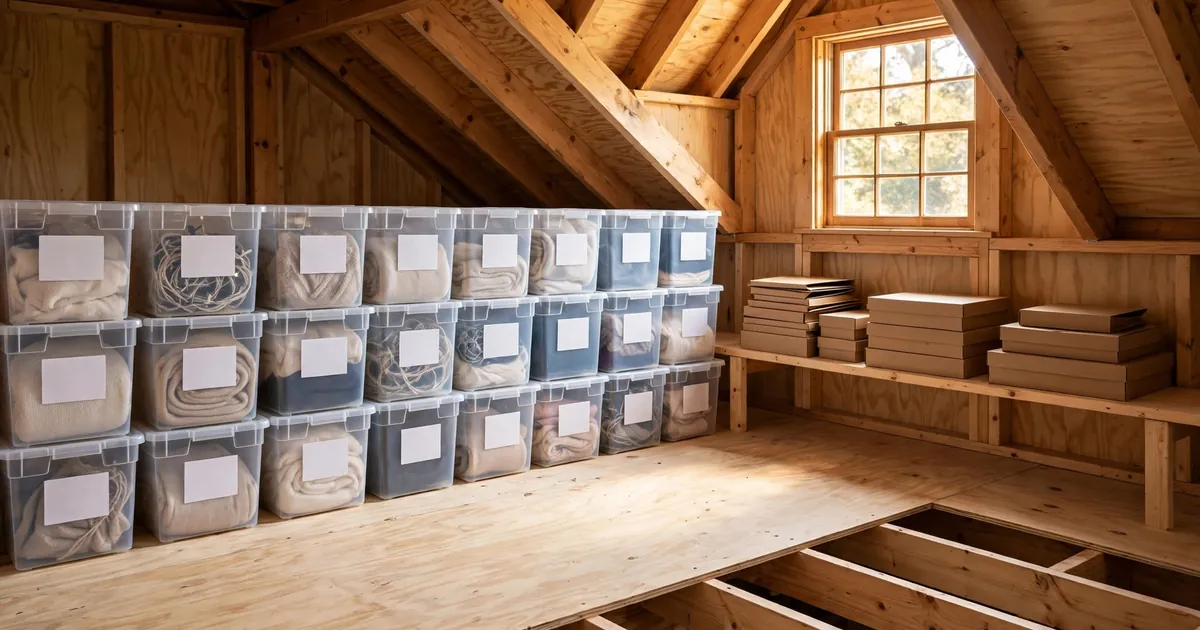

Yes, with limits. Your attic is free square footage, but only for the right things. Before a single box goes up, check five things: the floor’s weight limit, the summer heat, moisture and pests, your access, and your actual measurements. Get those right and the attic becomes a calm seasonal warehouse. Get them wrong and it becomes the place where keepsakes go to die.
These attic storage ideas come with the real numbers the thin ranking pages skip. Unconditioned attics hit 120 to 140 degrees in summer, according to the U.S. Department of Energy. Ceiling joists in most homes were designed for a 20-pound-per-square-foot live load for limited storage, and some hold half that. Weight, heat, moisture, access, measurements, decking, bins, zones, clothes, holiday decor, trusses, and budgets: that is the order these attic storage ideas follow, because that is the order that keeps your stuff and your house safe.
There is a reason beyond tidiness. UCLA’s Center on Everyday Lives and Families found that women who described their homes as cluttered showed flatter diurnal cortisol slopes, the pattern researchers link to poorer health. A usable attic takes pressure off every closet in the house. Start with the fit check below, because every one of these attic storage ideas depends on it.
- Weight comes first: most attics allow 20 pounds per square foot of limited storage. Keep loads light, spread out, and parked over load-bearing walls. Books and file cabinets belong downstairs.
- Heat is the silent killer: a parked-car test decides everything. If a summer day in a parked car would ruin it, the attic will too. Candles, photos, vinyl, and electronics stay downstairs.
- Moisture and pests are the slow killers: sealed totes beat cardboard every time, vents must stay clear, and a roof leak check comes before any loading.
- Zones keep it findable: holiday decor in one zone, seasonal gear in another, keepsakes in a third. One inventory page taped inside the access hatch answers “where is it” without a trip up the ladder.
- My one clear opinion: treat the attic as a seasonal warehouse, not a second closet. Daily and weekly items live downstairs. The attic earns its keep on things you touch twice a year.
- The fit check first: every one of these attic storage ideas assumes the five-part fit check above passed. Skip it and the rest is guesswork.
That is the whole philosophy behind these attic storage ideas: the attic is a warehouse you visit twice a year, not a closet you raid daily.
| Item class | The verdict | Why |
|---|---|---|
| Holiday decor in sealed totes | Do store | Heat-tolerant, seasonal, bulky. The attic's ideal tenant. |
| Off-season clothes in garment bags | Do store | Fine for coats and boots. Keep leather and heirlooms downstairs. |
| Luggage and duffel bags | Do store | Empty and bulky, which is the exact shape of attic space. |
| Camping and sports overflow | Do store | Seasonal by nature. Sealed totes keep out dust and rodents. |
| Kids' outgrown clothes, labeled | Do store | One bin per size. You will thank yourself next year. |
| Candles and wax melts | Never store | Heat melts them into one fused box. A Reddit commenter put it best: it turns a box of candles into a box of candle. |
| Photos, film, and important papers | Never store | Heat and humidity fade, curl, and stick. Keep them in the house. |
| Vinyl records and cassettes | Never store | Warp in sustained heat. Collectors store these at room temperature. |
| Electronics and batteries | Never store | Heat damage kills batteries and boards. A fire risk if batteries swell. |
| Unsealed food, pet food, perishables | Never store | Draws rodents. Once they nest, they chew everything nearby. |
| Leather, wool, and silk heirlooms | Never store | Heat, humidity, and pests attack all three. Climate-controlled space only. |
| Flammables (paint, solvents, propane) | Never store | Heat plus fumes plus an enclosed space is a bad mix. Store per the label, away from the house. |
Check this table against every box before it goes up. If it is on the right side, it stays downstairs, no exceptions.
Is your attic actually safe for storage?
Safe is the right first question for any attic storage ideas plan, and it has five parts. Weight: can the floor hold what you plan to store. Heat: will summer temperatures destroy the items. Moisture and pests: is the roof sound, or will mice treat your boxes as a hotel. Access: can you get a loaded tote up there safely. Measurements: is there usable space once the roof slope does its work.
Most attics pass with conditions, which is why attic storage ideas fail in predictable ways. The failures I see repeat: someone decks the whole floor without checking the joists, someone stores photo albums because the closet was full, someone stacks cardboard where the soffit vents breathe. Each mistake is cheap to prevent and expensive to fix. A quick visual pass answers most of it: look for water stains on the sheathing, sagging joists, chewed cardboard, and daylight where it should not be.
My opinion, up front and without hedging: treat the attic as a seasonal warehouse, not a second closet. If a thing gets used weekly, it lives downstairs, even if the attic has room. The attic’s job is the bulky, the seasonal, and the rarely touched. Everything that follows in this guide, and every list of attic storage ideas worth its salt, assumes that rule.
How much weight can you store in an attic?
Start with the code number. The International Code Council’s 2021 International Residential Code, Table R301.5, rates uninhabitable attics with limited storage at a 20 psf minimum live load, and attics without storage at 10 psf. Translation: the code assumes your attic floor holds 20 pounds per square foot, but only where storage was intended. These are the numbers every honest set of attic storage ideas should print, and most skip them.
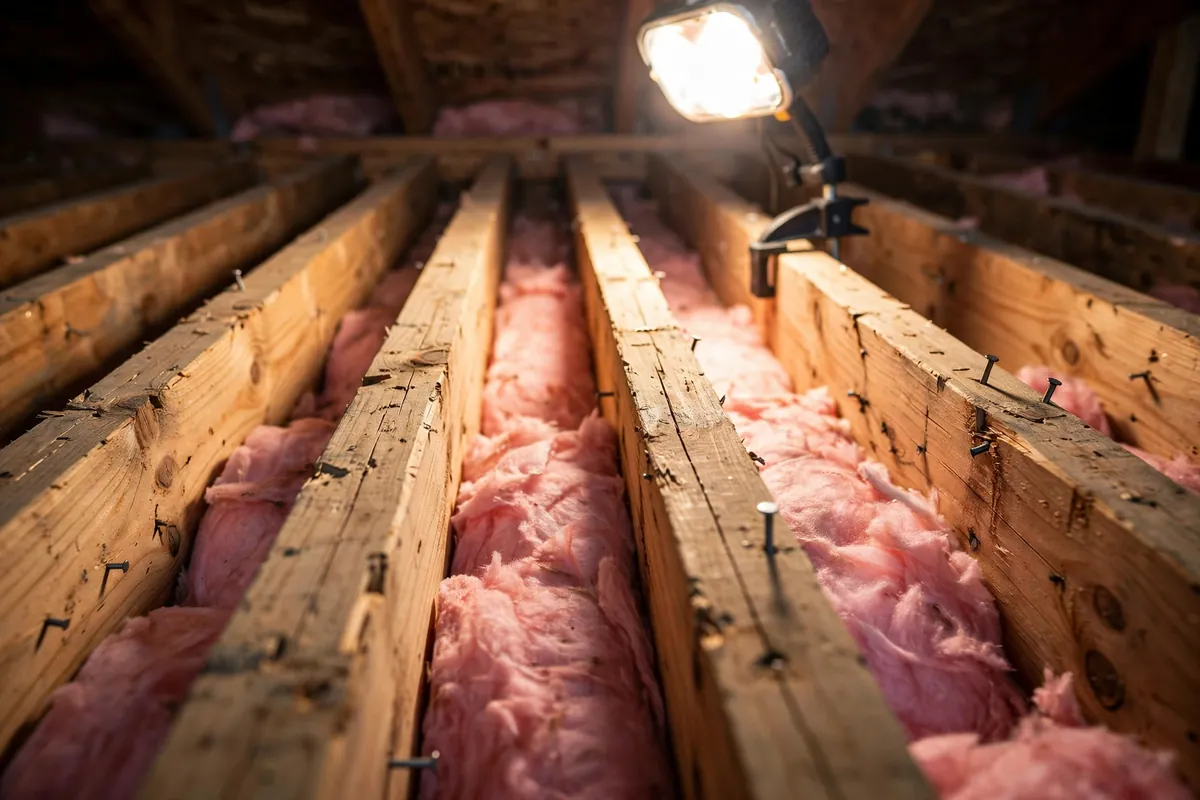
The framing details matter. A common builder rule of thumb: 2×6 ceiling joists spanning 10 feet or less hold roughly 300 pounds of distributed load mid-span, dropping toward 100 pounds as spans get longer. When the framing is unknown, assume the weaker number and keep loads light.
Keep storage over load-bearing walls and near the center of the house, where joists are shortest. That placement rule underpins most safe attic storage ideas. The middle of a long span is the worst spot for a tote. Walk boards give you a narrow path; full plywood decking spreads weight across more joists and makes the space usable.
Here is when I would store less than the math allows: any attic with unknown framing, any span I cannot see clearly, any floor that creaks underfoot. Books and file cabinets are not for attics, ever. Spread weight, stay near walls, and when in doubt, store less, closer to the house’s center.
What should you never store in an attic?
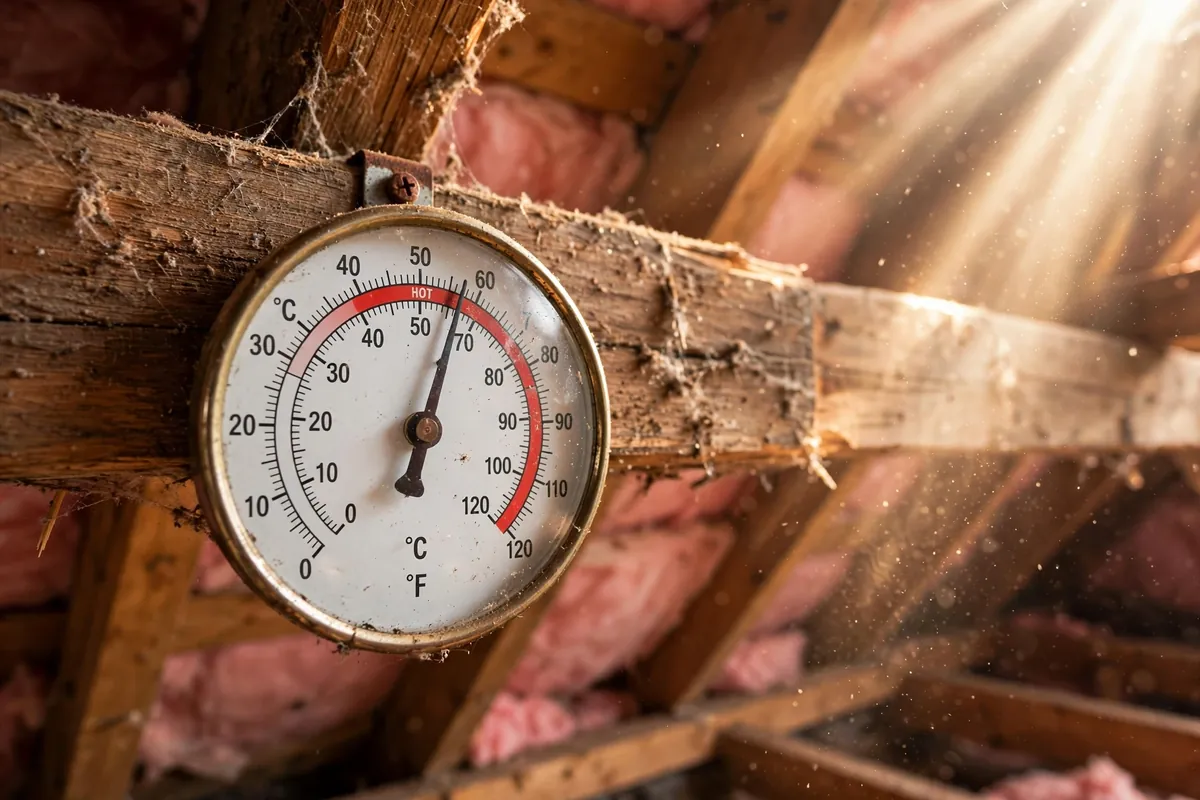
The heat answers this question, so here are the numbers every attic storage ideas guide should print. According to the U.S. Department of Energy, unconditioned attics reach 120 to 140 degrees in summer, which is hotter than a parked car on most days. Anything that fails the parked-car test fails the attic test. Start with the table near the top of this guide and treat its right column as law.
Candles are the classic lesson. Heat turns a box of candles into a single fused box of candle, and the wax seeps into everything nearby. Photos, negatives, and important papers curl, fade, and stick together in heat and humidity. Vinyl records warp. Electronics cook; lithium batteries swell and can become a fire hazard. Pet food and anything edible invites rodents, and once rodents nest, they chew wires, boxes, and insulation alike.
The less obvious entries: leather goods, wool suits, and silk heirlooms, which heat, humidity, and pests all attack. The attic is unconditioned space, full stop.
My opinion: if heat would ruin it in a parked car, the attic ruins it too. That one sentence replaces every “is it safe to store X” forum thread. It is the simplest of these attic storage ideas, and the one people ignore most. When the answer is unclear, the answer is downstairs.

How do you keep moisture and pests off your stuff?
Before any of these attic storage ideas goes up, look at the roof from the inside. Scan the sheathing and rafters for water stains, dark streaks, and soft spots. One active roof leak undoes every bin and label you will ever buy, so the leak check comes first.
While you are up there, find the ridge vent and the soffit vents and keep them clear. Buried vents turn an attic into a damp box.
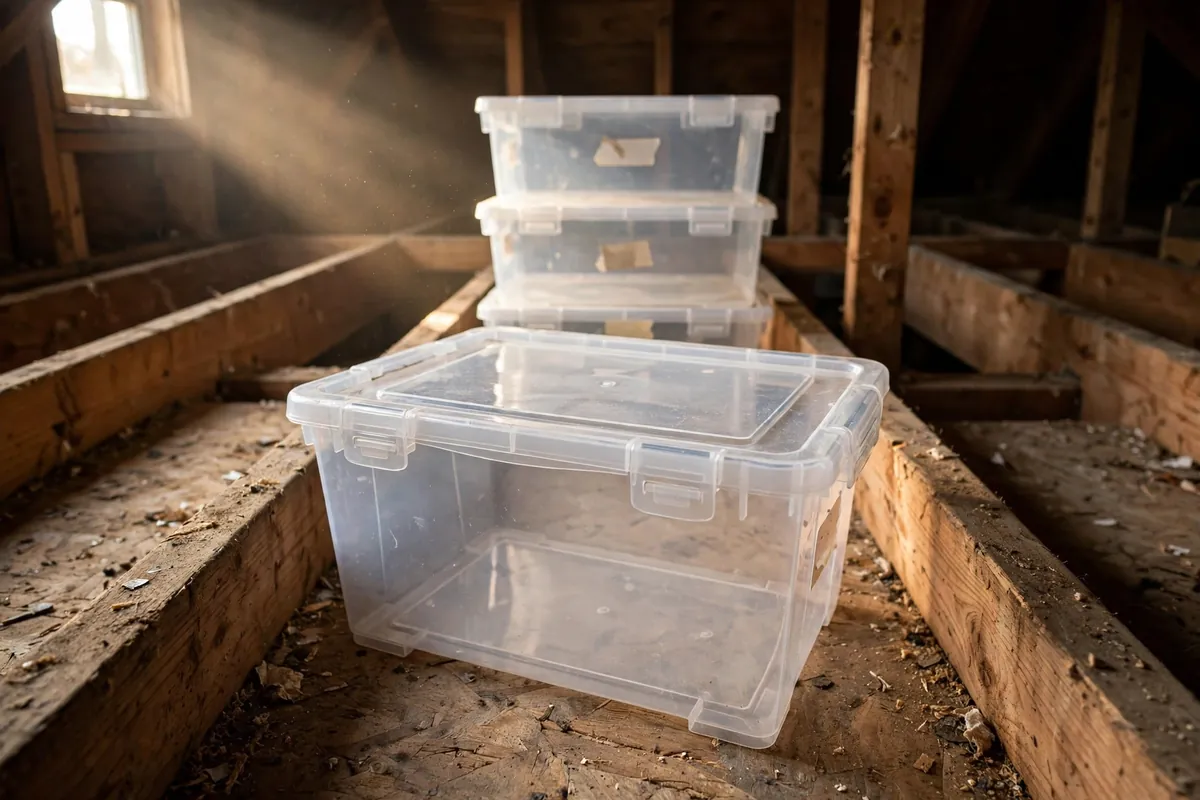
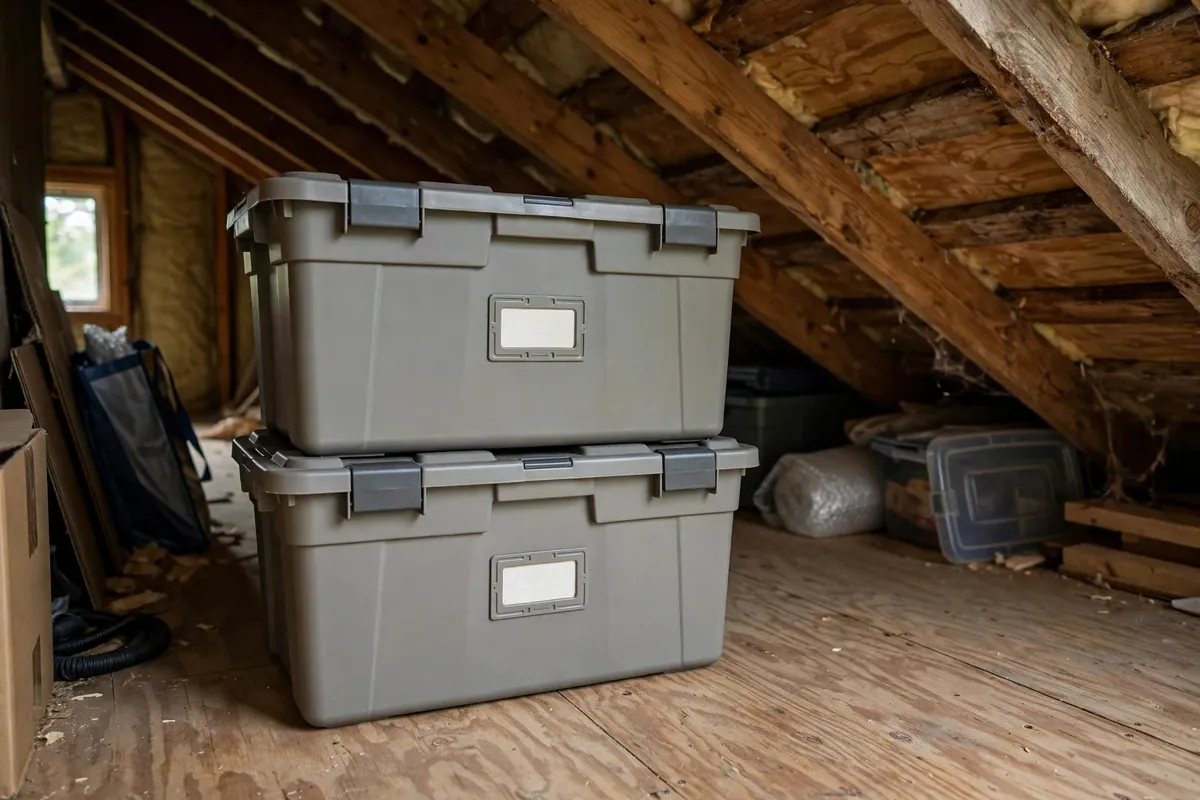
Then change the container. Cardboard boxes are not for long-term attic storage, and every serious roundup of attic storage ideas says the same. They absorb humidity, sag, and hand rodents nesting material with chewable walls. A sealed hard-sided tote with a latching lid resists chewing and shrugs off humidity swings. Never store food smells up there; smells are invitations.
The scale of the pest problem is real. Per the National Pest Management Association, rodents invade an estimated 21 million US homes each winter. Seal the gaps you can see around pipes and the access hatch, and skip the poison; snap traps and sealed containers do the job.
My opinion: cardboard is a pest invitation with handles. Of all the attic storage ideas in this guide, the sealed-tote rule prevents the most heartbreak. Replace every attic box with a sealed tote, starting with the ones nearest the vents.
What kind of attic access do you have?
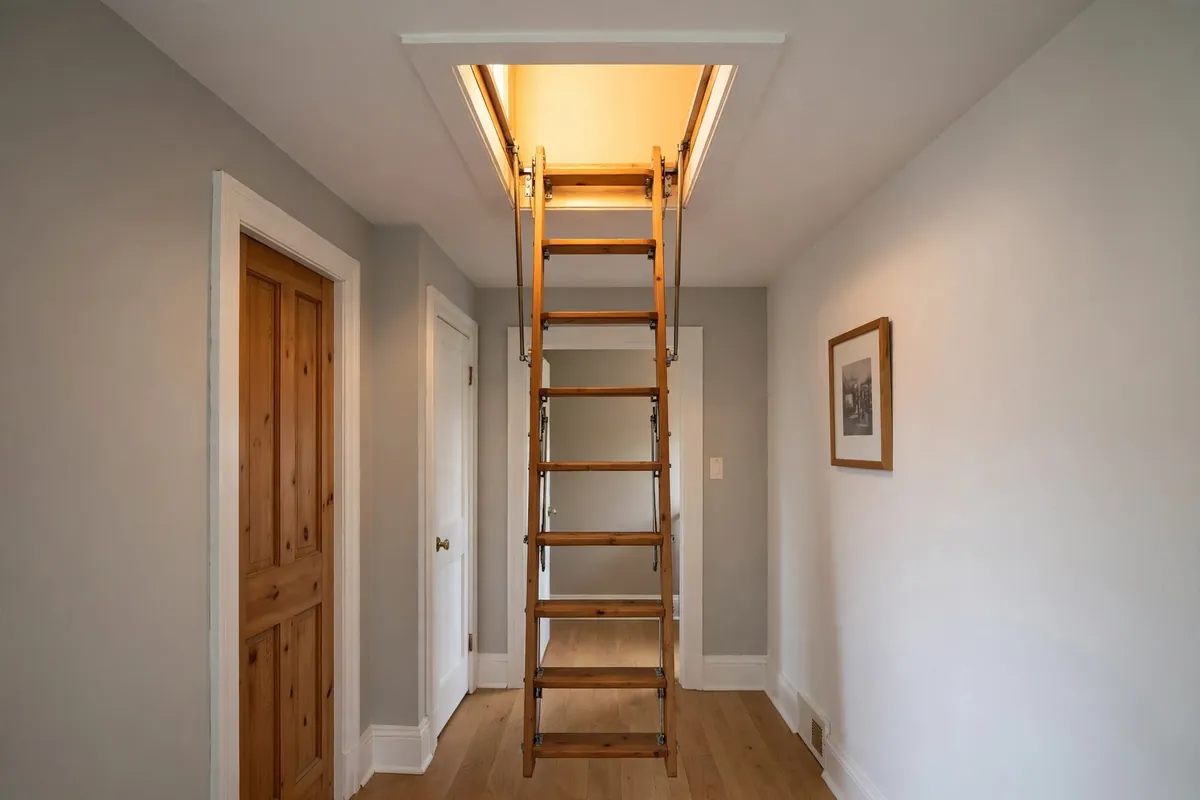
Attics come with three kinds of access, and the kind you have decides which attic storage ideas are realistic for you. A pull-down ladder is the best case: safe, fast, and wide enough for totes. A scuttle hole is the middle case: fine for light bins passed hand to hand, miserable for anything bulky. A walk-up stair is the dream case.
Match the access to the stuff; the smartest attic storage ideas all start from this match. Pull-down ladder: seasonal totes, holiday decor, luggage. Scuttle hole: light bins only, and keep the heavy or awkward items downstairs no matter how tempting the empty space looks. Two people and a plan beat one person muscling a tote through a hatch.
Light the space before you load it. The best attic storage ideas assume you can actually see what you are grabbing. A battery headlamp works for quick trips; a plug-in LED shop light makes the attic a place you can actually sort things. Put a battery smoke detector up there and pull the dust cap off the sensor once the dusty work is done.
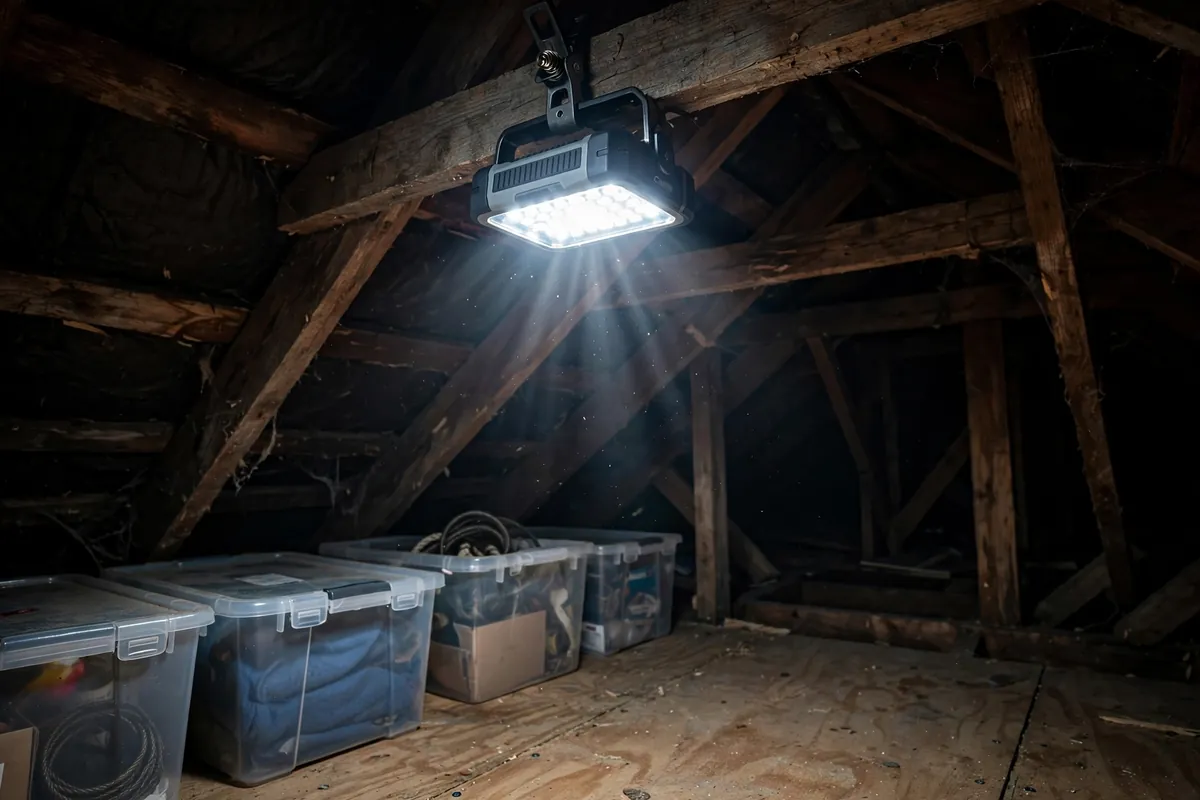
My opinion: if the access is terrible, the attic is for once-a-year stuff only. A scuttle hole you dread opening is not storage, it is a time capsule. Improve the access or lower your expectations; do not fight the hatch.
How do you measure an attic for storage?
Four measurements decide everything about your attic storage ideas, and they take fifteen minutes with a tape measure. One: ridge height, the tallest point, which tells you where a person can stand. Two: kneewall height, which tells you what bin height fits along the eaves. Three: clear floor width between the slopes. Four: the access opening size, because a bin that fits the attic but not the hatch is a return trip.
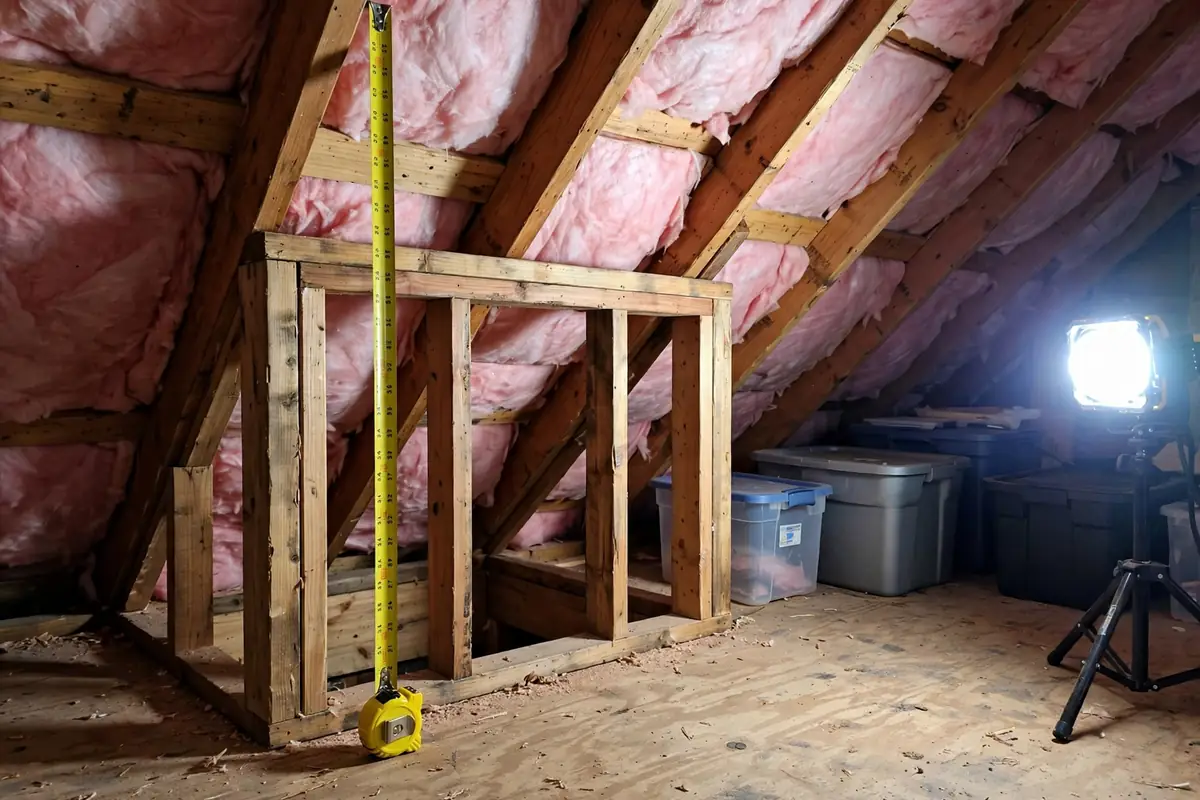
The usable zone is the floor where you can stand, kneel, or at least sit up and reach. The dead zone under the low slope is not storage; it is where lost things live. Mark the kneewall line with painter’s tape along the floor so you stop placing bins where the roof will scrape them. Write the four numbers on the tape. When the bins arrive, you will check the tape instead of guessing, and guessing is how a 16-inch tote ends up under a 12-inch kneewall.
My strong opinion: measure twice, because most attic buys become returns when people skip this. Of all the attic storage ideas here, this is the one that saves the most money. A tape measure is the cheapest tool in this guide and prevents the most expensive mistakes. Bins, shelving, and decking all get bought after the numbers, never before.
What is the best way to deck an attic floor?
Plywood decking turns unusable joists into a floor you can walk on, and it is the foundation most attic storage ideas assume. Use 1/2 to 3/4 inch plywood or OSB, screwed into the joists. Three-quarter inch suits spans over 16 inches on center; half inch handles light loads on 16-inch spans. Never screw through wiring or plumbing you cannot see.
Never lay decking straight over insulation. Compressing insulation kills its R-value, since insulation works by trapping air. Air-seal the ceiling plane first, then use a raised deck system, short sleepers or a platform frame above the joists, so insulation keeps its full depth. Raised platforms cost more, and they are the only honest way to deck an insulated attic, which is why they anchor the pricier end of these attic storage ideas.
Keep the soffit vents clear of insulation and decking; baffles hold the air channel open at the eaves. If your attic has spray foam, check local fire code, since fire code may require an ignition barrier over the foam. (If you suspect asbestos or lead in old insulation or paint, stop and call a pro.)
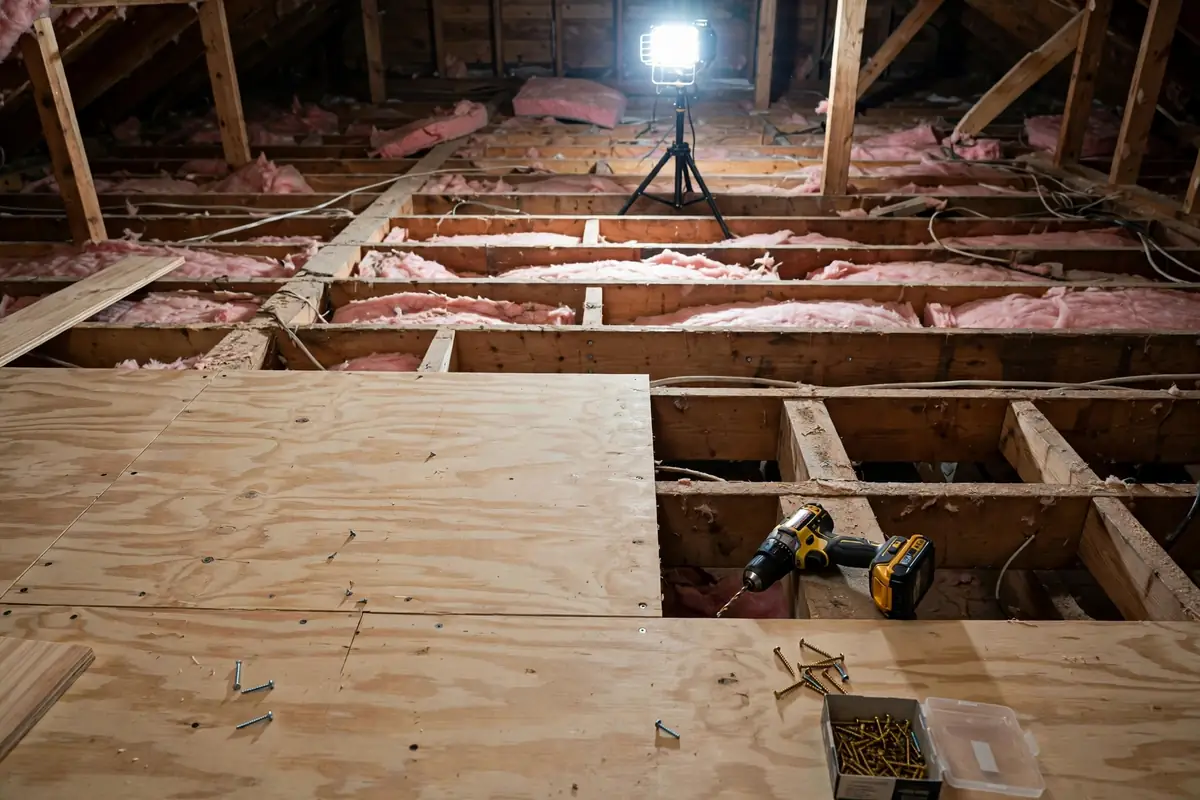
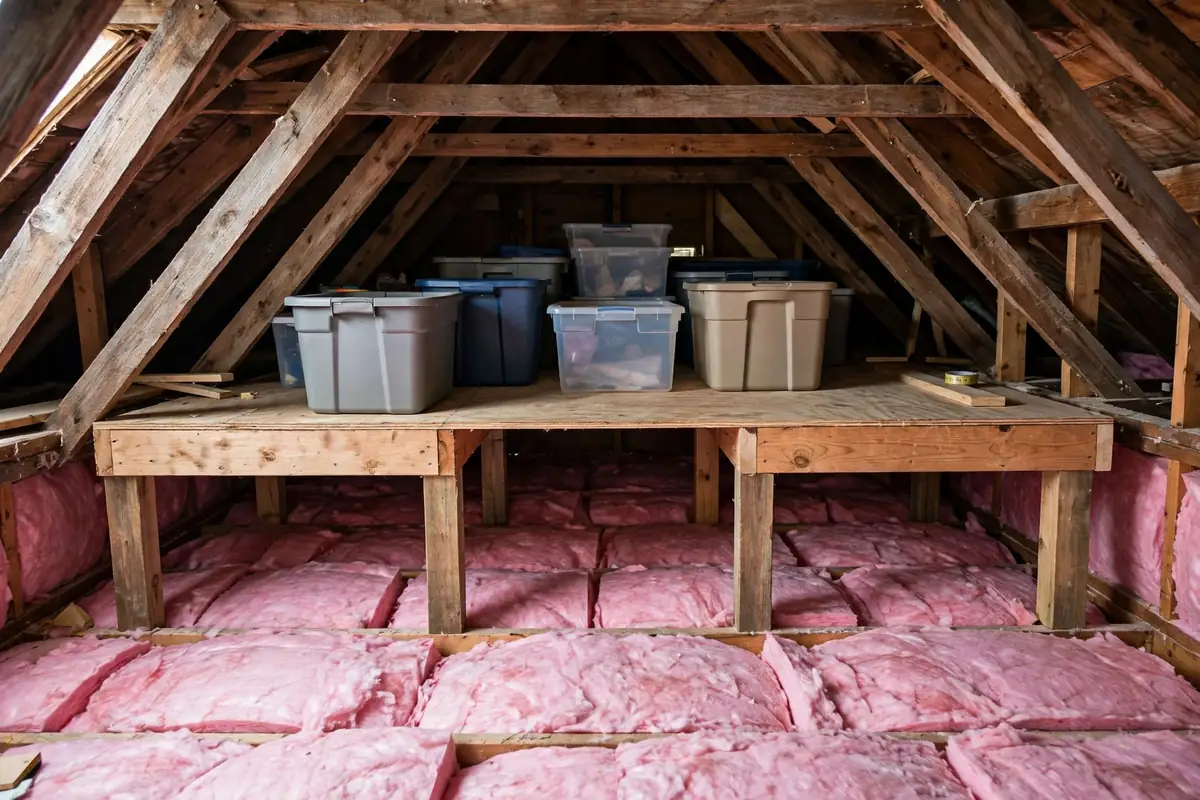
My opinion: decking is the one attic job worth doing right once. Flat plywood over insulation saves a weekend and costs you heating bills for years. Raise the deck, seal the air, and the floor pays you back every season.
Which bins and shelving actually work in an attic?
Short and wide beats tall and narrow. That is the first bin rule in any attic storage ideas plan. On a sloped ceiling, a tall tote tips when you slide it, and a tall shelf wastes the triangle the roof gives you. Buy clear bins in one sealed-tote size so they stack into clean columns; mixed sizes leave dead air between mismatched footprints. Clear walls mean you see the contents without opening anything.
The slope creates its own shelving, one of the quieter attic storage ideas most guides miss. The gable end, the flat triangular wall at each end of the house, takes simple fixed shelving beautifully. Kneewall cubbies, low open boxes tucked under the eaves, swallow wrapping paper and the flat things totes handle badly. Stackable totes step down the slope like stairs, each row shorter than the last.
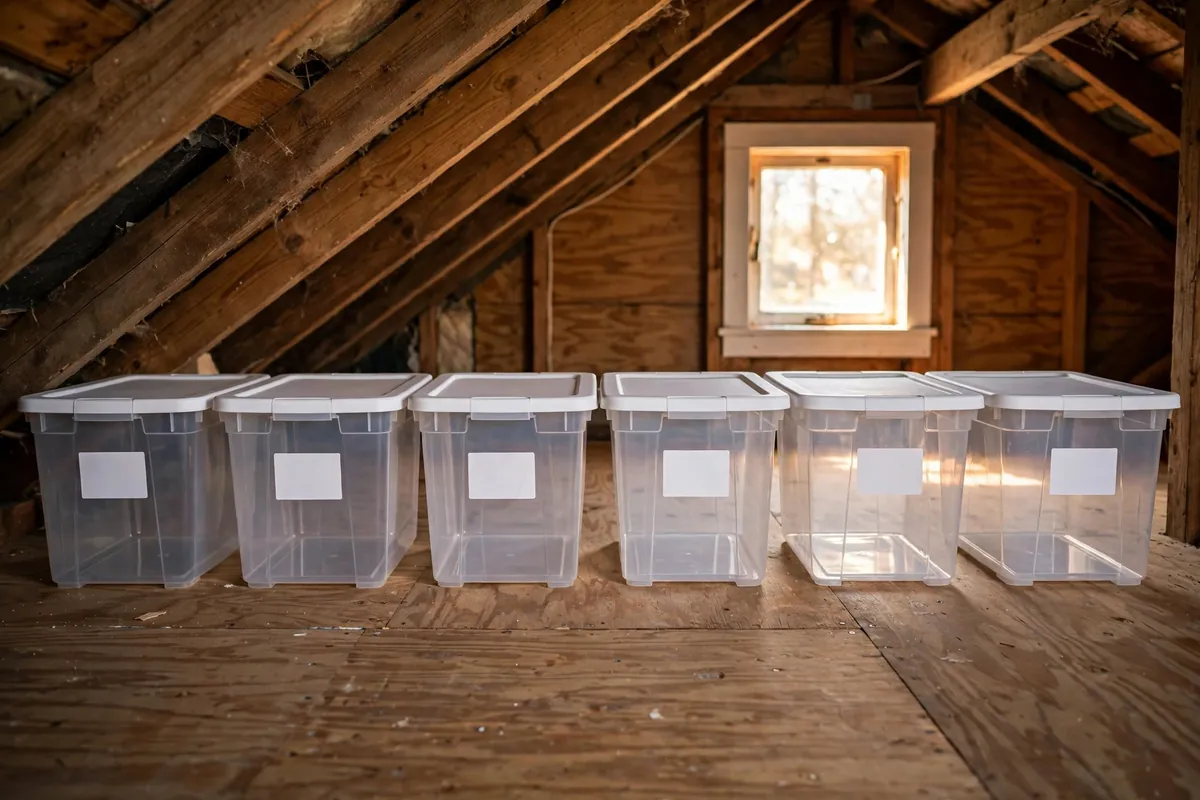
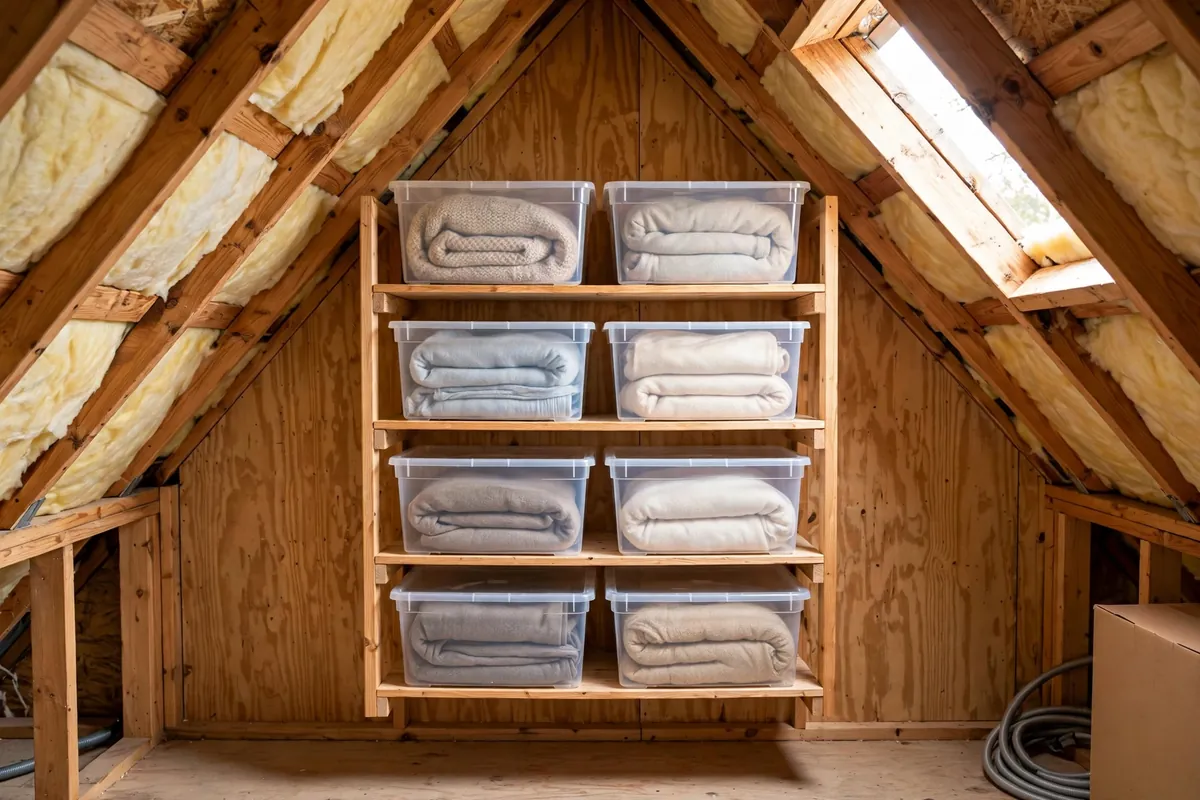

Wire shelving is not for sloped attics. Bins slide on wire, the slope nudges them downhill, and the first hot summer softens cheap plastic feet enough to start the drift. If you already own wire racks, keep them on flat floors downstairs.
| Bin type | Typical size | Best for | Watch out |
|---|---|---|---|
| Clear sealed totes | 27 to 66 qt | Holiday decor, seasonal gear, keepsakes | Buy one size for clean stacking; check lid latches |
| Garment bags | 40 to 60 in long | Off-season coats and suits | Breathable fabric only; no vacuum-sealed leather |
| Wreath boxes | 24 to 36 in round | Wreaths and garlands | Measure the wreath first; oversized boxes waste the slope |
One bin size across the whole attic stacks cleaner and labels faster than a mixed collection.
Use the same bin-labeling approach that works in small pantries: big labels on the short end you see from the ladder. My opinion: buy all one bin size. Mixed bins waste the slope and waste your one organizing Saturday.
How do you organize attic storage zones?
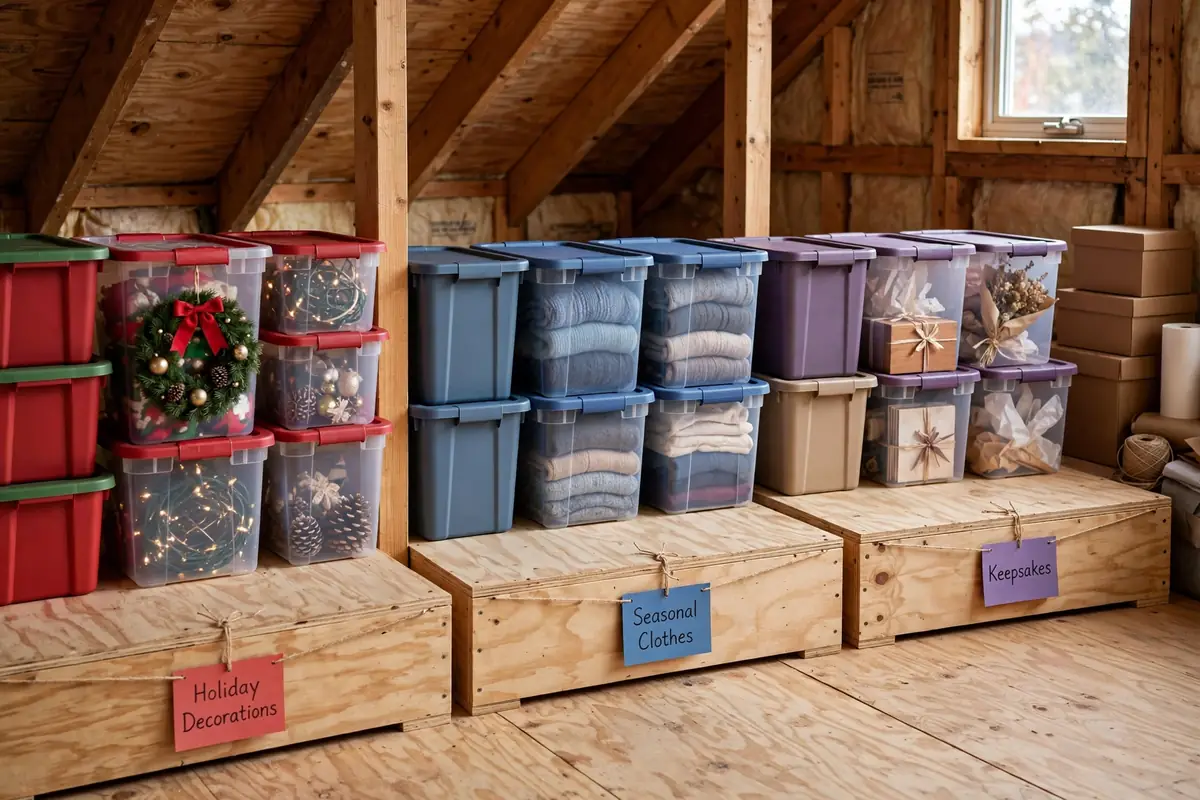
Three zones, no more. That is the organizing principle behind these attic storage ideas. Zone one: holiday decor, the bulky seasonal stuff with its own calendar. Zone two: seasonal gear, coats, boots, and camping equipment that rotate twice a year. Zone three: keepsakes and memories, labeled, sealed, rarely touched. Zone one sits nearest the access hatch; zone three goes deepest.
Map by frequency, not by category. The mistake is grouping all the boxes from one bedroom together; the fix is grouping by how often you touch things.
Then make the one-page inventory. List each zone, each bin’s label, and one line of contents per bin. Tape it inside the access hatch or the pull-down ladder frame, where you read it before climbing.
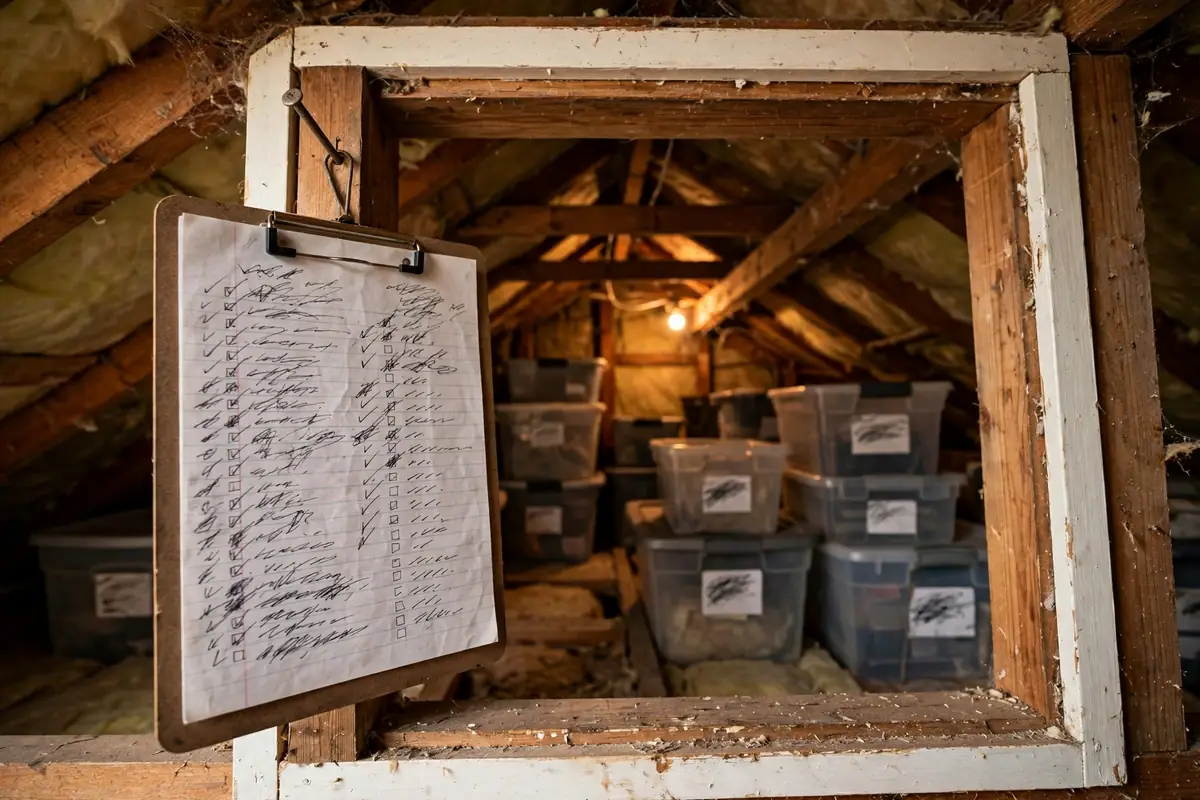
My opinion: unlabeled attics are where things go to be forgotten twice, once when you store them, once when you buy replacements. A labeled zone system with a taped-up inventory ends that cycle, and it is the least glamorous of these attic storage ideas and the most profitable. UCLA’s Center on Everyday Lives and Families tied cluttered-home descriptions to flatter cortisol slopes; an attic that absorbs the overflow takes pressure off the rooms you live in.
Sloped spaces follow the same zone math everywhere in the house: our under-stairs storage guide uses the identical frequency-zone system for another awkward triangle.
What are the best attic storage ideas for clothes?
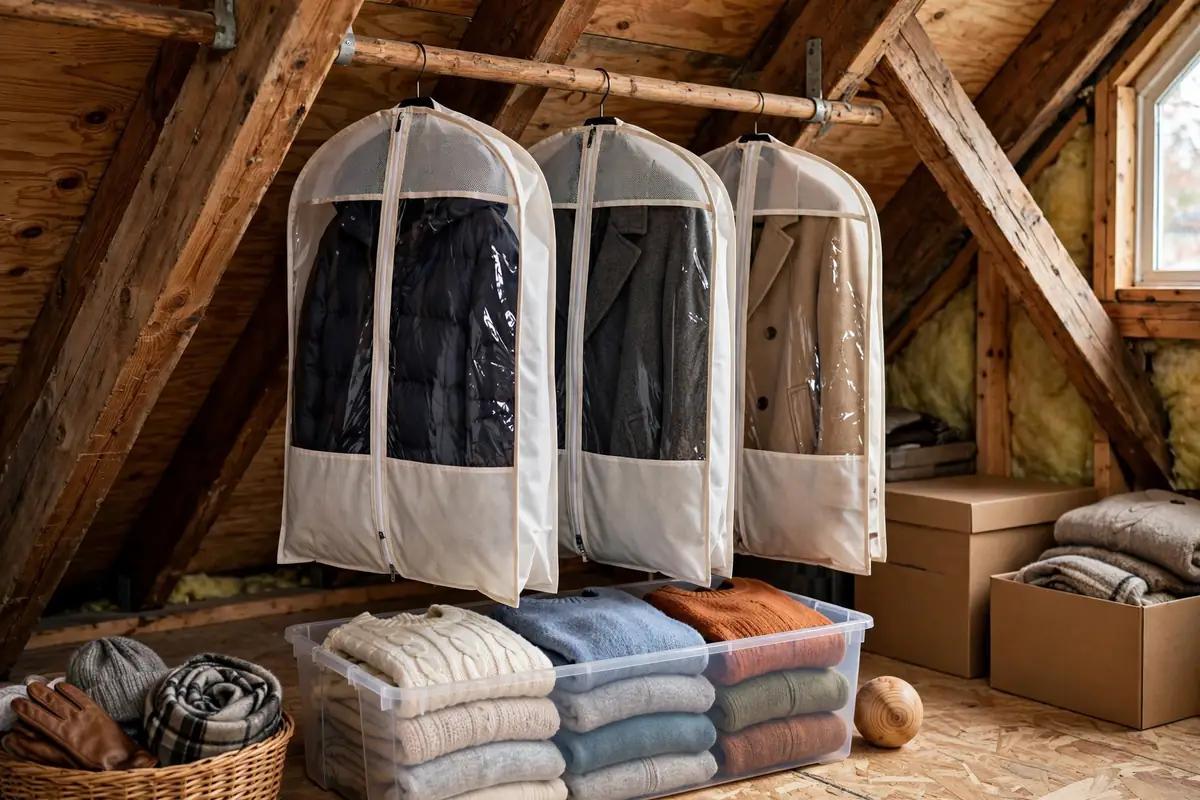
Off-season only, and only the sturdy stuff. Winter coats, boots, ski gear, and heavy sweaters handle attic conditions fine in breathable garment bags. Breathable matters: fabric lets moisture escape, while sealed plastic traps it.
The vacuum-bag debate is real. Vacuum bags save dramatic space and keep dust out, which suits bulky coats. They also wrinkle everything and can permanently crease structured shoulders. My take: vacuum the puffy coats, hang the blazers in garment bags, never vacuum what you would dry-clean. That split is one of the more practical attic storage ideas for anyone with a real winter wardrobe.
Keep clothes away from direct roof heat. This is one of those attic storage ideas that sounds obvious until a ridge-side bag cooks. The ridge zone runs hottest, so park garment bags along the kneewall or gable end. Leather jackets, wool suits, and silk heirlooms are not for the attic: heat, humidity, and pests attack all three, and a ruined heirloom is not a storage win. Those pieces belong in climate-controlled space inside the house. Our linen closet guide covers the overflow system for the pieces that stay downstairs.
My opinion: the attic is fine for winter coats and wrong for anything sentimental, which is the line every good set of attic storage ideas draws in the same place. If losing it would make you cry, it does not belong under the roof.
How do you store holiday decorations in an attic?
Holiday decor is why most people look up attic storage ideas in the first place: it is bulky, seasonal, heat-tolerant, and touched on a fixed calendar. A Talker Research survey for The Container Store, polling 2,000 US adults in September 2024, found 68 percent use storage areas dedicated to holiday decor, and 55 percent ended up with broken holiday items after storage. The breakage is a packing problem, not an attic problem.
Pack by fragility. Wreaths go in round wreath boxes, not garbage bags that crush the branches. Ornaments go in divided trays with individual cells; the tray pays for itself the first year nothing shatters. Prelit trees go in upright tree bags. They last roughly 5 to 10 years anyway, so attic heat is not shortening a forever item. Test every light string before it goes up.
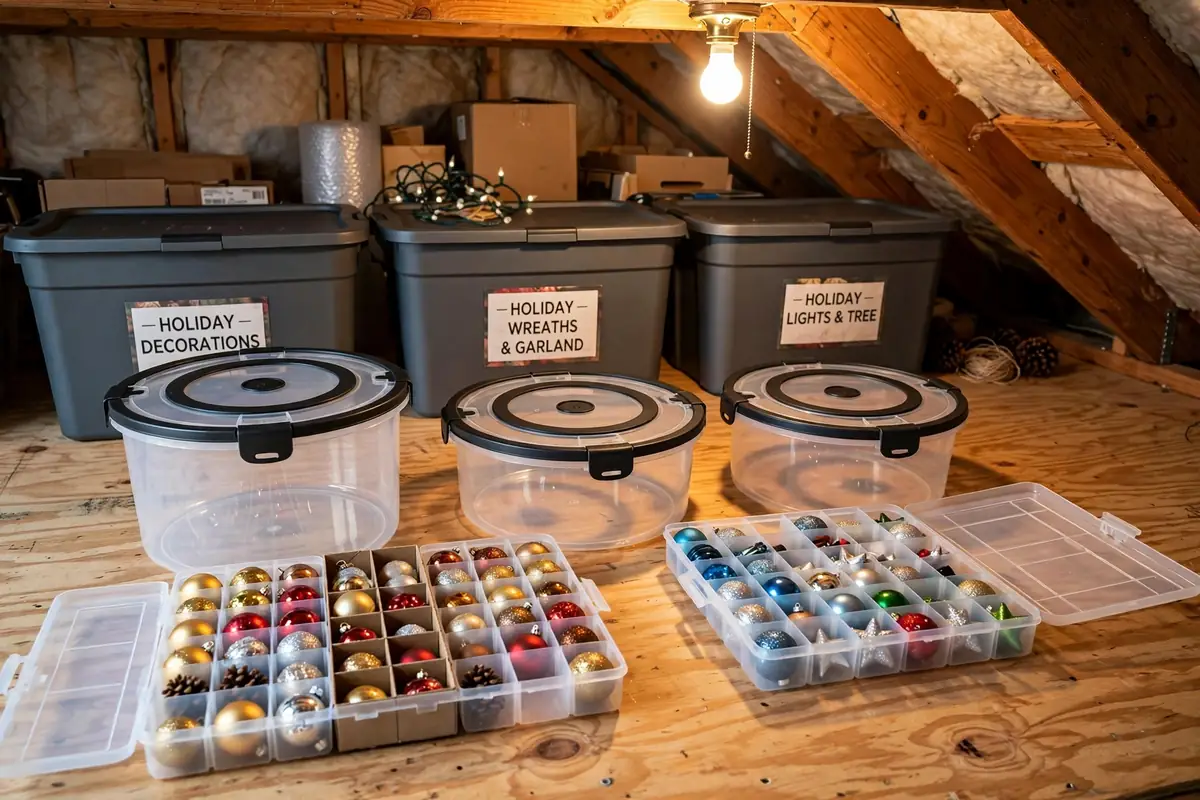

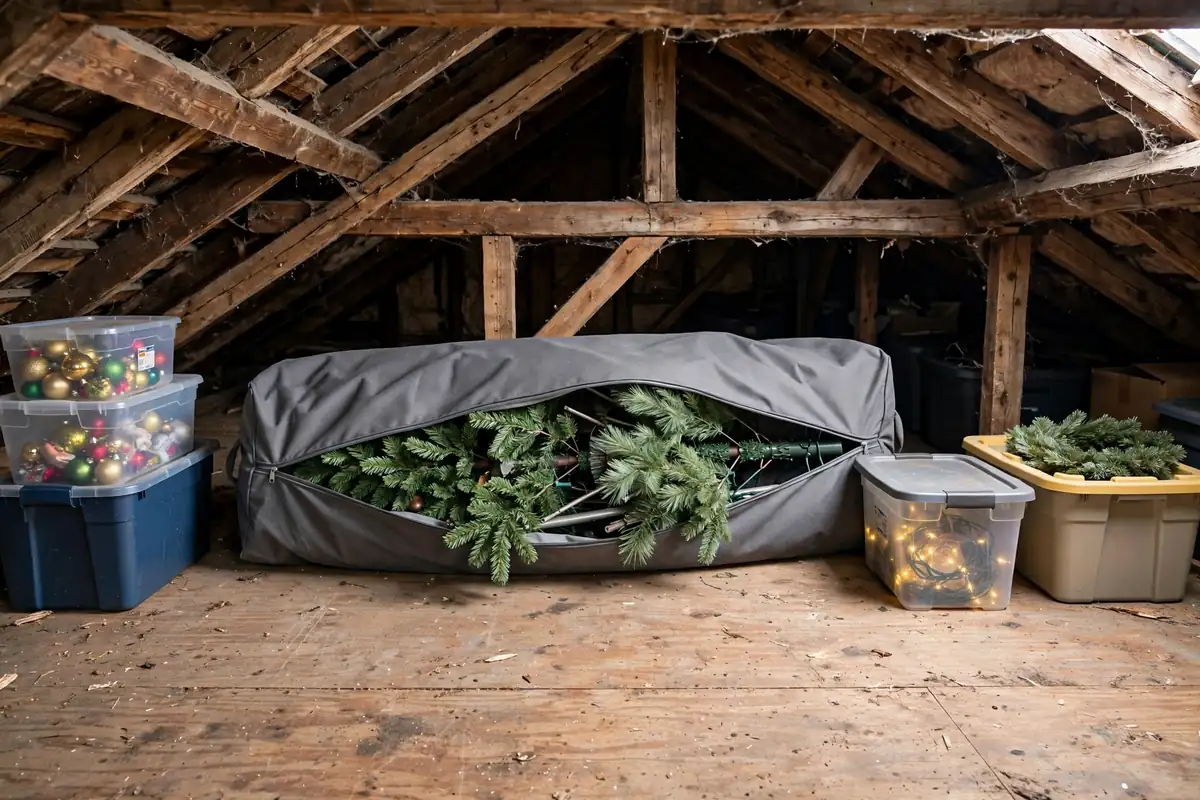
Wrap, don’t toss. Tissue around fragile pieces, lids latched, labels facing the aisle. Keep the tree bag near the hatch; it moves first and returns last.
My opinion: holiday decor is the attic’s perfect tenant and should anchor zone one of your attic storage ideas. If your attic holds nothing else, let it hold the holidays. For the seasonal rotation behind those bins, our under-bed storage guide runs the same twice-a-year swap system.
Can you use an attic with trusses for storage?
Yes, with stricter rules. Rafters are individual boards you can sister and reinforce; roof trusses are an engineered system where every member carries a designed load. Trusses are common in homes built from the 1970s on, and they change what you may touch.
The hard rule behind safe attic storage ideas for truss roofs: never cut, notch, or drill through any truss member, including the bottom chord you want to deck over. Cutting one chord breaks the engineering of the whole truss, and the fix involves an engineer and real money. Storage goes only on the bottom-chord zone, light and spread out, and the 20 psf ceiling from the code discussion still applies; many truss bottom chords were designed for 10 psf, so stay conservative.
My opinion: trusses are an engineered system, not a lumber pile. Respect the design and a truss attic stores holiday bins beautifully, which makes it one of the safer attic storage ideas for newer homes. Fight the design and you are buying an engineer’s invoice.
How much does attic storage setup cost?
Three tiers, and the honest answer is that most attics need tier one or two. Prices below are typical street prices at US retailers like Home Depot, Target, and The Container Store, not quotes.
| Budget tier | What it buys | Best first buy |
|---|---|---|
| Under $100 | 6 to 10 clear sealed totes, a label maker or tape and marker, a headlamp, a smoke detector | The totes plus labels |
| $100 to $400 | Plywood decking for a walk path or platform, a plug-in shop light, simple gable-end shelving, kneewall cubbies | Decking for the main path |
| $400 and up | Raised deck system over insulation, pull-down ladder upgrade, an attic fan for ventilation | The raised deck, if insulation is deep |
Typical street prices at US retailers. Sales move the numbers; the tiers do not move.
The ladder question comes up constantly in attic storage ideas discussions. A basic pull-down ladder runs in the low hundreds; insulated, higher-weight-rated models cost more. Upgrade the ladder when the current access fights you, not before, because access quality decides how much you will actually use the space.
Renters, note the limit: decking, ladder swaps, and anything screwed into joists need the landlord’s sign-off. The under-$100 tier is the renter tier, and it still transforms the space.
My opinion: the under-$100 tier beats the $400 tier if you declutter first, and it is the cheapest entry point in these attic storage ideas. Six labeled totes in zones beat a raised deck full of mystery boxes every time. Spend on structure after the stuff earns it. A Saturday of sorting is free, and it is the highest-return step in this entire guide.
Is your attic worth using, or should you declutter first?
Here is the judgment. Use the attic for seasonal and sentimental overflow after a real declutter, not as a substitute for one. The best attic storage ideas start with less stuff, not more bins. Run the five-part fit check from the top of this guide: weight, heat, moisture and pests, access, measurements. If it passes all five, load the zones and enjoy the breathing room. If it fails two or more, the attic is telling you something: try the garage, the basement, or fewer things.
Restate the numbers that matter before you commit to these attic storage ideas: 20 pounds per square foot of limited storage on a good day, 10 on a cautious one. Summer heat of 120 to 140 degrees that melts candles and warps records. Rodents visiting an estimated 21 million US homes each winter. None of these are reasons to fear the attic. They are reasons to store the right things in it.
Start with the fit check this weekend: the leak scan, the four measurements, and the parked-car test on every box. If the verdict is that the attic is not your space, our small garage guide runs the same zone-and-measure system for the room most families actually use daily. Either way, the goal is the same. That is the whole point of these attic storage ideas: fewer mystery boxes, lower stress, and a house where everything has a labeled home.
What do these attic storage ideas add up to?
If you remember nothing else from these attic storage ideas, remember the five-part fit check: weight, heat, moisture and pests, access, and measurements. Attics that pass all five become the calmest storage in the house. Attics that fail two or more are telling you to use the garage or own fewer things. The check takes a weekend; skipping it costs years.
The measurement habit is what separates these attic storage ideas from the inspiration galleries. Four numbers on painter’s tape: ridge height, kneewall height, clear floor width, access opening. Decking follows the same discipline, half to three-quarter inch plywood, never over insulation, vents always clear. Measure first, buy second.
Zones do the daily work. Of all the attic storage ideas here, the three-zone system with a taped-up inventory page returns the most for the least: holiday decor near the hatch, seasonal gear in the middle, keepsakes deepest. Unlabeled attics are where things go to be forgotten twice.
And the line holds. These attic storage ideas work for off-season coats, holiday decor, luggage, and labeled keepsakes. They stop at candles, photos, vinyl, electronics, and heirlooms, because 120 to 140 degrees of heat, humidity, and rodents do not negotiate. Do the fit check this weekend, and let the attic be the warehouse, not the junk drawer.
How much weight can you store in an attic?
The building code answer: the International Code Council’s 2021 International Residential Code, Table R301.5, rates uninhabitable attics with limited storage at a 20 psf minimum live load, and attics framed without storage at 10 psf. That is 20 pounds per square foot on a good day, 10 on a cautious one, and it assumes the load is spread out.\u003c/p\u003e\u003cp\u003eThe framing answer: a common builder rule of thumb says 2×6 ceiling joists spanning 10 feet or less hold roughly 300 pounds of distributed load mid-span, dropping toward 100 pounds as spans get longer. Keep storage over load-bearing walls and near the center of the house, where joists are shortest. That placement rule underpins most safe attic storage ideas. Books, file cabinets, and anything dense belong downstairs. When the framing is unknown, assume the weaker number.
What is the 7 and 7 rule for attics?
Honestly, it is forum folklore. The “7 and 7 rule” floats around attic threads without an official source, and there is no such rule in the International Residential Code. People usually mean the real IRC minimums for habitable space, which do involve the number 7: habitable rooms generally need a 7-foot ceiling height, and habitable attic space has its own floor-area and ceiling-height minimums that vary by code cycle. For storage, the numbers that actually matter are the load ratings, not a “7 and 7” slogan.\u003c/p\u003e\u003cp\u003eUninhabitable attics with limited storage get 20 psf per IRC Table R301.5, and attics framed without storage get 10 psf. If someone cites “7 and 7” as permission to load up an attic, ask them to name the code section. They cannot, because there isn’t one.
Is it better to store things in the attic or garage?
It depends on the item and the space, and most households end up using both. The garage wins for anything heavy, frequently used, or temperature-sensitive: tools, paint, sports gear you grab weekly, and anything you touch in winter.\u003c/p\u003e\u003cp\u003eWhen homeowners compare attic storage ideas with garage storage, the deciding factors are heat and weight. The attic wins for bulky seasonal items you touch twice a year: holiday decor, off-season clothes, luggage, keepsakes. Attics hit 120 to 140 degrees in summer, per the U.S. Department of Energy, so anything the heat would ruin goes to the garage or the house instead.\u003c/p\u003e\u003cp\u003eGarages have concrete floors with no meaningful weight limit for household storage, while attics top out at 20 psf of limited storage. One more consideration: a CRAFTSMAN/Atomik Research survey of 2,004 US adults found 36 percent say their garage is too cluttered to park inside and 62 percent call it the most cluttered space in the home. Moving the seasonal bulk to the attic is often what finally lets the car back in.
Can you store clothes in an unfinished attic?
Yes, off-season clothes only, and only the sturdy kind. That is the clothes rule in every attic storage ideas guide worth trusting. Winter coats, boots, ski gear, and heavy sweaters do fine in an unfinished attic inside breathable garment bags. Breathable matters: fabric bags let moisture escape, while sealed plastic traps humidity against the fabric.\u003c/p\u003e\u003cp\u003eSkip the vacuum bags for anything structured, since they crease shoulders permanently; they are fine for puffy coats and ski pants. Keep garment bags along the kneewall or gable end, away from the hottest zone near the ridge. And draw a hard line at leather, wool heirlooms, silk, and anything sentimental. Heat, humidity, and pests attack all of them, and those pieces belong in climate-controlled space inside the house.
Is it okay to store cardboard boxes in an attic?
It works until it doesn’t, which is why the answer is no for anything staying longer than a season. Cardboard absorbs attic humidity, sags under its own weight, and gives rodents nesting material plus chewable walls. Per the National Pest Management Association, rodents invade an estimated 21 million US homes each winter, and cardboard boxes are exactly the shelter they are looking for. Replace cardboard with clear sealed totes with latching lids. They keep out humidity swings, resist chewing, and let you see the contents without opening them. If budget is tight, convert the most vulnerable boxes first: the ones nearest the vents and the access hatch, where moisture and pests arrive first.
Do I need a permit to convert my attic for storage?
For basic storage, usually not. Laying plywood decking, adding shelving, installing a pull-down ladder, and organizing bins are maintenance-level improvements in most jurisdictions, and they do not trigger permits. The line appears when the work changes the structure or the use: cutting or modifying roof trusses or rafters, adding electrical circuits, or converting the space toward habitable living area.\u003c/p\u003e\u003cp\u003eTwo cautions. First, never cut, notch, or drill truss members without a structural engineer, permit or not; trusses are an engineered system and one cut breaks the design. Second, if your attic has spray foam insulation, some jurisdictions require an ignition barrier coating before you build storage around it, so check local fire code. When in doubt, a five-minute call to your local building department beats a guess. This guide does not cover finished-attic conversions or living space; that is a permitted project with its own rules.
How hot does an attic get in summer?
Hotter than a parked car, which is why attic storage ideas always start with a heat check. According to the U.S. Department of Energy, unconditioned attics reach 120 to 140 degrees in summer. The temperature peaks near the ridge in the afternoon and stays elevated for hours after sunset, since the roof radiates stored heat downward.\u003c/p\u003e\u003cp\u003eThat number drives every what-to-store decision. If a summer day in a parked car would ruin an item, the attic will ruin it too: candles melt, photos and film degrade, vinyl warps, electronics cook, and batteries swell. Ventilation helps at the margins; a ridge vent with clear soffit vents and an attic fan can shave degrees off the peak, but no vented attic becomes climate-controlled space. Store for the heat you have, not the heat you wish you had.
What is the best way to store Christmas decorations in the attic?
Pack by fragility and label by zone. Wreaths go in round wreath boxes, not garbage bags that crush the branches. Ornaments go in divided trays with individual cells; the tray pays for itself the first year nothing shatters. Prelit trees go in upright tree bags, and since prelit trees last roughly 5 to 10 years anyway, attic heat is not cutting short a forever item. Test every light string before it goes up. A dead string discovered in December costs you a shopping trip, while a dead string found in October costs you a replacement bulb.\u003c/p\u003e\u003cp\u003eGood attic storage ideas protect decor on the way back down, not just on the way up. Wrap fragile pieces in tissue, latch the lids, and keep the tree bag nearest the hatch since it moves first and returns last. The category deserves the care: a Talker Research survey for The Container Store found 68 percent of US adults use dedicated storage areas for holiday decor, and 55 percent ended up with broken holiday items after storage. The breakage is a packing problem, and good packing solves it.
Can I put plywood down in my attic for storage?
Yes, with two conditions. The attic storage ideas that last all respect the decking math: use 1/2 to 3/4 inch plywood or OSB screwed into the joists, with staggered seams, and keep the total load within the attic’s rating (20 psf for limited storage per the International Residential Code, less if the framing is unknown or spans are long). The critical condition: never lay plywood directly over insulation. Compressing insulation destroys its R-value, because insulation works by trapping air, and air-sealing the ceiling plane should come first.\u003c/p\u003e\u003cp\u003eIn an insulated attic, use a raised deck system, sleepers or a platform frame above the joists, so the insulation keeps its full depth. Keep soffit vents clear with baffles so airflow continues. If you suspect asbestos or lead in old insulation or paint, stop and call a pro before disturbing anything.
For the garage version of going vertical, our best garage storage systems for small garages compares 7 wall and overhead picks with real specs and prices.
