
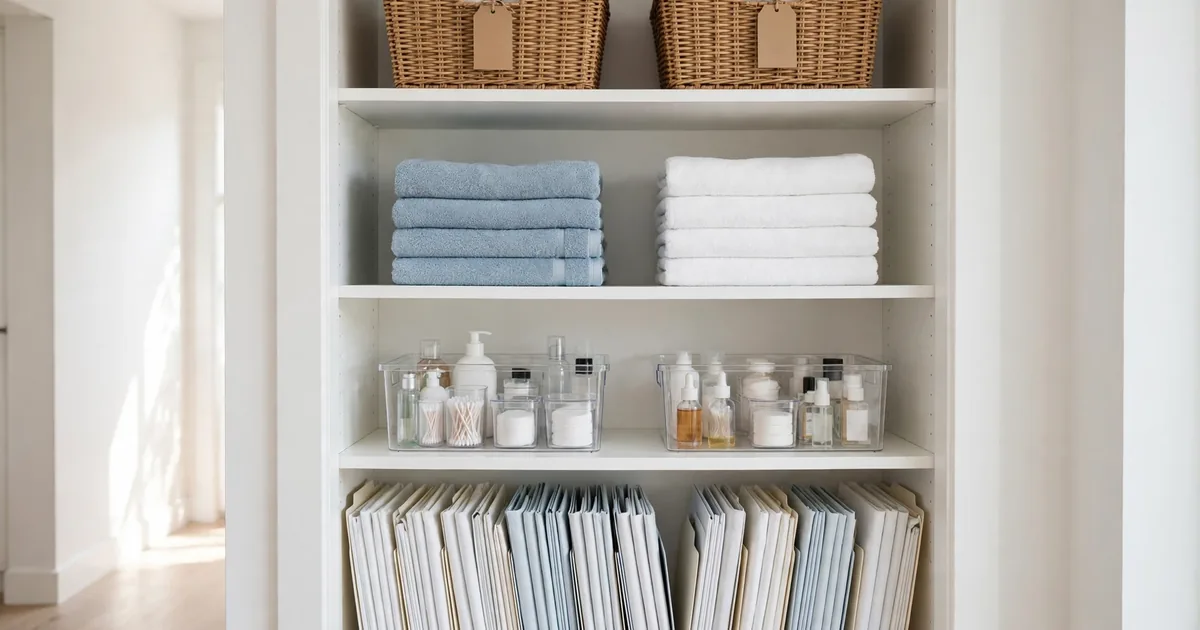

The best linen closet organization comes down to three moves: pull everything out and keep only what you actually use, give every item a home by shelf zone based on how often you touch it, and contain it in baskets or bins with labels so the next person who opens the door puts things back in the right place. Skip any one of those and the closet slides back into a pile within a month. That’s the whole system. Everything below is just how to run it in your closet, whether it is a deep hallway black hole or a tiny bathroom nook.
Ahrefs keyword data shows about 6,000 Americans search for “linen closet organization” every month, and the pages ranking for it are mostly before-and-after diary posts with no measurements, no budget options, and no folding help. This guide fixes all of that. You will get exact fold dimensions, three budget tiers, a deep-shelf strategy, and a shelf-by-shelf map of what goes where.
The short version:
- Empty the closet completely. Keep two full sheet sets per bed and two bath towels per person; donate or recycle the rest.
- Fold fitted sheets into a flat rectangle about the size of a folded pillowcase, then bundle each set inside one of its own pillowcases.
- Store daily items at eye level, weekly items above or below, and seasonal items on the top shelf.
- Deep shelves need pull-out bins or turntables; never stack loose items deeper than your arm can reach.
- Baskets hide clutter and look good; clear bins let you see stock levels. Use both, for different jobs.
| Container | Best for | Typical price per piece | Honest downside |
|---|---|---|---|
| Woven or fabric baskets | Bulky items you grab often: duvets, extra blankets, guest towels | $8 to $25 | You cannot see inside, so labels are mandatory |
| Clear stackable bins | Small backstock: toiletries, cotton balls, medicine, sewing kits | $5 to $15 | Show every crumb of mess; need wiping now and then |
| Stackable drawers | Sheet sets and pillowcases you want to file upright | $12 to $30 | Cost more per cubic inch than baskets |
| Shelf dividers | Keeping folded towel stacks from tipping sideways | $8 to $14 for a set | Only work on shelves, not inside bins |
Price ranges reflect typical US retail at Target, Walmart, and Amazon in October 2026; check current listings before you buy.
The table above is the only buying decision that matters. Everything else in a linen closet is a folding or placement problem, not a shopping problem. Now the sections.
What belongs in a linen closet (and what does not)?
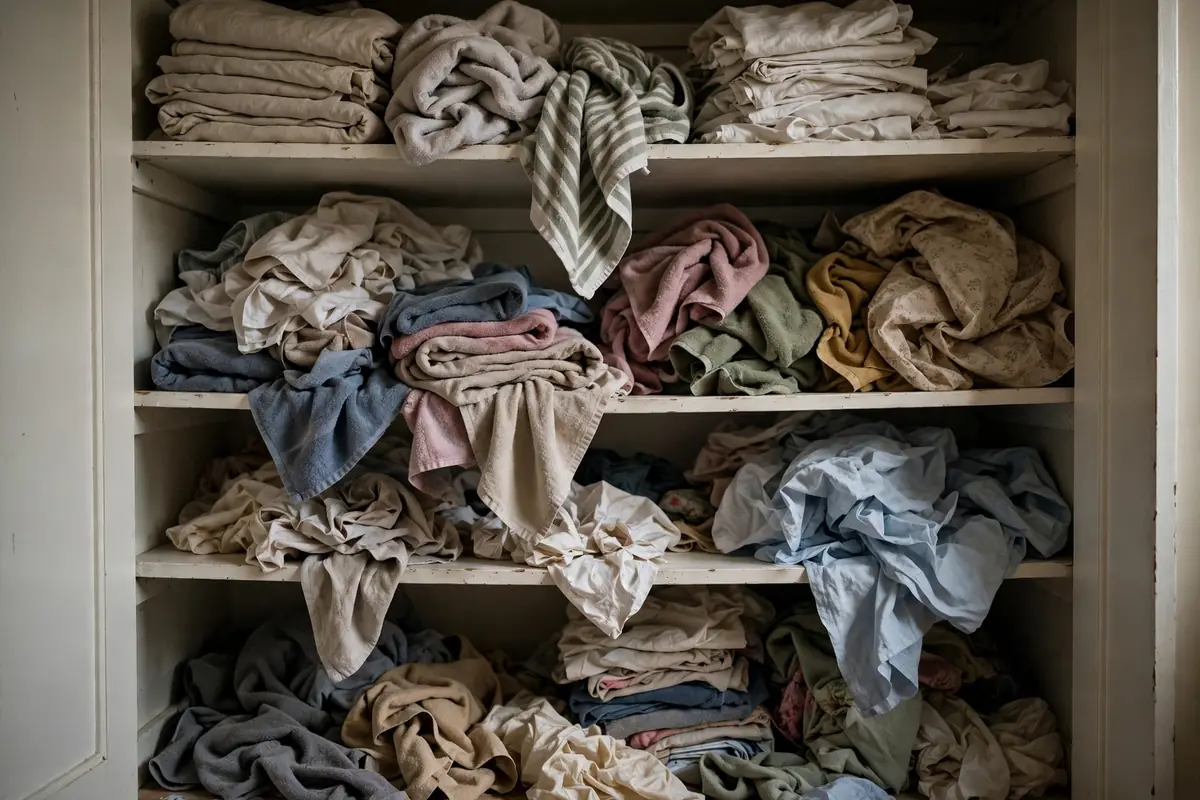
A linen closet is not a junk drawer with shelves. It holds the textiles and small household supplies you reach for between laundry days: bed sheets, pillowcases, bath towels, hand towels, washcloths, blankets and quilts, spare pillows, tablecloths, and the bathroom backstock that has nowhere else to go, like toilet paper, extra soap, and a small first-aid kit. That is the full list. If your closet also holds old paint cans, board games, and a box labeled “misc cords,” you don’t have an organization problem. You have a storage problem wearing an organization costume.
Here’s the inventory math I’d actually follow. Two complete sheet sets per bed. That isn’t my invention; cleaning coach Leslie Reichert, author of “The Joy of Green Cleaning,” gave exactly that advice to Realtor.com: one set on the bed, one clean set waiting. Two bath towels and two hand towels per person. One spare blanket per bed, plus one for guests if guests actually come over. One spare pillow per bed. Everything beyond that is clutter with a backstory.
How do you declutter a linen closet before organizing it?
Pull everything out. All of it, onto the bed or the floor, and sort into three piles: keep, donate, trash. Be honest about the towel that has smelled faintly musty since 2022. It’s done. Cleveland Clinic dermatologist Sean McGregor advises washing sheets at least once a week, and notes the average person sheds about a gram and a half of dead skin every day. That’s what lives in the linens you are keeping, which is why keeping fewer, fresher pieces beats keeping a museum of every towel you have ever owned.

Wipe the shelves while they’re empty. If the closet has wire shelving, lay a liner over the wires first: folded stacks pick up ridge marks from bare wire, and small items tip through the gaps. Check the back corners for the things that migrated there years ago. Then, and only then, start putting things back by zone. An empty closet you can see into is ten times easier to organize than one you’re working around.
How do you fold a fitted sheet so it actually stays folded?
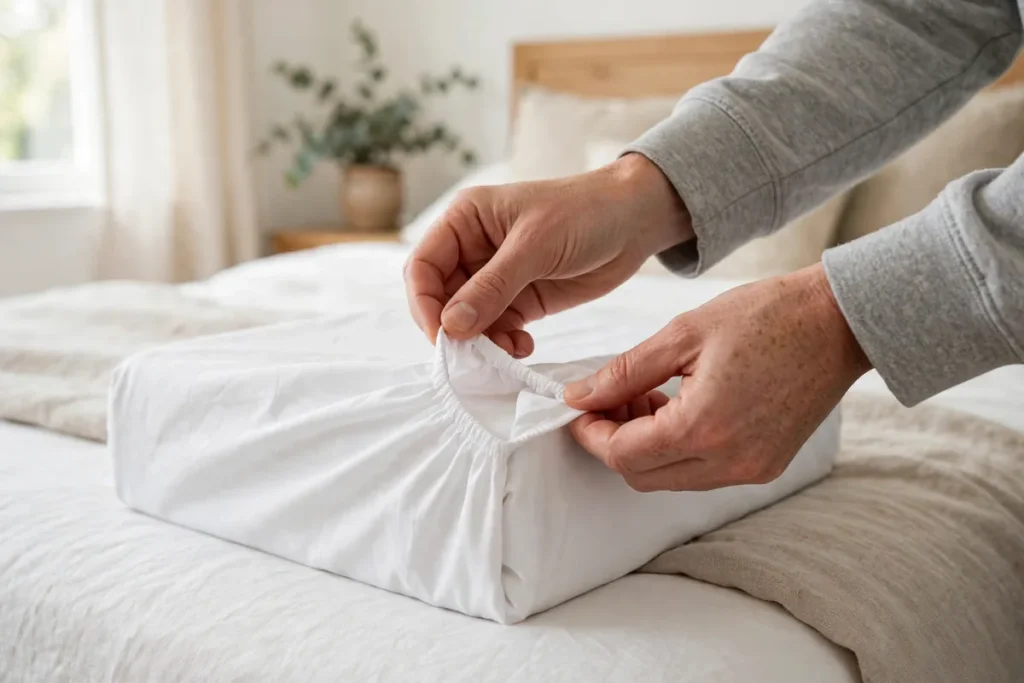
This is the skill the ranking guides skip and their commenters keep asking for. Fold a fitted sheet into a flat rectangle roughly 12 by 16 inches, about the size of a folded pillowcase. It stacks neatly and never unfolds itself on the shelf. Here’s the method.
- Hold the sheet inside-out at two adjacent corners of one long edge, hands inside the pockets.
- Fold one corner over the other so the elastic edges meet. Straighten the edge between them.
- Repeat with the next two corners, folding them over the first pair. All the elastic now sits along one edge.
- Lay it flat, fold the elastic edge toward the center, and smooth it into a straight rectangle.
- Fold into thirds, then in half. Slide the bundle into one of the matching pillowcases.
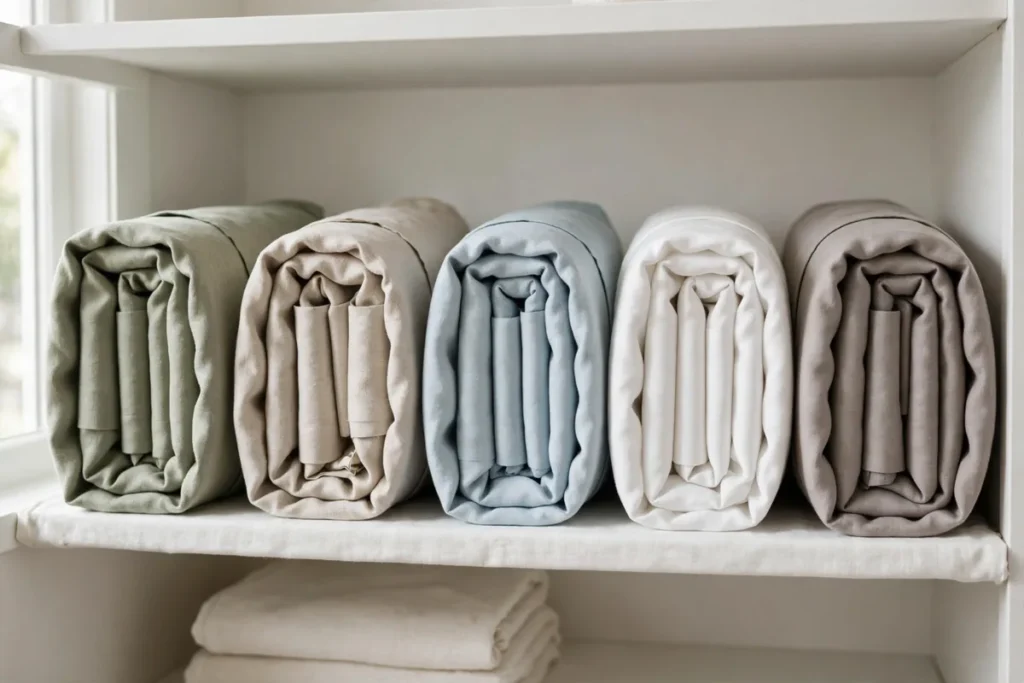
The pillowcase trick is the whole game. A sheet set stored loose separates within weeks: the fitted sheet migrates, a pillowcase vanishes. A set bundled inside its own pillowcase is one grabbable unit; write the bed size on the band in marker. Fold flat sheets to the same footprint, and fold towels into thirds lengthwise, then in half twice.
My opinion: stop ironing your sheets. Nobody sees the inside of the closet, and wrinkles press out under the stack. Neat rectangles beat crisp fabric.
The same shelf-zone thinking works in clothes closets too. See our closet shelf organization ideas for the full zone-by-zone system with exact spacing numbers.

What is the best linen closet organization method for deep shelves?
Deep shelves are where linen closets go to die. The back six inches become a dark zone where spare pillowcases go to be forgotten, and every retrieval avalanches the front row. The fix is simple and non-negotiable: nothing loose lives deeper than your arm can comfortably reach. Everything behind that line must slide or spin.
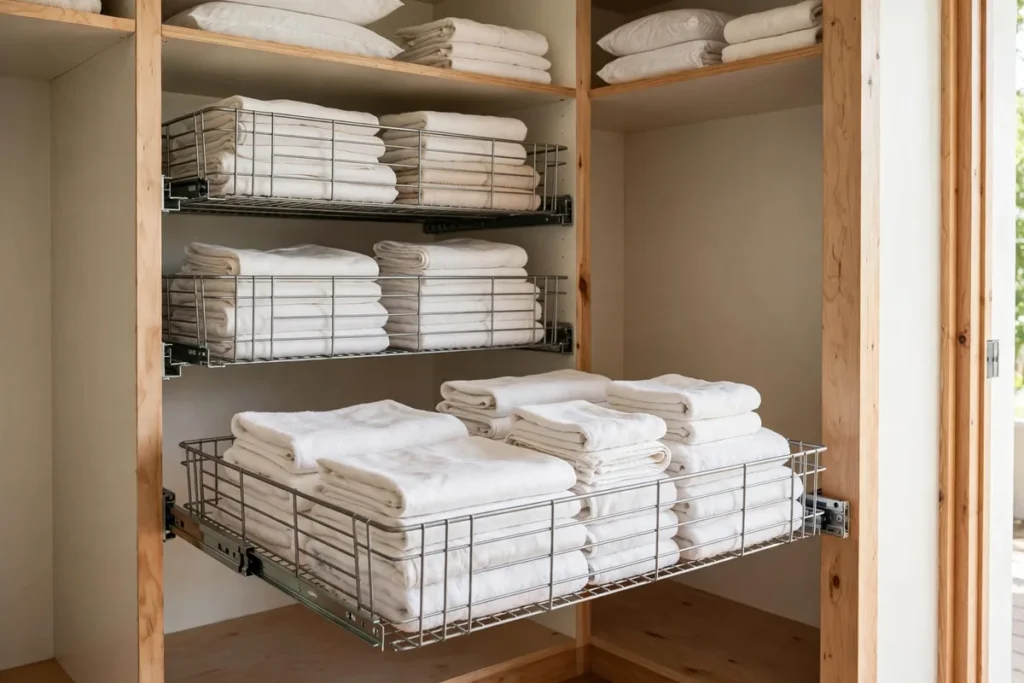
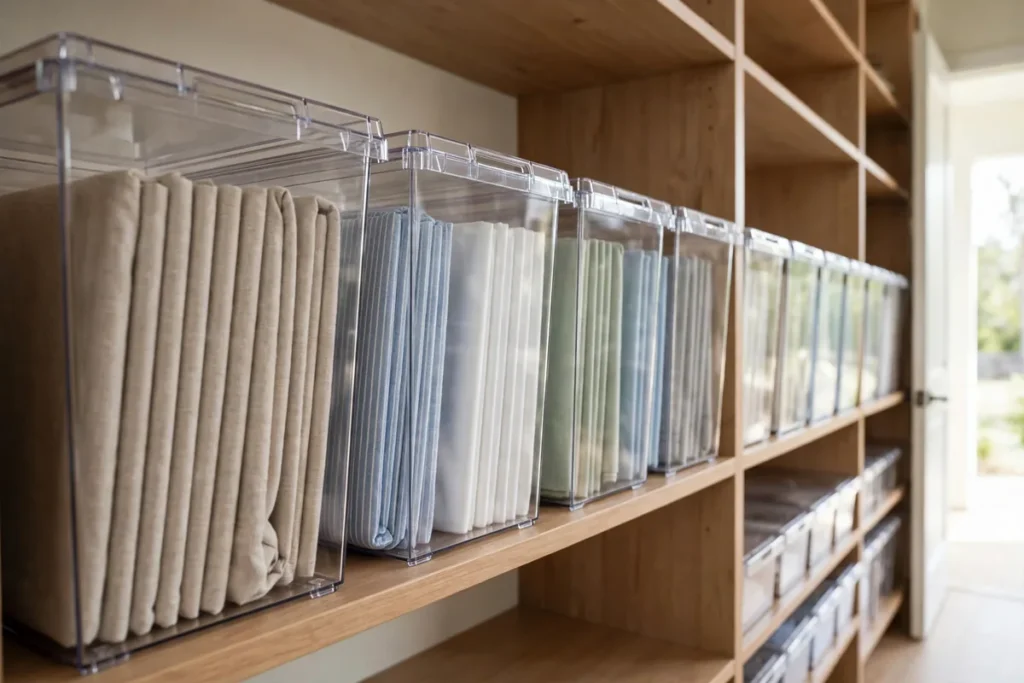
Pull-out bins are the best answer for deep shelves, full stop. A bin that slides toward you turns a 24-inch-deep shelf into a drawer. Measure the shelf depth, buy bins an inch narrower so they clear the frame, and file sheet sets upright like records. Two bins side by side hold about six sheet sets, enough for most households.
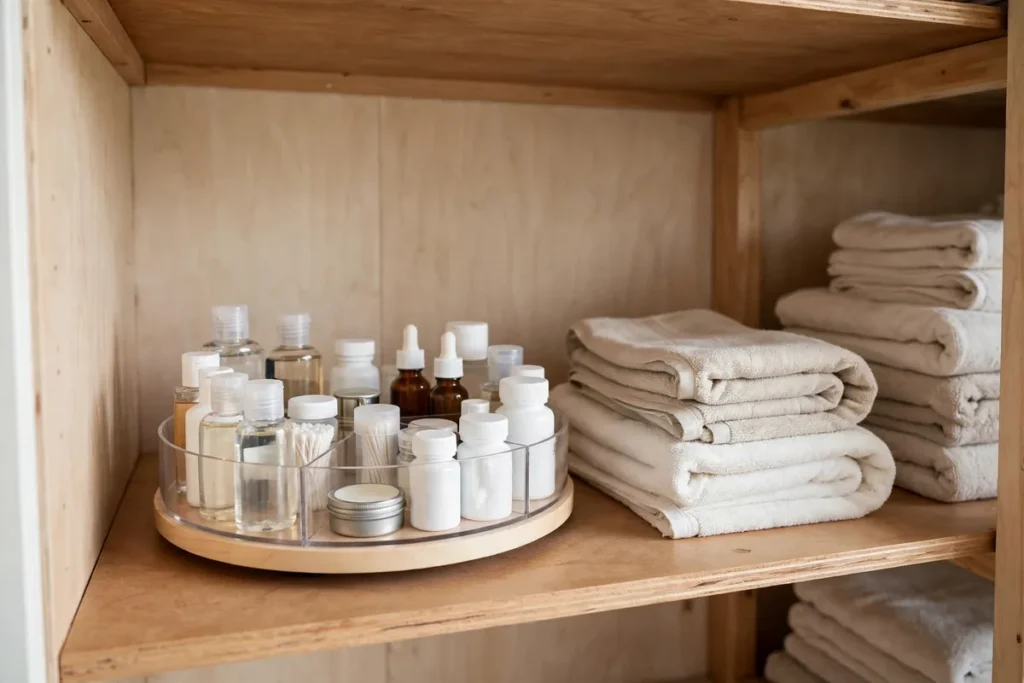
Turntables earn their place here too. A 12-inch turntable for backstock toiletries and medicine rotates the back row into view instead of letting it expire in the dark. A simple shelf riser at the back is the budget fix: it lifts the rear row above the front row so you can see both. A tiered organizer steps bottles and vials up row by row so nothing hides.
The honest admission: if your linen shelves run deeper than about 22 inches, the very back stays awkward. Put the twice-a-year items back there, vacuum-sealed off-season blankets or the guest sheets, and stop pretending you will reach them weekly.
How do you organize a small linen closet that keeps bursting open?
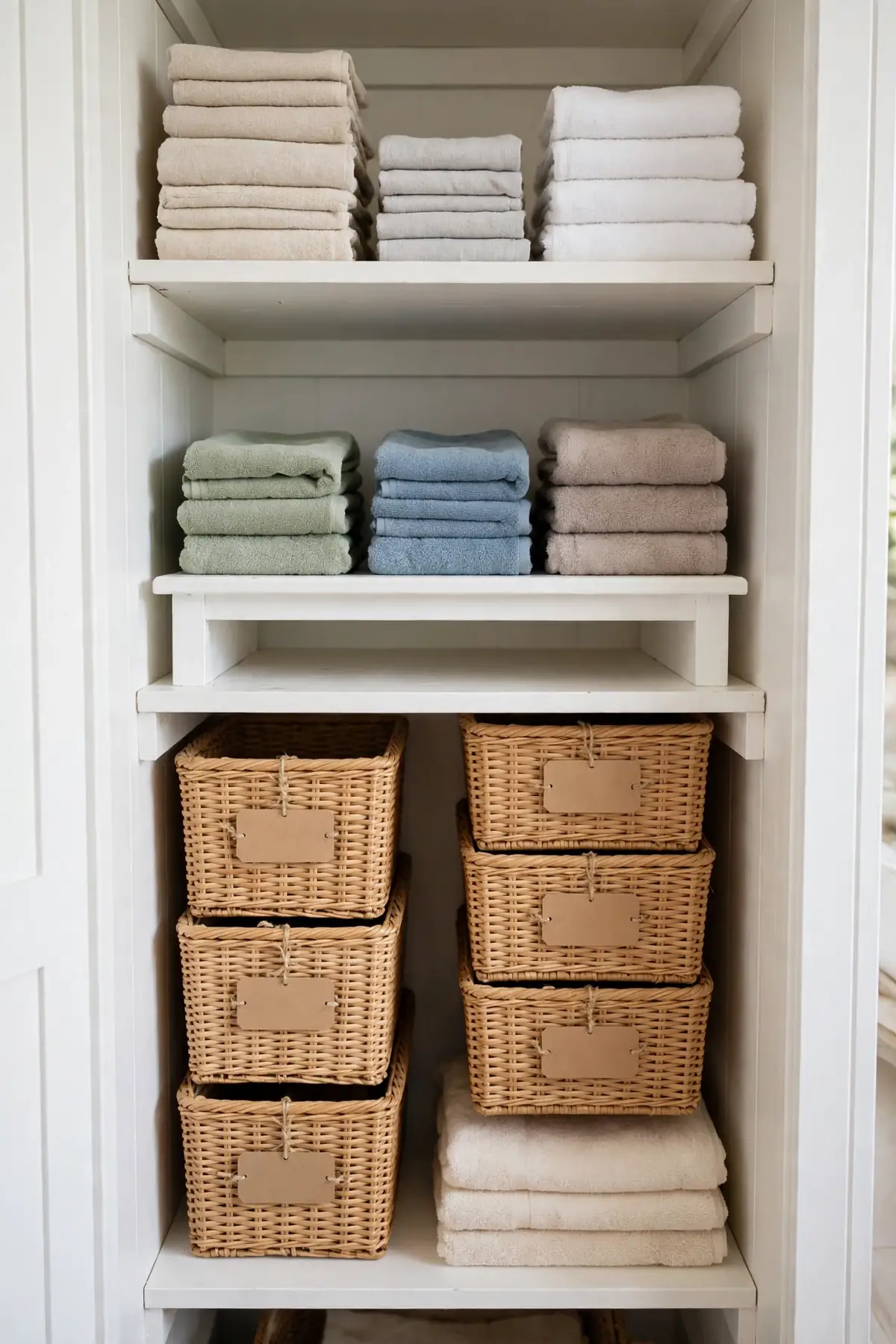
Small linen closets fail for one reason: the stacks are too tall and too deep. A pile of six bath towels is a landslide waiting for a door swing. Cap every stack at four items, fold everything one size smaller than you think you should, and use the vertical space you are ignoring. Look above the top stack on every shelf. Most closets have 12 to 18 inches of dead air up there, and a shelf riser reclaims it.
Rolling beats folding for towels in tight closets. A rolled bath towel wedges into gaps where a folded rectangle will not fit, and rolled towels in a basket look intentional instead of cramped. File rolled hand towels upright so you can see every color.
Cut the inventory harder than the big-closet math. One spare sheet set instead of two. The second set of guest sheets you have kept “just in case” for four years is the reason the door will not close. Donate it.
Door space is free real estate. An over-the-door wire rack holds pillowcases and washcloths without touching a single shelf. It costs less than most bins and adds half a shelf. Renters: it hangs, it does not drill, and it leaves with you.
Should towels and sheets live on the same shelves?
Sort by how often you touch things, not by what they are. The shelf at eye level, roughly 48 to 60 inches off the floor, is prime real estate: the current sheet set rotation and the towels in active use. Sheets and towels can absolutely share this shelf. The idea that they must be segregated is a leftover from hotel housekeeping carts, not from real homes.
Above eye level goes the monthly tier: spare sheet sets, guest towels, extra pillowcases. Below eye level goes the bulky weekly stuff: towel stacks and the cleaning caddy. The top shelf is for the twice-a-year tier: off-season blankets in vacuum bags and the spare duvet.
One exception: in a bathroom closet, keep everyday towels near the shower and move bed sheets to a drier shelf. Steam soaks into folded sheets over time. Ventilation beats convenience here.
| Shelf zone | Height | What lives there | How often you touch it |
|---|---|---|---|
| Prime (eye level) | 48 to 60 inches | Active sheet sets, towels in use | Weekly |
| Upper | Above 60 inches | Spare sets, guest towels, pillowcases | Monthly |
| Lower | Below 48 inches | Bulky towel stacks, cleaning caddy | Weekly |
| Top | Highest shelf | Vacuum-sealed seasonal blankets, spare duvet | Twice a year |
Are baskets, bins, or drawers best for a linen closet?
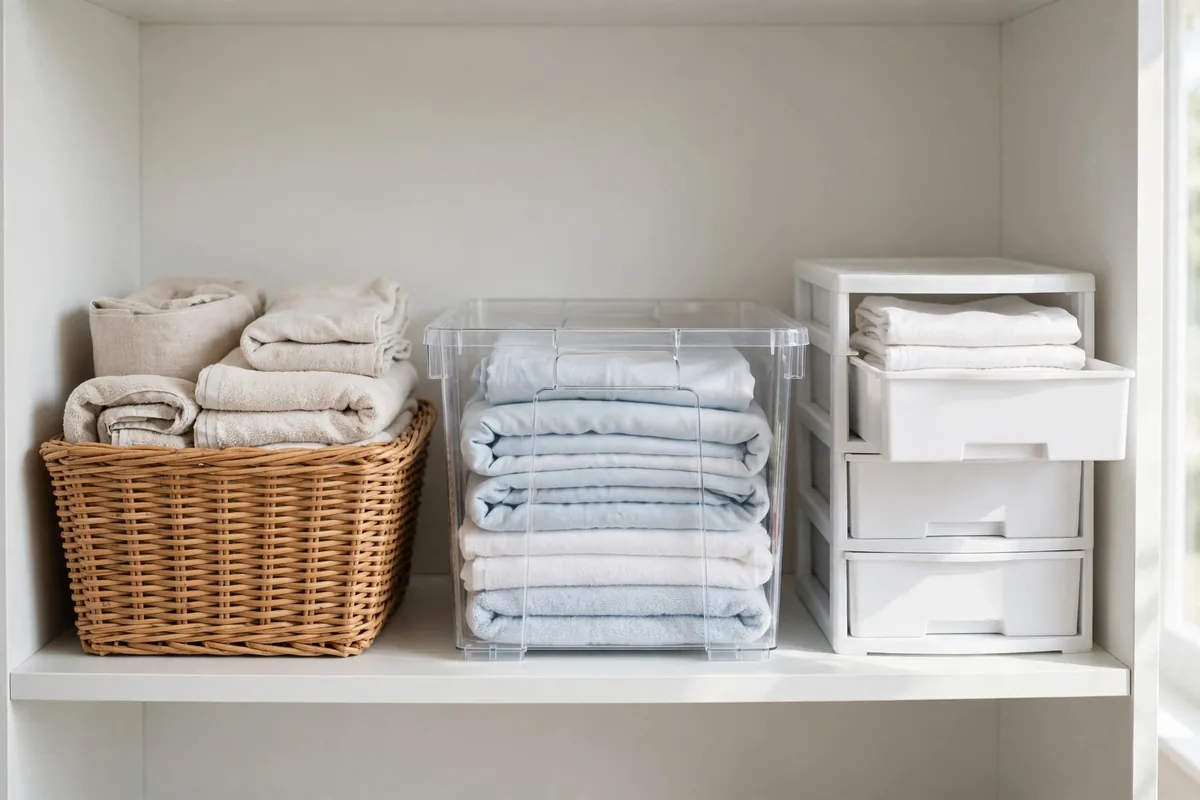
There is no single winner. Anyone selling twelve matching baskets is selling a photo, not a system. Baskets, woven or fabric, are for bulky things you grab by feel: duvets, blankets, guest towels. They hide mess and look good. Their weakness is opacity, so label every basket, or it becomes a decorative box of mystery. Line wire baskets with a simple fabric basket liner so washcloths and small items do not poke through the weave.
Clear bins are for small backstock where seeing the level matters: cotton balls, extra soap, medicine. When the bin looks low, you buy more.
Stackable drawers are the premium pick for sheet sets. File sets upright and spine-out; you pull one without disturbing the stack, and you only need two or three.
Shelf dividers are the cheapest fix with the highest return. A four-pack costs less than one basket and stops towel stacks from slumping sideways, which is half of what makes a closet look messy. If you buy one thing from this guide, make it dividers.
My opinion, stated plainly: buy containers last. Sort, fold, and place everything first, measure the gaps, then buy exactly what fits. The number one waste in closet organizing is beautiful bins that do not fit the shelves.
How can you organize a linen closet on a Dollar Tree budget?
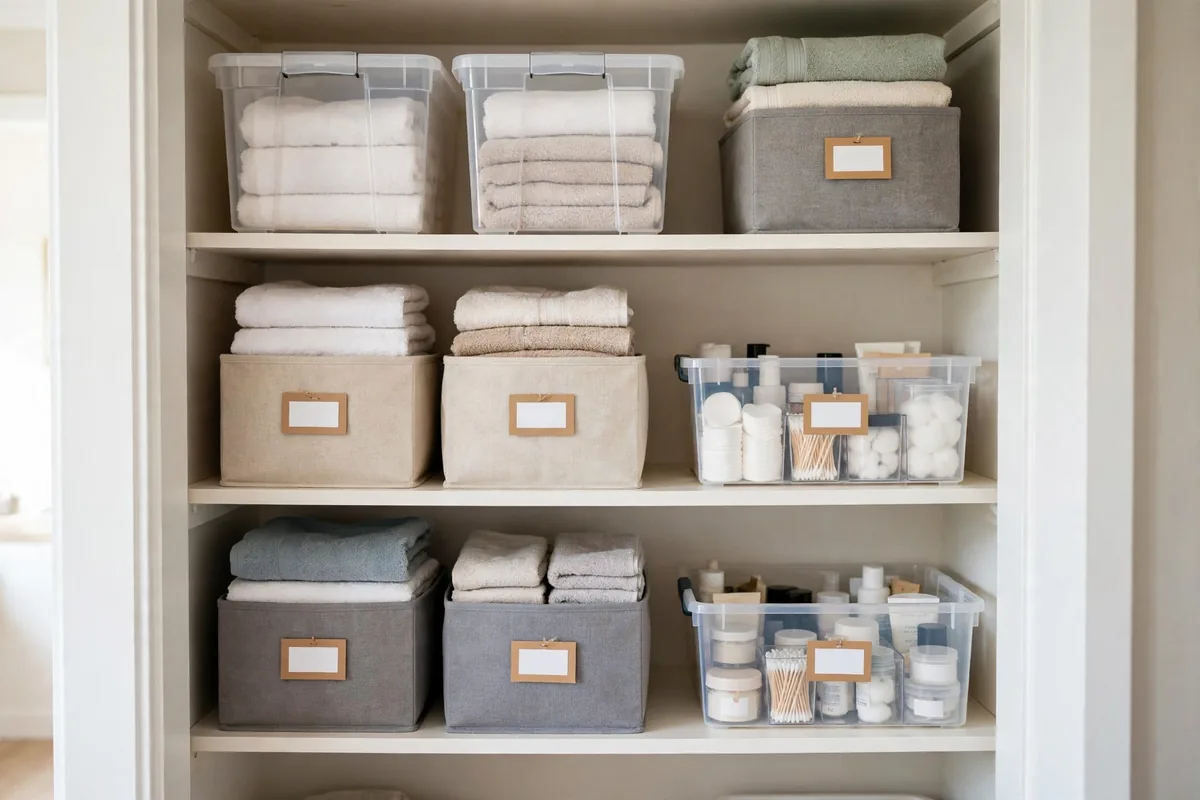
You can do this project for under $25. Cheap bins remove the pressure to make it look like a catalog: a catalog closet gets preserved, a working closet gets used.
The dollar-store version: small plastic bins for toiletries, fabric cubes for bulky items, a pack of adhesive labels. Roughly $15 to $25 for a standard closet.
| Tier | Typical total cost | What you get | Who it suits |
|---|---|---|---|
| Thrifty | $15 to $25 | Dollar-store bins, fabric cubes, adhesive labels, a marker | Renters, first apartments, anyone testing the system |
| Mid-range | $50 to $100 | Sturdier stackable bins, woven baskets, shelf dividers, a label maker | Homeowners who want it to last five years |
| Premium | $150 to $300 | Matching basket sets, pull-out sliding bins, turntables, custom shelf risers | Deep or awkward closets where hardware solves real problems |
What makes a budget closet look expensive is uniform folding, tight stacks, and labels. A row of dollar bins with clean labels beats $25 baskets with sloppy folds. Spend effort on the fold, not the bin.
The honest downside: thin bins crack when overloaded and fabric cubes sag under heavy blankets. Put heavy quilts in the sturdiest thing you own.
Do labels actually keep a linen closet organized?
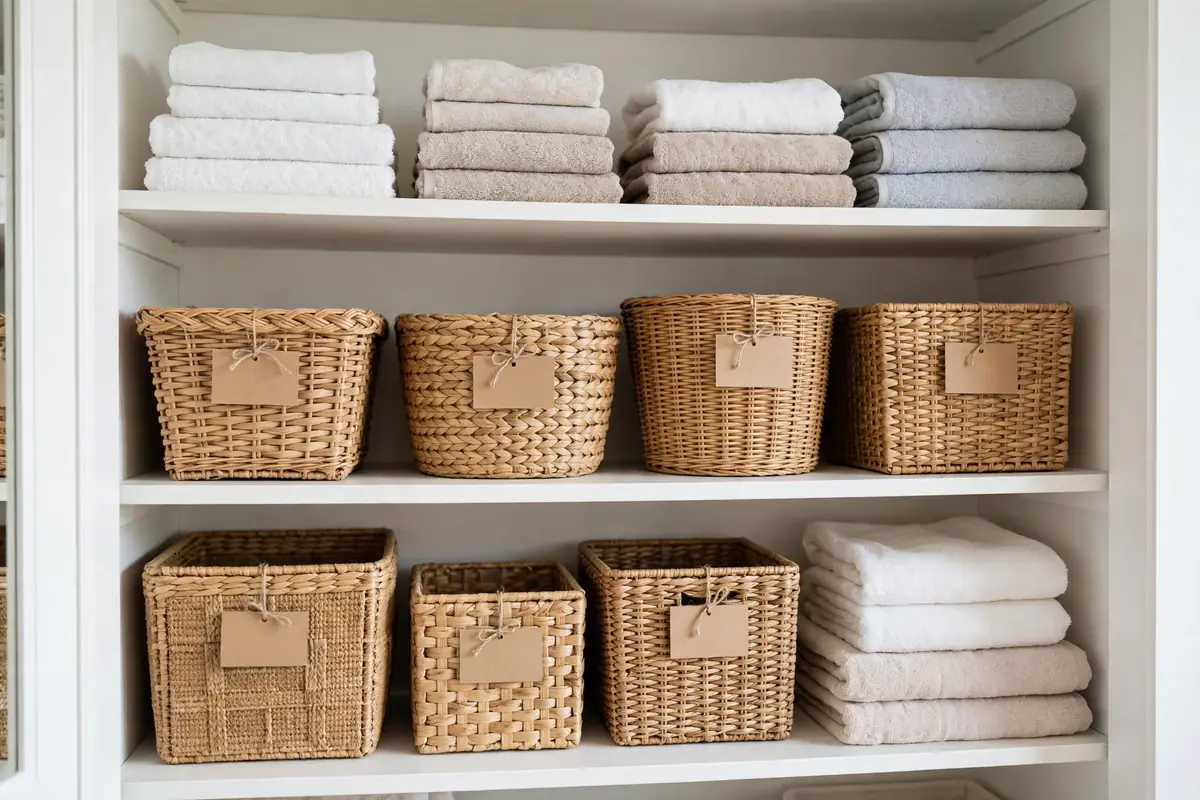
Labels do not organize a closet. They maintain your linen closet organization, and only if other people open the closet. If you live alone and you put everything away yourself, labels are decoration. Admit that and skip them. If you share the house with a partner, kids, or a well-meaning mother-in-law, labels are the difference between a system that survives and one that lasts three weeks.
Keep labels brutally specific. “Bath towels” beats “towels.” “Queen sheet sets” beats “sheets.” The label is answering the question a family member asks while holding the item: where does this go. Vague labels get ignored, and an ignored label is worse than no label because it teaches everyone that the labels do not matter.
A label maker is the mid-range luxury that earns its keep, but a marker on masking tape works the same on day one. Upgrade when the tape starts peeling and annoying you, not before. Pretty script labels from the craft store are for closets people photograph. Yours is a closet people use.
Where should you keep cleaning supplies in a linen closet?
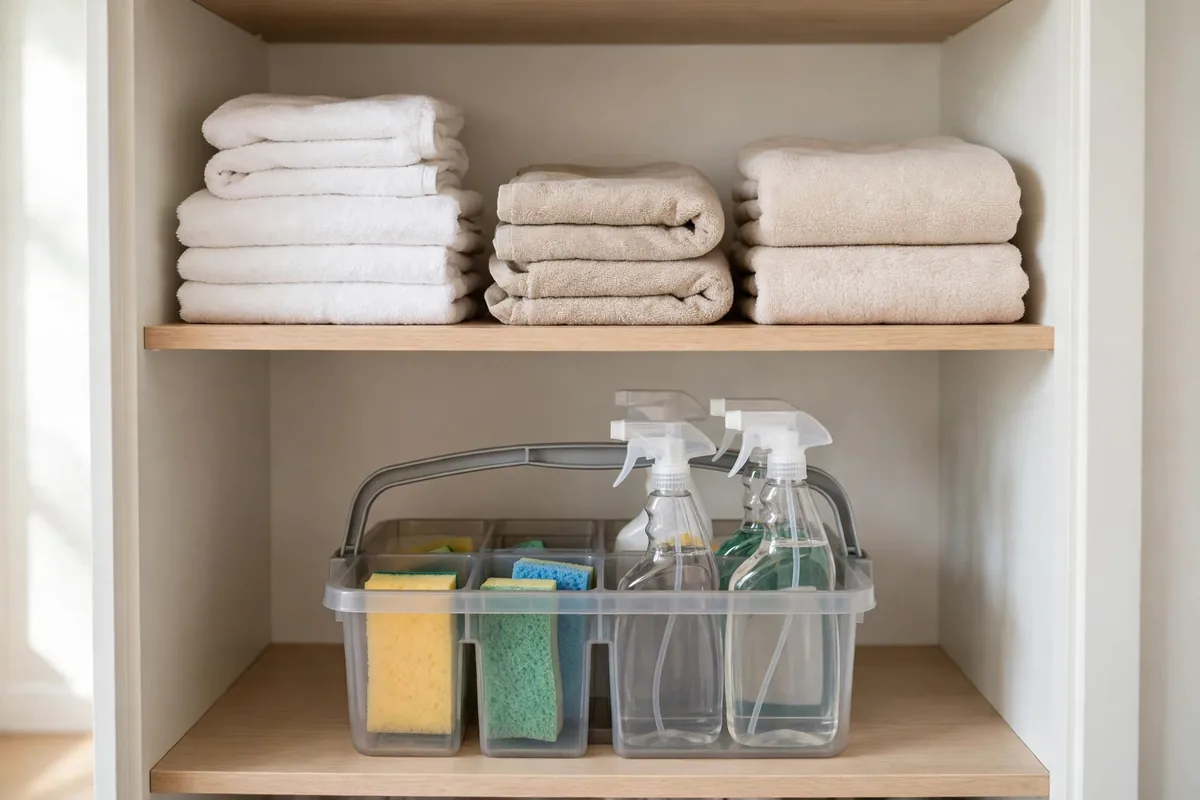
Cleaning supplies belong in a linen closet only under strict conditions: one caddy, bottom shelf, nothing else. The moment spray bottles colonize two shelves, the closet has stopped being a linen closet and started being a utility closet with some towels in it.
The caddy rule exists for a practical reason. Bottles leak. A leaking bottle on a bottom shelf ruins a shelf liner. A leaking bottle on a middle shelf ruins the sheets below it. Keep liquids low, keep them contained in a caddy with a handle, and keep the caddy small enough that you are forced to edit it. If a bottle has not been touched in six months, it goes.
What earns a spot in the caddy: an all-purpose spray, glass cleaner, a toilet bowl cleaner if this is a bathroom linen closet, and spare sponges. What does not: the specialty grout pen you bought in 2021, three half-used bottles of the same cleaner, and anything whose label you cannot read anymore. Cleaning products lose strength over time as their chemicals break down, so that ancient bottle is not even doing its job.
How do you stop the top shelf from becoming a dumping ground?
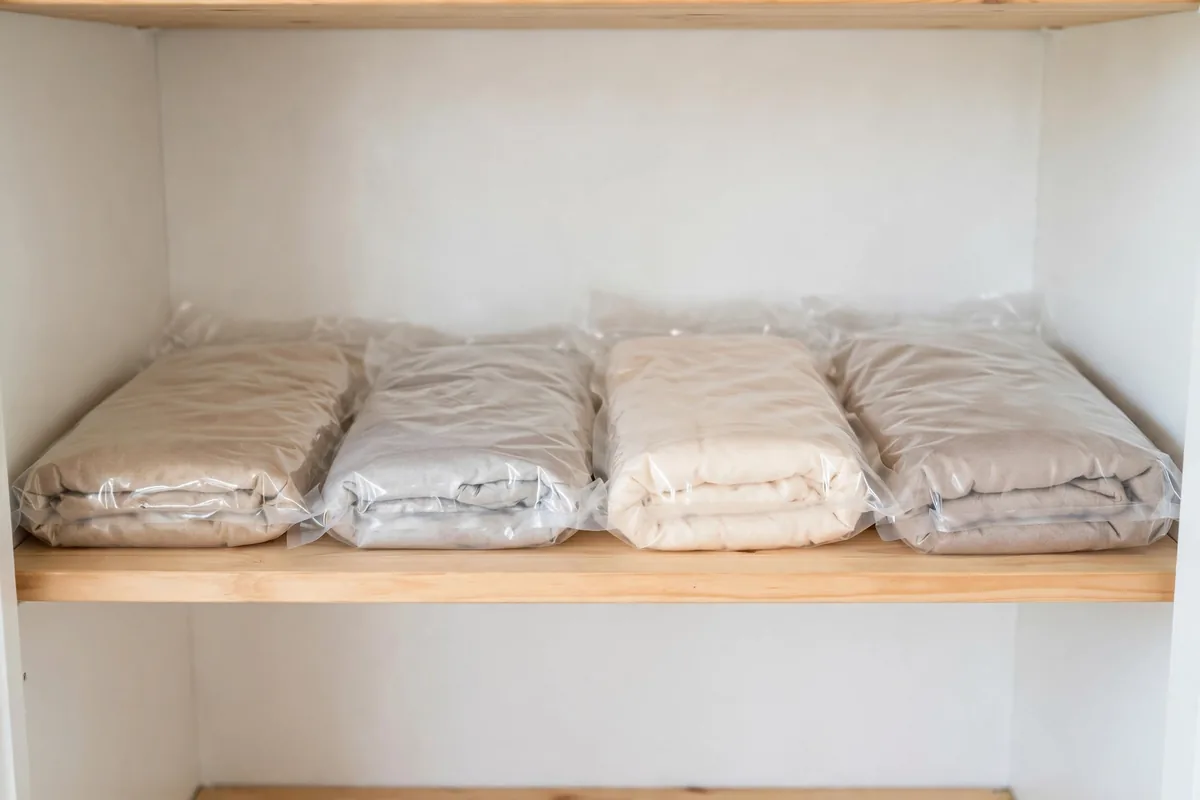
In linen closet organization, the top shelf fails because it is the shelf of good intentions. Things go up there “temporarily” and achieve permanent residency. The fix is a rule with no exceptions: the top shelf holds only vacuum-sealed seasonal items and the spare duvet, one layer deep, with every bag labeled by contents and season.
Vacuum storage bags are the only reason a top shelf works at all. A queen comforter eats roughly two cubic feet of shelf. Vacuum-sealed, it drops to under one cubic foot and stacks like a tile. Buy the bags with the double-zip seal; the cheap single-zip ones slowly reinflate over a month and you end up with puffy bags that do not stack.
Keep a small folding step stool inside the closet or within arm’s reach of it. This sounds like a footnote and it is actually the load-bearing detail. If reaching the top shelf requires dragging a chair from the kitchen, you will shove things up there instead of placing them, and you will never take the seasonal swap down when the season changes. A $20 folding stool removes the friction that creates the dumping ground.
How often should you declutter and refold your linen closet?
Twice a year, tied to seasons you cannot forget: when you swap to warm-weather bedding and when you swap back. Each session takes about 30 minutes once the system exists. Pull the seasonal items, refold anything that has slumped, check the backstock bins for expired medicine and empty bottles, and retire the towel that has gone thin.
This is also when the hygiene math catches up with you. A microbiologist writing in Phys.org in 2025 advised washing bedding at 60 degrees Celsius or higher to kill bacteria and dust mites, and replacing the mattress every seven years. Pillows need their own schedule: Southern Living, quoting board-certified dermatologist Dr. Jennifer Holman and Clean Mama founder Becky Rapinchuk, puts pillow replacement at every one to two years, with cheaper polyester pillows on the shorter end and memory foam lasting two to three. If your spare pillows have been on the top shelf since you moved in, check their age during the seasonal reset.
The refold matters more than the declutter after the first year. Stacks settle, bundles get disturbed, and a ten-minute refold of the prime shelf restores the whole closet. Do not reorganize from scratch every time. The system is the system. Just tune it.
What do you do when you have no linen closet at all?
Plenty of apartments and older homes simply do not have one, and the answer is not to suffer. It is to build the zones somewhere else. An armoire or a tall bookshelf with bins does the exact job of a linen closet: prime zone at eye level, bulky stuff low, seasonal up top. Under-bed storage bins, the flat kind, swallow off-season sheet sets and spare blankets whole; our guide to under bed storage ideas covers the bin types that actually fit under standard bed frames.
A rolling cart is the renter-friendly stand-in for a linen closet. Three tiers, narrow enough to live in a hallway or beside the dresser, holding the active sheet set, the towels in use, and the cleaning caddy. It is not as pretty as a closet. It is more functional than a closet you do not have.
For small-space dwellers generally, the same zone logic applies everywhere. If you are working with a tight bedroom, our small closet organization ideas use the same frequency-zone system for clothes, and the laundry room organization ideas guide handles the wash-fold-put-away loop this closet feeds into.
Your weekend plan: a two-hour linen closet reset that lasts
Here is the whole guide compressed into a Saturday morning. Hour one: empty the closet, sort into keep, donate, and trash, and cut to the inventory math, two sheet sets per bed, two towels per person, one spare blanket. Hour two: fold everything to the 12 by 16 inch rectangle, bundle sets in pillowcases, place by shelf zone, contain in whatever bins you already own, and label only the baskets someone else will open.
Do not buy anything until hour two is done. Most people discover they need two bins and a pack of shelf dividers, not a $200 matching set. The deep-shelf pull-outs and the label maker can wait for the weekend you notice you actually need them.
The test of this system is not how the closet looks on Saturday. It is how it looks in March. If every item has one home and the homes are labeled, the closet survives. If you skipped the purge and just bought prettier bins, you will be reading another organization guide by spring. Start with the purge. The rest is folding.
If this is the closet project you have been putting off, the two-hour reset above is the place to start, and the bathroom drawer organization guide is the natural next win once the closet is done.
What is the best way to organize a linen closet?
The best linen closet organization starts by emptying it completely: keep only what you use (two sheet sets per bed, two towels per person), fold everything to a uniform rectangle, place items by how often you touch them with daily items at eye level, and contain each category in labeled baskets or bins. That routine is the backbone of lasting linen closet organization.
How should linen be arranged?
In linen closet organization, arrange by frequency, not by type. Daily and weekly items go at eye level (48 to 60 inches), monthly items above, bulky weekly items below, and seasonal items on the top shelf in vacuum bags. That frequency-first rule is the heart of good linen closet organization.
What is the best way to organize a deep linen closet?
For linen closet organization on deep shelves, never store loose items deeper than your arm can reach. Use pull-out bins that slide toward you, a turntable for small backstock bottles, or a shelf riser at the back so the rear row sits higher than the front row. Reserve the deepest zone for items you touch twice a year; that is the golden rule of deep-shelf linen closet organization.
How do you organize a linen closet with baskets?
For linen closet organization with baskets, use storage baskets for bulky grab-by-feel items like duvets, blankets, and guest towels, and label every basket since you cannot see inside. Pair them with clear bins for small backstock where seeing the stock level matters; mixing both is smart linen closet organization.
What is the best towel organizer for a linen closet?
Shelf dividers are the cheapest effective towel organizer for linen closet organization: they stop folded stacks from tipping and cost less than one basket. Good towel folding matters more than the organizer itself: fold every towel to the same footprint so stacks stay even, which is the simplest linen closet organization win there is.
What do people put in linen closets?
A linen closet holds sheets, pillowcases, bath and hand towels, washcloths, blankets, spare pillows, tablecloths, and bathroom backstock like toilet paper, extra soap, and a small first-aid kit. In linen closet organization, cleaning supplies get one caddy on the bottom shelf at most. That boundary is what keeps linen closet organization from turning into utility-closet chaos.
How to make a linen closet look nice?
In linen closet organization, uniform folding does more than any container. Fold everything to the same footprint, cap stacks at four to six items, use matching or coordinated bins, and add labels. A coat of paint or wallpaper inside is optional; neat rectangles are what read as “organized,” and that is the cheapest linen closet organization upgrade there is.
What is the most efficient way to organize a small closet?
For small-closet linen closet organization, cap stacks at four items, roll towels instead of folding them, use shelf risers to reclaim dead vertical space, cut inventory harder (one spare set instead of two), and hang an over-the-door rack for pillowcases and washcloths. Small-space linen closet organization rewards ruthlessness.
Where should a linen closet be located?
For good linen closet organization, locate it in a hallway central to the bedrooms and bathrooms it serves. If yours sits inside a steamy bathroom, keep bed sheets on a drier shelf or in a different closet, since humidity from showers soaks into folded linens over time and quietly undoes your linen closet organization.
No linen closet at all? Our bathroom towel storage without a linen closet guide covers the door, over-toilet, and outside-basket system for homes that never had one.
If the linen closet is full, the space under the bed takes the overflow: see the best under bed storage containers for small apartments for bins sized to your bed clearance.
