
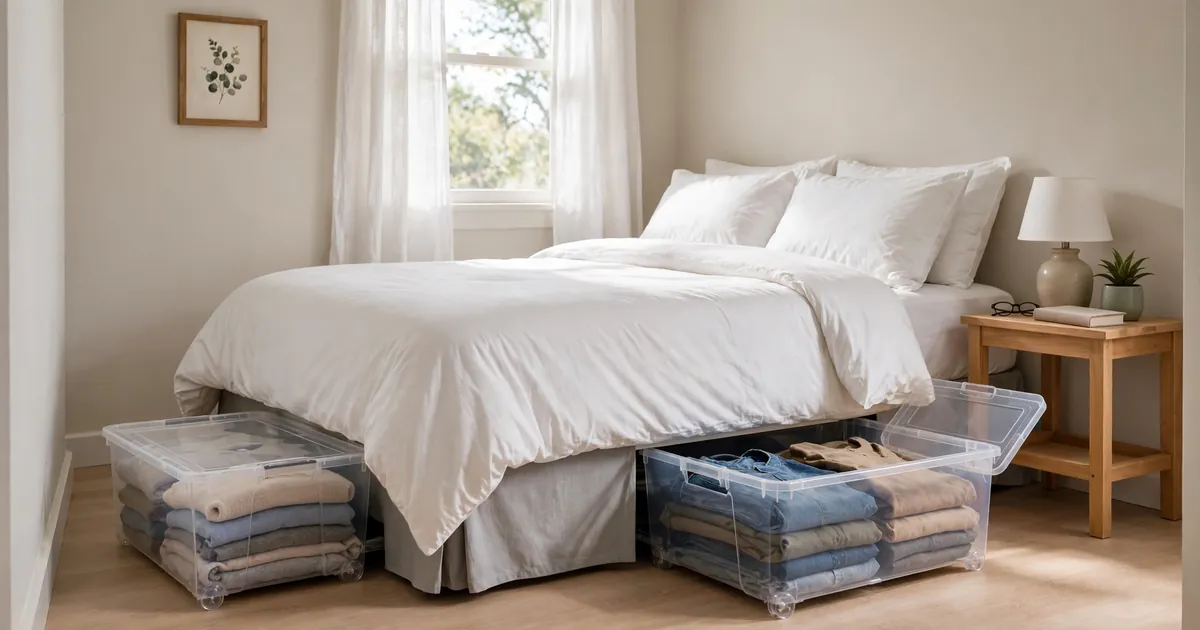

The space under your bed is the biggest free storage zone in a small bedroom. These under bed storage ideas start with one rule: measure your clearance first, then buy containers that fit it. A standard queen hides about 33 square feet of floor space, and with 8 inches of clearance that works out to roughly 22 cubic feet of storage you’re probably ignoring. Below is how to measure it, what fits at each height, and how to keep everything clean and dust-free. I’ll also show you real budget math and the maintenance routine that keeps under-bed bins from turning into a dusty graveyard.
TL;DR
- Measure clearance from the floor to the lowest point (slats or rails), then subtract 2 inches for easy sliding.
- Rolling bins with lids are the best default; zippered fabric bins are the cheapest way to cover a whole bed.
- Vacuum-sealed bags shrink bulky bedding by up to 75%, but plan to re-vacuum them every few months.
- A bed skirt plus lids or zippered tops keeps dust out; cedar blocks help with moths but will not kill an existing problem.
- Never store documents, food, damp items, or valuables under the bed.
| Container type | Best for | Typical height | Price range | Dust protection |
|---|---|---|---|---|
| Rolling bins with lids | everyday access, shoes | 6 to 8 in | $15 to $30 each | strong |
| Zippered fabric bins | budget setups, clothes | 5 to 7 in | $10 to $20 each | good |
| Vacuum-sealed bags | bulky seasonal bedding | flat when sealed | $15 to $25 per pack | excellent |
| Flat bins (no wheels) | low-clearance beds | 3 to 5 in | $10 to $18 each | strong |
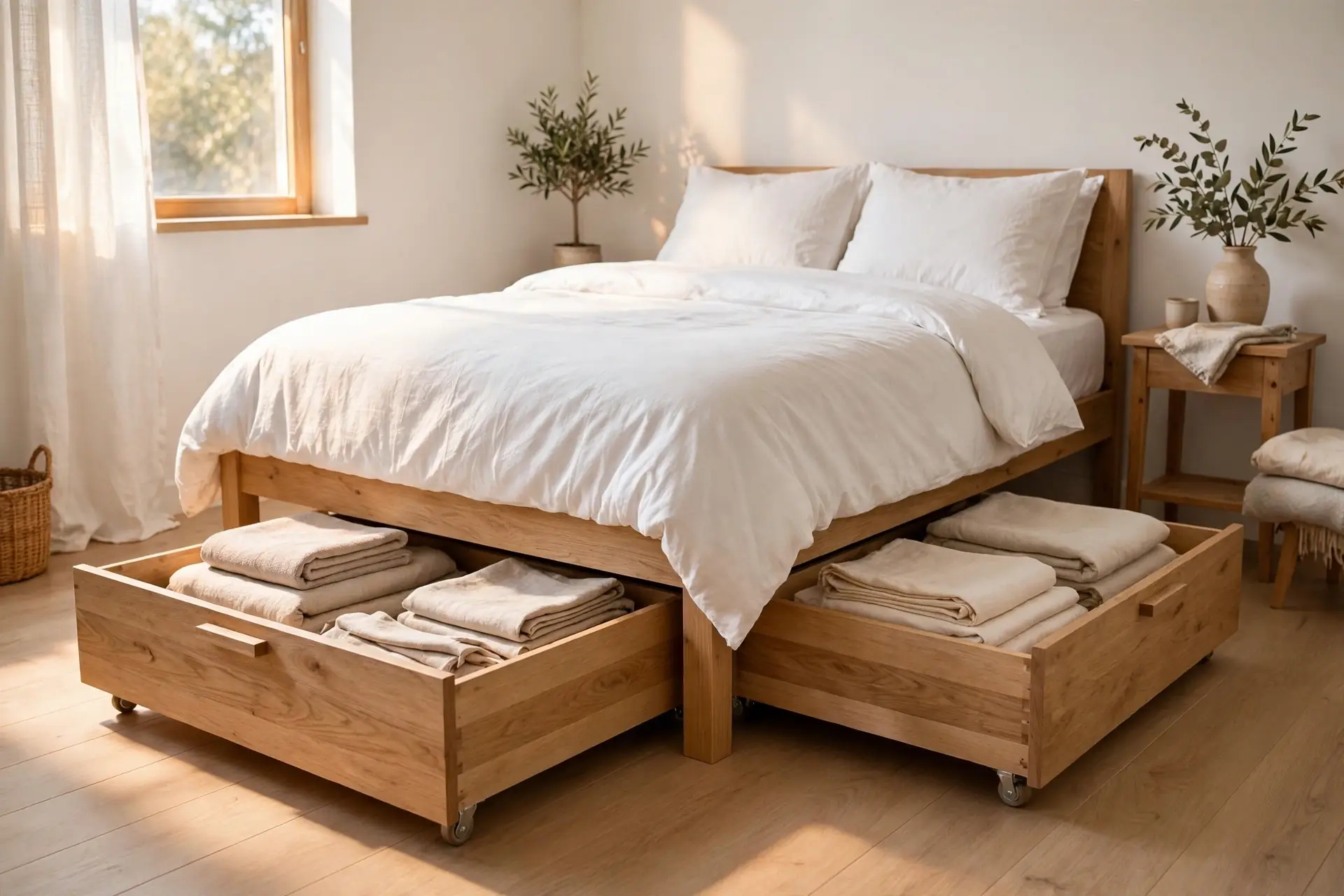
| Rolling drawers and wood crates | built-in look, heavy use | 8 to 12 in | $40 to $90 each | moderate |
How much storage space is actually under your bed?
More than you think. A standard queen mattress measures about 60 by 80 inches, per Merriam-Webster, which gives the bed a footprint of roughly 33 square feet. At 8 inches of clearance, the air under it holds about 22 cubic feet, close to the volume of a small closet.
That math matters most in genuinely small rooms. The International Residential Code says habitable rooms need a floor area of at least 70 square feet, so a code-minimum bedroom leaves almost no spare floor for extra furniture. In that kind of room, the 33 square feet under the bed isn’t bonus space, it’s the main storage you have.
Here is my honest opinion: most people guess the space under their bed holds “a few boxes” and they are wrong by half. Two rolling bins, one vacuum-sealed comforter, and a shoe tray fit under a typical queen with room to spare. You don’t need a bigger bedroom. You need to use the one you have.
How do you measure under-bed clearance the right way?
Measure from the floor to the lowest point under the bed, which is usually a slat, a center rail, or a support leg, not the side rail. Take the reading in two or three spots, keep the smallest number, and subtract 2 inches so bins slide in without scraping.
The mistake almost everyone makes is measuring the side rail and calling it done. Slats sag lower than rails, and center support legs hang lower still. If you buy bins for the rail height, they will jam on the slats.
Use a real tape measure, not your phone guess, and write the number down. If you plan to use bed risers, measure again after they are installed. That one number decides everything you buy next, so get it right once.
What fits under the bed at each clearance height?
Under 4 inches of clearance fits only flat bins and vacuum-sealed bags. From 5 to 7 inches you can use zippered fabric bins and shoe trays. At 8 inches and up, rolling bins with wheels glide easily, and 10 inches or more handles rolling drawers and small crates.
| Clearance | What fits | Best container |
|---|---|---|
| 2 to 4 in | vacuum-sealed bags, flat dust covers, gift wrap tubes | sealed flat bags |
| 5 to 7 in | zippered fabric bins, shoe trays, folded sweaters | zippered fabric bins |
| 8 to 10 in | rolling bins with lids, boot boxes | rolling bins with wheels |
| 10 in and up | rolling drawers, small crates, soft luggage | rolling drawers |
Buy for the clearance you have, not the one you wish you had. I have watched people buy tall rolling bins for a 6-inch gap and then blame the bins. The bins were fine. The tape measure was the missing step. If your number lands under 5 inches, skip straight to flat bins, vacuum bags, or bed risers before you spend a dollar on anything else.

The under bed storage ideas that actually work: bins, bags, and drawers
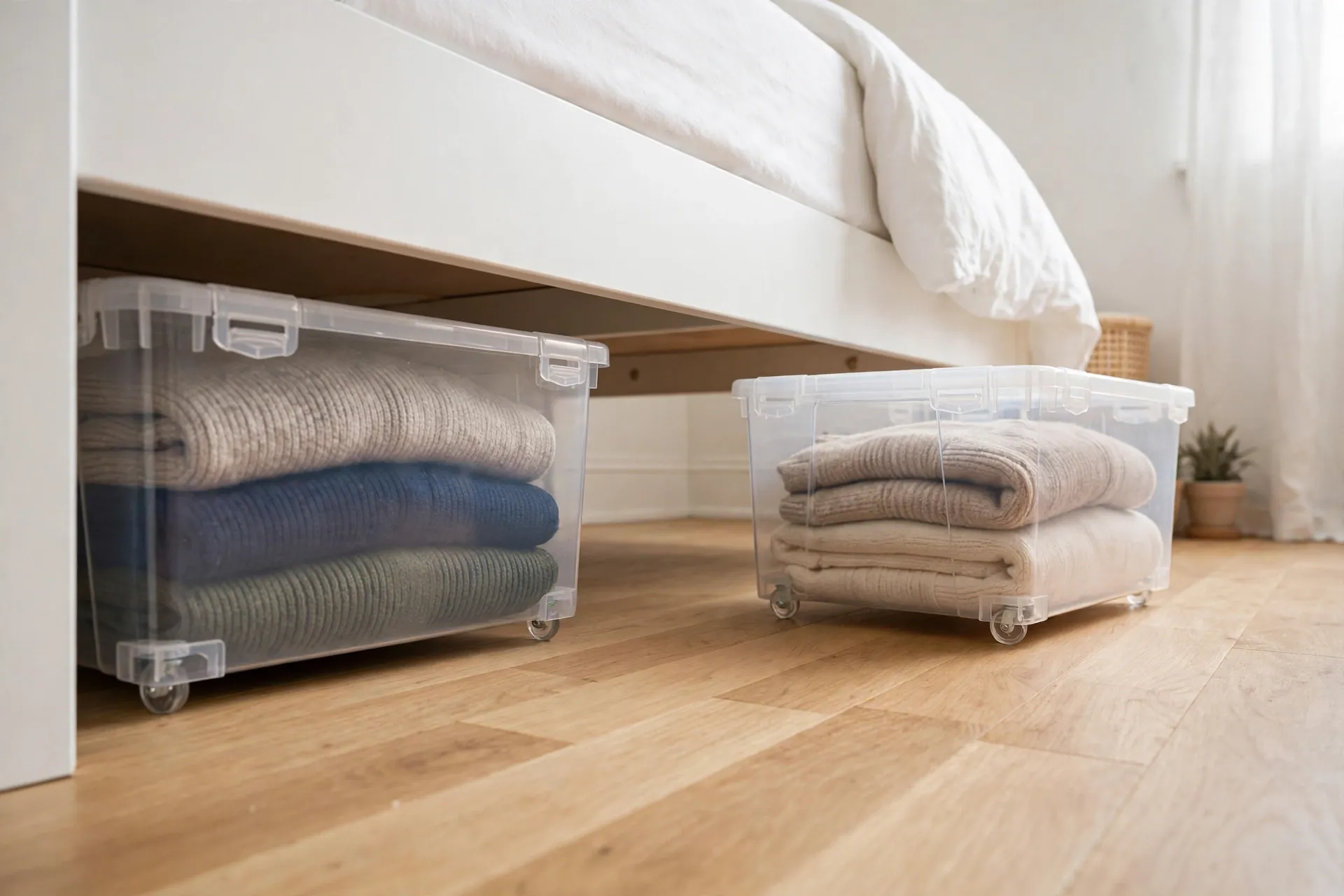
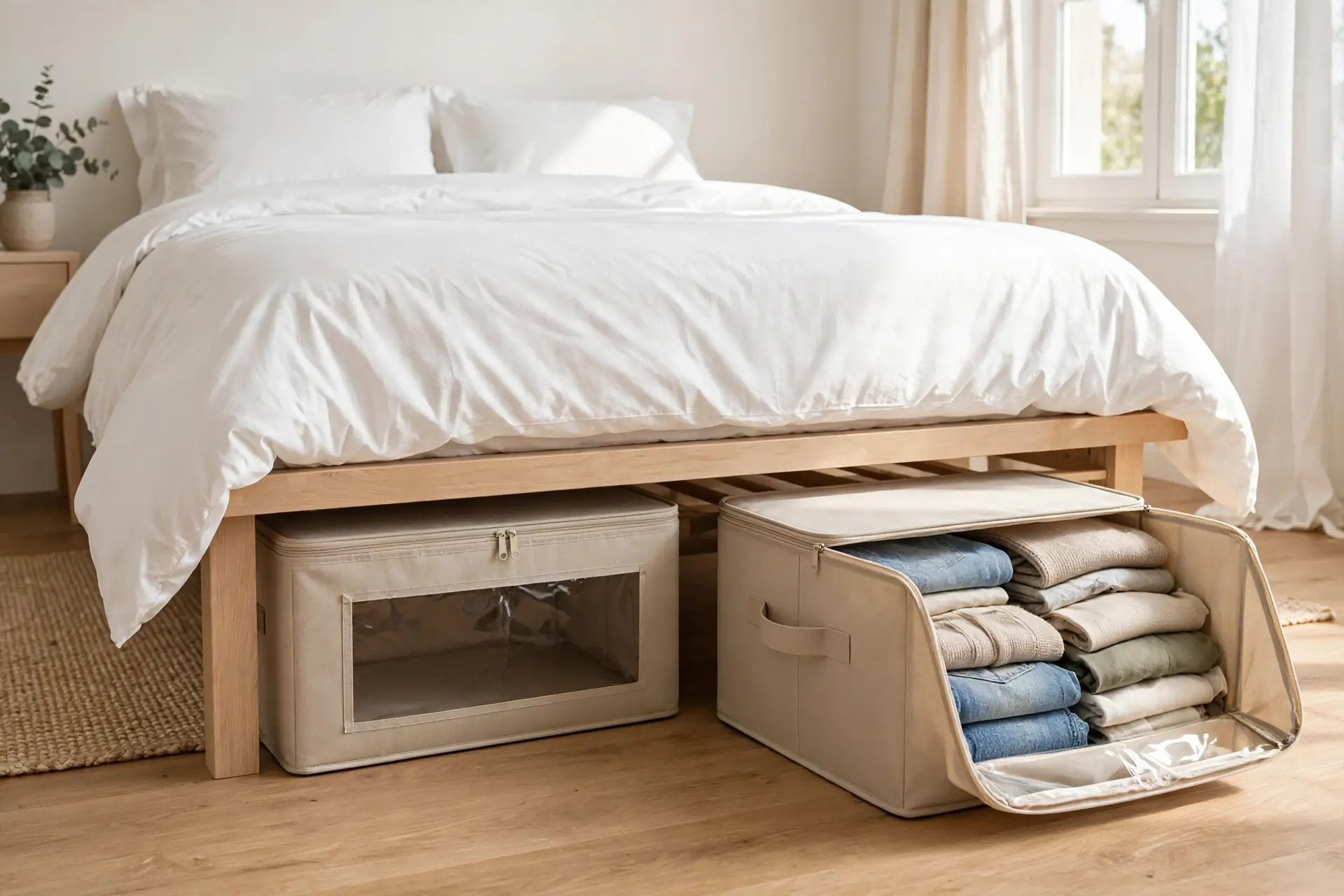
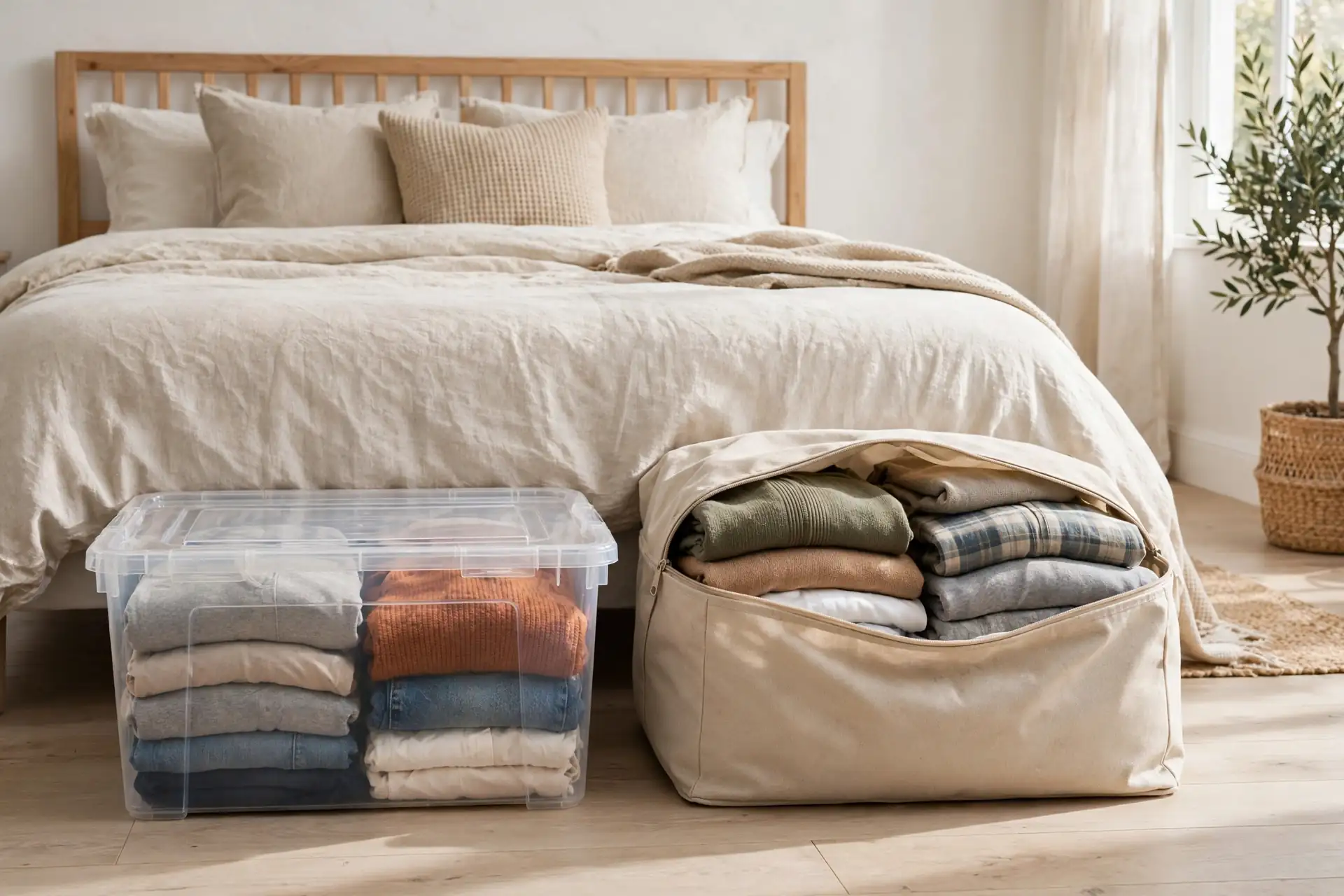
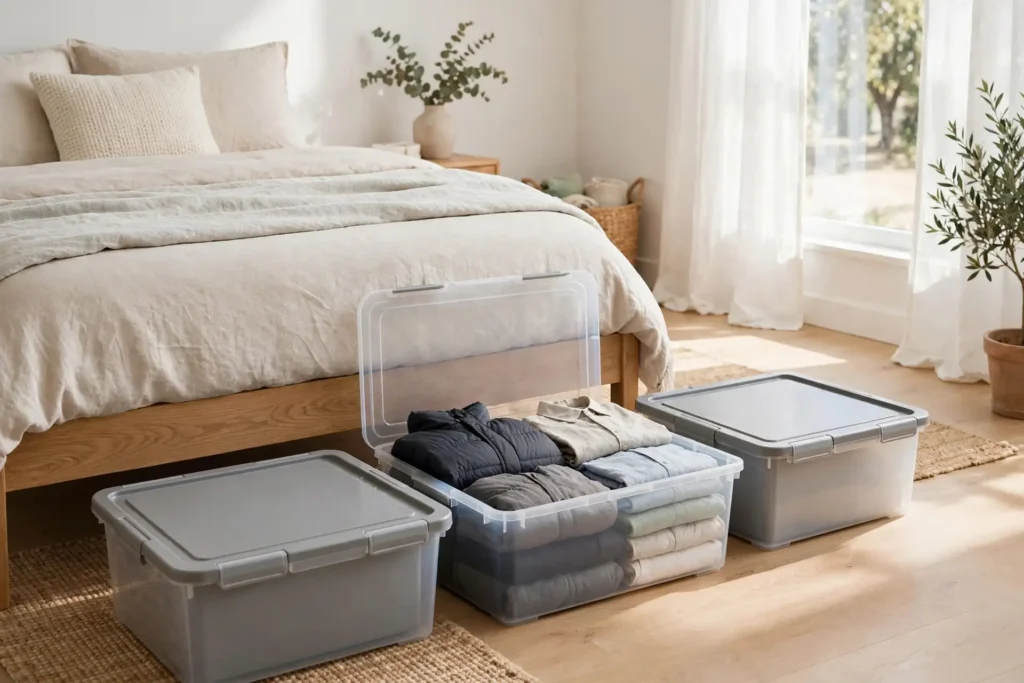
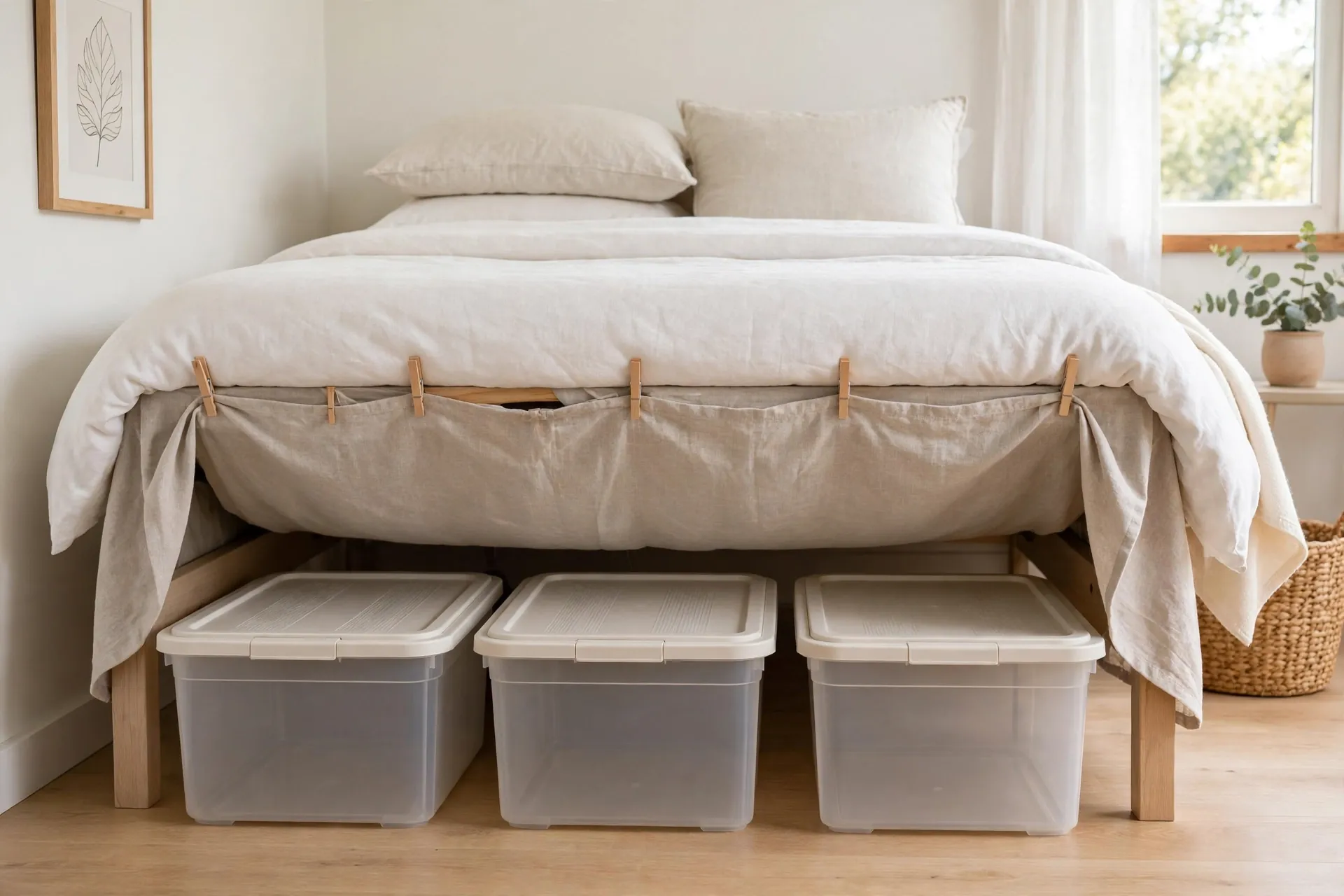
Rolling bins with lids are the best default pick for under bed storage containers. They roll out on hard floors with one hand, the lids block dust, and clear ones let you see what is inside without opening them. Flat bins win under low beds where wheels would eat your last inch. Zippered fabric bins are the cheapest way to cover a whole bed, and they fold flat when empty.
Each type has a real trade-off. Hard plastic bins are rigid, so they never collapse, but they are bulky to store when empty. Fabric bins breathe, which is nice for clothes, but dust works through the weave over months, so they need the seasonal rotation I will get to below. Vacuum-sealed bags flatten bulky bedding to almost nothing and seal out dust completely, but you need a vacuum every time you pack them.
Open woven baskets look great on a shelf. Under a bed they are dust magnets, so skip them. If you buy exactly one thing, buy two clear rolling bins with lids. They solve 80 percent of under-bed storage for most people.
Do vacuum-sealed bags really free up 75% more space?
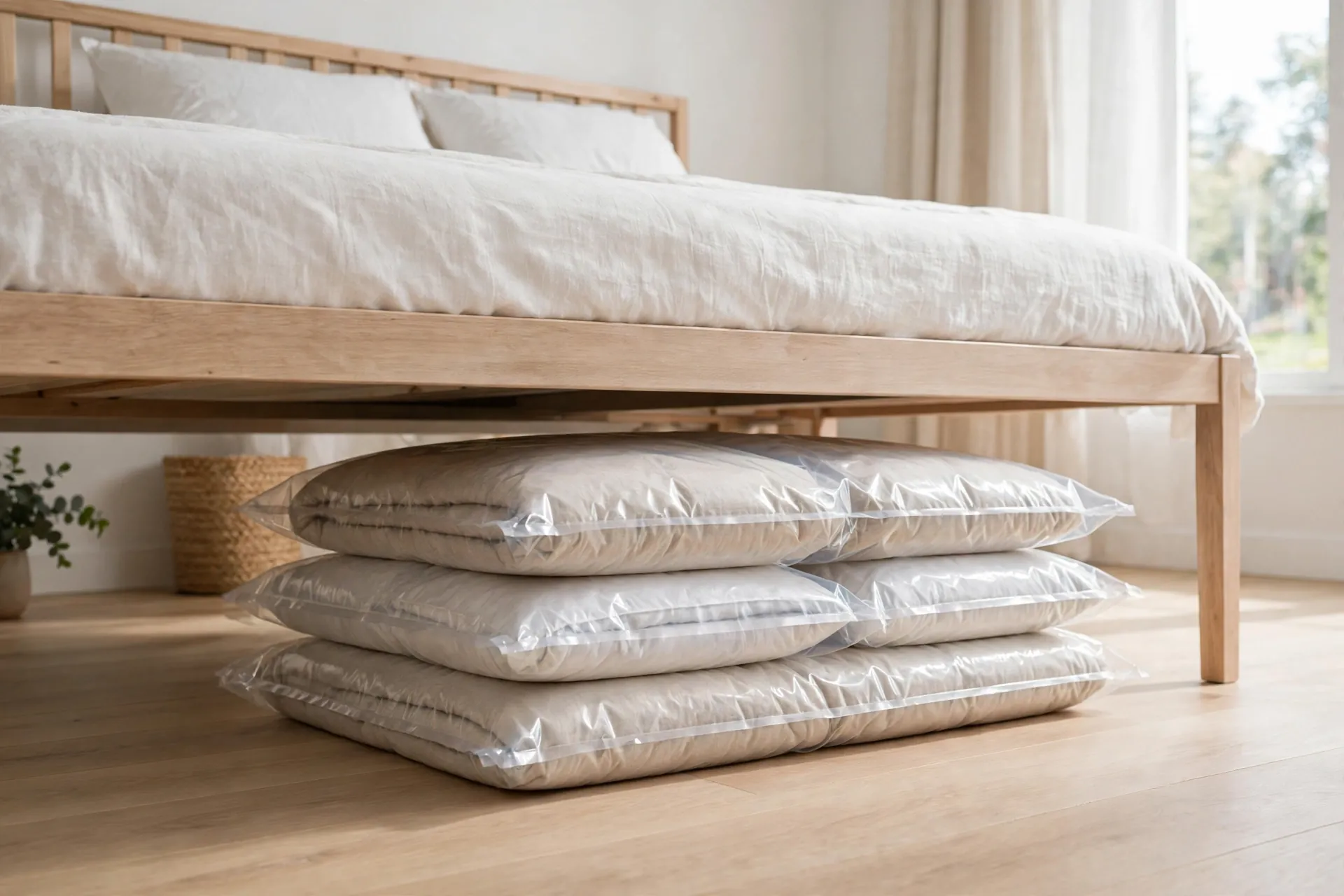
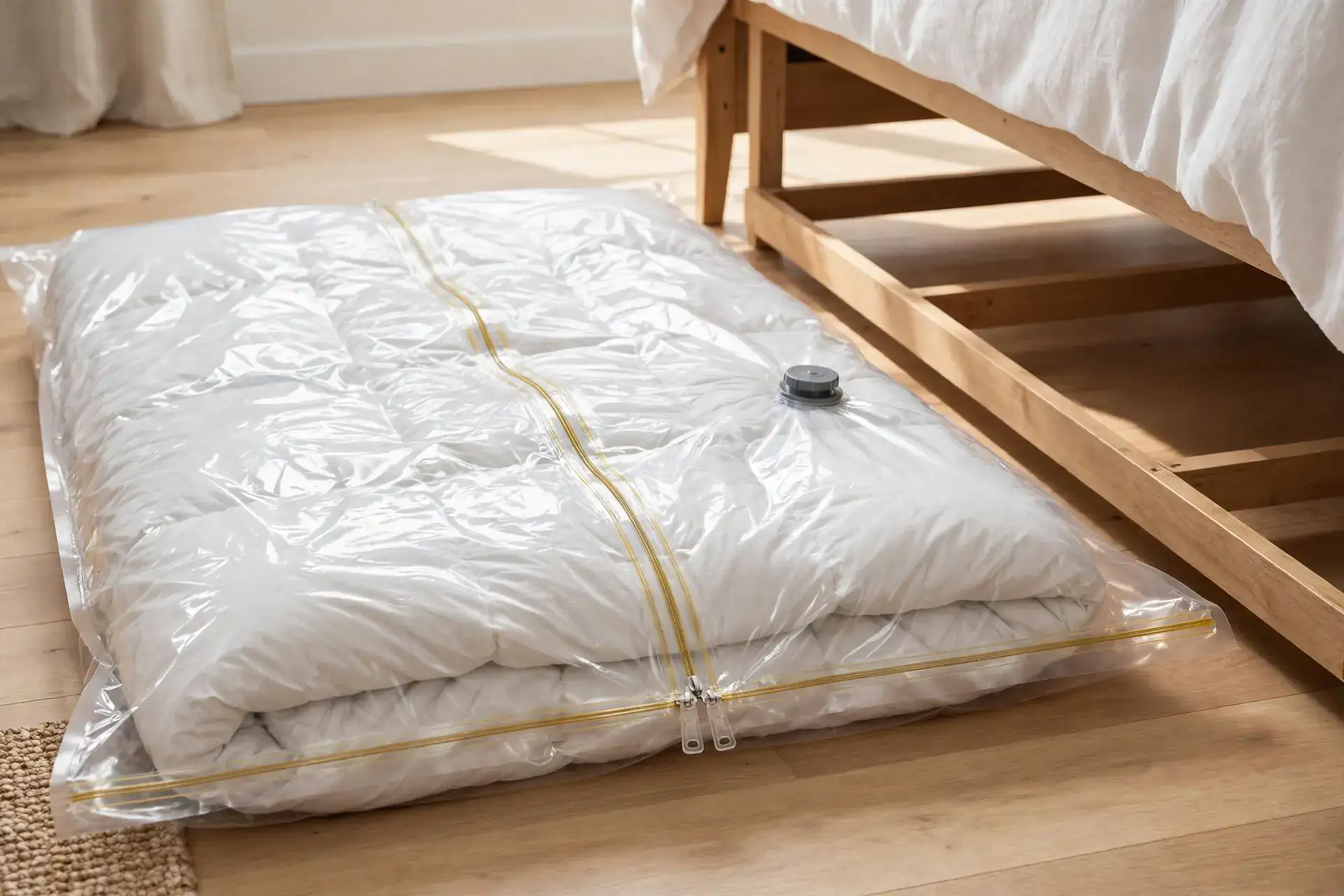
They can, for the right items. Greenco’s manufacturer listing says its vacuum seal bags increase storage space by up to 75%, and that matches what most brands claim. Bulky comforters, winter coats, and spare pillows compress the most. Thin cotton shirts barely change, so don’t expect miracles on a drawer of t-shirts.
The honest limits matter. Vacuum bags compress fibers and leather poorly, so keep those out. Long-term compression can crease fabrics, which is fine for a spare comforter and bad for a suit you wear to work. And the seal isn’t forever: manufacturer usage tips say to re-vacuum the bags every 3 to 4 months for long-term storage, because slow leaks happen.
For under-bed use, vacuum bags are best for one job: bulky seasonal bedding. Pack the winter comforter in spring, slide the flat bag under the bed, and forget it until October. Don’t vacuum-seal your everyday pillow. You will resent the unpacking within a week.
Are bed risers safe, and how much height do they add?
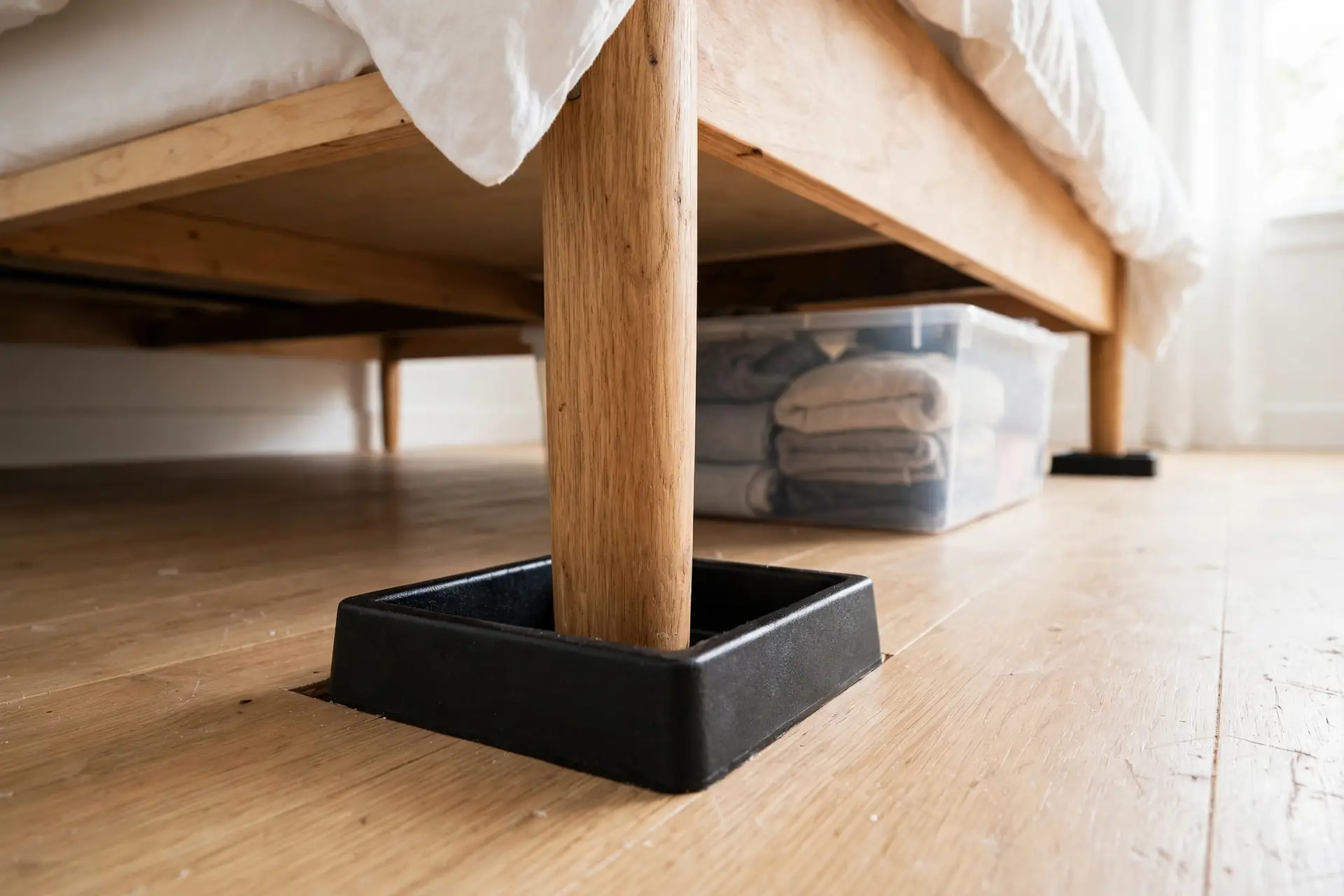
Bed risers for storage are safe when you buy the heavy-duty kind and seat each leg fully in its cup. Most sets add 2 to 6 inches of height. A typical heavy-duty 6-inch plastic set lists a total weight rating up to 1,200 lbs (one widely sold set on Fruugo carries exactly that rating), which covers the bed, the mattress, two adults, and the bins with room to spare.
Follow three rules and you will be fine. First, every leg goes fully into a recessed cup, no half-seating. Second, use them on flat hard floors, never on wheeled bed frames or adjustable bases. Third, give the bed a firm shake after setup and check for wobble during the first week. Felt pads under the risers protect hardwood floors from the extra pressure points.
Skip risers on shaky frames, and skip them if anyone using the bed has mobility trouble, because a taller bed is harder to get into and out of. Otherwise, risers are the cheapest square footage you will ever buy: a few inches of lift turns a useless 4-inch gap into a working 8-inch one.
Under bed storage with wheels: when they are worth it
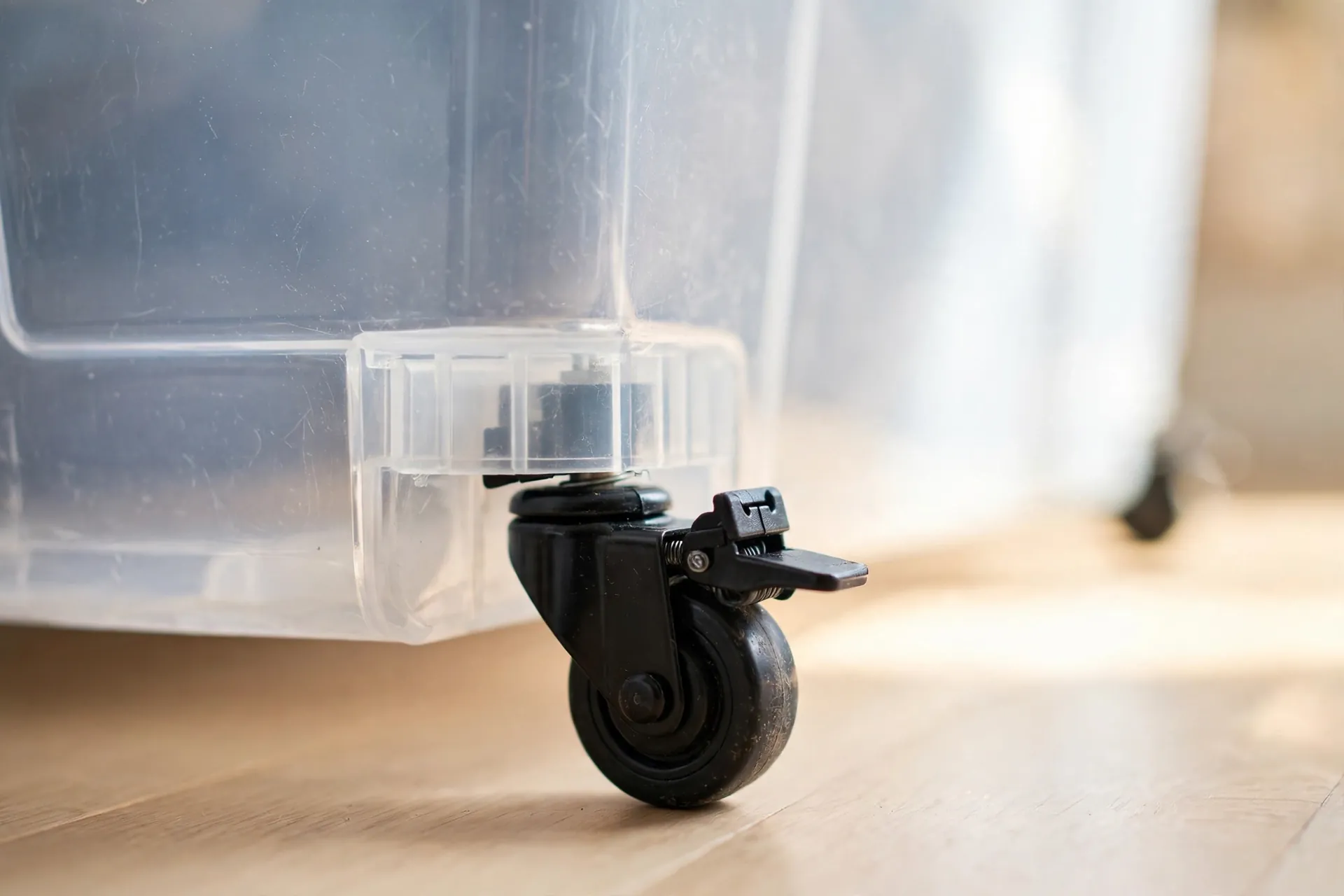
On hard floors, yes. Under bed storage with wheels turns a heavy bin of shoes into a one-hand pull, and locking casters keep the bin from drifting every time you bump the bed. On thick carpet, wheels sink and fight you, so flat bins or fabric bags with pull handles work better there.
Locking casters are simply wheels with a small brake lever you flip with your toe. They cost a little more and they are worth it, because without the brake set, a bin drifts to the middle of the bed where you can’t reach it. For a king-size bed, add a fabric pull strap to the front of each bin so you can drag it out from the long side without crawling.
Wheels pay for themselves the first week on hardwood or laminate. If your bedroom is wall-to-wall plush carpet, save the money and buy flat bins instead. The right call depends on your floor, not on the bin.
Plastic vs fabric vs wood: which material should you choose?
Plastic wins for dust and moisture protection, fabric wins for breathability and price, and wood wins on looks but costs the most and weighs the most. For the space under a bed, where dust is the enemy, sealed plastic or zippered fabric are the practical picks.
| Material | Dust sealing | Moisture protection | Breathability | Weight | Cost |
|---|---|---|---|---|---|
| Hard plastic bins | excellent | excellent | low | medium | $ |
| Zippered fabric bins | good | fair | high | light | $ |
| Wood drawers and crates | moderate | poor | moderate | heavy | $$$ |
| Open baskets | poor | poor | high | light | $ |
Choose plastic if anyone in the house has allergies, because a latching lid is a real barrier and fabric isn’t. Choose fabric if you rotate clothes seasonally and want the cheapest full-bed coverage. Choose wood only if it matches your furniture and you accept dusting the drawers, because wood under a bed collects dust on every surface. A storage bed frame with built-in drawers skips this whole decision, but it costs five to ten times what bins cost.
The closet is the other half of most bedroom storage problems, so once the bed is sorted, our guide to small closet organization ideas applies the same zone-by-zone logic to tight closets.
How do you keep dust out of under bed storage?
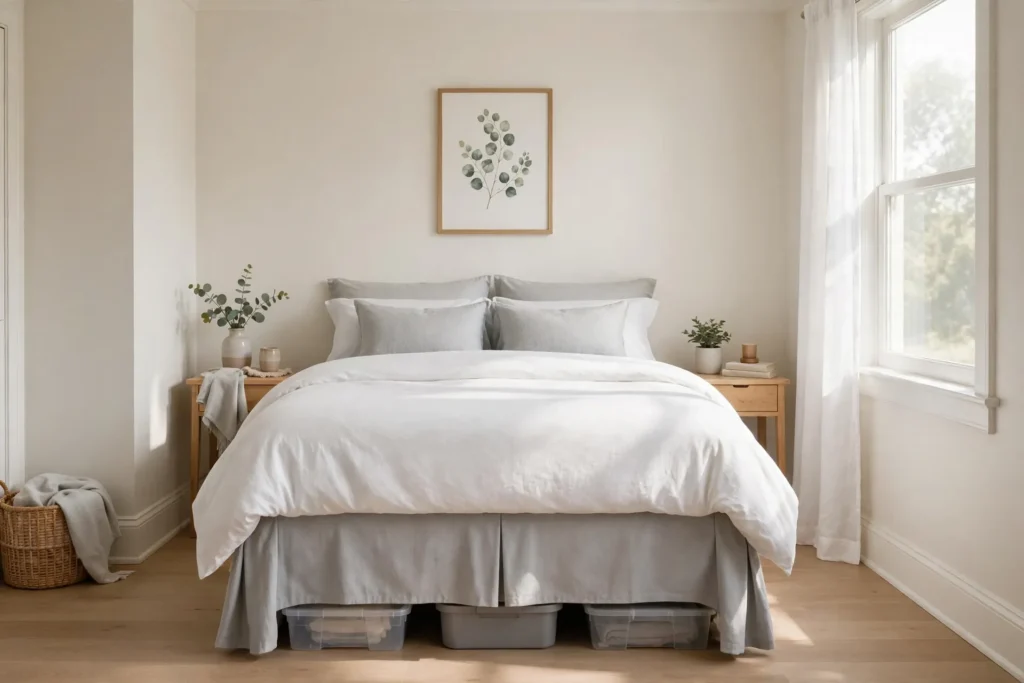
Use containers with lids or zippered tops, never open baskets, and add a bed skirt as a dust barrier so airborne dust never reaches the bins. Wipe the tops of the bins monthly, and vacuum under the bed with a HEPA-filter vacuum every few weeks.
This matters more than it sounds. The Asthma and Allergy Foundation of America (AAFA) says dust mites thrive in temperatures around 70 F and above, like humidity levels above 50%, and feed on the tiny flakes of human skin you shed each day. Your bedroom, AAFA notes, usually has more dust mites than anywhere else in your home. The space under the bed is ground zero for that problem, which is why open containers there are such a bad idea.
A bed skirt is just a fabric panel that hangs from the mattress to the floor around the bed. As a dust barrier it does more work than any bin feature, because it stops dust at the edge instead of on your bins. My routine: pull every bin out once a season, vacuum the floor underneath, wipe the bin lids, and slide everything back. If anyone in your home has a dust-mite allergy, skip fabric bins entirely and use sealed hard containers only.
How do you stop mustiness and protect wool from moths?
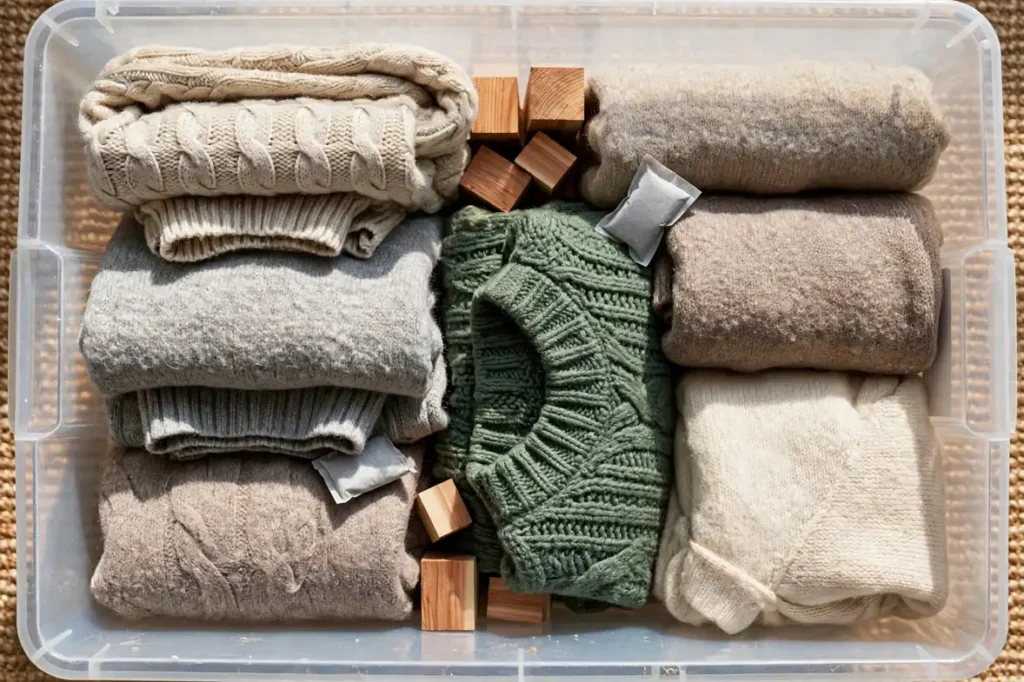
Wash and fully dry everything before it goes under the bed, because damp fabric is what turns musty. Cedar blocks work as a mothballs alternative for repelling moths, but Colorado State University Extension is blunt about the limit: cedar chests and moth balls do repel some moths, but they will not consistently kill existing insects.
So treat cedar as prevention, not cure. If you already see moth damage, wash or dry-clean the wool first, because heat kills every life stage and scent doesn’t. For mustiness, toss a few desiccant packs (rechargeable silica gel ones are cheap and last years) into each bin, especially in humid rooms or ground-floor bedrooms.
The seasonal rotation habit ties it all together: when you swap the bins each season, air everything out for a day, re-fold, and check for damp spots. Sand cedar blocks lightly to refresh their scent, since the repelling oils fade over time. Washing before storage matters more than any gadget here. Clean, dry clothes in a zippered bin simply don’t go musty.
What to store under your bed in a small bedroom
Store seasonal and occasional items: winter coats, spare bedding, extra shoes, soft luggage, gift wrap, and hobby supplies you touch monthly rather than daily. The rule is simple: if you reach for it every day, it doesn’t belong under the bed.
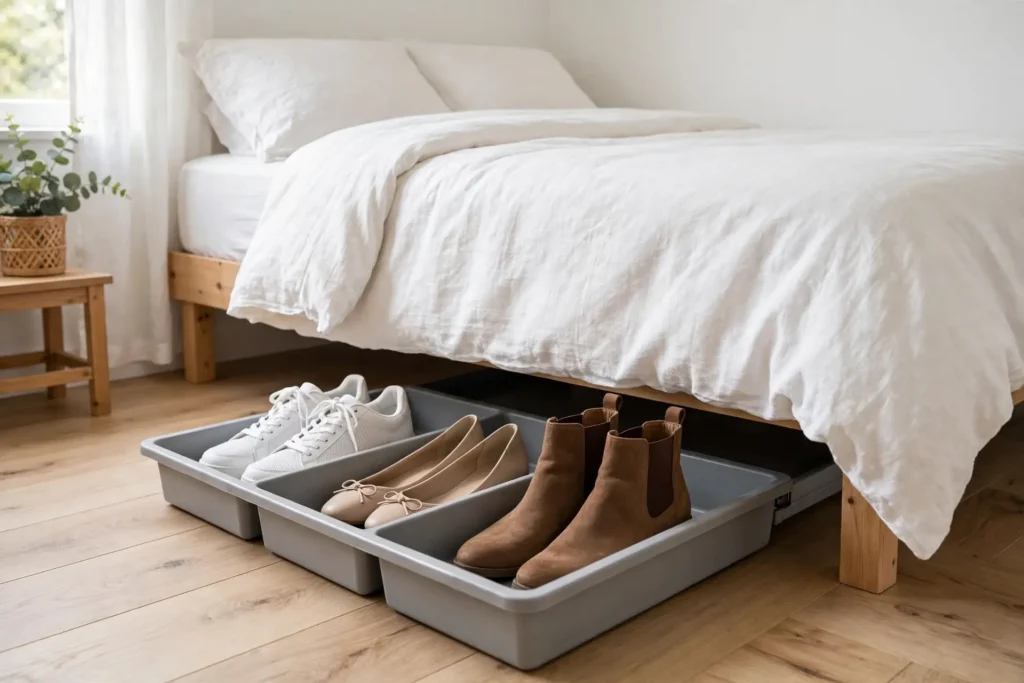
Under bed shoe storage ideas work especially well because shoes are bulky, seasonal, and easy to forget. Keep everyday shoes by the door and slide the off-season pairs under the bed in a tray or low bin. Tall boots fit if you lay them flat or use a boot box at 8 inches of clearance or more. Luggage doubles as a container: pack it with off-season clothes and slide the whole suitcase under.
Under-bed bins are also the natural home for off-season clothes. If you are packing summer clothes away, our guide on how to store summer clothes for winter walks through the full wash, stain-treat, and pack routine so they come out fresh in spring.
Under-bed boxes are also the top overflow spot for shoes: our shoe storage for small closets guide explains which pairs belong under the bed and which deserve prime closet space.
Store by season, not by category. One winter bin you swap twice a year beats three perfectly sorted bins you never open. The same overflow rule we use for small pantry organization ideas applies here: when a bin is full, something leaves before something new goes in. And off-season gear that clutters the door, like extra tote bags and scarves, can live under the bed instead; see our entryway storage ideas for small spaces for the door-side half of that system.
What should you never store under the bed?
Never store important documents, food, anything damp or freshly washed, valuables, fragile antiques, or heavy tools under the bed. Heat, dust, hard-to-reach corners, and the odd plumbing leak make it the wrong home for all of them.
If you remember one rule about what not to store under the bed, make it documents: they belong in a fire safe or a filing cabinet, because a flood or pest problem under a bed destroys paper fast, and you can’t grab them quickly in an emergency. Food invites pests; Indian meal moths infest stored dried foods, and a forgotten snack under a bed is an open invitation. Damp items grow musty within days in a dark, still space. Valuables get forgotten, which is its own kind of loss. Fragile antiques get kicked every time you pull a bin out. Heavy tools damage floors and your back.
Cleaning supplies don’t belong here either. They belong in their own zone, set up like the system in our under-sink kitchen organization guide, where leaks are contained and labels face forward. Think of the under-bed as a seasonal warehouse, not a junk drawer, and it will stay useful instead of turning into the place things go to disappear.
Real budget math for under bed storage
A full under-bed setup for a queen costs $40 to $90 in the mid tier: two rolling bins, a pack of vacuum bags, and a set of risers if you need the height. The budget tier lands under $40, and a built-in drawer frame costs $200 or more.
| Tier | What you buy | Typical total |
|---|---|---|
| Budget | 2 zippered fabric bins + 1 vacuum-bag pack | $25 to $40 |
| Mid | 2 rolling bins with lids + vacuum bags + risers | $40 to $90 |
| Built-in | storage bed frame with drawers | $200 and up |
For real anchors: The Container Store’s Montauk underbed bin lists at $29.99 with exterior dimensions of 35.5 by 19 by 6.5 inches, a useful reference for what fits a standard gap. Vacuum bag multi-packs run $15 to $25, and riser sets run $15 to $30. Prices move, so treat these as anchors, not quotes.
The mid tier is the sweet spot for most small bedrooms: lidded rolling bins for daily access, vacuum bags for the bulky seasonal stuff, risers only if your clearance needs them. The budget tier works fine if your bed already sits high enough. Either way, a full setup costs less than one dinner out for two, which is a fair trade for a closet’s worth of storage.
Measure first, then buy one bin and test it
Start with the tape measure, not the shopping cart. Measure your clearance at the slats, buy one bin that fits with 2 inches to spare, live with it for a week, then buy the rest. Most small bedrooms need only three or four bins to feel twice as big.
The whole system fits in one sentence: sealed containers beat open ones, wheels beat dragging on hard floors, a bed skirt beats dust, and seasonal rotation beats “set it and forget it.” Measure tonight, order one bin this weekend, and when the bedroom is sorted, carry the same system into our small bathroom storage ideas guide. Small rooms don’t need more space. These under bed storage ideas are about making the space you already have work harder.
Heading off to college? Our dorm room storage organization ideas guide takes this under-bed system further, with twin XL measurements, bed-riser rules, and a roommate closet-split that survives the whole semester.
What is the best way to store things under my bed?
Measure your clearance first, then use containers with lids or zippered tops sized to fit with 2 inches to spare. Store seasonal or occasional items, not daily-use things, and add a bed skirt to block dust. Pull everything out once a season to vacuum underneath and check for dampness.
What not to store under the bed?
Keep out important documents, food, damp or freshly washed items, valuables, fragile antiques, heavy tools, and anything you use daily. The under-bed area is dusty, hard to reach, and vulnerable to leaks, so it suits seasonal storage, not precious or perishable things.
How much clearance do I need under my bed for storage?
You need at least 5 inches for zippered fabric bins, 8 inches for rolling bins with wheels, and 10 inches for rolling drawers. Under 5 inches, use vacuum-sealed bags or flat bins, or add bed risers to gain 2 to 6 inches of height.
Do under bed storage bins damage floors?
Hard plastic bins can scratch wood and laminate if you drag them. Put felt pads under bins and risers, choose bins with locking casters, and lift rather than drag on hardwood. On carpet, wheels are less useful and flat fabric bins slide more gently.
Are wheels necessary for under bed storage?
No, but they are worth it on hard floors, where a loaded bin becomes a one-hand pull. Locking casters stop the bin from drifting to the middle of the bed. On thick carpet, skip wheels and use flat bins or fabric bags with pull handles instead.
How do I keep dust out of under bed storage?
Use lidded or zippered containers, never open baskets, and hang a bed skirt as a dust barrier. Wipe bin tops monthly and vacuum under the bed with a HEPA-filter vacuum every few weeks. For dust-mite allergies, use sealed hard containers only.
Are plastic bins or fabric bags better under the bed?
Plastic bins seal out dust and moisture better, so they win for allergy households and long-term storage. Zippered fabric bags are cheaper, lighter, and breathe better, which suits clothes you rotate each season. Avoid open baskets in either material.
Should I use vacuum sealed bags for under bed storage?
Yes, vacuum sealed bags under bed storage is worth it for bulky seasonal bedding like winter comforters and coats, where they can cut volume by up to 75%. Re-vacuum every 3 to 4 months to keep the seal tight. Skip them for everyday items, leather, and anything that creases badly.
Are bed risers safe?
Yes, when you use a heavy-duty set, seat each leg fully in its recessed cup, and place them on flat hard floors. Typical heavy-duty sets add 2 to 6 inches and list total weight ratings up to 1,200 lbs (per widely sold sets on Fruugo). Avoid risers on wheeled frames, adjustable bases, or shaky beds.
Under-bed bins are one piece of a bigger system. Our studio apartment storage ideas show how the sleep zone, entry zone, and four other zones each get a fixed address so nothing drifts.
Pair this with our guide to organizing a bedroom without a closet, which puts under-bed bins in a five-zone system.
Once you know what to store under the bed, pick the container by your clearance: our roundup of the best under bed storage containers for small apartments gives verified dimensions for low beds, rolling bins, and wood drawers.
