
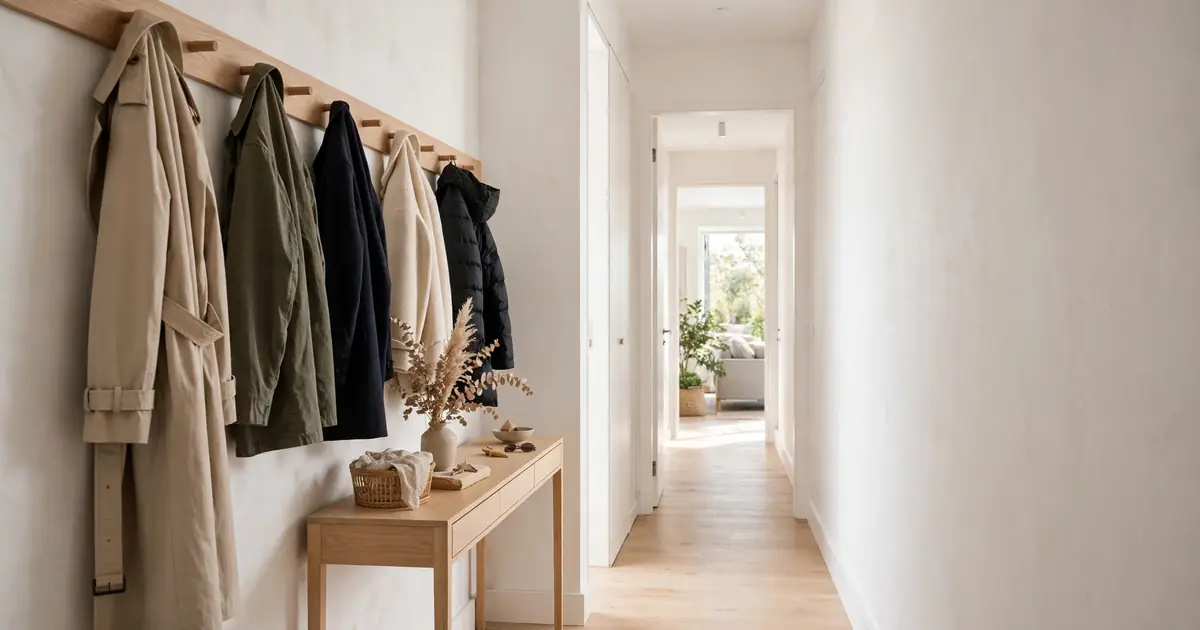

Narrow hallway storage ideas start with one rule: keep the path clear, keep pieces shallow, and let the walls do the work.
A narrow hallway can hold coats, shoes, keys, and bags without turning into an obstacle course, as long as every piece stays shallow, most storage moves to the walls, and at least 30 inches of clear walking space survives after everything is in place. The trick is not buying smaller versions of normal furniture. It is picking pieces made for tight halls, measuring first, and leaving the floor as open as you can.
TL;DR
- Keep at least 30 inches of clear walking space after furniture goes in, and aim for 36 inches when you can.
- Wall storage beats floor storage in a narrow hall: hooks, peg rails, and shallow shelves cost zero walking space.
- Slim consoles work at 10 to 14 inches deep; standard 18 to 24 inch deep pieces do not belong in a narrow hall.
- One closed shoe cabinet plus one open hook rail covers most halls better than five small pieces.
- Store only what you use daily in the hall. Everything else lives in a closet or another room.
How wide does a hallway need to stay clear?
A hallway in a US home must be at least 36 inches wide under the International Residential Code, section R311.6, and the 2010 ADA Standards for Accessible Design set the same 36 inch minimum clear width for an accessible route in section 403.5.1.
Those numbers describe the empty hall, not the hall after you add furniture, so they are the floor, not the goal. Most US homes are built with halls between 42 and 48 inches wide, which is why a 36 inch hall feels tight the moment a shoe rack appears. My rule is simple: after every piece is in place, you should still have 30 inches of open walking space at the narrowest point, and 36 inches is better if your hall allows it.
Two people can pass each other at 42 inches without the awkward sideways shuffle, but most narrow halls will never offer that, so plan for one person walking freely with a bag in hand. If a piece leaves less than 30 inches clear, it does not fit, no matter how good it looks in the store photo. That test is the heart of narrow hallway storage ideas. Measure at the tightest spot, not the widest, because one pinch point decides how the whole hall feels.
What is the one rule for narrow hallway storage ideas?
The rule is that the wall does the work and the floor stays open. That single shift explains why two halls of the same width can feel completely different: one has a coat stand, a shoe pile, and a bench jutting out, and the other has the same coats and shoes flat against the wall.
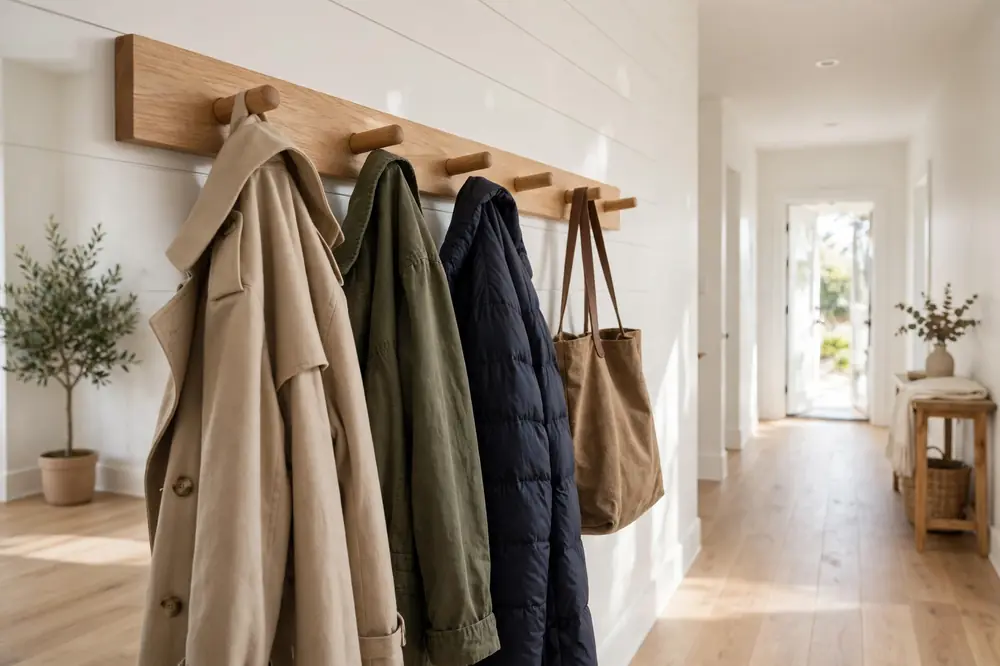
Every item that sits on the floor costs walking space, while hooks, rails, and shelves mounted on the wall cost none. I would start every narrow hall plan by moving coats and bags to a peg rail before buying any furniture at all, because hooks solve the biggest mess for the least space. A coat on a hook sticks out about 6 to 8 inches from the wall, which is far less than any freestanding rack, and a row of hooks holds a whole family’s daily coats on one short stretch of wall.
The trade-off is real, though. Wall storage only works if the wall can hold the weight, so a rail full of heavy winter coats needs screws in studs, not just drywall anchors. And open hooks show everything, so this rule is not for people who want coats hidden. If hidden storage matters more to you than floor space, a closed cabinet is the honest pick, and you pay for it in inches.
How do you measure a hallway before you buy anything?
You measure three things, and you do it before you order a single piece. First, measure the width at the narrowest point, wall to wall, and write it down. Baseboards and door trim steal an inch or two, so measure where feet actually walk, not where the studs sit.
Second, measure each clear wall stretch, noting door swings, light switches, and vents. A door that swings into the hall can wipe out a whole furniture plan, so swing every door while you measure. Third, measure the height you can reach with ease and the height where a shelf stops being useful. A shelf above 72 inches holds seasonal stuff you fetch with a step stool, not daily gear. Subtract your target clear width from your narrowest width and you get your maximum furniture depth.
A 42 inch hall with a 30 inch clear target allows a 12 inch deep piece. A 36 inch hall with the same target allows only 6 inches, which means wall storage or nothing at all. I would tape the outline of a planned piece on the floor and live with it for a day before buying. Tape costs nothing, and it catches mistakes a tape measure misses, like a door that clips the corner of a cabinet. It is the cheapest narrow hallway storage ideas check you can run before buying.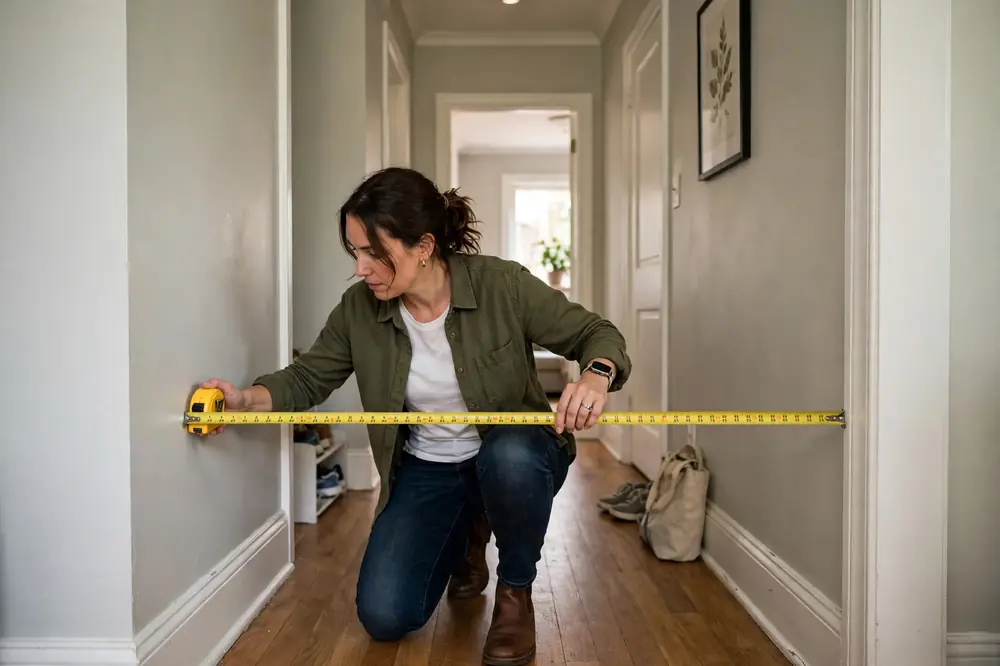
Which slim console depth actually works in a narrow hallway?
Console tables sold for hallways usually run 10 to 18 inches deep, and the right depth for a narrow hall sits at the shallow end of that range. In a 42 to 48 inch hall, a console 10 to 14 inches deep leaves a comfortable path and still holds keys, mail, a small lamp, and a tray.
At 15 to 18 inches deep, a console starts to dominate a narrow hall, and it only works in a wider hall or a spot nobody walks past, like a dead end. Ultra-slim consoles exist too: one widely sold model measures just 5.9 inches deep, which fits almost any hall, but a top that shallow holds a tray and a phone and not much else. My pick for most narrow halls is a 12 inch deep console with open legs, because you can see floor beneath it and the hall reads wider than it is.
A solid plinth base or a skirt to the floor makes the same piece look like a wall, and that visual weight matters in a tight space. This is not the piece for heavy storage, though. A console is a landing spot, not a cabinet, and if you pile it with baskets and boxes it becomes the clutter it was meant to fix. Good narrow hallway storage ideas keep the landing spot clear.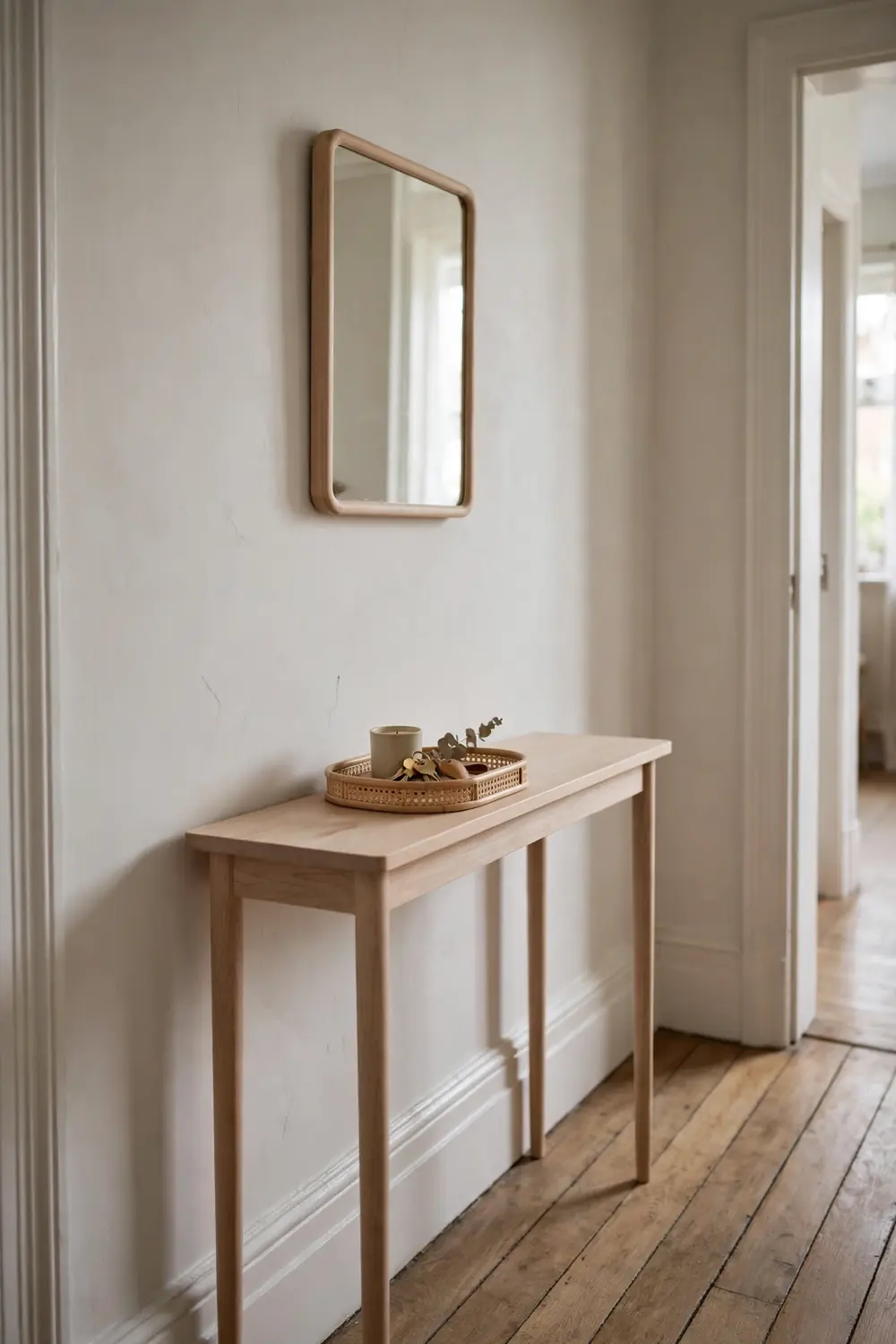
How do shoe cabinets fit without blocking the walkway?
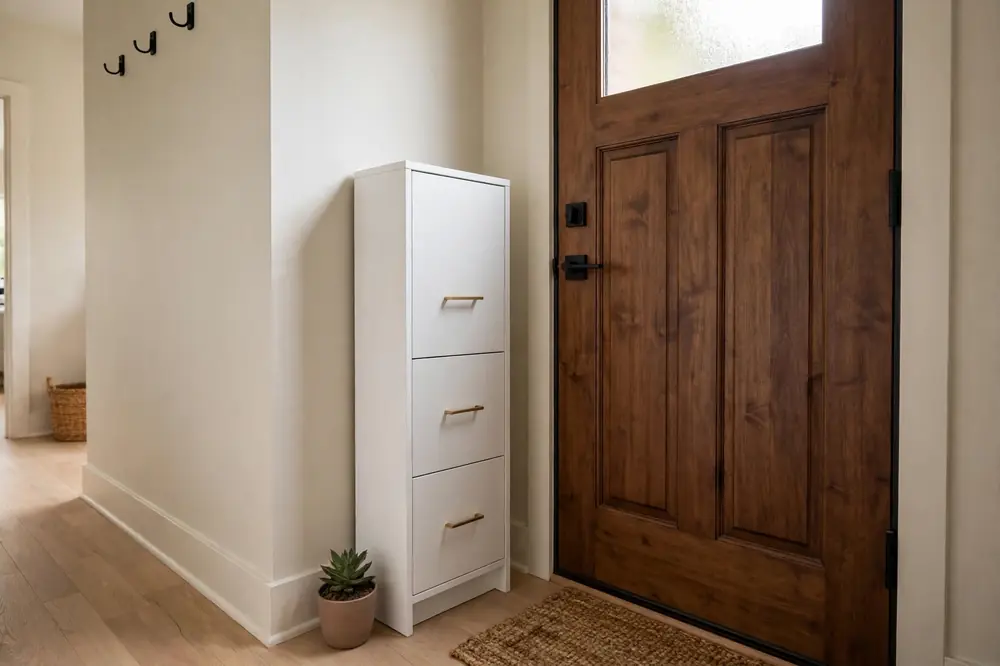
Shoe cabinets built for narrow halls are shallow on purpose. Tilt-out shoe cabinets usually run 8 to 10 inches deep, leaving a 36 inch hall with about 26 to 28 inches of walking space, so in a truly tight hall even a slim cabinet can be too much.
In a 42 inch or wider hall, a slim cabinet is the single best shoe fix, because it hides the mess behind closed doors and gives you a top surface for keys and mail. Put it near the door you actually enter through, not at the far end of the hall, or shoes will never make it inside. Count pairs before you buy: a two-tier tilt cabinet holds roughly 6 to 8 pairs, and a family that owns more needs a second spot, like a closet shelf, for the overflow.
I would buy the cabinet with the fewest visible seams in a color close to the wall paint, because a tall white box on a colored wall draws the eye and makes the hall feel narrower than it is. One honest admission: a tilt cabinet is not for tall boots. That kind of honest limit is what makes narrow hallway storage ideas useful instead of just pretty. Boots need a taller cabinet or a separate boot tray by the door, and forcing them into tilt slots bends the shafts and breaks the mechanism over time.
Where should coats, bags, and keys go in a narrow hallway?
Coats, bags, and keys each need a fixed home within reach of the door, or they end up on the floor and the hall fails. Hang coats on a peg rail or hooks at about 65 inches high, with a second row at about 43 inches for kids.
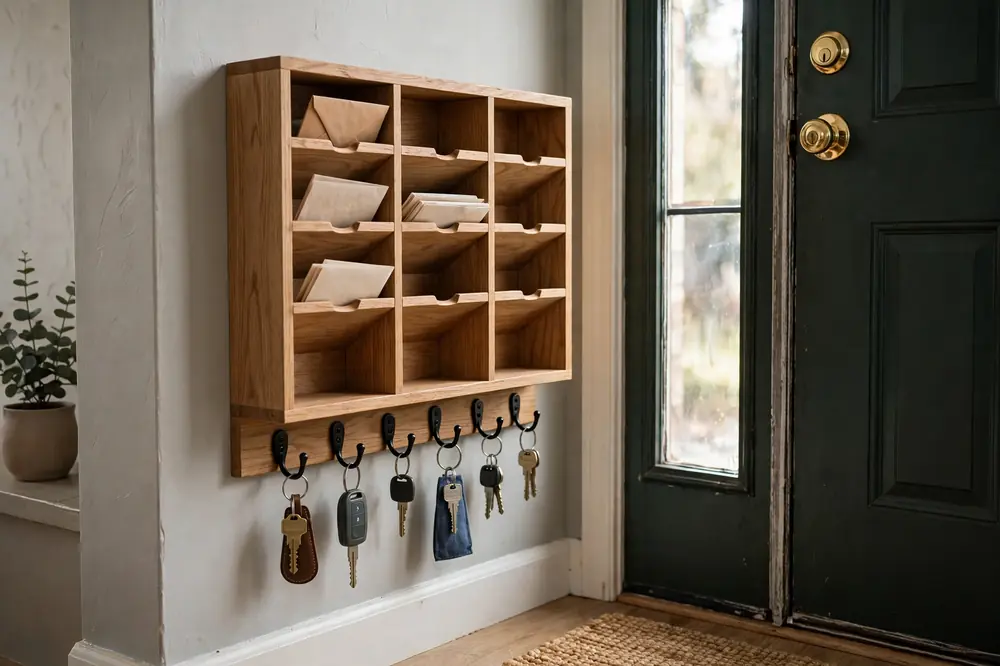
Space hooks 6 to 8 inches apart so coats do not bunch into one heavy clump. Bags go on a single sturdy hook at the end of the rail or on a wall hook by the door, never on the floor, because a bag on the floor trips people in a narrow space. Keys and mail belong in a small tray or a wall-mounted mail sorter right where you walk in, at hand height, so the drop becomes automatic. The sorter is worth it: loose mail on a console drifts into piles, while slots keep bills and school papers apart.
My opinion here is firm. If you can only install one thing in a narrow hall, install the hook rail, because coats are the bulkiest daily item and hooks solve them with zero floor space. This setup is not for a household that wants a spotless look, though. Open hooks are the trade-off at the center of most narrow hallway storage ideas. Open hooks show every coat and bag, and if that bothers you, a closed hall cabinet is the price you pay in inches.
For a full drop-zone plan at the door, see our entryway storage ideas for small spaces.
How do you use wall height without making the hallway feel closed in?
Wall height is free storage, but only if you use it in the right band. The band between 60 and 84 inches, above the hooks and below the ceiling, takes a shallow shelf or two for hats, gloves, and small baskets, and it costs no walking space at all.
Keep those shelves 6 to 8 inches deep, and keep the items on them light and few, because a loaded shelf above head height is a hazard. Above 84 inches, one high shelf works for seasonal gear you fetch a few times a year with a step stool. I would paint high shelves the wall color so they blend in, and never run shelves down both walls at once.
Two walls of shelving turn a hall into a tunnel, while one wall of storage and one clean wall keeps it feeling open. Tall, narrow cabinets belong in this same logic: a cabinet 12 to 14 inches deep and 72 inches tall holds a lot without eating floor length, but it must be fixed to the wall, because a tall slim cabinet tips easily. This approach is not for renters who cannot drill, and it is not for halls with low ceilings, where high shelves press down on the space instead of opening it up. Wall height is still one of the best narrow hallway storage ideas when the ceiling allows it.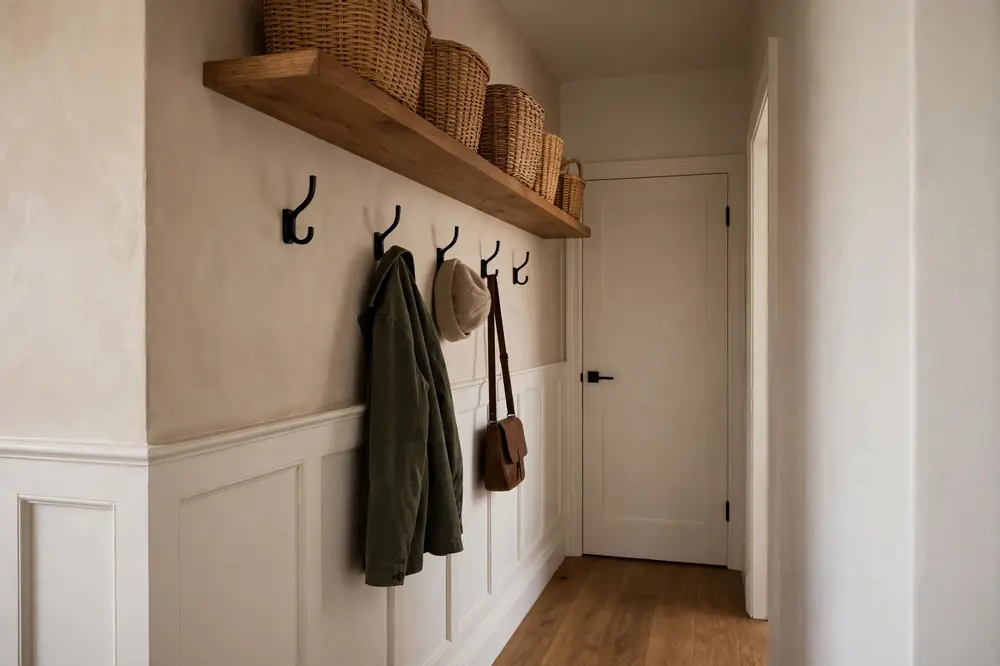
What works best for shoes when you have no floor space to spare?
When no floor space can be spared, shoes move to the wall or the door, full stop. A wall-mounted slatted rack or shallow shelves just above the baseboard keeps two or three daily pairs off the floor, sticking out only about 10 inches.
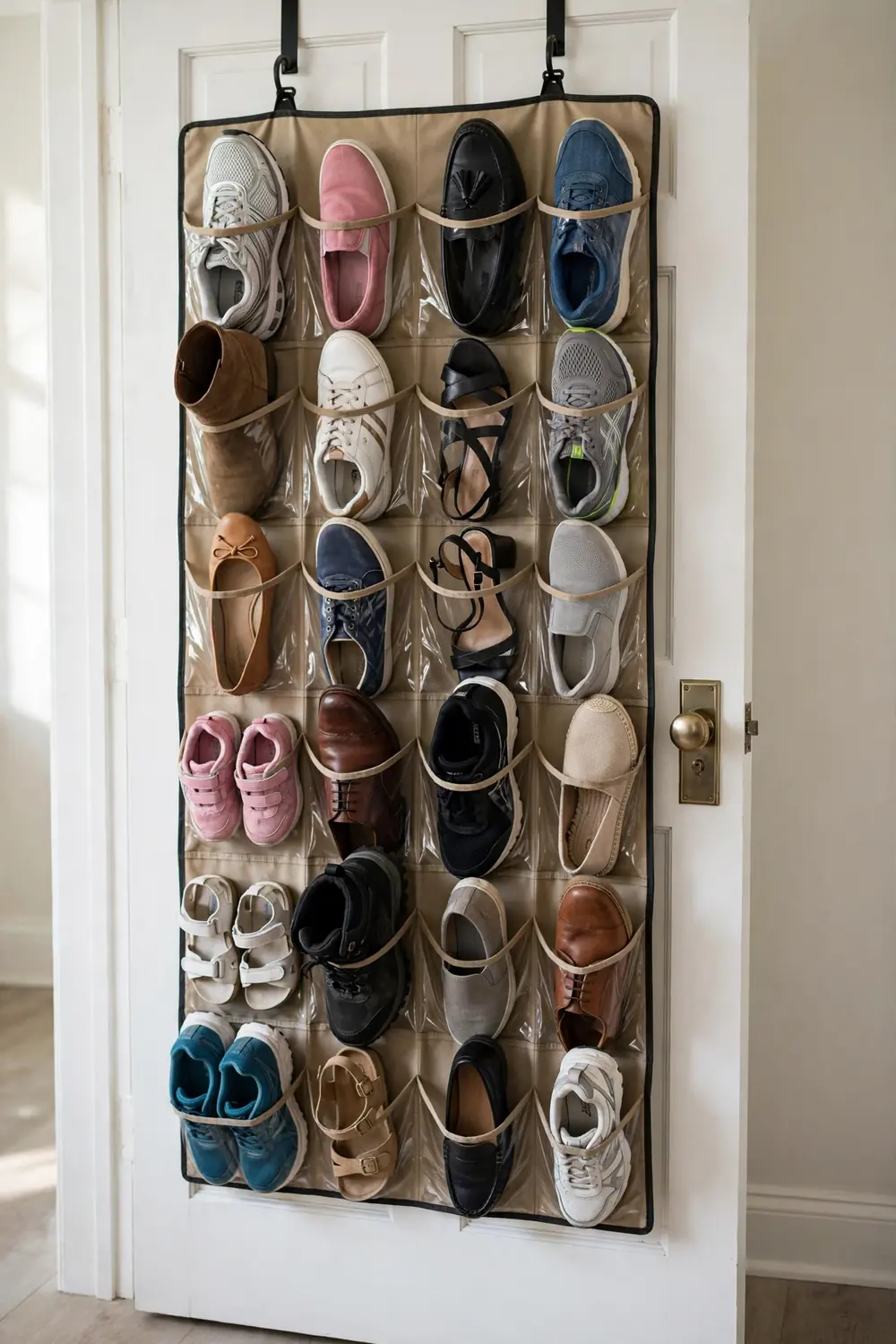
Over-door shoe organizers work on a bedroom or closet door off the hall and hold many pairs with zero hall space, but only fit doors that close fully with the organizer on, so check the gap at the top first. A pair of stackable wire baskets under a slim console is a third option for halls with a console already in place. My pick for the tightest halls is the wall-mounted rack, because it is cheap, it holds the pairs you actually wear, and it forces a useful rule: only today’s pairs live in the hall, and the rest live in the closet.
That rule is the real fix, not the rack. No rack survives a household that keeps ten pairs by the door. This is not a system for big families with many daily pairs, though. If four people each wear two pairs a day, wall storage alone will overflow, and you need a closed cabinet plus a closet plan instead of pretending a rack will hold it all.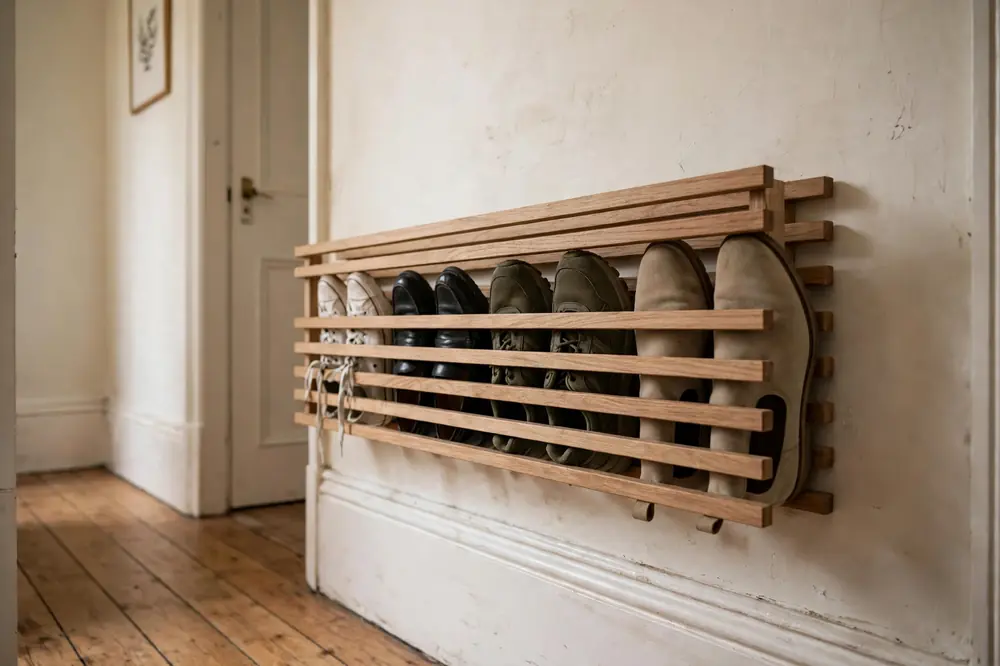
How do you store cleaning supplies and seasonal gear in a hallway?
Cleaning supplies and seasonal gear do not belong in the daily path, but a hall closet or a high shelf can hold them without blocking anyone. If your hall has a closet, zone it: daily coats and shoes at easy reach, cleaning supplies in a lidded bin on a middle shelf, seasonal gear up high.
A lidded bin matters, because cleaning bottles leak and a bin keeps a spill off coats and shoes. If there is no hall closet, a tall slim cabinet at the end of the hall, where foot traffic does not pass, can hold a broom, a mop, and a few bottles, as long as the cabinet is no more than 14 inches deep and fixed to the wall. Seasonal gear should rotate: winter gear lives in the hall from November to March, then moves to a bedroom closet, and summer gear takes its place.
I would keep one umbrella stand or wall hook by the door year round, because a dripping umbrella in a closet ruins what sits below it. This is not a plan for bulk storage. Narrow hallway storage ideas work only when bulk stays somewhere else. A hall is a bad place for a vacuum, a steam mop, or a case of paper towels, and those belong in a utility closet or a garage, not in a passage people use every day.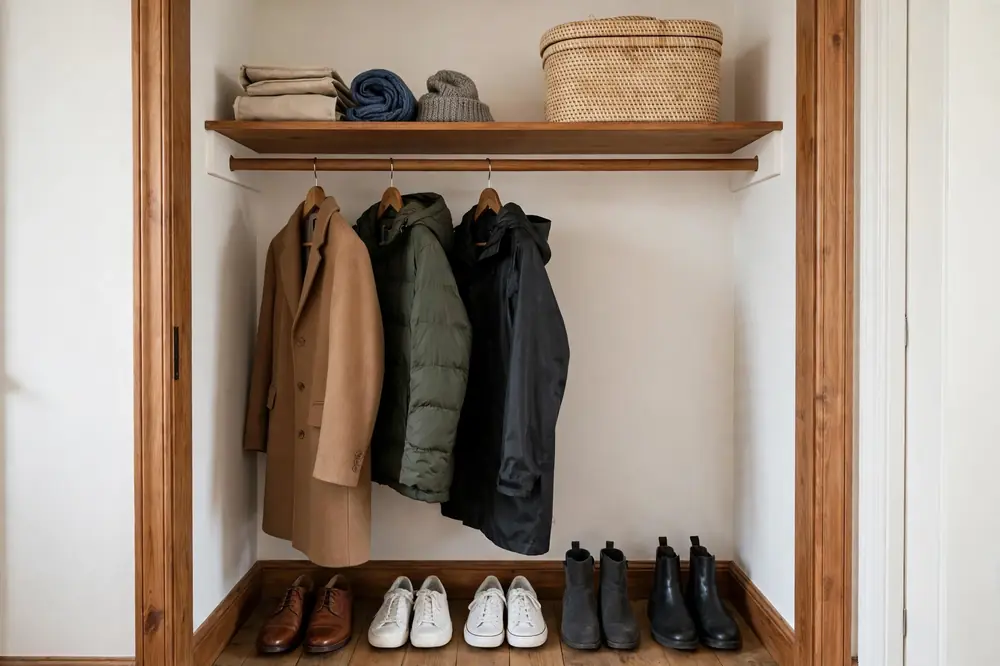
If your hall has a closet under the stairs, our under stairs storage ideas cover that awkward space in more detail.
Which renter-friendly hallway storage needs no drilling?
Renters can fix a narrow hall without drilling a single hole, and the best options need no landlord permission at all. A freestanding slim console or shoe cabinet works with zero wall damage, as long as it is shallow enough to keep the path clear.
Over-door hooks and over-door shoe organizers use a door that already exists, and they come off without a mark when you move out. A leaning full-length mirror needs no hardware, and a freestanding coat rack tucked in a corner holds coats when wall hooks are off limits, though it costs floor space a narrow hall can ill afford. Adhesive hooks hold light items like keys or a dog leash, but fail under heavy winter coats, so do not trust them with the load that matters.
Tension rods wedged between walls can hold a small shelf or curtain to hide a nook, but only where walls are solid and close enough to grip. My opinion is plain: if you rent, buy freestanding pieces you take with you, not hardware you leave behind. The trade-off is that freestanding pieces are always deeper and clumsier than wall-mounted ones, so a rented narrow hall will hold less than an owned one, and that is a fact to plan around, not a problem to fight with more furniture.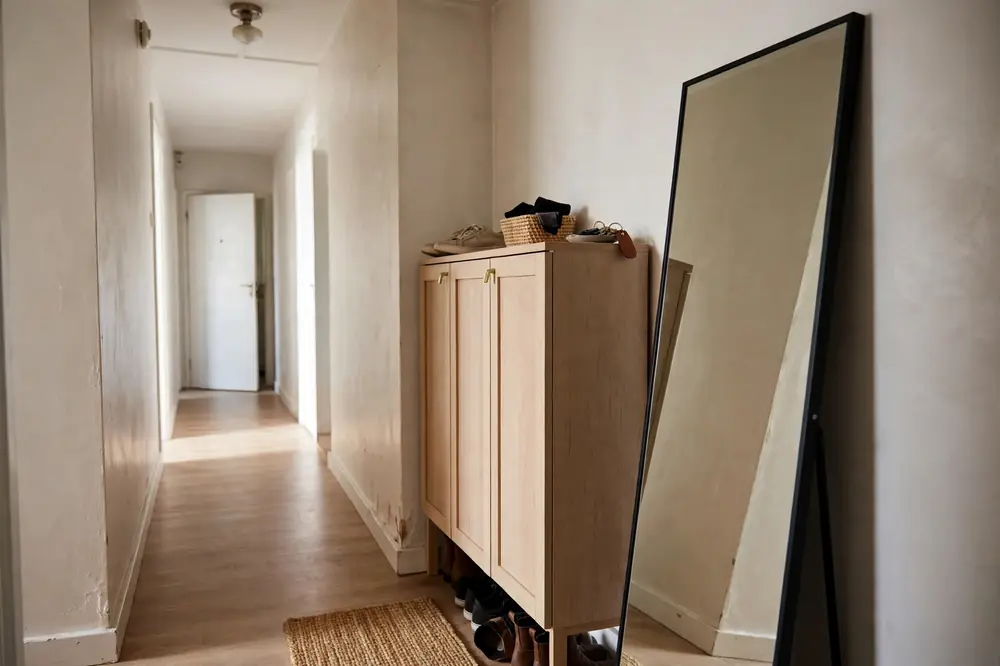
Renters in a one-room home can pair this with our studio apartment storage ideas for the rooms beyond the hall.
How do you keep a hallway bench from becoming a tripping hazard?
A bench only works when the hall is wide enough to hold it and the path still survives, so the math comes first. A bench 12 to 14 inches deep in a 48 inch hall leaves about 34 inches clear.
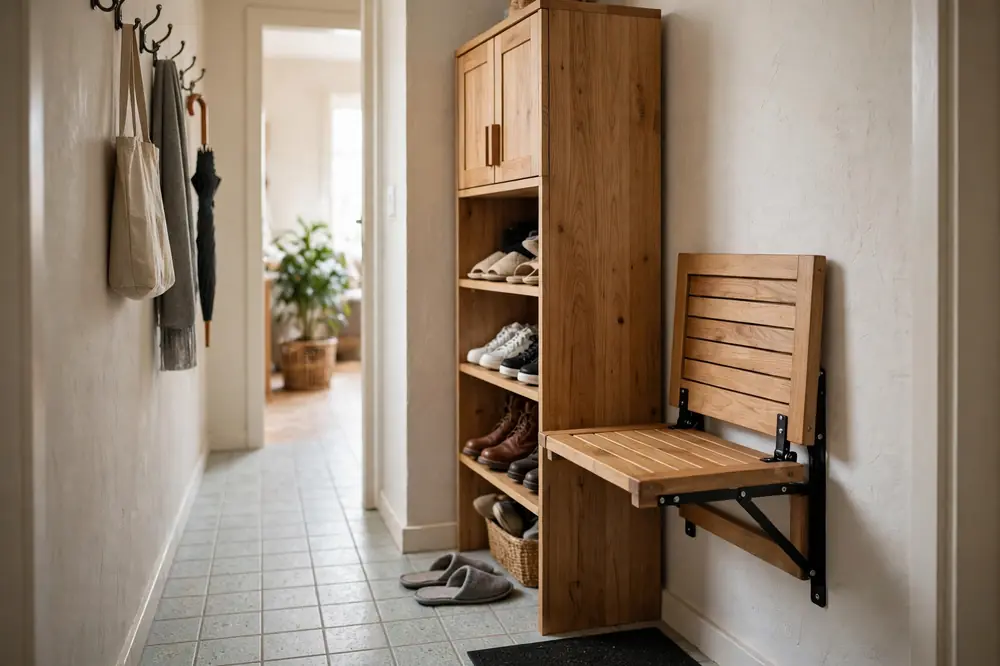
The same bench in a 36 inch hall leaves 22 to 24 inches, which is a squeeze, not a seat. If the numbers fail, skip the bench and use a fold-down wall seat, which folds flat and gives you a perch without a permanent footprint. Place the bench against the longest clear wall, never across from a door that swings into the hall, and never where it blocks the night path to bedrooms. Keep the top clear except for a cushion, and store shoes underneath in a basket or on a low shelf, not in a pile in front.
Shoes in front of a bench defeat it, because you trip over them while sitting down. I would pick a bench with open legs over a solid base: seeing floor beneath it keeps the hall feeling open. One clear admission: a bench is a luxury in a narrow hall, not a need. If space is tight, hooks and a shoe cabinet beat a bench every time, and a bench bought for looks becomes a clutter shelf within a month. Restraint is a narrow hallway storage ideas habit, not a purchase.Hall width Furniture depth allowed (30 inch clear target) What fits 36 inches 6 inches Wall hooks, shallow shelves, over-door storage only 42 inches 12 inches Slim console, tilt shoe cabinet, peg rail 48 inches 18 inches Console, shoe cabinet, narrow bench 54 inches and up 24 inches Bench, cabinet, console with room to spare
What makes a narrow hallway look wider while it holds more?
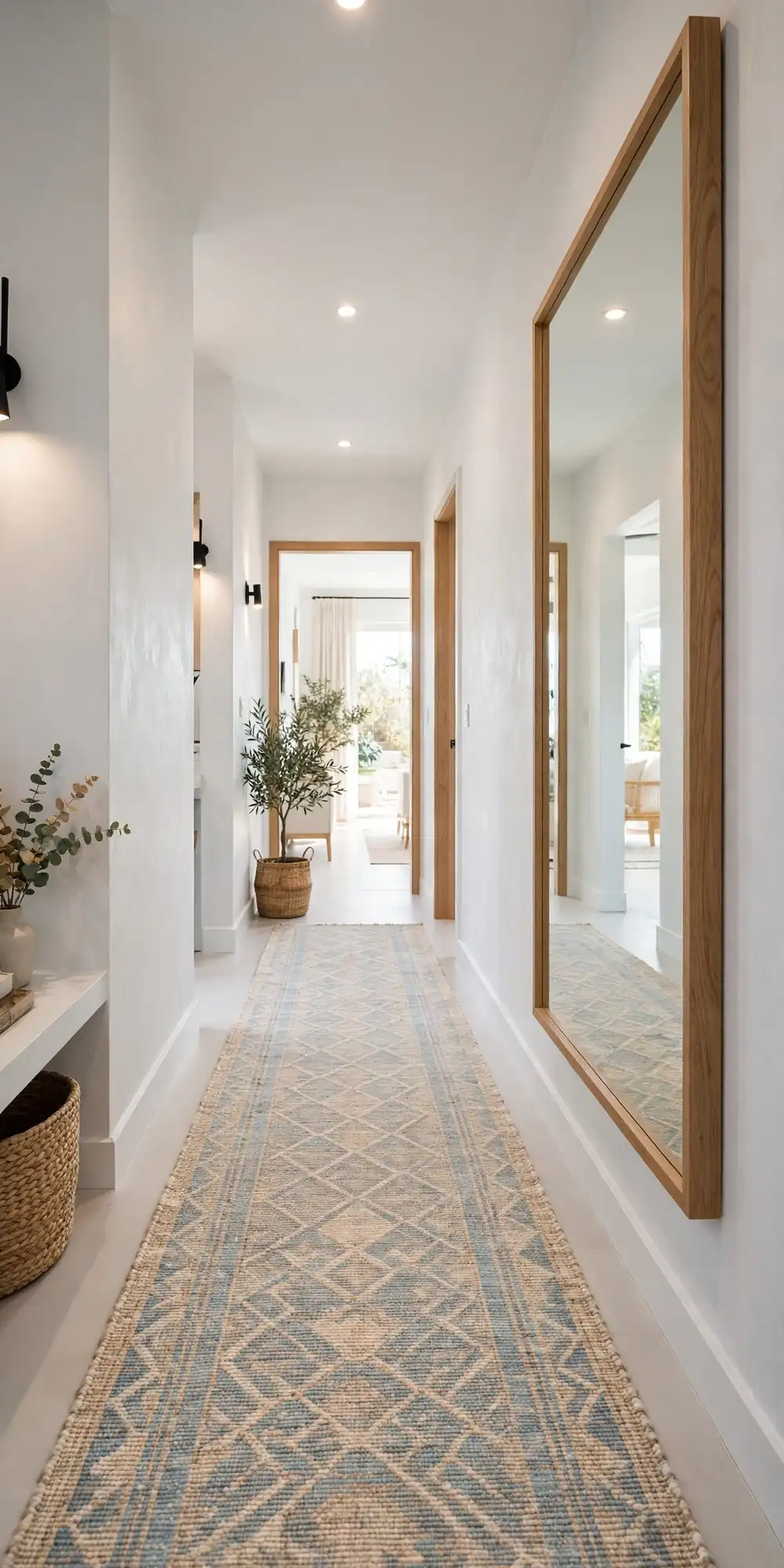
A narrow hall looks wider when the eye travels cleanly down its length, and storage helps that illusion when it stays low, light, and on one side. Paint walls and storage one light warm neutral, so cabinets blend instead of chopping the wall into blocks.
A large mirror on one wall bounces light and doubles the sense of depth, and works best across from a light source or near the door, not facing down the hall where it reflects the tunnel back at you. Run a runner rug lengthwise, not across, so its lines pull the eye toward the far end, and pick a flat rug that does not bunch underfoot. Lighting matters as much as furniture: one ceiling light plus a small wall light or console lamp beats a single harsh overhead bulb, because pools of warm light break the tube feeling. Keep the floor visible wherever you can, with open-legged pieces and no piles at the edges.
My take is that color and light do more than any new cabinet, and people who buy furniture before fixing dark paint and bad lighting waste money. Light and color are free narrow hallway storage ideas in the sense that they make the storage you have work harder. This look is not for halls that double as display space, though. Framed photos on both sides narrow the feel fast, so pick one wall for art and keep the other calm.
What should you skip in a narrow hallway, even if it looks good online?
Some pieces photograph well and fail in a real narrow hall, and skipping them saves money and bruised shins. Skip any console deeper than 14 inches in a hall under 48 inches wide, because the product photo hides how much path it eats.
Skip a full hall tree with bench, hooks, and cubbies unless your hall is at least 48 inches wide: hall trees run 16 to 20 inches deep and swallow a narrow passage whole. Skip open shoe racks that hold shoes in rows on the floor: they spread pairs outward and collect dust, while a closed cabinet hides the same pairs in less space. Skip a coat stand in a hall under 42 inches wide: its base spreads in all directions and its coats swing into the path.
Skip bulky floor baskets at the door: they migrate, tip, and trip people at night. I would also skip matching sets sold as a bundle: a set forces pieces into a hall with room for one of them, and spares end up in another room or in the way. The common thread is depth and spread: anything that sticks out far, spreads wide, or sits on the floor without a wall to anchor it is a bad fit for a narrow hall, no matter how many five-star reviews it has.Hall problem Best fit Depth it costs Skip instead Shoes by the door Tilt-out shoe cabinet 8 to 10 inches Open floor shoe rack Coats with no closet Peg rail with hooks 6 to 8 inches Freestanding coat stand Keys and mail pileup Wall mail sorter plus tray 2 to 4 inches Deep console drawers Nowhere to sit Fold-down wall seat 0 inches folded Full hall tree bench Seasonal overflow High wall shelf 6 to 8 inches Floor baskets and bins 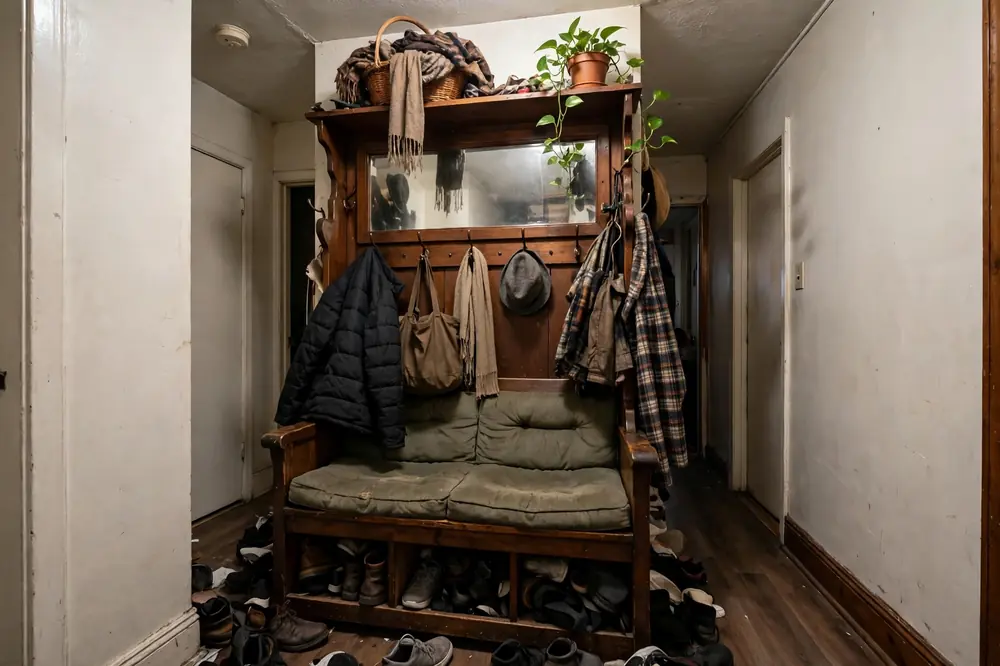
What should you buy first for a narrow hallway?
Buy in this order, and stop when the hall works: most narrow halls need three pieces, not ten. First, a peg rail with sturdy screws in studs, since coats are the biggest daily mess and hooks cost no floor space.
Second, a slim tilt-out shoe cabinet if your hall is 42 inches or wider, or a wall-mounted rack if it is not, since shoes are the second mess and must live behind something closed or flat to the wall. Third, a small tray or wall mail sorter by the door for keys and mail, since small items cause daily friction far beyond their size. After those three, live with the hall for two weeks before buying more. You may find you need no console at all, or that a mirror and better light fix more than furniture would.
If you still want a console, buy one 10 to 14 inches deep with open legs, and if you want seating, buy a fold-down seat before a bench. My judgment is that a narrow hall rewards restraint more than shopping: every piece you skip is walking space you keep, and a hall that feels easy to walk through stays tidy, because putting things away takes seconds when each item has one clear home. That is the whole point of narrow hallway storage ideas. Start with hooks, add shoes, then stop and see.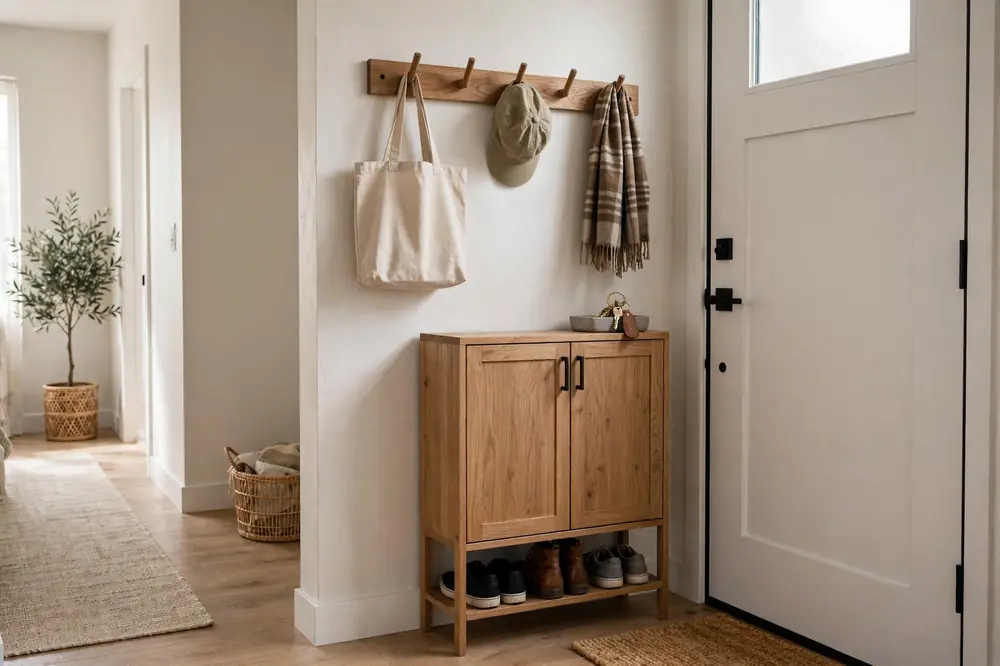
Small bedrooms off the hall benefit from the same shallow thinking in our small closet organization ideas.
How much clear space should a narrow hallway keep?
At least 30 inches at the narrowest point after furniture is in place, and 36 inches when the hall allows it, based on the International Residential Code minimum hallway width of 36 inches.
What depth console table fits a narrow hallway?
A console 10 to 14 inches deep fits most narrow halls. Standard consoles run 10 to 18 inches deep, so pick from the shallow end and check the spec sheet before ordering.
Can a shoe cabinet fit in a 36 inch hallway?
A tilt-out cabinet 8 to 10 inches deep leaves about 26 to 28 inches of walking space in a 36 inch hall, which is tight. In halls that narrow, wall-mounted shoe storage or an over-door organizer is often the better pick.
What is the best storage for a hallway with no closet?
A peg rail for coats, a slim shoe cabinet or wall rack for shoes, and a wall mail sorter for keys and mail. Those three cover daily gear with almost no floor space.
How do renters add hallway storage without drilling?
Freestanding slim cabinets, over-door hooks and shoe organizers, leaning mirrors, and adhesive hooks for light items all work with no holes in the wall.
Should you put shelves on both walls of a narrow hallway?
No. Shelving on both walls makes the hall feel like a tunnel. Keep storage on one wall and leave the other wall clean.
What hallway furniture should you avoid in a narrow space?
Consoles deeper than 14 inches, full hall trees, freestanding coat stands, open floor shoe racks, and floor baskets all eat walking space and cause trips.
How high should hallway coat hooks be?
About 65 inches for adults, with a second row at about 43 inches for kids. Space hooks 6 to 8 inches apart so coats do not bunch.
Where should a hallway bench go?
Against the longest clear wall, never across from a door that swings into the hall, and only when at least 30 inches of walking space remains after it is in place.
