
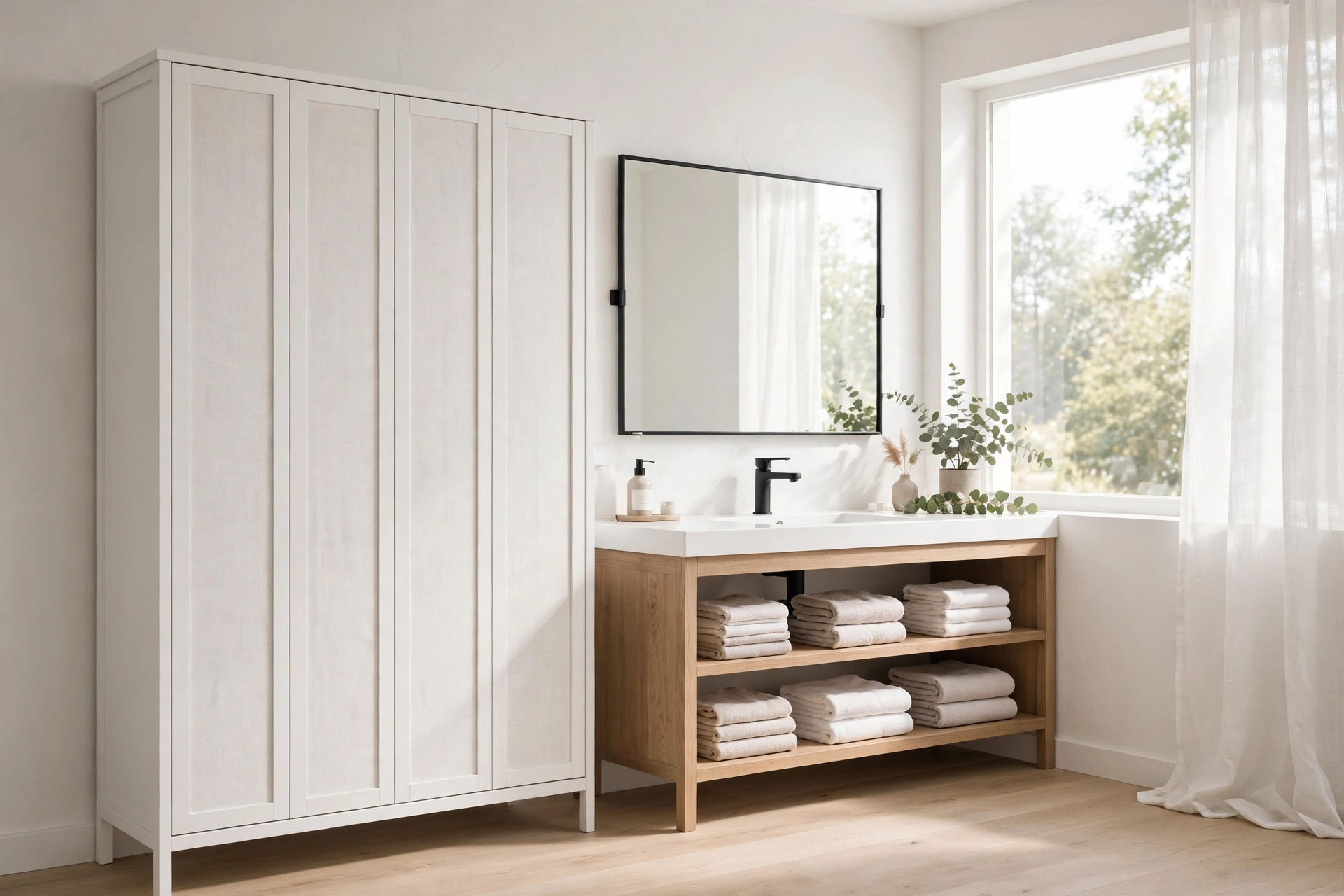

The best bathroom storage cabinet for your space comes down to three things: how much floor space you have, what you need to store, and your budget. A tall linen tower adds the most storage per square foot in small bathrooms, while a wall-mounted cabinet keeps your floor completely clear. Expect to spend $75–$300 for a quality freestanding or wall-mounted unit. This guide compares every type with real dimensions, honest pros and cons, and budget tiers — so you can buy once and buy right.
Let’s be honest — bathrooms turn into cluttered chaos zones faster than you can say “where’s my hairbrush?” If you’ve ever knocked over a tower of products reaching for your toothpaste, you already know a quality bathroom storage cabinet isn’t just nice to have. It’s essential.
The right cabinet transforms your morning routine from a frantic treasure hunt into a calm, organized experience. Whether you’re working with a sprawling master bath or a tiny powder room, there’s a solution that fits your space, style, and budget.
What Is the Best Bathroom Cabinet for Storage?
There is no single best bathroom storage cabinet — the right choice depends on your bathroom’s layout. Freestanding linen towers suit renters and small bathrooms, wall-mounted cabinets free up floor space, medicine cabinets double as mirrors, and vanity cabinets anchor a full remodel. The table below compares all seven types side by side so you can shortlist in seconds.
| Cabinet type | Best for | Typical size | Price range | Install difficulty |
|---|---|---|---|---|
| Freestanding linen tower | Small bathrooms, renters | 60–72″ H × 12–20″ W | $75–$200 | None — position and done |
| Wall-mounted cabinet | Tiny bathrooms, over-toilet | 24–30″ W × 8″ D | $100–$300 | Moderate — needs studs |
| Medicine cabinet | Small items, mirror replacement | 16–24″ W × 4–8″ D | $80–$400 | Moderate–hard if recessed |
| Vanity cabinet | Full remodels | 24–60″ W | $200–$600+ | Hard — involves plumbing |
| Over-toilet cabinet | Dead space above toilet | 24″ W × 8″ D × 24–30″ H | $60–$200 | Moderate |
| Corner cabinet | Awkward corners | Varies | $50–$150 | Easy–moderate |
| Slim/narrow cabinet | Gaps between fixtures | 8–12″ W | $60–$180 | None |
Freestanding Cabinets
A freestanding bathroom storage cabinet is the workhorse of bathroom storage. It sits directly on the floor with zero installation — unpack, position, done. That makes it perfect for renters or anyone who rearranges often. Popular styles include linen towers (tall and narrow), single-door cabinets, and wider console units with drawers.
One safety note: if your freestanding cabinet is tall and narrow, secure it to the wall with an anti-tip strap. This matters in homes with kids or in earthquake-prone areas — a loaded linen tower is top-heavy.
Wall-Mounted Cabinets
When floor space is tight, look up. Wall-mounted bathroom storage cabinets use vertical real estate while keeping floors clear for cleaning and foot traffic. They typically mount above the toilet or beside the vanity mirror. Installation needs basic tools and a comfort with drilling, but most homeowners finish in a weekend afternoon.
Medicine Cabinets
The classic medicine cabinet combines mirror and hidden storage — a two-for-one that’s worked for over a century. Modern versions go far beyond the basic metal box: soft-close doors, interior electrical outlets, LED lighting, and even defogging technology. Recessed models sit inside the wall cavity for zero footprint; surface-mounted ones install like a small wall cabinet.
Vanity Cabinets
Your vanity does double duty as sink support and storage powerhouse. Under-sink vanity cabinets range from simple open shelving to drawer systems with built-in organizers. If you’re renovating, a quality vanity with pull-out drawers and tiered organizers pays off daily. Look for models with built-in electrical strips for hair tools — the IKEA GODMORGON series is a well-designed example at an accessible price.
Over-Toilet and Corner Cabinets
Over-toilet cabinets turn the most wasted wall in the bathroom into enclosed storage. Standard units measure about 24 inches wide × 8 inches deep × 24–30 inches tall — sized to clear the tank below. Corner cabinets fit awkward angles that nothing else uses. Both are renter-friendlier than they look: many freestanding over-toilet units need no drilling at all.
What Are the Best Tall Bathroom Storage Cabinets?
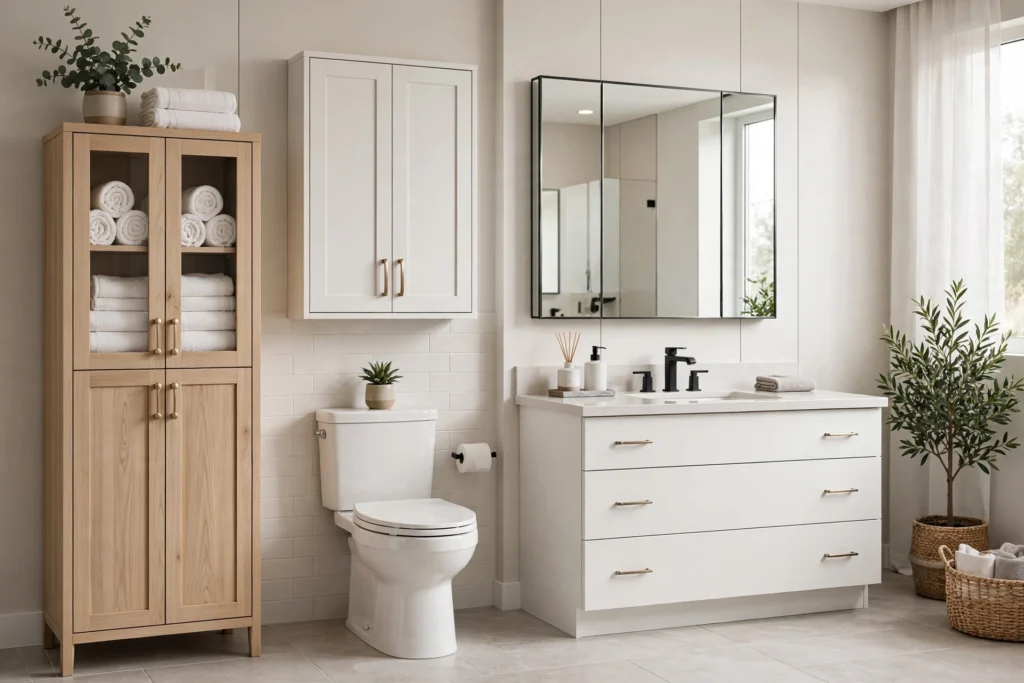
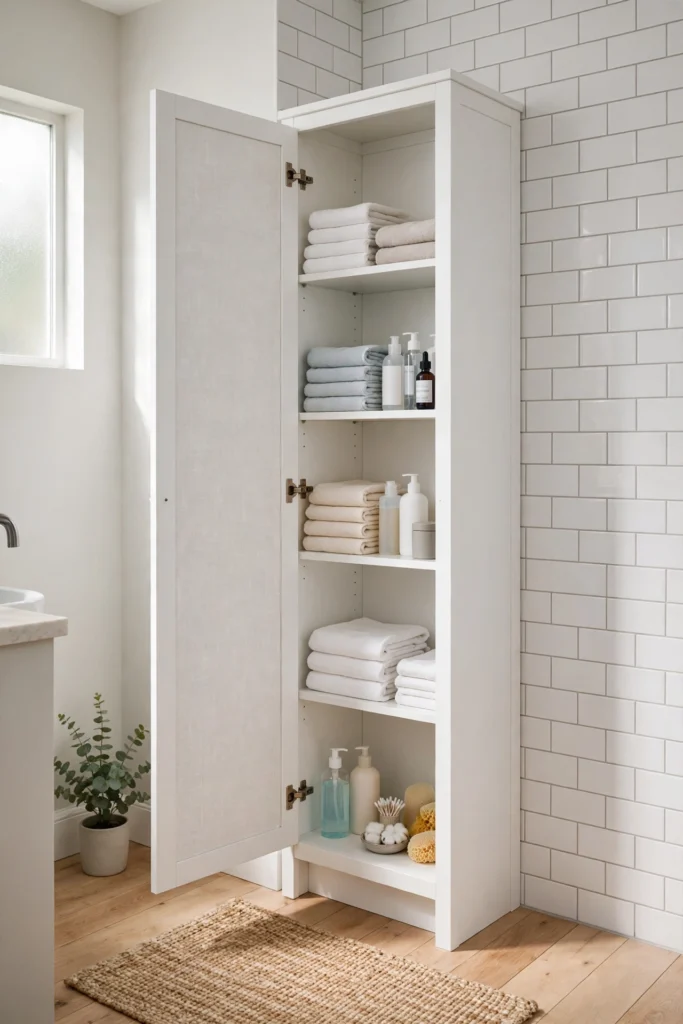
Tall bathroom storage cabinets — usually called linen towers — give you the most storage per square foot of any cabinet type. Standard towers measure 60–72 inches tall and just 12–20 inches wide, so they slide into corners and narrow gaps that would otherwise sit empty. Look for adjustable shelves, a depth under 14 inches so doors swing freely, and an anti-tip strap for safety.
Why towers win in small bathrooms: a single 15-inch-wide tower holds roughly the same as two wall cabinets but uses about one square foot of floor. If floor space is your constraint, a tall bathroom storage cabinet is usually the answer. That’s the entire storage equation for a powder room.
What to check before buying a tall cabinet:
- Height vs. ceiling: leave at least 2–3 inches above the unit for ventilation and easy positioning. Standard 8-foot ceilings fit any tower; low basement ceilings need measuring.
- Depth: 12–14 inches is the sweet spot. Deeper units hold more but make doors swing wide in tight bathrooms.
- Shelf adjustability: fixed shelves waste space on tall bottles. Adjustable shelves let you fit everything from cotton balls to full-size shampoo.
- Door style: solid doors hide clutter; glass doors look airy but demand tidiness.
- Tip safety: any tower over 60 inches tall should be strapped to the wall — most include the hardware in the box.
Renters love tall freestanding cabinets because they move with you. No holes, no patching, no lost deposit.
What Is the Best Small Bathroom Storage Cabinet?
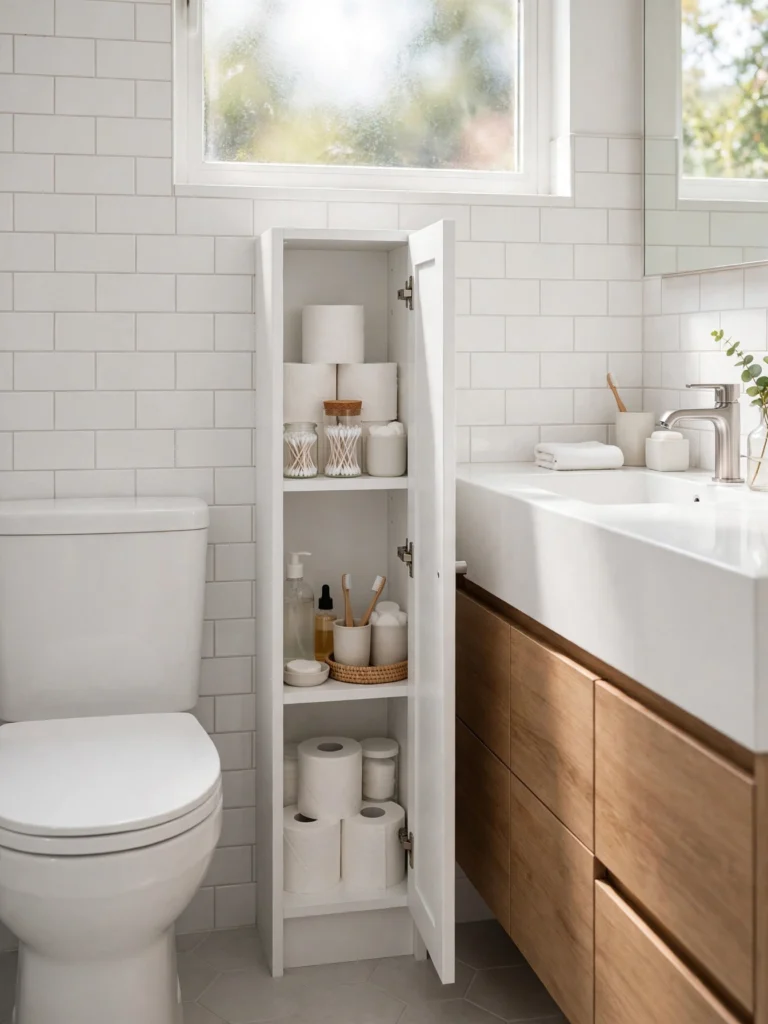
For a small bathroom, the best small bathroom storage cabinet is a slim bathroom storage cabinet (8–12 inches wide) that slides into the gap beside the toilet or vanity, or a wall-mounted cabinet above the toilet. Both add real storage without touching your floor space. Measure your gap first — slim cabinets come in 8, 10, and 12-inch widths, and buying blind is how you end up with a unit an inch too wide.
This is the section most guides skip, and it’s exactly what small bathroom owners search for. Here’s how to think about it:
- The toilet–vanity gap: that dead strip between fixtures is prime slim-cabinet territory. A 10-inch-wide rolling or stationary unit there holds cleaning supplies, backup toilet paper, and toiletries.
- Above the toilet: a wall-mounted or freestanding over-toilet cabinet adds enclosed storage to genuinely dead space. Keep the bottom of the cabinet at least 24 inches above the tank lid so you can sit comfortably and lift the lid for maintenance.
- Behind the door: a narrow wall cabinet on the wall behind the door swing uses space you’d never notice.
- What to avoid: deep cabinets (over 14 inches) in walkways — they’ll catch hips and elbows. And skip anything that blocks the bathroom door’s swing.
If your bathroom is truly tiny, pair one slim cabinet with a few of these bathroom storage ideas — wall hooks, a shower caddy, and an over-door organizer cover the rest without any furniture.
What Should You Measure Before Buying a Bathroom Cabinet?
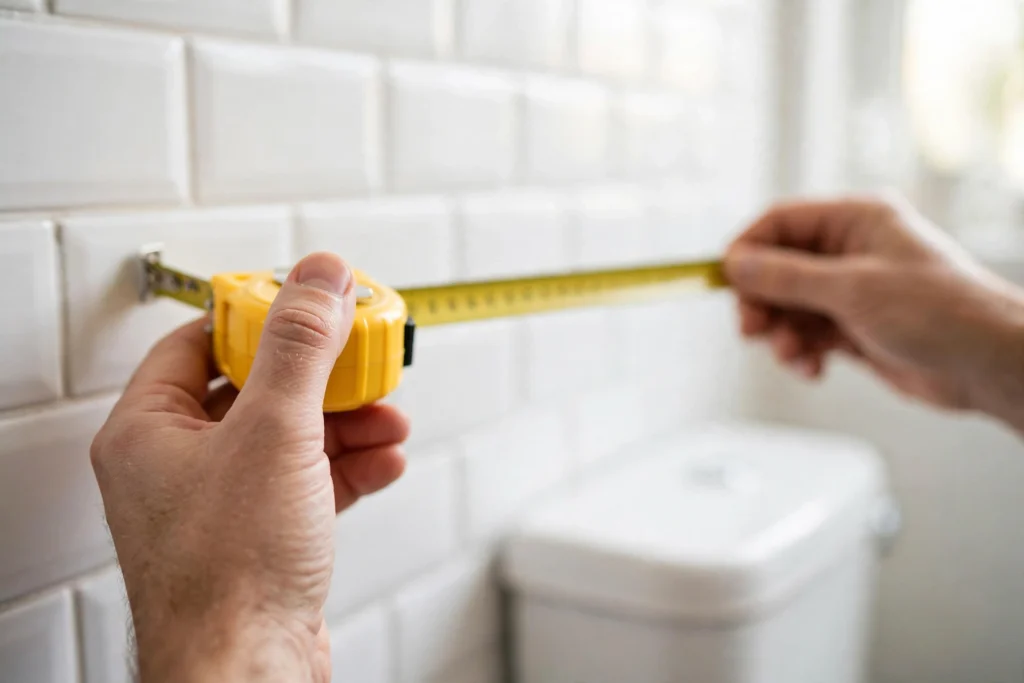
Before buying any bathroom storage cabinet, record five numbers: available floor space (width × depth), ceiling height, wall width for mounted units, door swing clearance, and the distance from the toilet tank lid to the cabinet bottom (keep 24 inches minimum). These five measurements prevent the number-one cabinet regret: a unit that’s an inch too wide for the spot.
Grab a tape measure and note each one:
- Floor space available — length and depth of the exact spot, not the general area.
- Ceiling height — for tall cabinets; note any soffits or sloped ceilings.
- Wall space — width and height for mounted options. For stud mounting, studs sit 16 inches apart (center to center) in most US homes — a stud finder confirms.
- Door swing clearance — both the bathroom door and the cabinet’s own doors. Open everything and check for collisions with light fixtures, towel bars, and the toilet paper holder before you drill.
- Distance from fixtures — toilet, sink, shower door. Over-toilet cabinets need that 24-inch minimum above the tank lid.
Write the numbers on your phone. You’ll use them while shopping, and they’ll save you from the most common (and most annoying) buying mistake.
Which Cabinet Material Survives a Humid Bathroom?
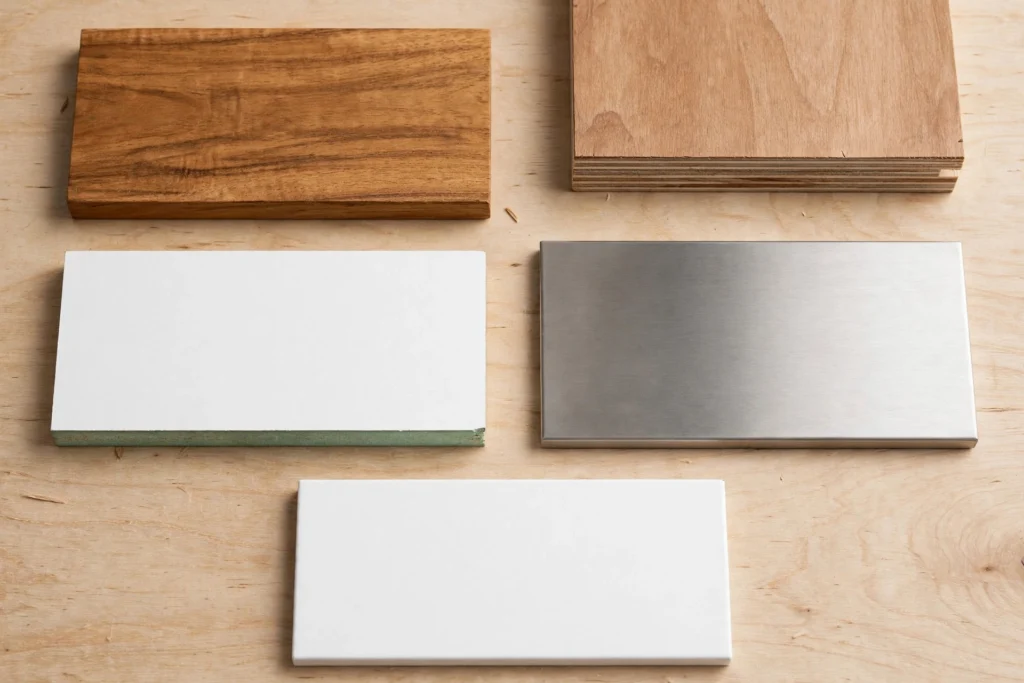
In humid bathrooms, the most durable bathroom storage cabinet materials are marine-grade plywood, PVC, and powder-coated metal — they resist warping, swelling, and rust far better than standard options. Solid wood works if properly sealed. Avoid raw particleboard entirely: it’s a moisture magnet that swells and falls apart. Here’s the honest breakdown:
| Material | Pros | Cons | Price tier |
|---|---|---|---|
| Solid wood (teak, oak) | Beautiful; very durable when sealed | Needs periodic resealing; can warp in steam | $$$ |
| Marine-grade plywood | Excellent moisture resistance; strong | Expensive; heavy | $$–$$$ |
| MR-MDF (moisture-resistant) | Affordable; stable; smooth painted finish | Swells if water gets into unsealed edges | $–$$ |
| PVC / plastic | Fully waterproof; cheapest option | Looks budget; less sturdy | $ |
| Metal (aluminum, stainless) | Handles humidity perfectly; modern look | Shows fingerprints; cold aesthetic | $$ |
A few practical notes from the table. Teak’s natural oils make it the most forgiving solid wood in steamy bathrooms — but you still need to seal it. MR-MDF (often identifiable by its green core) is the smart budget pick: it performs far better than standard MDF as long as edges stay sealed. And whatever material you choose, a working ventilation fan does more for cabinet lifespan than any material upgrade.
Match the material to your bathroom’s ventilation — and to your bathroom styling: warm woods suit earth-tone palettes, while powder-coated metal fits modern minimalist looks. No fan or window? Stick to PVC, metal, or marine-grade plywood. Good ventilation? Sealed wood and MR-MDF are perfectly fine.
How Much Should You Spend on a Bathroom Storage Cabinet?
A quality bathroom storage cabinet costs $75–$200 freestanding, $100–$300 wall-mounted, and $200–$600+ for a vanity with built-in storage. Custom built-ins run into the thousands. For most bathrooms, the $100–$200 sweet spot buys solid construction that lasts for years — spending less usually means replacing sooner, which costs more in the long run.
| Budget tier | What you get | Best for |
|---|---|---|
| $ — Under $75 | Basic over-toilet units, small wall cabinets; particleboard or thin MDF | Renters, tight budgets, temporary fixes |
| $$ — $75–$200 | Freestanding linen towers, quality wall cabinets; MR-MDF, sealed wood, metal | Most buyers — the sweet spot |
| $$$ — $200–$600+ | Vanities with organizers, premium brands, solid wood, soft-close hardware | Remodels and forever homes |
Think in cost-per-year, not sticker price. A $150 linen tower that lasts eight years costs under $19 a year. A $60 particleboard unit that swells and gets replaced in two years costs $30 a year — and the hassle of shopping twice.
Where the money actually goes: hardware quality (hinges and drawer slides fail first on cheap units), moisture-resistant materials, and finish durability. A mid-range cabinet with soft-close hinges will feel premium every single day; a cheap cabinet with creaky doors will annoy you every single day.
How Do You Install a Wall-Mounted Bathroom Cabinet?
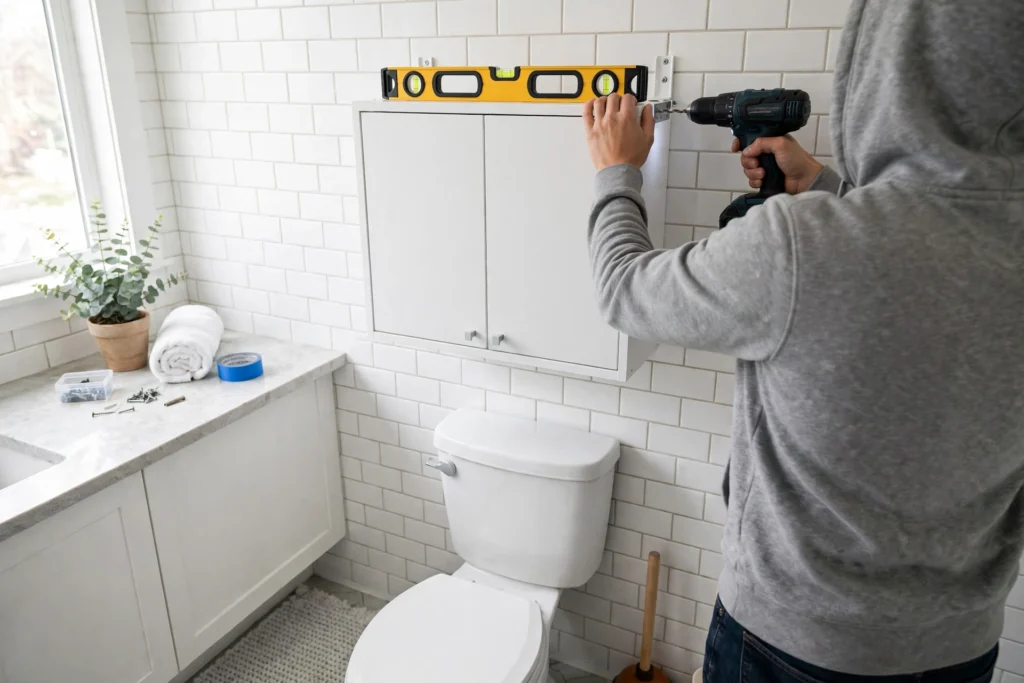
To install a wall-mounted bathroom storage cabinet: locate studs with a stud finder, mark the position with a level, pre-drill into the studs (or use wall anchors rated for the cabinet’s loaded weight), attach the mounting rail or brackets, hang the cabinet, and verify it’s level. Most installs take under an hour — and the critical step is hitting studs, because a loaded cabinet is far too heavy for drywall alone.
Step by step:
- Locate wall studs with a stud finder. Stud mounting gives the strongest hold by far.
- Mark the cabinet position on the wall, using a level for straight lines.
- Pre-drill holes into the studs, or install appropriate wall anchors for your wall type.
- Attach mounting brackets (if your cabinet uses them) or drive screws through the cabinet’s mounting rail.
- Hang the cabinet, check for level, and make final adjustments.
- Reattach shelves and doors if you removed them for installation.
Two pro tips. First, before drilling, hold the cabinet in position and swing every door and drawer open — make sure nothing hits light fixtures, towel bars, or the toilet paper holder. Adjusting placement now is free; patching holes later isn’t. Second, tile walls need tile drill bits and a slow hand to avoid cracking — and always check for pipes or wiring behind the tile. When in doubt, an hour of a handyman’s time is money well spent. (Lowe’s publishes a solid step-by-step installation walkthrough if you want a second reference.)
How Do You Organize Inside a Bathroom Cabinet?
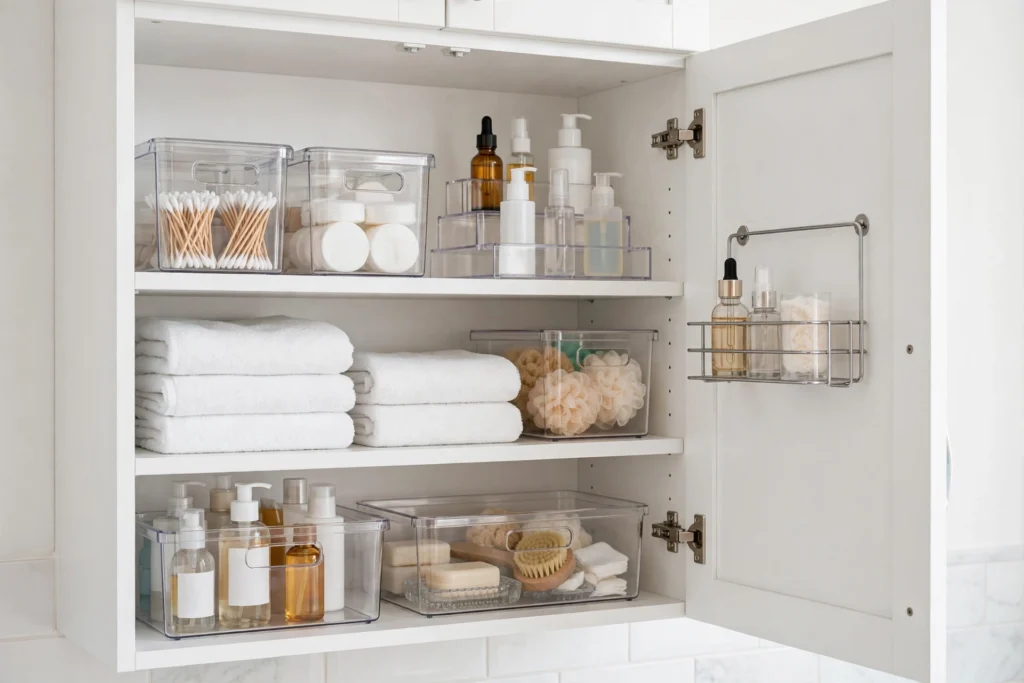
Organize a bathroom cabinet by usage zones: daily essentials at eye level and within easy reach, occasional-use items higher or lower, and bulk backups in the hardest-to-reach spots. Add shelf risers, stackable bathroom storage baskets, and door-mounted racks to roughly double your usable space — and leave doors slightly ajar after steamy showers so moisture escapes instead of turning musty.
The system that actually sticks:
- Shelf risers and tiered organizers — create a second level inside deep shelves so small bottles don’t vanish behind tall ones. These are the highest-impact bathroom storage shelves you can add for under $20.
- Stackable bins — group by category (hair, skin, first aid, cleaning) so every shelf has a visible zone.
- Door-mounted racks — the inside of the cabinet door is free real estate for sprays, brushes, and small bins.
- Pull-out baskets — bring the back of deep cabinets to you instead of requiring blind reaching.
- Labels — it feels excessive until the first time someone else puts things back correctly. Frequently used items in front, bulk supplies in back or up high.
Frequently Asked Questions About Bathroom Storage Cabinets
What is a tall bathroom cabinet called?
A tall, narrow bathroom cabinet is usually called a linen tower (or tower cabinet). Standard towers measure 60–72 inches tall and 12–20 inches wide, designed to store towels, toiletries, and cleaning supplies in a single square foot of floor space.
What can I use instead of a bathroom cabinet?
If a dedicated bathroom cabinet storage unit isn’t an option, open floating shelves, slim rolling carts, over-door organizers, and shower caddies all replace a cabinet’s function without the furniture. These bathroom storage ideas work especially well for renters who can’t — or don’t want to — install anything permanent.
What are the best bathroom cabinets for small bathrooms?
The best small bathroom storage cabinet is a slim freestanding unit (8–12 inches wide) that fits beside the toilet or vanity, or a wall-mounted cabinet above the toilet. Both give small bathrooms real storage without using floor space. Measure your gaps before shopping — an inch makes the difference between a perfect fit and a return.
What’s the best material for bathroom storage cabinets in humid climates?
In consistently humid environments, prioritize moisture-resistant materials like marine-grade plywood, PVC, or powder-coated metal. Solid wood works if properly sealed with a waterproof finish, but needs more maintenance. Avoid particleboard — it’s a moisture magnet that swells and falls apart.
How much should I budget for a quality bathroom cabinet?
Expect $75–$200 for a decent freestanding cabinet, $100–$300 for a quality wall-mounted unit, and $200–$600+ for a vanity with storage. Custom or premium options run into the thousands. Cabinets last for years, so cost-per-year usually favors the mid-range sweet spot.
Can I install a wall-mounted cabinet if I have tile walls?
Absolutely, but you’ll need tile drill bits and appropriate wall anchors. Go slowly when drilling through tile to avoid cracking, and always check for pipes or electrical lines behind the tile. If you’re uncertain, hiring a professional for an hour is money well spent.
How do I prevent my bathroom cabinet from smelling musty?
Ensure proper ventilation, keep items dry before storing, use moisture absorbers, and clean cabinet interiors monthly. For persistent odor, a small bowl of baking soda or activated charcoal left inside works wonders. Also check for hidden mold if the smell persists despite your efforts.
Final Thoughts on Choosing Your Bathroom Storage Cabinet
Choosing the right bathroom storage cabinet doesn’t have to be overwhelming. Start with honest measurements, think carefully about what you actually need to store, and pick the type that fits your space — a tall linen tower for maximum storage per square foot, a slim unit for tight gaps, or a wall-mounted cabinet to keep floors clear.
Whether you opt for a budget-friendly freestanding piece or invest in quality built-ins, the goal stays the same: a bathroom that works for your life. No more digging through cluttered shelves. No more knocking over products. Just calm, organized mornings.
Ready to start? Grab that tape measure, note your five numbers, and shortlist from the comparison table above. Your future self — the one who knows exactly where the nail clippers are — will thank you.
