
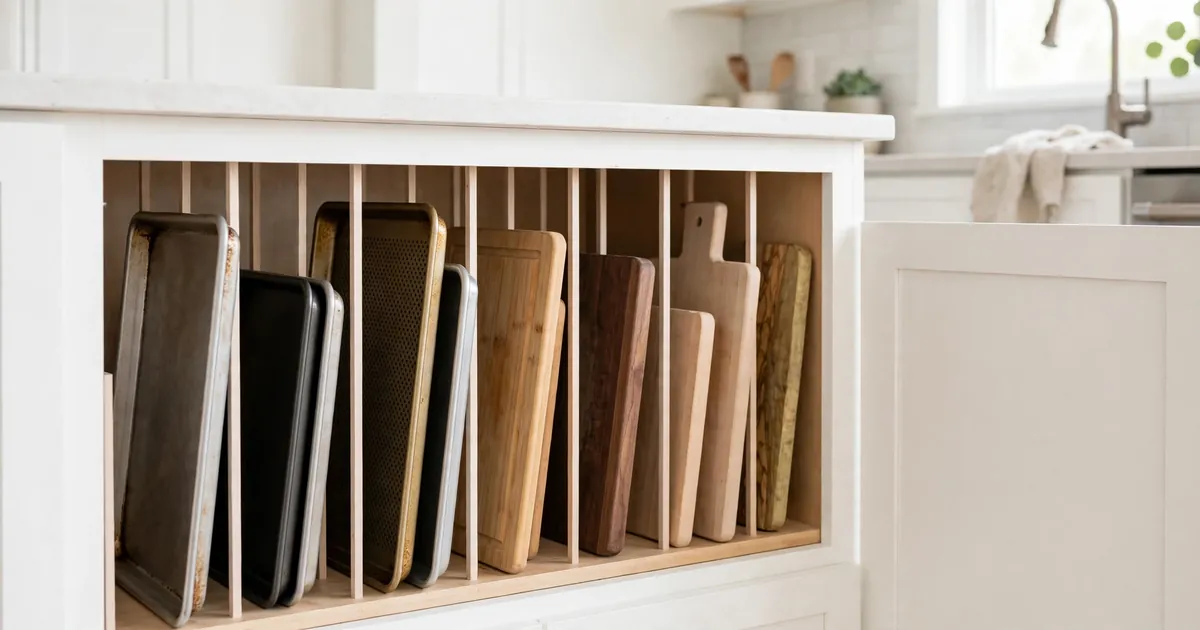

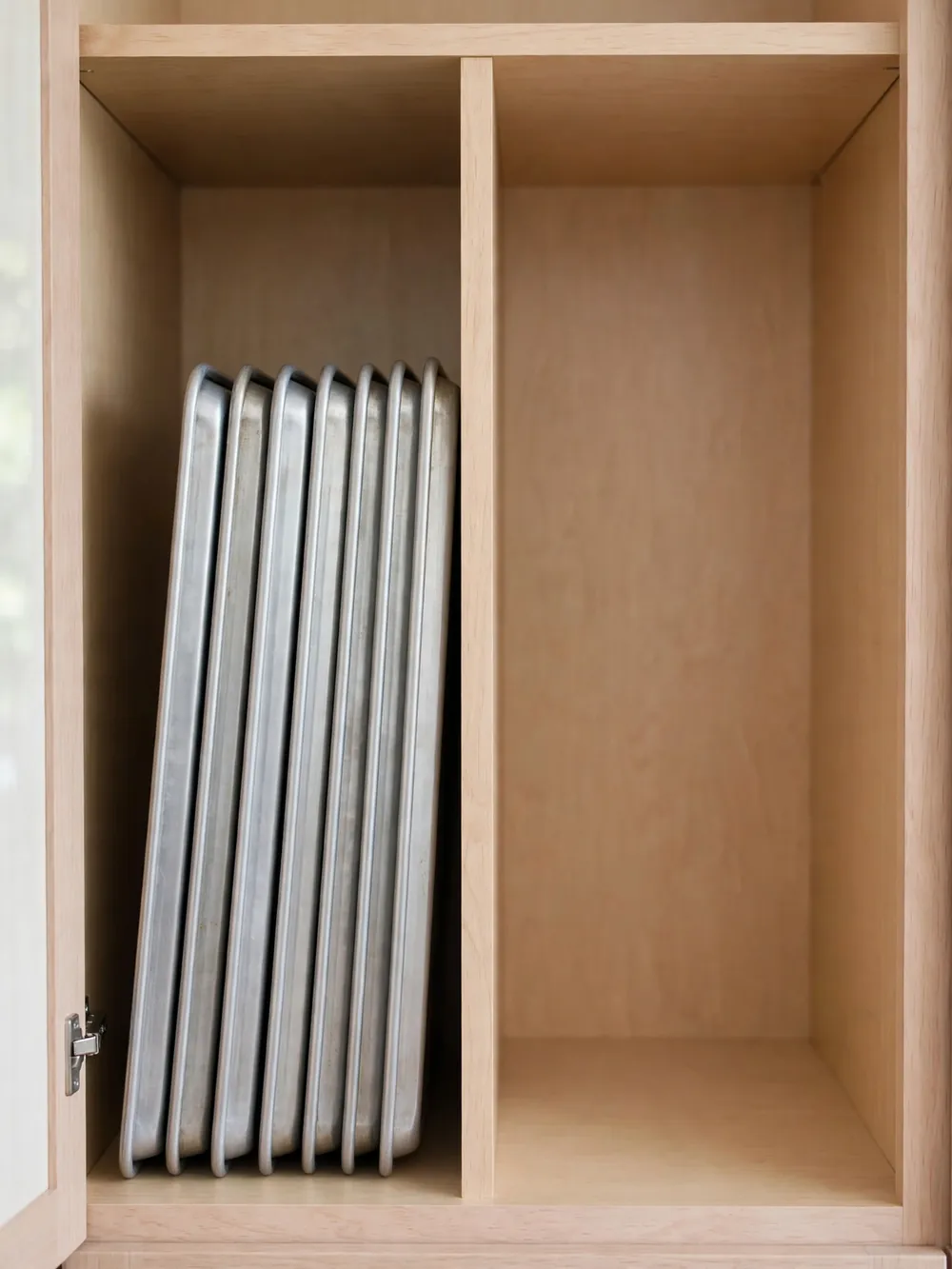
Learning how to store baking sheets and cutting boards upright, filing them like books on a shelf, ends the pileup in one move. Each piece gets its own slot, so you pull out the one pan you need without lifting five others, and nothing slides off the stack onto your feet. The whole system rests on two measurements: the size of your pans and the inside of your cabinet. Get those right, and a cheap divider or a pair of tension rods does the rest.
- File pans and boards upright in slots, one piece per slot, instead of stacking them flat.
- A half sheet pan measures 18 by 13 inches, so it needs about 19 inches of clear height and 14 inches of depth when filed upright.
- Base cabinets fit half sheets upright. Standard wall cabinets, at 12 inches deep, do not.
- Keep heavy wood boards in wide slots near the cabinet walls, and light pans in narrow slots in the middle.
- Start with one divider in the cabinet you already open most. Add a second spot only if that one fills up.
Why do baking sheets and cutting boards end up in a pile?
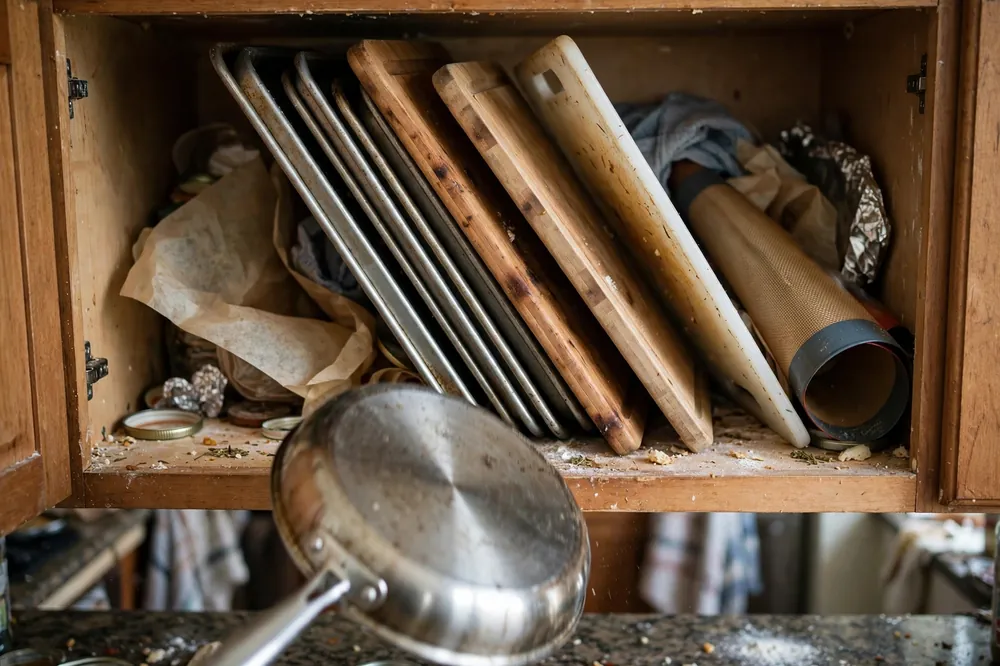
They end up in a pile because flat stacking rewards the last thing you put down and punishes everything under it. You slide a clean sheet on top of the stack, and the next time you need the pan at the bottom, you lift the whole pile, set it on the counter, pull your pan out, and restack the rest. Most people skip the restack. The pile drifts, a cooling rack wedges sideways, and soon the cabinet holds a leaning tower that falls forward every time the door opens. Store sheets on their sides and you learn how to store baking sheets and cutting boards upright without a cabinet remodel.
Upright storage breaks that cycle because nothing sits on top of anything else. A pan filed on its edge has no load above it, and a board in its own slot cannot trap the board behind it. You can see every edge at once, like book spines, so you grab the right piece on the first try. The trade is simple and worth naming: upright storage uses height instead of floor area. If two cooks share the kitchen, agree on the slots, as how to store baking sheets and cutting boards upright only works when both use it.
If your cabinet has a fixed middle shelf that chops the height in half, upright filing may not fit there, and you will need a different cabinet or a different plan for that shelf. That is a measurement problem, not a reason to keep stacking. A magazine holder fits half sheets well, and that is how to store baking sheets and cutting boards upright without new hardware.
What sizes are you actually storing?
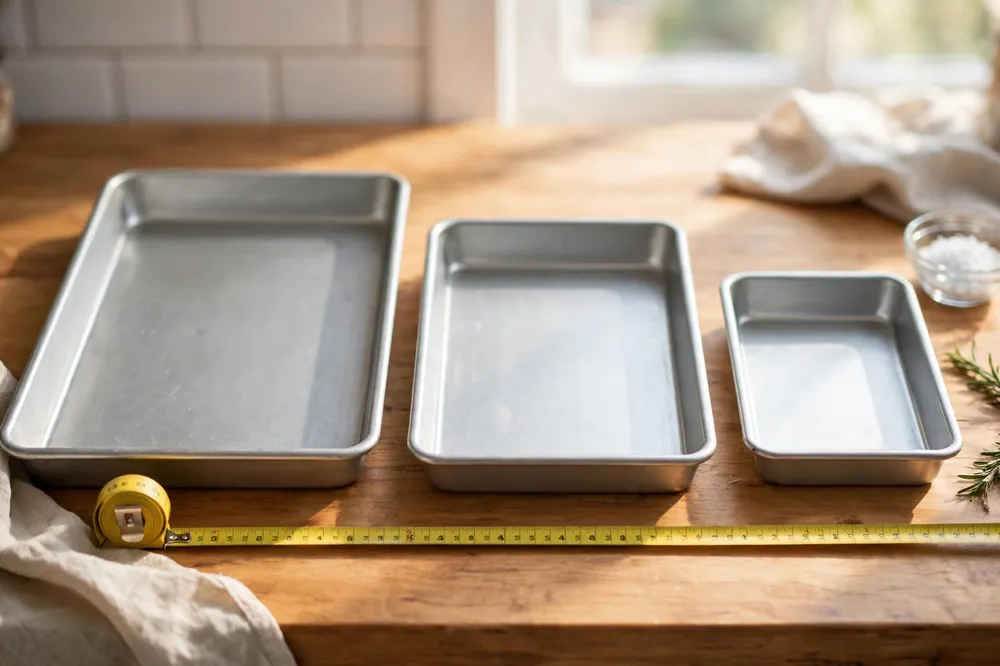
You cannot pick a divider until you know what you own, and pan names hide real sizes. Nordic Ware lists its half sheet pan at 18 by 13 inches, its quarter sheet pan at 9 by 13 inches, and its full sheet pan at 18 by 26 inches. The quarter sheet guide from the same company notes that a quarter sheet pan has raised edges about 1 inch high. A vertical divider turns a deep cabinet into order, which is how to store baking sheets and cutting boards upright on a budget.
A half sheet filed upright, standing on its short side, rises 18 inches tall and runs 13 inches front to back. Add an inch of clearance at the top and at the front, and you need about 19 inches of clear height and 14 inches of depth. A full sheet, at 18 by 26 inches, rises 18 inches tall but runs 26 inches front to back, which is deeper than any standard kitchen cabinet. Small kitchens gain the most, since how to store baking sheets and cutting boards upright frees a whole flat shelf.
That pan lives somewhere else, and this guide says so plainly rather than pretending a divider will fix it. Tension rods cost little and work well, so that is how to store baking sheets and cutting boards upright in a rental kitchen.
Measure your boards the same way, height and width and thickness, because a board that is 18 inches tall will not fit a cabinet with 17 inches of clear height, no matter how good the divider is. Measure the tallest board first, because how to store baking sheets and cutting boards upright starts with the cabinet height.
| Pan | Size, per Nordic Ware | Height filed upright | Depth filed upright |
|---|---|---|---|
| Quarter sheet | 9 by 13 inches | 13 inches | 9 inches |
| Half sheet | 18 by 13 inches | 18 inches | 13 inches |
| Full sheet | 18 by 26 inches | 26 inches front to back | Does not fit a standard cabinet |
| Jelly roll | 10.5 by 15.5 inches | 15.5 inches | 10.5 inches |
How do you measure your cabinet before you buy anything?
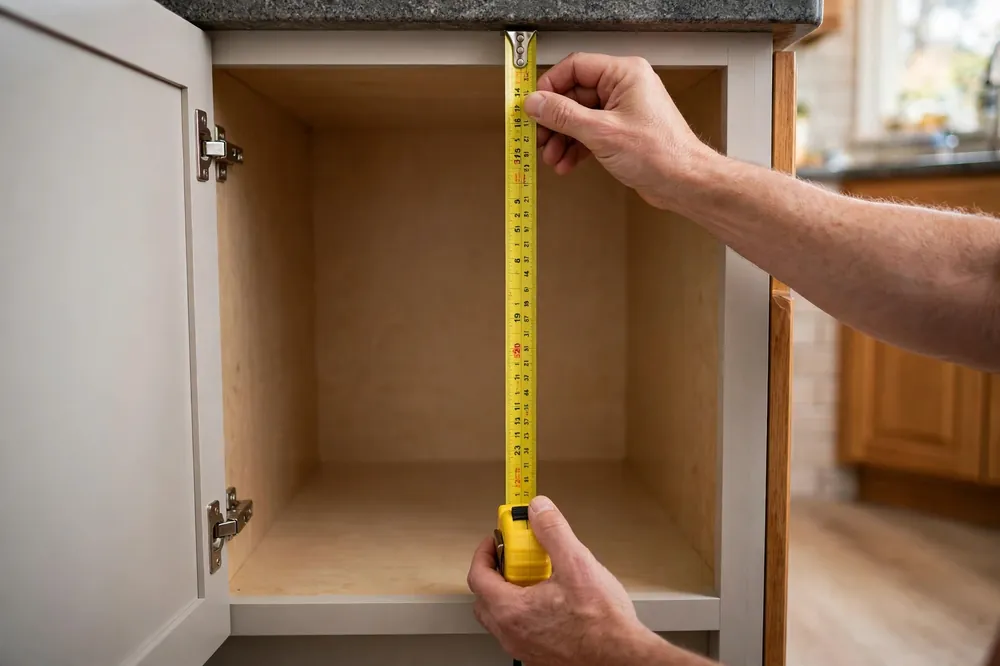
You measure three things, and you do it with the cabinet empty. First, measure the clear height from the cabinet floor to the underside of the next shelf or the cabinet top. A fixed shelf, a shelf pin, or a hinge plate can steal an inch, so measure at the exact spot, not at the door opening. Second, measure the inside depth from the back wall to the inside of the door frame, and subtract an inch so pans slide in without catching the door. Third, measure the inside width, and subtract the width of any pipe, hinge, or drawer slide that intrudes.
The Spruce cabinet guide lists standard base cabinets at 24 inches deep and 34.5 inches high as a box, toe kick included, and standard wall cabinets at 12 inches deep with heights of 30, 36, or 42 inches. Those are box sizes, not inside sizes. Your inside height will be a few inches less once you count the cabinet floor, the top rail, and any shelf. Test the fit with the biggest pan first, as how to store baking sheets and cutting boards upright is decided by one measurement.
That gap is why a half sheet that looks like it should fit a 30 inch wall cabinet often does not: the pan needs 19 inches of height, which fits, but it also needs 14 inches of depth, and a 12 inch deep wall cabinet cannot give it. In the end, how to store baking sheets and cutting boards upright comes down to vertical slots, dry boards, and daily reach.
Which spot in the kitchen works best for upright storage?
The best spot is the base cabinet you already open when you cook, usually the one beside the oven or under the counter near your prep area. Base cabinets win for two reasons: they are deep enough for half sheets, and they sit at a height where you can slide a pan out without lifting it over your head. Lids and boards need separate slots, and that is how to store baking sheets and cutting boards upright without scratching.
Wall cabinets are the wrong home for half sheets, as the last section showed, but they can hold quarter sheets, small boards, and muffin tins filed upright, since those need less depth. A deep drawer can work if the drawer is tall enough and you add dividers that keep pans from sliding when the drawer moves, but most kitchen drawers are too shallow for an 18 inch tall pan. Baking sheets bend when piled flat, so how to store baking sheets and cutting boards upright protects the pans you own.
The drawer in my own kitchen holds cutting boards flat, and that is fine, because boards used daily earn a flat drawer near the prep area while pans live upright in the base cabinet. My opinion here is firm: pick one home for pans and one home for boards, and stop splitting either group across three cabinets. Two homes you remember beat five homes you forget. A rack by the oven saves steps, and that is how to store baking sheets and cutting boards upright where you actually cook.
| Cabinet type | Depth, per The Spruce guide | Fits half sheets upright? | Fits quarter sheets upright? |
|---|---|---|---|
| Base cabinet | 24 inches | Yes, with room to spare | Yes |
| Wall cabinet | 12 inches | No, needs 14 inches | Yes, needs about 10 inches |
| Tall pantry cabinet | 24 inches | Yes, if a shelf clears 19 inches | Yes |
| Standard drawer | Varies, often too shallow | Usually no | Sometimes, if the drawer is tall |
How do vertical dividers work, and which type fits your cabinet?
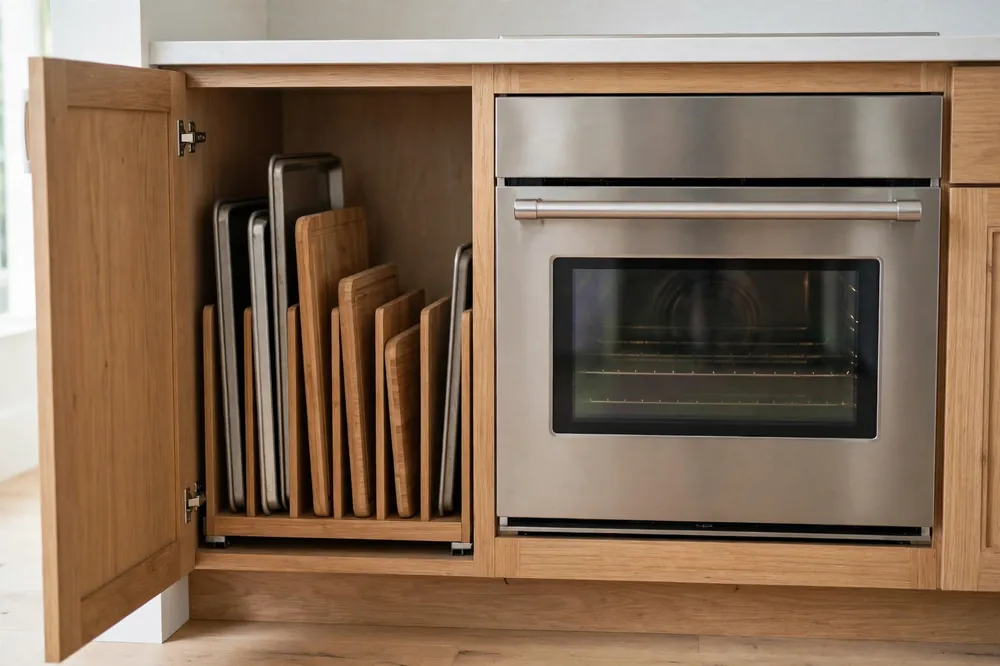
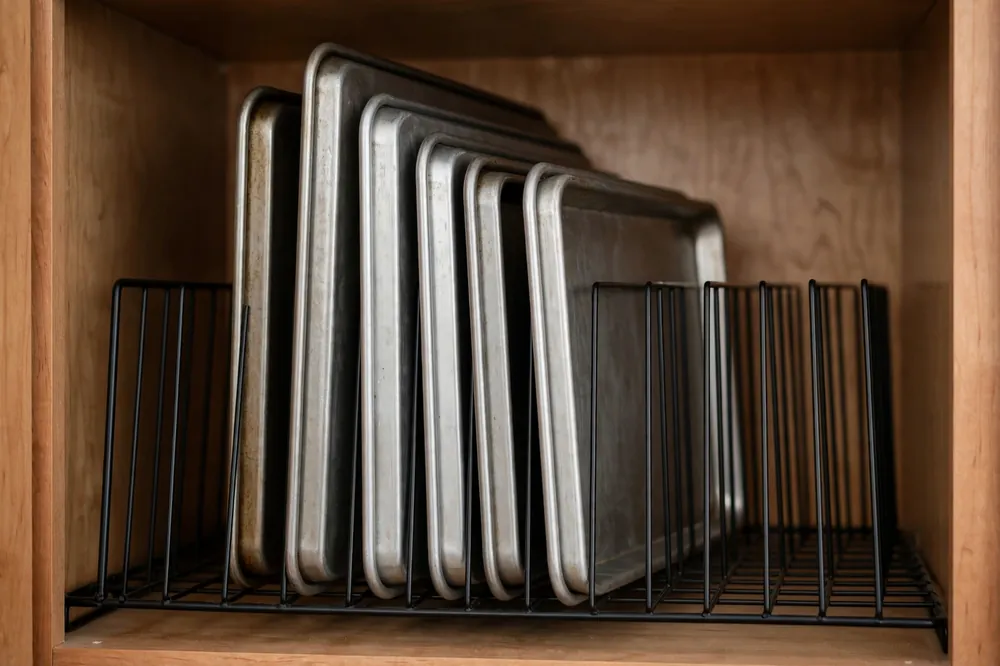
A vertical divider is just a set of slots that hold flat things on edge. The slots do three jobs: they stop pans from leaning on each other, they give each pan a gap wide enough to grip, and they keep the whole row from sliding when you pull one piece out. The divider types differ in how they do those jobs, and the right one depends on your cabinet, not on which product photo looks nicest. A narrow pull-out beats a wide shelf here, which is how to store baking sheets and cutting boards upright in small kitchens.
Wire racks are the cheapest start. They drop into a cabinet with no tools, and their slots run about 1 to 1.5 inches wide, which suits thin aluminum sheets. Wood dividers cost more and hold up better under heavy boards, because a wood slot does not bend when a thick board leans on it. Adjustable dividers, with pegs or sliding panels, fit odd cabinet widths, but their moving parts can shift over time, so check them every few months. If the cabinet is shallow, try the pantry end, as how to store baking sheets and cutting boards upright fits any tall narrow slot.
I would buy a wire rack first in a rental, a wood divider first in a home you own, and a pull-out only when you are already remodeling that cabinet. This is not a system for pans stored above a hot oven with no clearance, since heat and steam age wood dividers and warp thin wire over time. Label the slots by size and see how to store baking sheets and cutting boards upright stops the daily dig for the right pan.
Does the tension rod trick actually hold up?
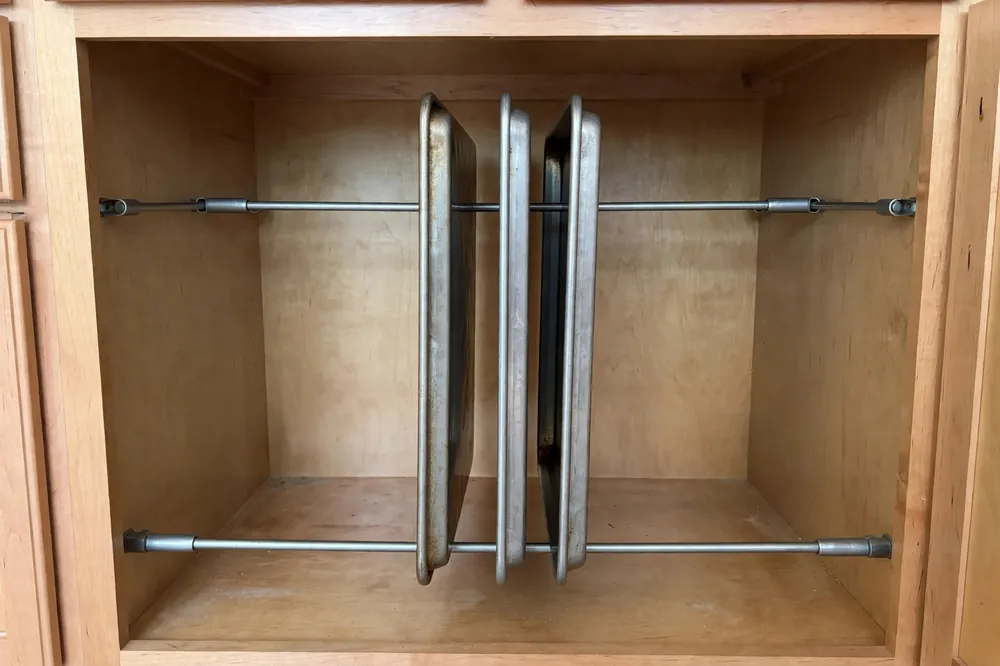
The tension rod trick works, and it has one clear limit. You wedge two spring-loaded rods across a cabinet, front to back or side to side, and the rods act as dividers that pans lean against. For light aluminum sheets and thin plastic boards, it works well. The rods grip the cabinet walls, the pans stand between them, and you can move a rod in seconds when your collection changes. Keep daily pans near the front, since how to store baking sheets and cutting boards upright should save time, not add steps.
The limit is weight and sideways force. A heavy wood board leaning on a tension rod can push the rod out of place, especially if the cabinet walls are smooth laminate with little grip. Rods also sag over a wide span, so a rod stretched across a 36 inch cabinet holds less than the same rod across an 18 inch cabinet. My rule is plain: use tension rods for sheets and thin boards only, keep the span under 24 inches, and put a small rubber grip pad under each rod end if the wall feels slick.
If your boards are thick hardwood, skip the rods and buy a wood divider that screws or wedges into place. A rod that falls at midnight, with a clatter of pans, is not a storage system. It is a prank you play on yourself. Clean the divider monthly, since crumbs collect fast, and that is how to store baking sheets and cutting boards upright without odors.
How do you store cutting boards with baking sheets without scratching everything?
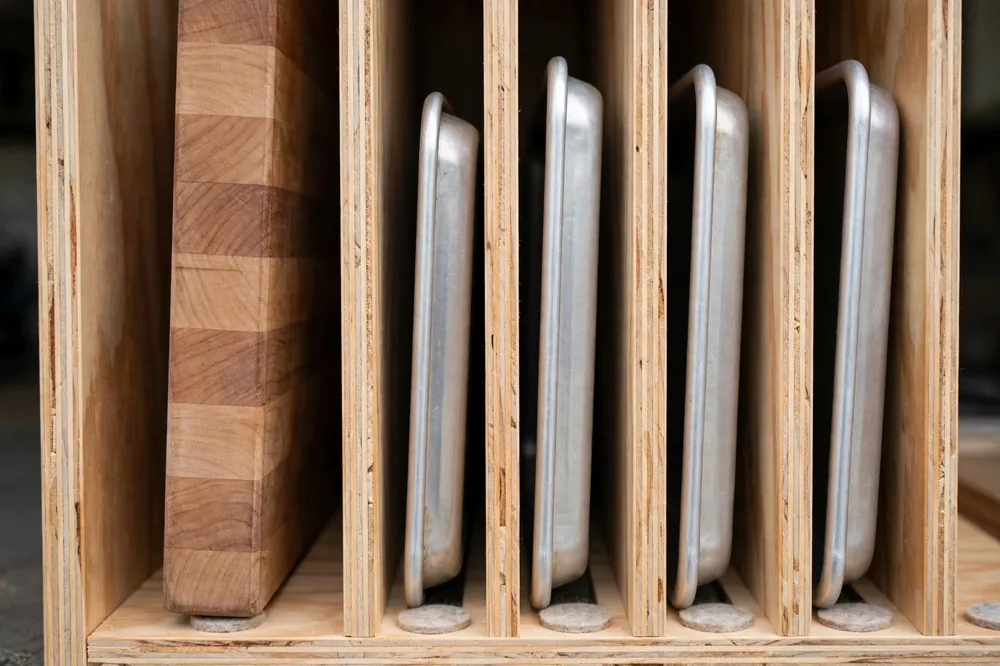
You store them together by giving each material its own slot width and its own place in the row, and by never letting a rough edge rest against a coated surface. Thin aluminum sheets need narrow slots, about 1 to 1.5 inches wide, so they stand straight and do not lean. Thick wood and bamboo boards need slots 2 to 3 inches wide, or they wedge tight and you have to yank them out, which scrapes the board beside them. Wooden boards warp when stacked wet, so how to store baking sheets and cutting boards upright means drying them first.
Order the row by weight and by how often you use each piece. Put heavy wood boards near the cabinet walls, where the divider or the wall braces them, and light pans in the middle, where you can reach them without moving a heavy board first. Put the board you use every day at the front of the row, not buried behind the roasting pan you use twice a year. Renters can skip screws here, because how to store baking sheets and cutting boards upright works with tension rods alone.
If a nonstick sheet must share a cabinet with a rough wood board, slip a silicone baking mat or a sheet of parchment between them, or give the nonstick pan a slot of its own with felt pads on the divider. A slot that is a little too wide, with a soft pad, beats a slot that is a little too tight, every time. Group by use, not by brand, since how to store baking sheets and cutting boards upright is about grabbing the right one fast.
What about muffin tins, cooling racks, and pizza pans?
Muffin tins, cooling racks, and pizza pans fit the same system, but each one needs a small adjustment. Muffin tins are lumpy. Their cups stick out on one side, so a tin filed upright needs a wider slot than a flat sheet, about 2 to 3 inches, and it should sit at the end of the row where its cups do not press into a flat pan. If you file two muffin tins face to face, cups against cups, they nest a little and take less room, but they also stick together, so pull them apart slowly.
Cooling racks are thin and springy, and they are the pieces most likely to slide out of a slot and clatter. File them beside their matching sheet, one rack per slot, and never stack three racks in one slot, because the top rack will spring free when you pull the bottom one. Round pizza pans are the awkward case. Store lids behind the boards, because how to store baking sheets and cutting boards upright keeps matching sets together.
A 16 inch round pan filed upright rises 16 inches tall and needs a slot wide enough for its rim, and it rolls forward if the slot is too loose. Give round pans the end slot, where the cabinet wall stops the roll, or store them flat on top of a low shelf if your cabinet has one. A pull-out tray beats a fixed shelf here, so how to store baking sheets and cutting boards upright stays reachable at the back.
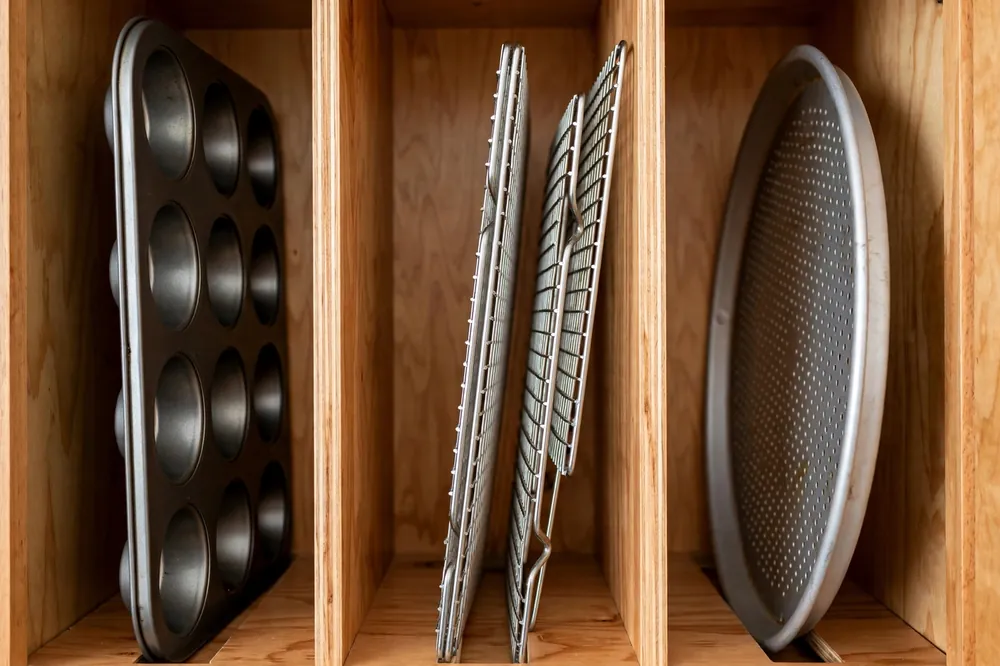
How do you make a simple wood divider yourself?
You make a wood divider from a base board, a set of upright strips, and a way to fix them in place, and the whole job takes an afternoon if you measure first. Cut a plywood base to fit your cabinet floor, leaving a small gap at the front so the door closes. Cut upright strips from hardwood or plywood, each as tall as your tallest pan plus an inch, and as deep as your cabinet minus an inch. Space the strips to match your pieces: narrow gaps for sheets, wider gaps for boards, and one wide gap at the end for the muffin tin.
Glue and screw each strip to the base from below, so no screw tip sticks up to scratch a pan, and sand every edge smooth before the divider goes in the cabinet. A strip with a rough edge will mark a nonstick coating on the first pull, and you will not notice until the coating flakes. Start with one divider this weekend, because that is how to store baking sheets and cutting boards upright begins without a remodel.
This divider is not for a cabinet with a damp floor or a leak under the sink, since wood swells and the slots close up. In a dry base cabinet, though, a homemade divider outlasts most wire racks, because you sized every slot for a pan you actually own, not for a pan the manufacturer guessed at.
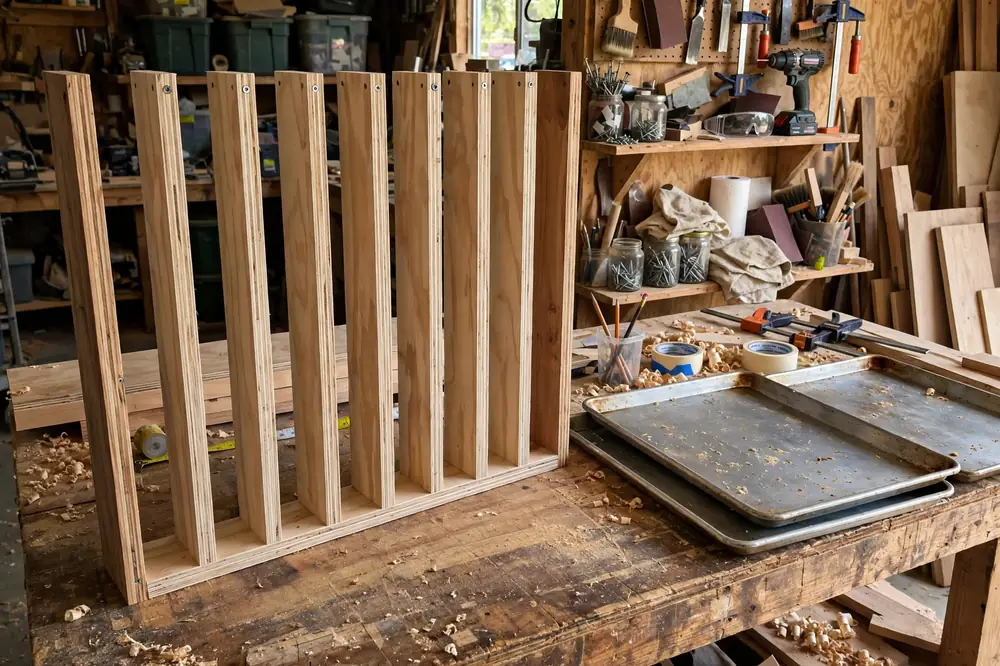
What works in a rental when you cannot drill or screw?
Renters have good options, and none of them need a drill. A freestanding wire rack drops into a base cabinet and comes out clean when you move, which makes it the default rental pick. Tension rods work for light sheets, as long as you respect the weight limit from the earlier section. Over-door racks hang on a pantry door and hold thin boards and sheets, but they only work if the door still closes fully with the rack on, so check the gap at the top hinge before you buy. Thin dividers hold more pans, so how to store baking sheets and cutting boards upright favors slim metal over thick wood.
Adhesive hooks hold a single light board on the inside of a cabinet door, but they fail under a heavy wood board, so do not trust them with the load that matters. Keep one board out for daily use, because how to store baking sheets and cutting boards upright still leaves room for habit.
The honest trade is that rental storage holds less than owned storage, and that is a fact to plan around, not a problem to fight with more hardware. A renter with one wire rack and one over-door rack has a complete system, while a renter who buys five gadgets ends up with a cabinet full of racks and no room for pans. I would rather see a renter use one good rack in the right cabinet than drill a landlord’s cabinet for a pull-out that stays behind. The deposit you keep is worth more than the perfect slot.
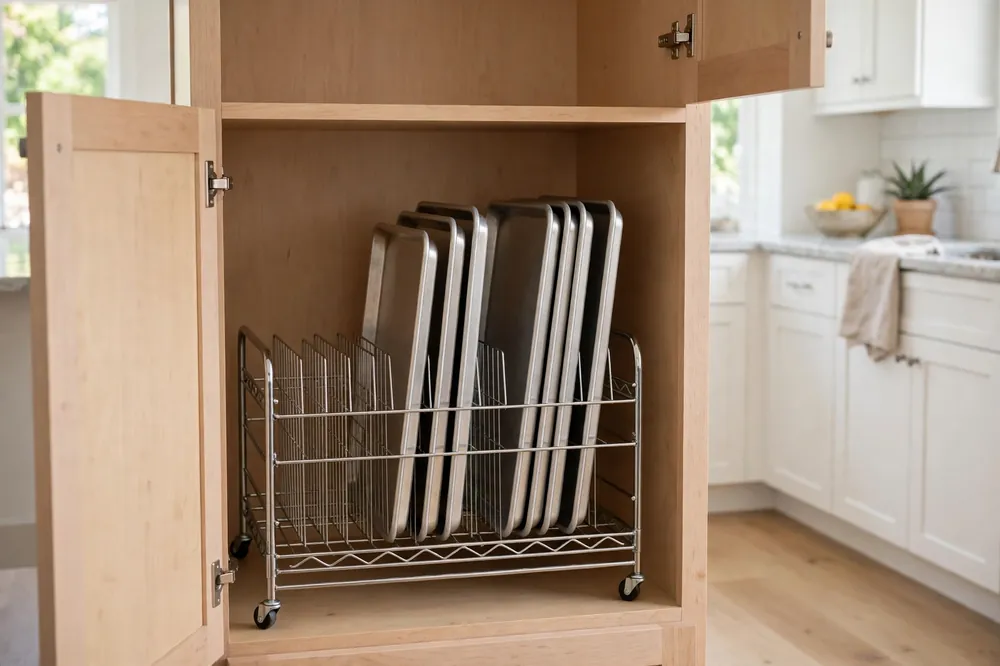
How do you keep heavy wood boards from toppling light pans?
Heavy boards topple light pans when the row has no order, so the fix is order, not a stronger rack. Put the heaviest board at one end of the row, against the cabinet wall or the sturdiest divider, so its weight braces the row instead of leaning into it. Put the next heaviest board beside it, and work toward lighter pieces as you move across the row. Light aluminum sheets go in the middle or at the far end, where no heavy board can fall onto them. A file organizer from the office aisle works too, and that is how to store baking sheets and cutting boards upright for under ten dollars.
Slot width matters as much as order. A heavy board in a slot that is too wide leans, and a leaning board pushes the whole row sideways. A heavy board in a slot that fits snugly, with a felt pad or a silicone strip where it touches the divider, stays put. If a board is taller than the divider, it will tip forward when you pull a neighbor out, so the divider should rise at least two-thirds of the height of the tallest board it holds. A cutting board holder near the sink helps, and that is how to store baking sheets and cutting boards upright after washing.
One more habit helps: pull a pan straight out, along the slot, instead of lifting it up and over the divider. Lifting drags the pan across the divider top and knocks the next piece over. Straight out, straight back in, and the row stays standing. Check the cabinet depth before buying, as how to store baking sheets and cutting boards upright fails when the door will not close.
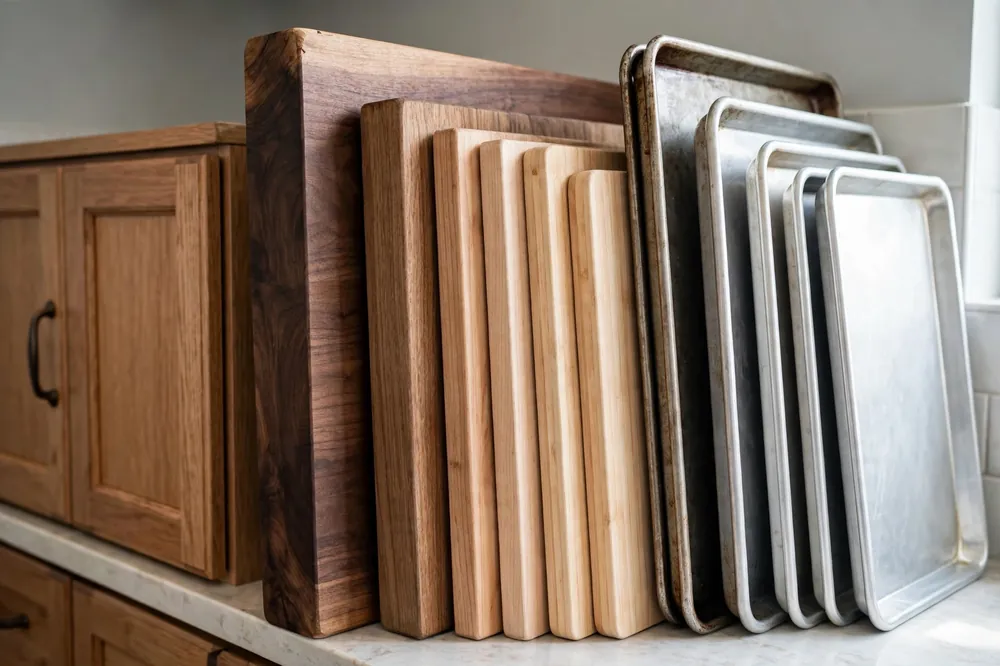
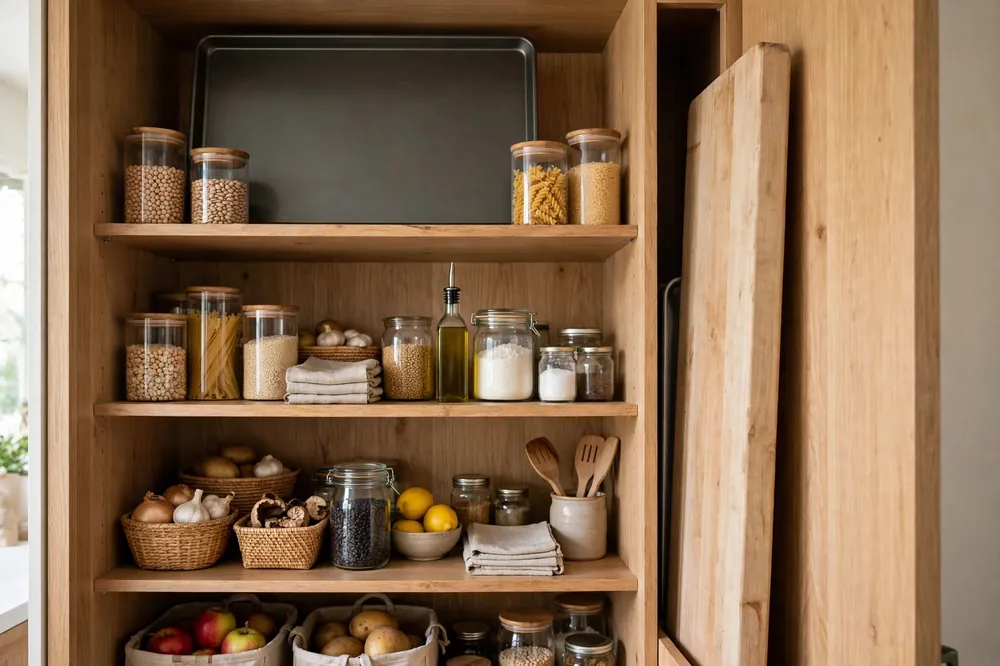
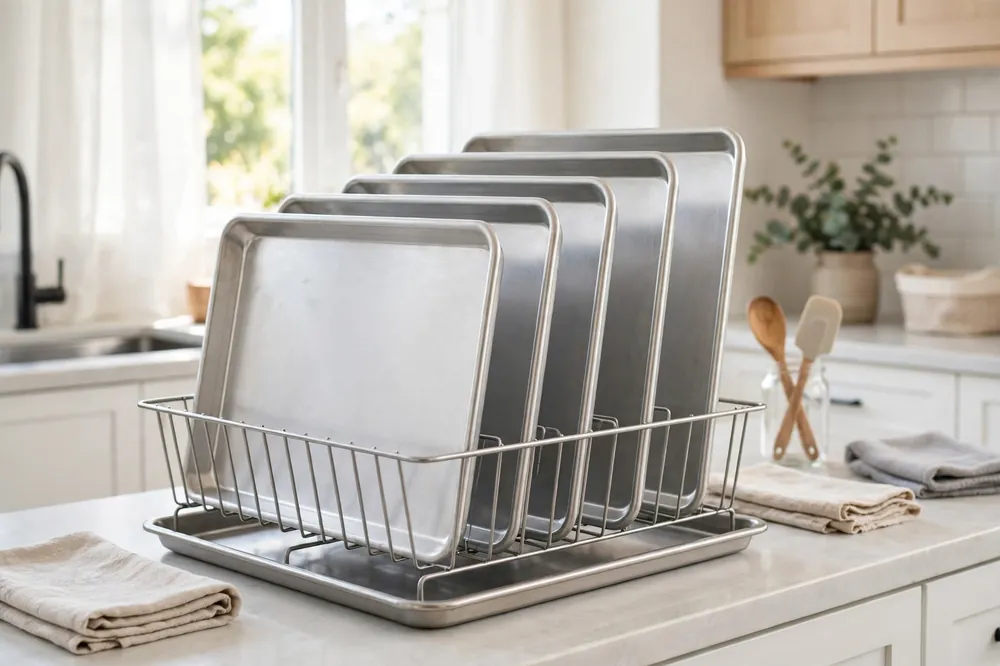
What should you do with oversized boards and full-size sheets?
Oversized pieces need a different home, and forcing them into the daily row ruins the row. A full sheet pan, at 18 by 26 inches, does not fit a standard base cabinet filed upright, and it does not fit most ovens in a home kitchen either, since home ovens are built around half sheets. Store a full sheet flat on a high pantry shelf, on top of a tall cabinet, or in the oven itself if you bake with it weekly and remember to take it out before preheating. Dividers spaced too wide waste the slot, so how to store baking sheets and cutting boards upright needs snug, even gaps.
Oversized boards, the kind that span a sink or cover a countertop, need a tall slot or a flat home. A board taller than your cabinet’s clear height cannot stand upright in that cabinet, full stop, so it goes on top of the fridge, in a tall pantry slot, or flat in a wide drawer. My opinion is blunt: if a piece does not fit the system, change the piece’s home, not the system. One oversized board wedged into a row of half sheets makes every piece harder to reach, and the row you use daily should never pay for the piece you use twice a year.
What mistakes make upright storage fail?
Upright storage fails for a handful of repeatable reasons, and most of them are measurement errors, not product failures. The first is buying before measuring, which puts a 19 inch tall row into an 18 inch cabinet and ends with the door not closing. The second is slots that are too tight, which turn every pull into a scrape and teach you to stop using the system. The third is mixing heavy boards and light pans with no order, so the row topples the first week and you go back to stacking. Put heavy boards low and light sheets high, because that is how to store baking sheets and cutting boards upright safely.
Other mistakes are quieter. Storing pans wet leads to rust spots on steel and dark marks on aluminum, so dry every pan fully before it goes back. Storing a nonstick pan against a rough board scratches the coating, which shortens the pan’s life. Overfilling a rack past its weight limit bends wire slots, and the bend makes the next pan lean, which makes the next one lean, until the row looks drunk. A vertical slot near the stove cuts walking, which is how to store baking sheets and cutting boards upright earns its keep.
Putting the divider in a cabinet far from where you cook means the system is correct and unused, which is the same as no system. Fix the measurement, fix the order, dry the pans, and the system holds. Skip those steps, and no divider, however well reviewed, will save it. Wipe boards dry before storing, since how to store baking sheets and cutting boards upright starts with dry wood.
What should you buy first, in what order?
Buy in this order, and stop when your row works. First, buy nothing. Empty the cabinet, measure it, and sort your pans and boards into keep, move, and let go. Second, buy one divider that fits the cabinet you measured, wire if you rent, wood if you own. Third, add felt pads or a silicone strip only if you see scratches after a week of use, not before. Fourth, add a second spot, like an over-door rack, only if the first cabinet fills up with pieces you actually use weekly. A toe-kick drawer hides the whole set, which is how to store baking sheets and cutting boards upright in a tiny kitchen.
That order keeps the cost low and the system honest. A reader who buys a pull-out, a rack, and a set of rods in one order has spent money on three systems and uses none of them well. A reader who measures, buys one divider, and lives with it for two weeks knows exactly what the second buy should be, if a second buy is needed at all. If you take one step from this guide to how to store baking sheets and cutting boards upright, make it the measurement step. Measure the cabinet, match the pan, file it upright, and the pile that has annoyed you for years is gone by tonight.
Related guides: kitchen cabinet organization, pots and pans storage, kitchen drawer organization, and food container lid storage.
Can you store baking sheets and cutting boards together?
Yes, if each piece has its own slot and heavy boards sit near the cabinet walls. Keep nonstick pans away from rough wood edges, or use a felt pad or silicone strip between them.
How tall does a cabinet need to be for half sheets filed upright?
About 19 inches of clear height, since a half sheet pan measures 18 by 13 inches and needs an inch of clearance at the top. Measure inside the cabinet, not the outside box size.
Will filing pans upright warp them?
No, upright filing takes weight off the pans instead of stacking it on them. A pan warps far more often from a heavy stack pressing on its rim, or from a sudden temperature change, than from standing on edge in a slot.
Do tension rods work for heavy wood boards?
No, not well. Tension rods suit light aluminum sheets and thin boards over a short span. Heavy hardwood boards can push a rod out of place, so use a wood divider that screws or wedges into place for those.
How do you stop pans from sliding out when you open the cabinet door?
Use slots that fit snugly, keep the row ordered by weight, and pull pans straight out along the slot. A silicone strip or rubber grip pad at the base of the row also stops sliding.
Can you store nonstick pans upright?
Yes, as long as the slot is wide enough to pull the pan out without scraping, and the pan never rests against a rough wood edge. A felt pad on the divider protects the coating.
What if your cabinet has a fixed middle shelf?
Use the taller section for upright pans, or move upright storage to a base cabinet with no middle shelf. A half sheet needs 19 inches of clear height, so a shelf that leaves less than that rules that section out.
How do you store a board that is too tall for the cabinet?
Give it a different home: a tall pantry slot, the top of the fridge, or a wide flat drawer. Do not wedge it into a row where it forces every other piece out of place.
Is it safe to store baking sheets in the oven?
Only if everyone in the house knows they live there. A forgotten pan in the oven will heat up with dinner, so this trick suits a single-cook kitchen far better than a shared one.
