
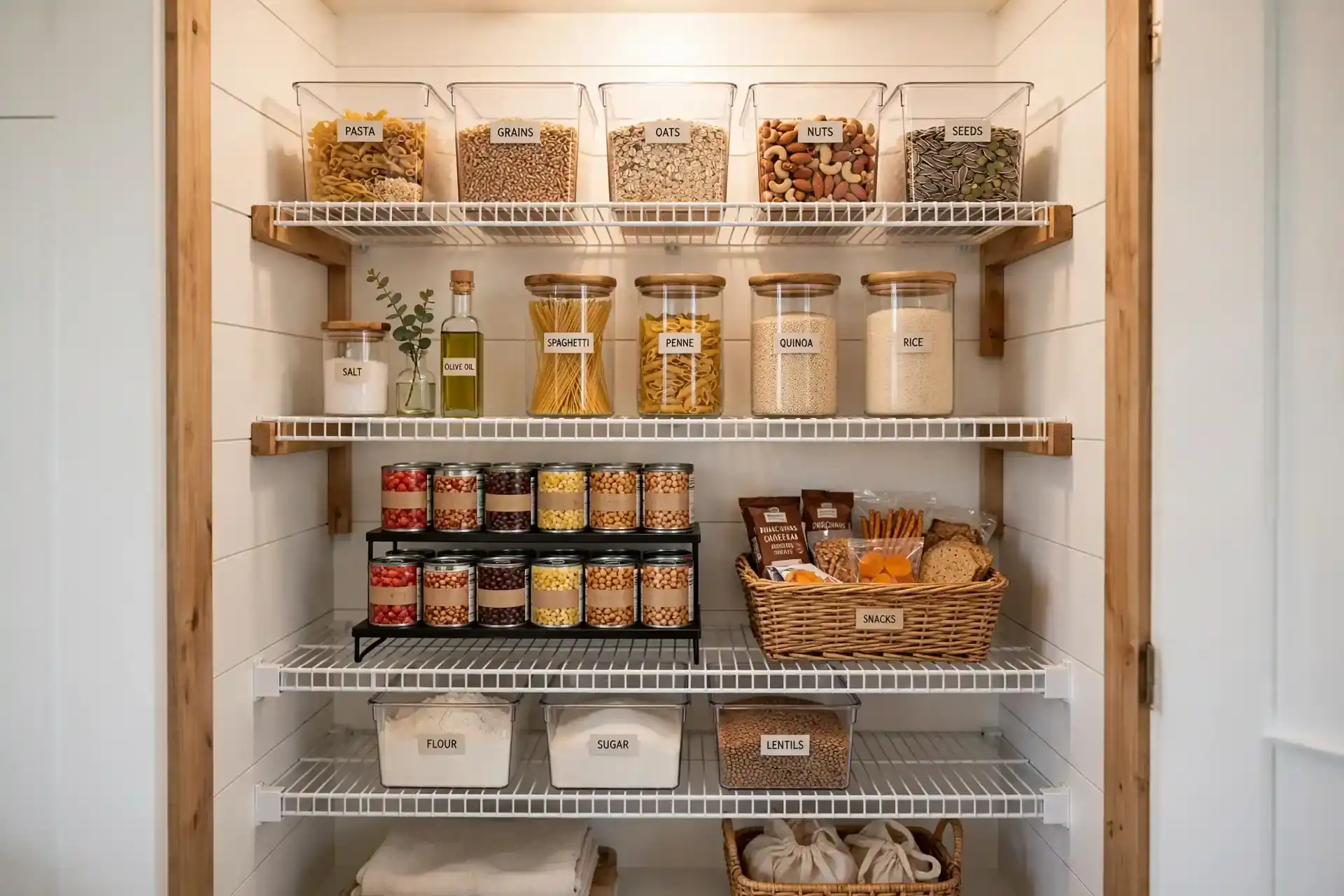

A small pantry fails for one reason: food goes in where there is space and comes out only when you can see it. These 23 pantry organization ideas fix that with a simple order. Measure first, sort by how you actually cook, zone each shelf by height and weight, and buy an organizer only when it solves a problem you can name. Nothing here needs a remodel, and most of it costs nothing. You will find ideas for deep shelves, wire shelves, door backs, tight budgets, and kitchens with no pantry at all, plus the five-minute routine that keeps it all working.
TL;DR: pantry organization ideas in five moves
- Measure every shelf (width, depth, shelf gap) before you buy a single bin. The tape measure is the cheapest organizer you own.
- Do a free-first pass: empty the pantry, toss the expired stuff, and reorganize with jars, cardboard trays, and masking tape you already have.
- Zone by height and weight. Heavy and rarely used goes low or high, daily food sits at eye level, and one “use soon” basket stops duplicate buying.
- Buy one organizer per named problem. A riser for tall gaps, a rack for the door back, a turntable for the deep corner. That is it.
- Label everything with the contents and the fill date. A system only one person understands lasts one week.
| Pantry problem | The fix | Cost |
|---|---|---|
| Cans stacked two deep, nothing visible | Tiered riser or single front-to-back rows | Free to one small purchase |
| Tall empty gap above short jars | Shelf riser or stackable bins | One small purchase |
| Deep shelf swallows food at the back | Pull-out baskets or a turntable for the corner | One small purchase |
| Wire shelves tip small cans | Cut cardboard liner laid flat on the shelf | Free |
| Door back sits empty | Slim over-door rack for flat, light items | One small purchase |
| No pantry at all | Converted closet, rolling cart, or freestanding shelves | Free to moderate |
One honest note before we start: if you have a walk-in pantry, these pantry organization ideas are overkill for you. It is written for the closet-sized pantry, the single cabinet, the deep awkward shelves, and the kitchen with no pantry at all. The principles scale up, but the specific tricks here solve small-space problems.
Which pantry organization ideas actually work in a small pantry?
The ones that change what you can see and reach. A small pantry breaks down in three places: food hides behind food, vertical gaps go unused, and nothing has a zone. Fix those three and the same shelves hold more and waste less. For the full playbook, see our small pantry storage ideas with 14 fixes that actually work.
Here is why this matters beyond the kitchen. The U.S. Department of Agriculture estimates that between 30 and 40 percent of the food supply is wasted, and the average American family of four loses about $1,500 a year to uneaten food. The USDA’s Economic Research Service puts the retail and consumer share at 31 percent, which worked out to roughly 133 billion pounds and $161 billion worth of food in 2010.
The EPA adds that wasted food is the single most common material landfilled and incinerated in the country. Most of that loss starts at home: NRDC’s research finds consumers responsible for about 43 percent of food waste, more than restaurants, grocery stores, or farms. A disorganized pantry is not just annoying. It is where a lot of that money quietly expires behind a bin.
The good news: a small pantry is easier to fix than a big one, and every change covers a bigger share of the space. Here is the full playbook.
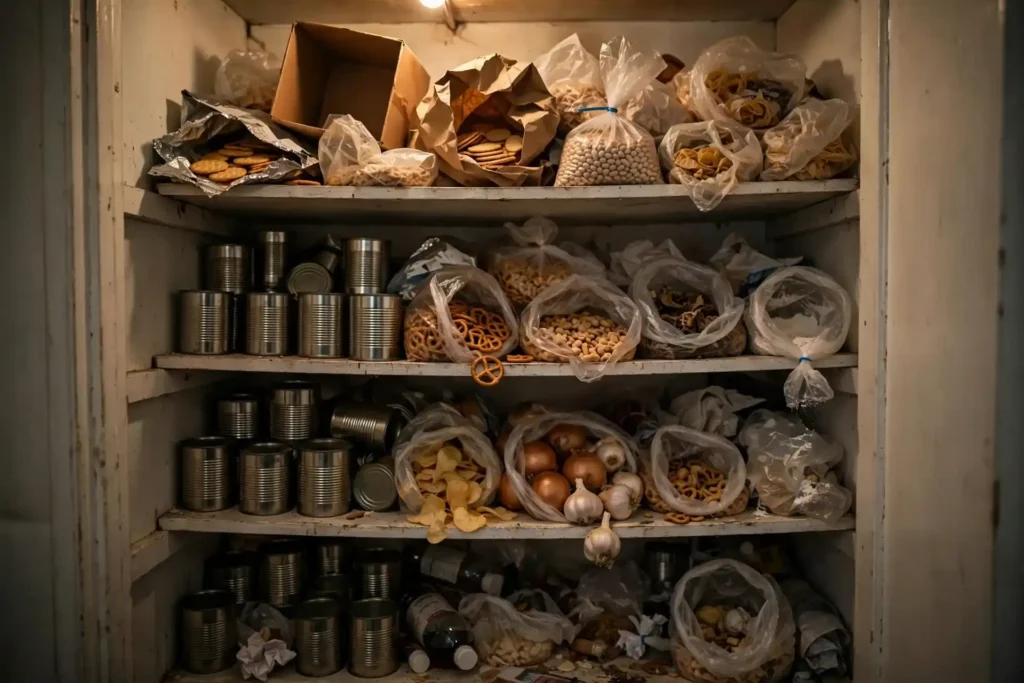
Should you empty the whole pantry before you organize it?
Yes. Every time. Trying to organize a full pantry is like cleaning a closet with the clothes still in it: you end up shuffling the same mess into slightly neater piles. Pull everything out onto the counter and the table, then sort it into four honest piles.
Eat now: anything expiring within a week goes on a list on the fridge and into this week’s meals. Donate: sealed, unexpired food you genuinely will not eat. Feeding America can point you to a local food bank, and unopened dry goods and cans are always welcome. Toss: opened packages past their date, anything with visible spoilage, anything that smells off. Keep: what you actually cook with. Be strict here. If you bought two kinds of salsa and opened neither in four months, one of them leaves.
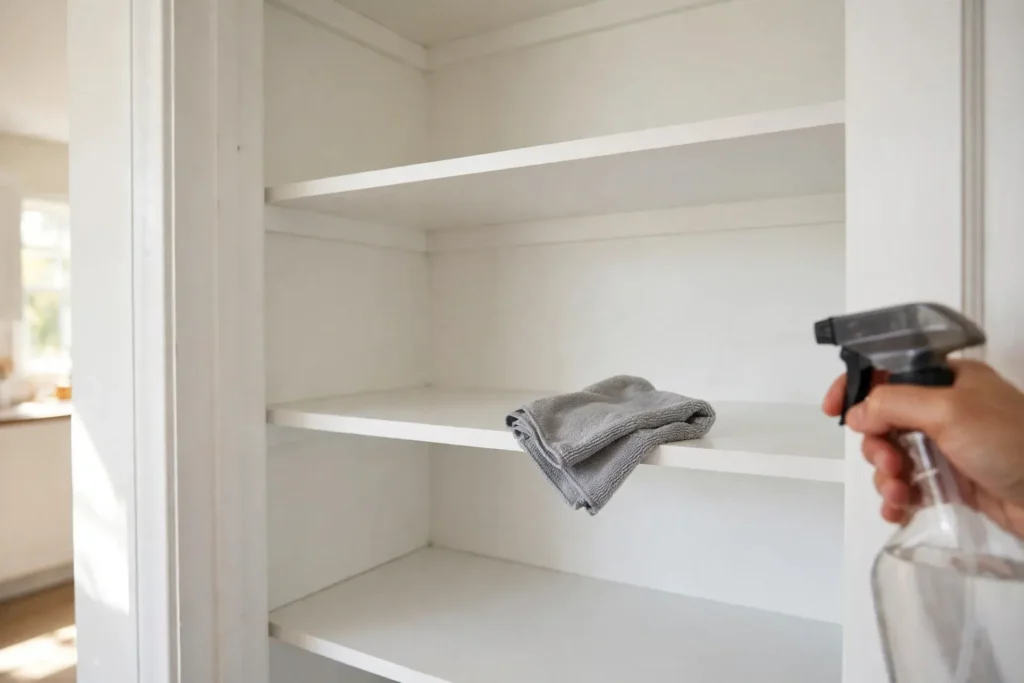
Wipe the bare shelves while they are empty. Crumbs and dust are what draw pantry pests, and a clean empty shelf is the honest test of how much room you really have. Most people find the keep pile fits on far fewer shelves than they expected, which is the first win of the whole project.
Two details make the sort work better. First, build the eat-now pile into an actual meal plan for the week, not a vague intention; food on a written plan gets eaten, food on a mental note expires. Second, bag the donate pile immediately and put it by the door. A donation bag that sits in the pantry for a month migrates back onto the shelves, and then you have sorted nothing. That sort is the least glamorous of these pantry organization ideas and the most important.
While you are at it, check the freezer for pantry overflow hiding as a second bag of the same thing, and give your spices the sniff test. Ground spices lose their punch after about a year.
How do you measure a small pantry so organizers actually fit?
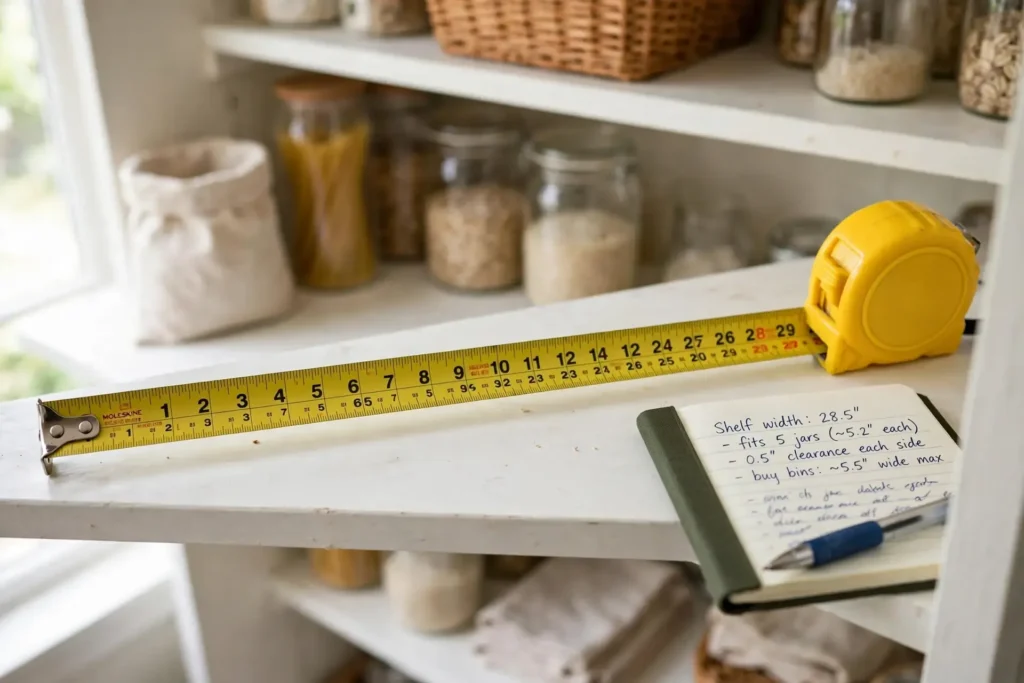
With a tape measure and four numbers per shelf: width, depth, the gap between shelves, and the height from one shelf to the one above it. Also measure the door swing: in many small pantries the door stops halfway and that stretch is dead space. Write the numbers in your phone and take them shopping with you.
This step feels fussy and it is the step that saves the most money. A container that is perfect in a wide pantry becomes a wasted purchase in a narrow one. Shelf gaps matter as much as shelf size: a 10-inch gap above 6-inch jars is 4 inches of dead air per shelf, which is exactly what a riser fixes. Note vented wire shelves too, because small cans will tip through the gaps unless you lay something flat over them (more on that in the wire-shelf section).
My rule: if an organizer cannot be matched to a measurement you wrote down, it does not come home. Impulse bins are how pantries end up with twenty pieces and three that get used.
A real example: shelf one is 24 wide and 12 deep with a 14 inch gap; shelf two matches with a 10 inch gap. Those two lines tell you a 10 inch riser fits one but not the other. Worth repeating: the best pantry organization ideas start with numbers, not shopping.
What is the cheapest way to organize a small pantry?
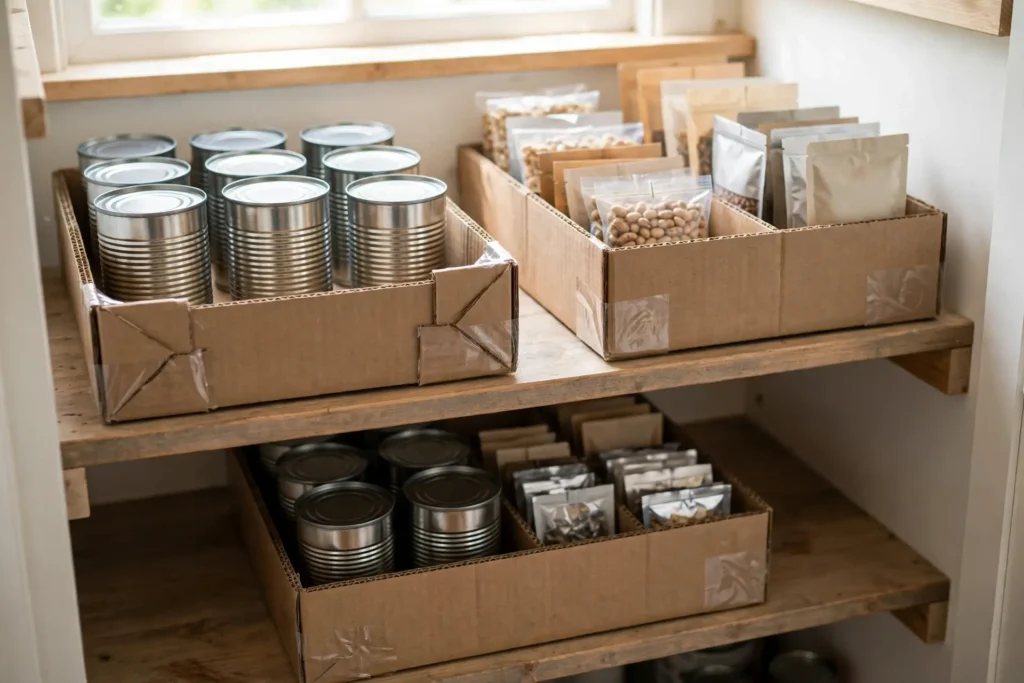
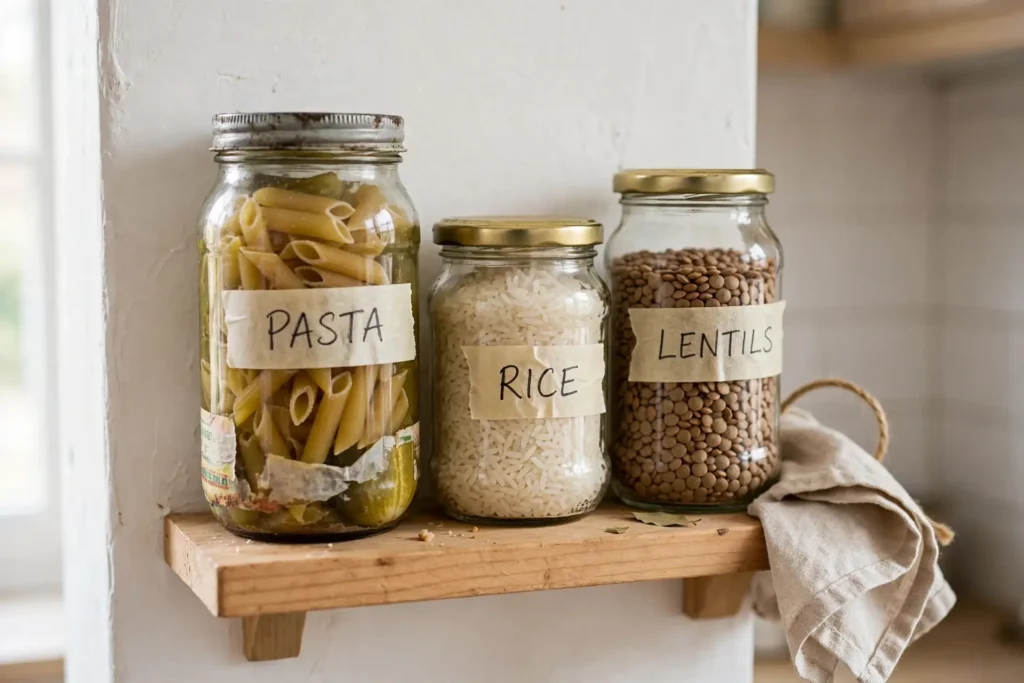
Spend nothing on the first pass. The cheapest pantry organization ideas are free. Seriously. Most small pantries can be completely reorganized with four things you already own: glass jars from pickles, sauces, and drinks for dry goods; cardboard boxes cut down to shelf-height trays that slide in and out; baskets or wire bins pulled from anywhere else in the house as pull-out drawers; and masking tape or a free printable label template instead of a branded label maker.
The cardboard tray trick deserves a closer look because it is the best free organizer in a small pantry. Cut a box to about 4 inches tall for a tray that corrals packets and slides out like a drawer. Cut one to 2 inches and it becomes a liner that stops cans from wandering. They are free, stackable, and when one gets sticky you recycle it and cut another.
If you do spend money later, spend it on one problem at a time. The table below is the honest version of a budget: same method, different shopping lists.
| Tier | What you buy | When it makes sense |
|---|---|---|
| No-cost | Jars, cardboard trays, masking-tape labels | Almost always enough; try this first |
| One-problem | One riser, one turntable, or one door rack | A specific frustration survived the free pass |
| Full refresh | Matching containers, risers on every shelf | Measuring proved you are out of room, not just out of order |
The test for the full refresh: if the keep pile fits comfortably on your shelves, you do not need it. Redistributing beats buying. And if your kitchen has the same chaos under the sink, the zoning ideas in our under-sink kitchen organization guide carry over directly.
How do you organize a small pantry with deep shelves?
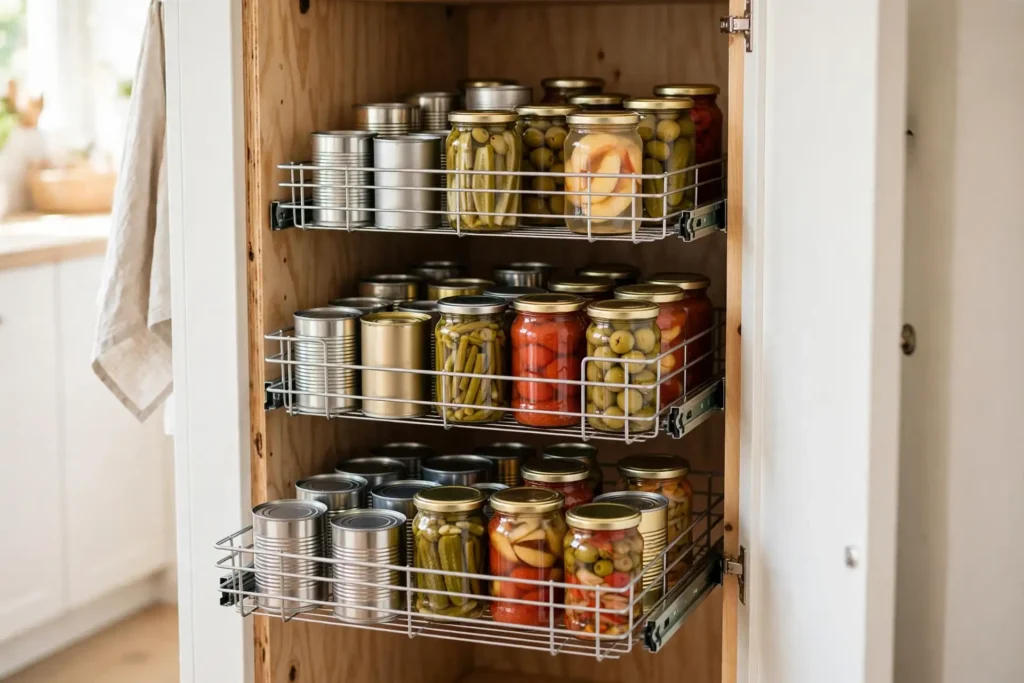
Deep shelves are the number one food-waster in small pantries. The front row hides everything behind it, so you buy a third bag of rice because the other two are invisible. The fix is a simple rule: nothing hides behind anything. Run single front-to-back rows of like items, or give the shelf pull-out baskets so the whole depth glides forward.
For deep corners, a turntable, the classic lazy Susan, earns its keep: oils and sauces spin forward instead of getting shoved back.
On wide shelves, arrange rows in a U-shape with the open end facing you: sides and back filled, middle clear, so you see everything without unpacking. Small-space pantry organization ideas live or die on visibility.
Zone the depth too. Put the backup supply at the very back and the working supply in front, and only double up on items you genuinely buy in bulk. Keep a small “use soon” basket at eye level for open packages and soon-expiring items, and let its overflow live at the back of the deep shelf, never the things you reach for daily. And keep like items in one front-to-back line. Two different categories sharing one deep row is how the hiding starts again.
Deep-shelf ideas
What do you do about wire shelves in a pantry?
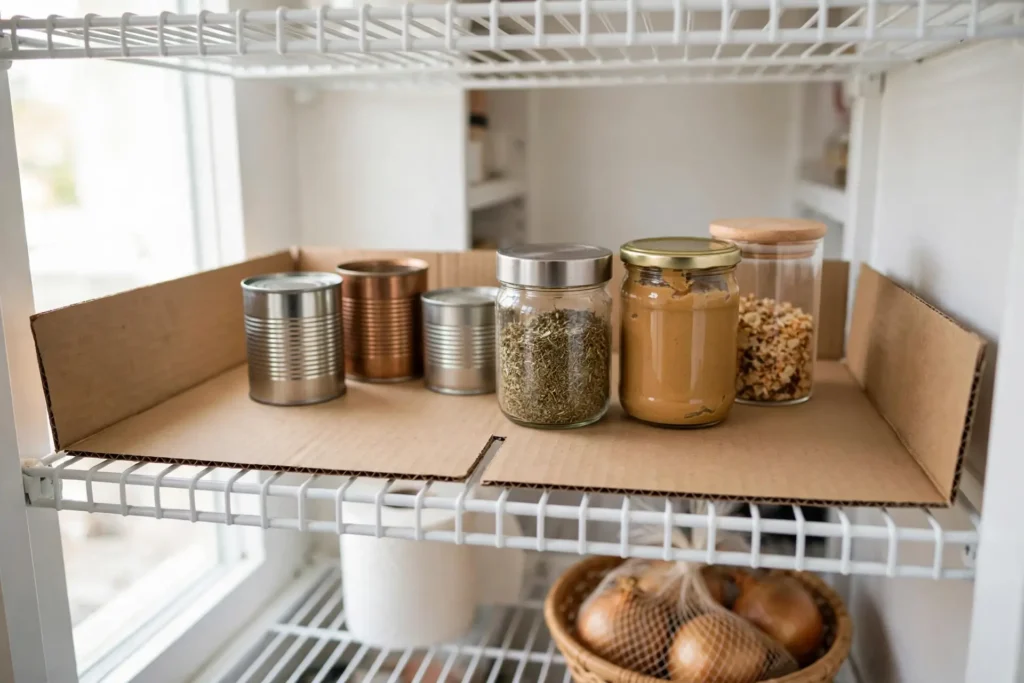
You cover them, and it costs nothing. Cut a piece of cardboard to fit the shelf and lay it flat. Small cans and jars stop tipping and dropping through the gaps, and the whole shelf becomes usable in about two minutes. This is the fix renters on r/organization threads swear by, and it works because the problem was never the shelf, it was the holes.
If you want an upgrade later, slide low pull-out baskets onto the wire shelves. They turn the shelf into a drawer and the wire underneath stops mattering. Measure the basket against your shelf gap first: a basket that is 6 inches tall needs a 7 inch gap to glide, and wire shelves in older pantries often sit closer together than they look. But skip the fitted wire-shelf liners sold as a pair for a single shelf; plain cardboard does the same job for free and you can replace it when it gets grimy.
One honest note: wire shelves are not a defect you must fix before anything else works. They hold weight fine and they ventilate, which is actually good in a humid kitchen. Line them, wipe the liner when you do your quarterly check, zone them like any other shelf, and move on to bigger wins. Not every pantry organization idea needs a purchase; this one needs scissors.
How can you use the back of the pantry door?
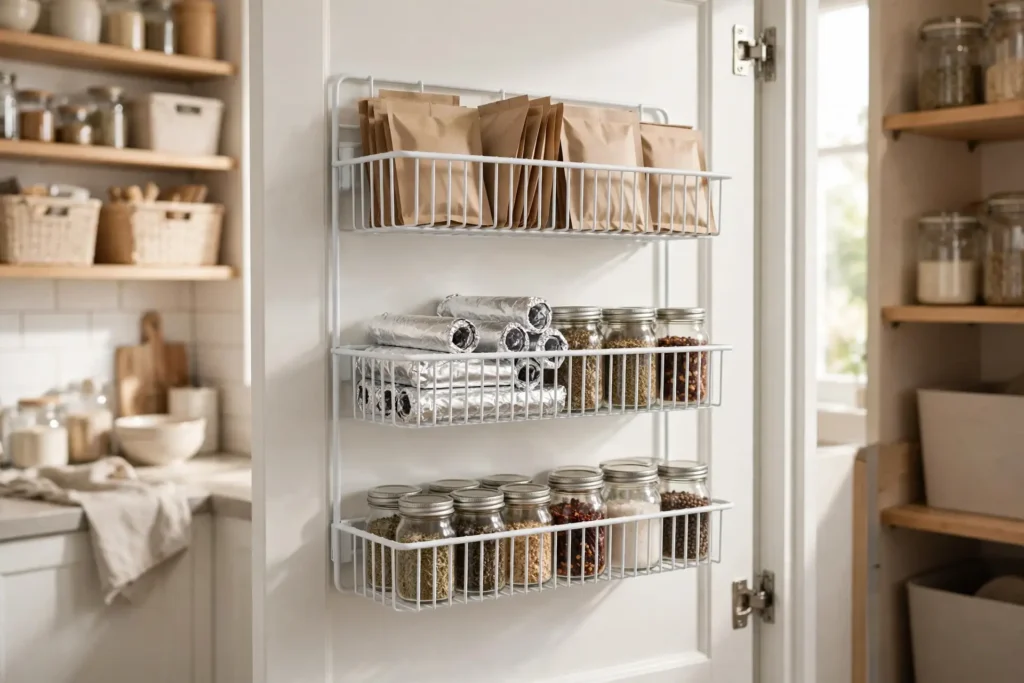
The back of the pantry door is the most underused square footage in a small kitchen. A slim over-door rack holds spices, seasoning packets, foil, plastic wrap, and flat boxes, and it can free up a full shelf. Two rules keep it safe. First, check the door’s weight capacity and keep the heavy stuff on the shelves; the door is for light, flat, frequently grabbed items, not glass jars of beans. Second, make sure the door still closes and the rack does not block the shelves behind it. Measure the gap between the door and the shelf front before you buy. For the full system, see these spice storage ideas for small kitchens.
What belongs on the door back: spice packets and small jars, wraps and foils, snack bars, tea boxes, the lunch-packing supplies. What does not: anything glass and heavy, anything you use once a month (it becomes clutter you dust), and anything a toddler can reach if the pantry is at kid height. If your pantry has no door at all, mount a narrow rail with S-hooks on the nearest wall or the side of a cabinet for the same small items. A tension rod wedged between two walls works as a no-drill hanging rail for light baskets. Our over-toilet storage ideas show the same door-back trick working in a bathroom.
How do you fill the wasted space above your shelves?
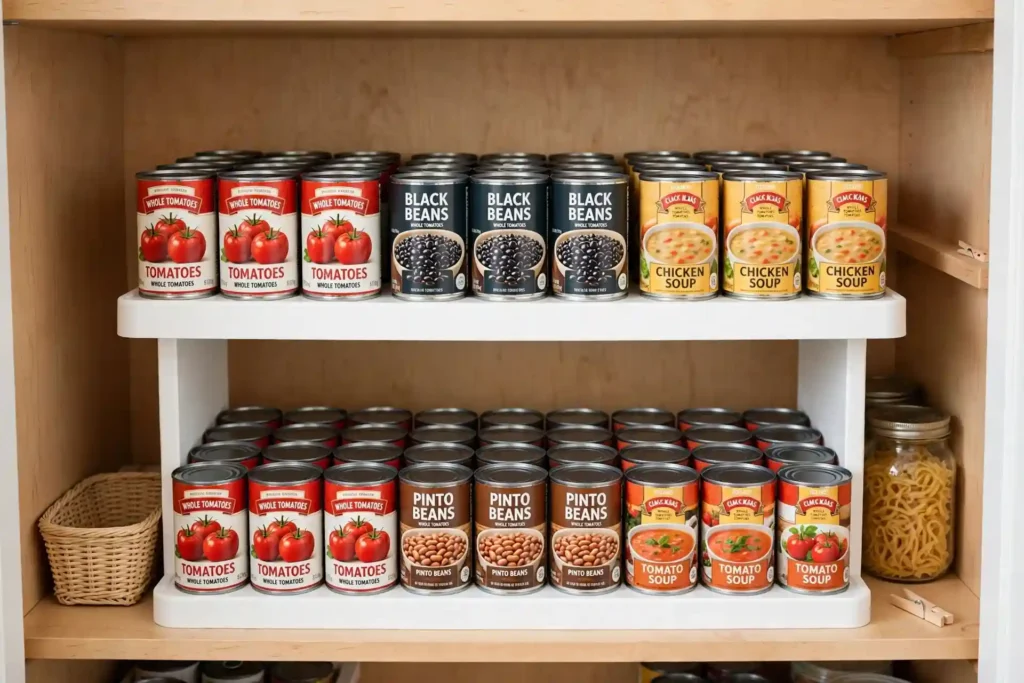
Look at the gap between your shortest items and the shelf above them. If it is more than 3 or 4 inches, you are renting air. A tiered shelf riser turns one shelf into two for cans and short jars, with every label still readable. Stackable bins do the same for snacks and packets: two short bins stacked beat one tall bin with a dead zone on top.
Do the gap math before you shop. If the shelf gap is 12 inches and your cans are 4 inches tall, a two-tier riser gives you a full second row. If the gap is 8 inches and your jars are 6, you need a low single-step riser or shorter jars, not the tall three-tier one from the photo. This is why the measuring step comes first: risers come in real dimensions, and the wrong one wastes the exact space you bought it to save.
Under-shelf baskets are the bonus move. They clip onto the shelf above and use the dead air for lightweight items like bread, chips, and snack bags. Keep them light; a sagging under-shelf basket is worse than the empty gap. Check the clip against your shelf thickness before you buy, because the wire arms that fit a thick wood shelf will not grip a thin wire one. These pantry organization ideas reward measuring twice.
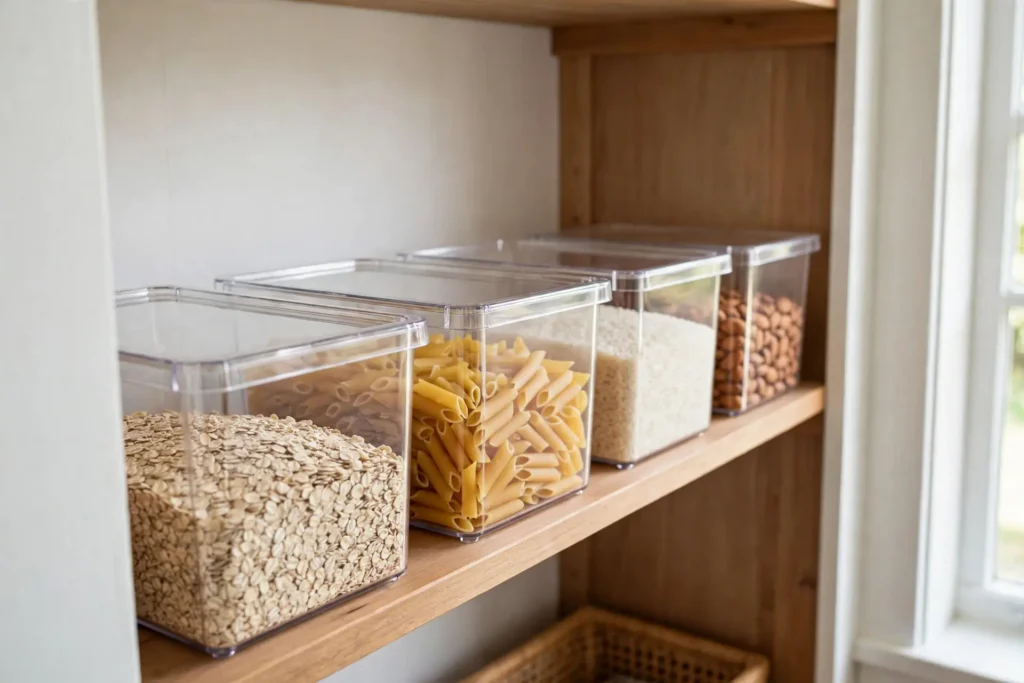
Should you pour food into clear containers in a small pantry?
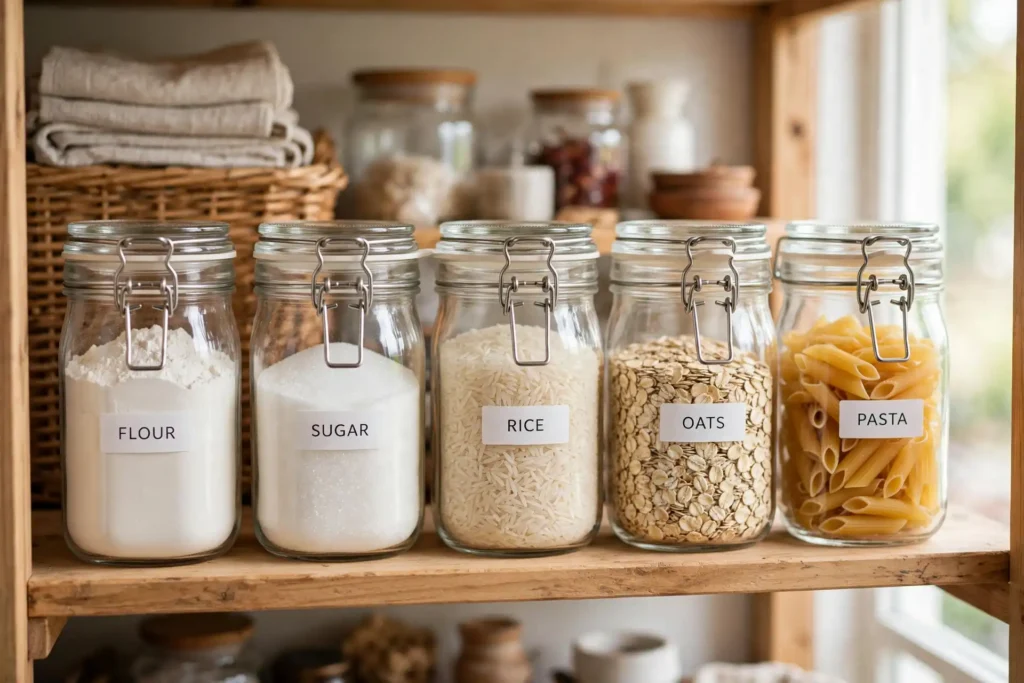
Only sometimes. This is where my take on pantry organization ideas differs from half the pantry internet. Decanting, pouring dry goods out of their packaging into matching containers, earns its keep in exactly three cases: you buy flour, rice, or beans in bulk and the bags will not reseal; pests are a real problem in your kitchen and airtight matters; or half-open bags keep collapsing and spilling. In those cases, airtight containers with the fill date written on the label are genuinely worth it. Airtight also matters most if pantry moths have ever visited your kitchen; one sealed jar beats a year of traps.
Skip it for everything else. Decanting a half-used box of crackers costs you the expiration date and the cooking instructions for zero space saved. My rule: decant the bulk bags and the pest targets, leave the rest in its packaging, and put the money toward a riser instead. The quick version:
| Decant it | Leave it in the package |
|---|---|
| Bulk flour, rice, beans in bags that will not reseal | Boxes of crackers, cereal, and pasta |
| Anything in a kitchen with pantry moths or ants | Snack bags and anything you finish within two weeks |
| Half-open bags that keep collapsing and spilling | Items where you need the cooking instructions or date |
One more caution if you do decant: label for allergens. The moment pasta leaves its factory bag, nobody can tell it apart from the gluten-free box anymore. Write what it is and when you filled it. NRDC reports that up to 90 percent of Americans misinterpret date labels and throw food away early, and losing the original package makes that confusion worse, not better.
How should you group and zone food in a small pantry?
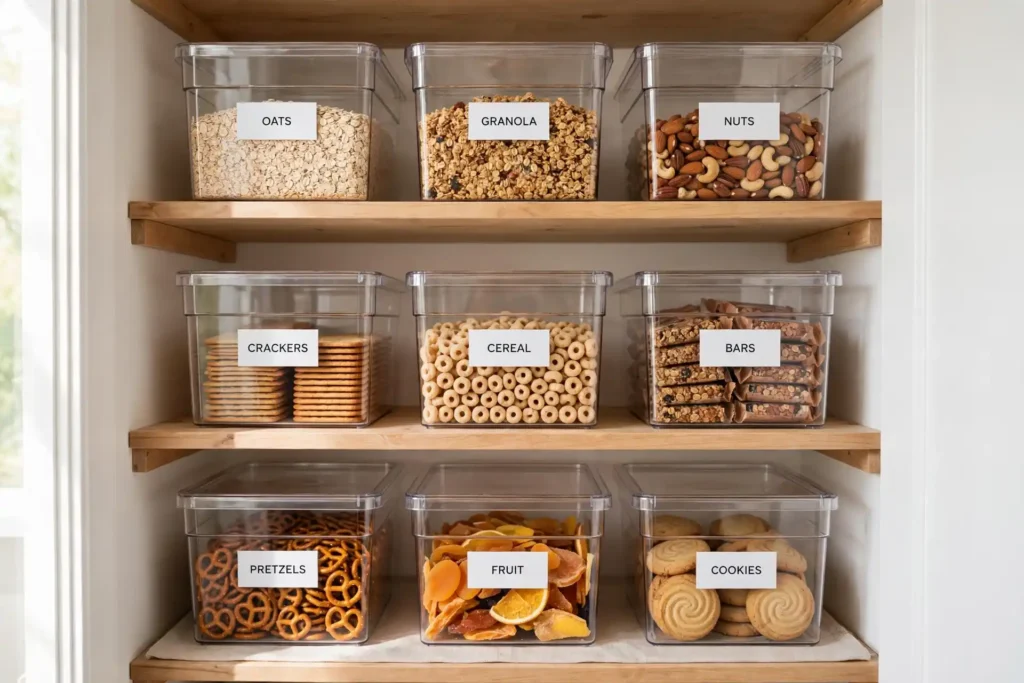
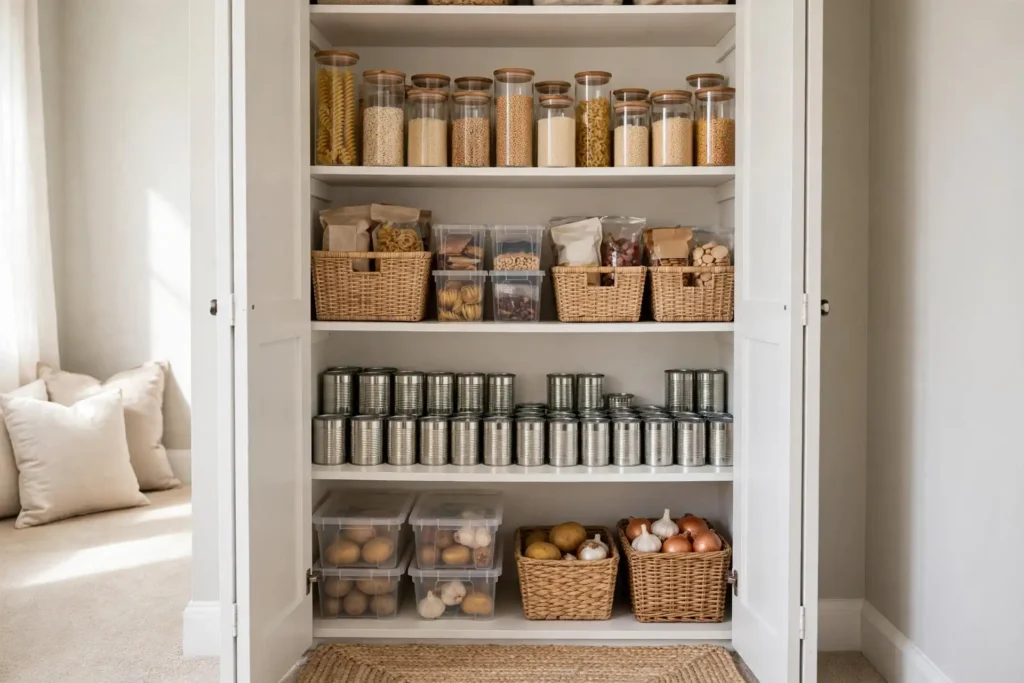
Group by use, not by type. Of all the pantry organization ideas in this guide, this is the single biggest mindset change. Grouping by type is what makes pantries look organized and behave badly: all the cans together, all the boxes together, and then you open six different zones to make one dinner. Group by when you use it instead, and the pantry starts working like a grocery list.
Build zones by use: breakfast, baking, snacks and lunch pulls, canned goods, condiments and sauces, bulk dry goods. Keep duplicates visible rather than hidden, because seeing four cans of diced tomatoes is how you stop buying a fifth.
Then place each zone by height and weight. The cheat sheet below is the placement map; tape it inside the pantry door until it becomes habit.
| Shelf zone | What goes there | Why |
|---|---|---|
| Top shelf | Rarely used, light: seasonal baking, holiday overflow | Out of the way, nothing heavy overhead |
| Second from top | Light but occasional: weekend breakfast, condiment overflow | Reachable with a small stretch |
| Eye level | Daily use, one-bin deep: breakfast, lunch pulls, use-soon basket | Visible, stops duplicate buying |
| Below eye level | Heavier daily items: cans, jars, kid-safe snacks | Safe to lift, out of small hands’ reach for the wrong things |
| Bottom shelf | Heaviest and least used: bulk bags, water cases, refills | Floor-adjacent, no lifting overhead |
| Kid height | A low basket with snacks and lunch items at their height | Kids grab their own without climbing |
| Door back | Flat and light: foil, wraps, spice packets | Frees a full shelf |
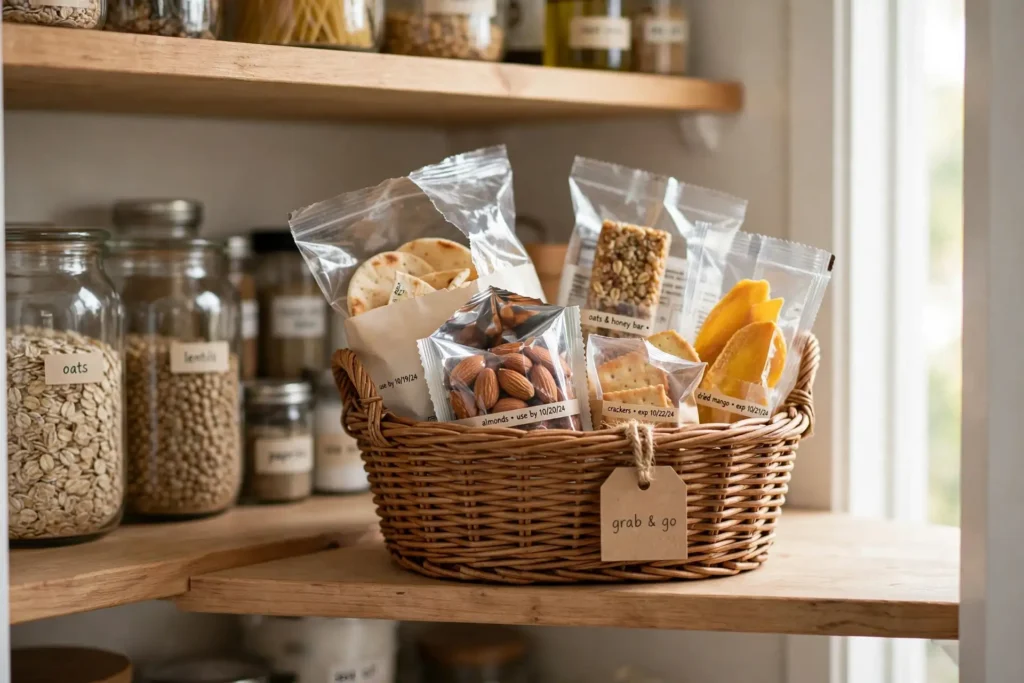
Two rules sit under all of it. Never put a heavy item at eye level next to a light one, because the shelf reads wrong and the wrong thing gets grabbed. And never hide a category behind another category, because hidden food is wasted money in slow motion. The same zoning logic works beyond the pantry: our small kitchen storage ideas apply it to the whole kitchen, and the grab-and-go basket is a smaller cousin of the entryway storage zones that keep mornings moving.
What if you do not have a pantry at all?
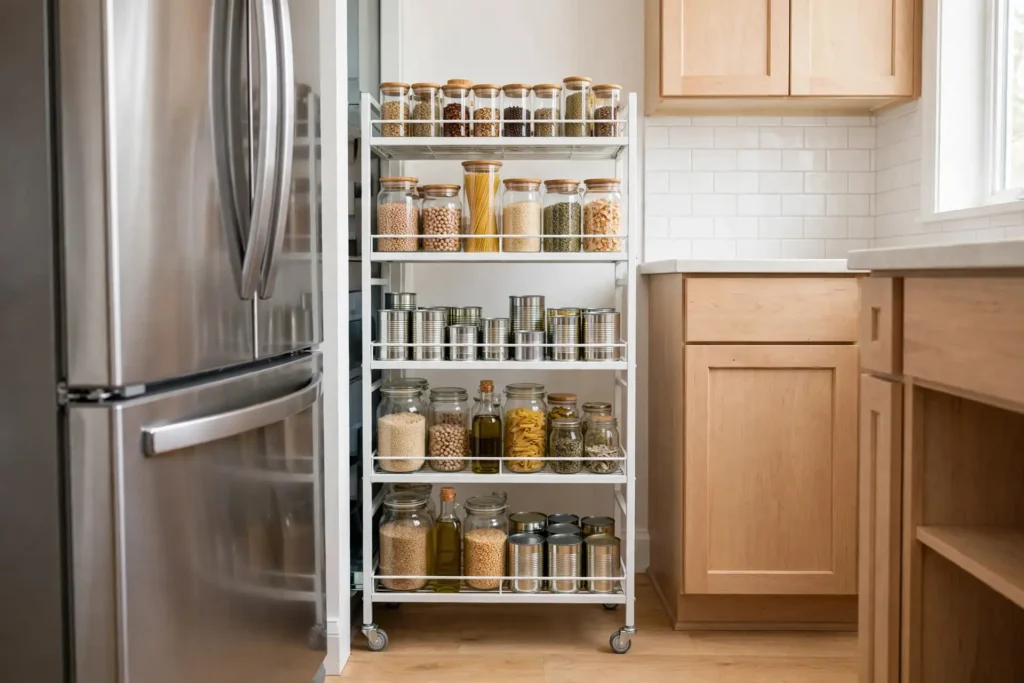
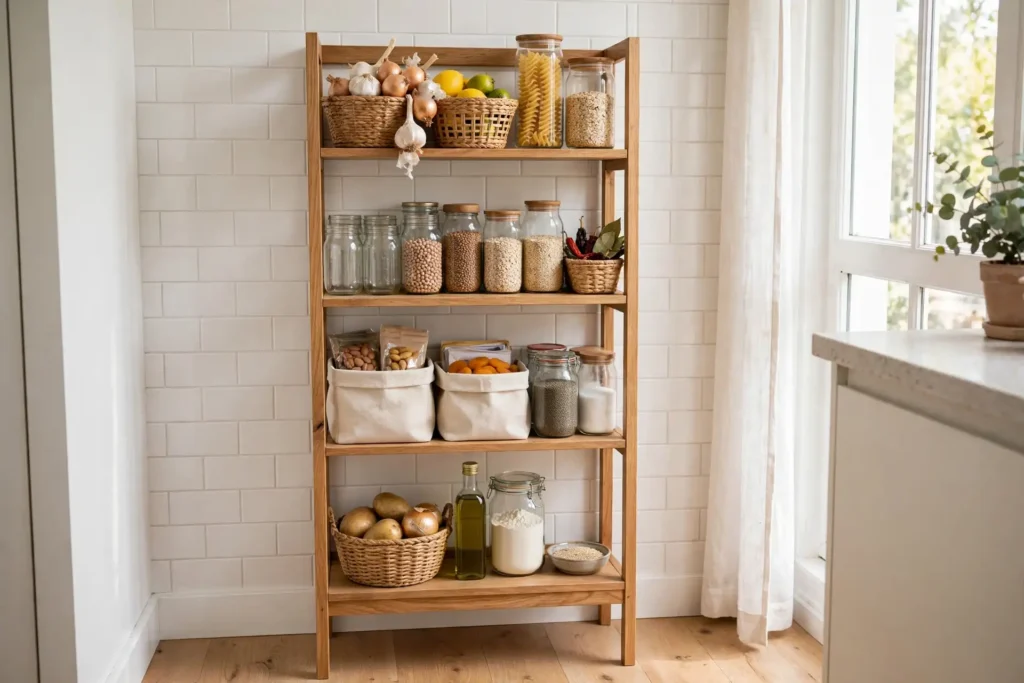
Then you build one; these pantry organization ideas work for renters too. A shallow closet near the kitchen converts well: take out the rod, add four or five shelves at 10 to 12 inch spacing, and you have gained real food storage without touching a wall. A slim rolling cart in the gap between the fridge and the cabinets, those 6 to 9 inch slots most kitchens have, carries a surprising amount of cans and packets and rolls away when you need the floor.
Freestanding shelving is the no-drill answer: a narrow shelf unit against any free wall becomes a pantry the day you load it, and it moves with you. Wall space works too: a rail with hanging baskets or a magnetic strip for spice tins, fixed into studs, holds the small stuff that clutters counters. Between studs, a recessed shelf just 3.5 inches deep holds tins and jars in a single visible row. The rule for all of it: nothing comes home without a named place, or a cart becomes a rolling junk drawer within a month.
If you are converting a closet, the shelf-spacing logic from our small closet organization ideas applies directly: measure first, adjustable beats fixed, and the most-used items live between waist and shoulder height.
No-pantry ideas
What should never go in a small pantry?
A surprising amount of what ends up in a small pantry does not belong there, and the crowd-in effect of a small space makes every mistake worse. Keep it to shelf-stable, unopened or properly sealed food.
Refrigerated perishables. Dairy, fresh meat, leftovers, cut produce. A pantry is not a second fridge, and in a small closed pantry the temperature swings are worse, not better.
Opened items that need refrigeration. Opened oils, jarred sauces, and condiments go back in the fridge once opened, sealed. They migrate to the pantry because the fridge is full, which is a fridge problem, not a pantry solution.
Medicines and supplements. Humidity and temperature swings shorten their shelf life, and a pantry is not child-resistant storage. This one matters more in small pantries because the medicine bottle ends up at kid height.
Cleaning chemicals. A pantry door is usually unlocked and often at child height. Keep chemicals under the sink with a child lock or in a high cabinet, never next to the cereal.
Open pet food. It belongs low and sealed in a lidded container, because insects and rodents find open pet food fast.
Fresh bread and bakery items. They go stale quickly and attract mold in a closed space. A bread box on the counter keeps daily bread better than any pantry shelf.
Then there is the gray zone, the items people argue about. Potatoes and onions are fine in the pantry as long as they are stored apart from each other and away from light; together they spoil faster. A bread box on the counter beats the pantry for daily bread. Wine is fine at cool room temperature for bottles you will drink soon, but a hot pantry shelf above the stove is the worst spot in the kitchen for it. Bulk spices belong in the pantry only if you cook through them; the giant club-store paprika from two years ago is seasoning nothing but the shelf. Knowing what not to store is one of the most underrated pantry organization ideas.
One more rule that saves real money: learn what date labels actually mean. With the exception of infant formula, date labels on food are not federally regulated, and NRDC reports that up to 90 percent of Americans misinterpret them and throw food away early. “Best by” is about quality, not safety. When in doubt, the USDA’s FoodKeeper guidance lists real storage times by food, and it beats guessing every time.
How do you keep a small pantry organized after the big reset?
With a five-minute weekly habit, not another overhaul. Pick a fixed day, set a timer, and do three things: put away the strays, restock the zones you emptied, and check the use-soon basket. When you refill, rotate stock first in, first out: new item to the back, older one to the front. That is the whole maintenance system. The least exciting pantry organization ideas are the ones that last.
Every quarter, do a ten-minute inventory against your list and adjust what you buy. Keep the list where you will see it before shopping. Twice a year, rotate the seasonal stuff: holiday baking comes down in November, back up in January. If you keep buying the same item after inventorying, the problem is the list, not the shelves. Add one grocery rule and the system mostly maintains itself: nothing new comes home without a named place to go. If the peanut butter spot is full, the new jar waits until there is room, which is also how you stop the slow creep of a third, fourth, and fifth backup.
And here is the part nobody wants to hear: if the system collapses after six weeks, the system was too complicated, not you. Fewer zones, bigger labels, and one basket for the homeless items. A pantry that survives real life beats a pantry that photographs well.
What is the single change that saves the most time in a small pantry?
The use-soon basket at eye level, with labels on everything else. If you do nothing else in this guide, do those two. Of all the pantry organization ideas here, those two carry the whole system. The basket stops the slow bleed of expired food and duplicate buying, which is where the USDA’s $1,500-a-year figure actually lives. The labels make the system survive everyone else in the house, because a system only one person understands is a system that lasts one week.
Start this weekend. Empty it, measure it, run the free-first pass, and buy exactly one organizer for the one problem that survives. Then tell me the pantry is not the calmest shelf in the kitchen.
Your first-weekend checklist, in order: pull everything out and sort the four piles. Wipe the shelves. Write down the four numbers per shelf. Set up the zones with jars, cardboard trays, and tape labels. Put the use-soon basket at eye level. Photograph the finished shelves; the photo becomes your reset target when things drift. Buy the one organizer only if a named problem survived all of that. Set a weekly five-minute reset on the same day you take out the trash, so it becomes part of a routine you already have.
For the rest of the house, our small kitchen storage ideas and under-sink organization guide use the same measure-first, zone-by-use method room by room.
How do I organize a small pantry on a budget?
These pantry organization ideas start free: spend nothing on the first pass: empty every shelf, measure the space, group food by how you actually cook, and reorganize with jars, cardboard trays, and masking-tape labels you already own. Buy one organizer only for a problem the free pass cannot fix, like a riser for tall shelf gaps or a rack for the door back.
How do you maximize space in a small pantry?
These pantry organization ideas use the vertical gaps with shelf risers and stackable bins, put the back of the door to work with a slim rack, and zone each shelf by height and weight: heavy and rarely used goes low or high, daily food sits at eye level in single front-to-back rows so nothing hides.
How do you organize a deep pantry so food does not get lost?
For deep shelves, these pantry organization ideas follow the nothing-hides rule: single front-to-back rows of like items, or pull-out baskets so the whole depth glides forward. Use a turntable in deep corners for oils and sauces, and keep backup supply at the very back with the working supply in front.
What is the best way to organize a pantry with wire shelves?
The cheapest of these pantry organization ideas: lay a piece of cardboard cut to fit flat on each shelf so small cans and jars stop tipping through the gaps. It costs nothing and takes about two minutes per shelf. For an upgrade, slide low pull-out baskets onto the wire shelves to turn them into drawers.
Do I need bins to organize a small pantry?
No. Of all the pantry organization ideas here, bins are optional: they help with small loose items like packets and snacks, but most small pantries work fine with cardboard trays, repurposed jars, and one-bin-deep rows. Buy bins only when a specific category keeps scattering after the free-first pass.
How do I stop buying food I already have?
Keep duplicates visible instead of hidden, run single front-to-back rows so nothing hides behind anything, and keep a “use soon” basket at eye level with open and soon-expiring items. The USDA estimates the average family of four loses about $1,500 a year to uneaten food, and most of it starts as invisible duplicates.
What should you not store in a pantry?
Refrigerated perishables, opened items that need refrigeration, medicines and supplements, cleaning chemicals, open bags of pet food, and fresh bread. A pantry is for shelf-stable, unopened or properly sealed food; the crowd-in effect of a small pantry makes every wrong item worse.
How do I organize a pantry if I do not have one?
No pantry? These pantry organization ideas still apply: convert a shallow closet near the kitchen with shelves at 10 to 12 inch spacing, slide a slim rolling cart into the gap between the fridge and cabinets, or set up a freestanding shelf unit as a no-drill pantry. The same rules apply: measure first, zone by use, and give every item a named place.
